
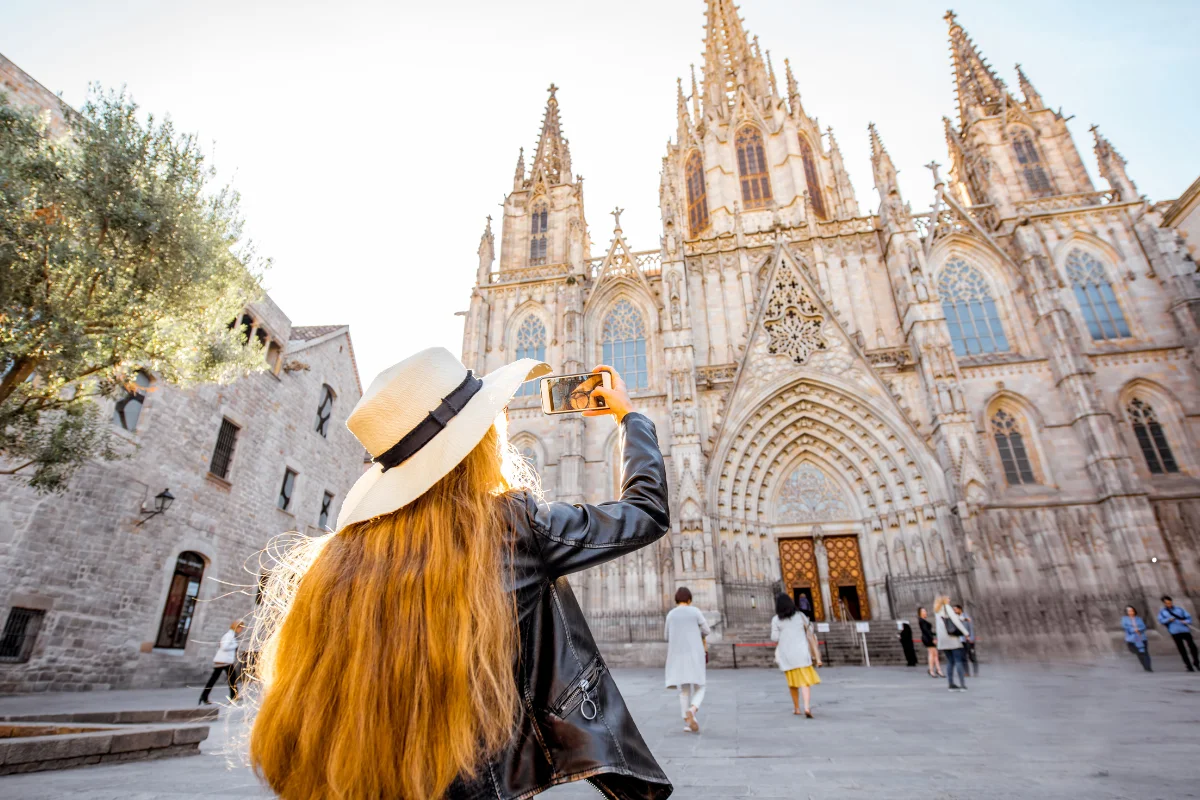

The most efficient way to organize two days in Barcelona is by geography. The city has a clear north-south axis with most monuments and neighborhoods clustered in logical circuits. Mixing those circuits — going from the Sagrada Família to Montjuïc and back to the Born in a single day — is where two-day visits lose an hour to unnecessary transit and arrive at each place slightly wrong.
This itinerary treats the two days as two geographic arcs:
Day 1 (north): Sagrada Família → Sant Pau → Passeig de Gràcia → Gothic Quarter → Born. A 10–12km walking circuit from north-central to the historic waterfront.
Day 2 (south and west): Park Güell → Gràcia → Montjuïc → Barceloneta. A descent from the northern hillside through the neighborhood to the mountain to the sea.
Both days require two advance bookings before leaving home. Without them, the plan doesn’t work.
Book These Before You Leave Home
Sagrada Família — online booking with a specific time slot, mandatory. Tickets from €26 (basic entry). Book minimum 3–5 days ahead; 2–3 weeks for summer. Add tower access for €6–8 more — the Passion towers give the best views over the Eixample.
Park Güell monumental zone — online booking with time slot, €18. The grace period from your booked time is exactly 30 minutes, automated, no exceptions. Arriving at minute 31 means no entry and no refund.
Everything else on this itinerary — the Gothic Quarter, the Born, Gràcia, Montjuïc — is free to navigate or has walk-up tickets.
Day 1: From Gaudí North to the Medieval Harbor
09:00 — Sagrada Família
Book your slot for 09:00. The security checkpoint uses X-ray scanners — oversized bags are refused. The Nativity Facade (east) receives morning light in cool tones before 11:00; the Passion Facade (west) receives warm light in late afternoon. For morning visits, photograph the Nativity facade on the way in.
Inside the basilica: the branching columns simulate a stone forest at 45 meters height. The stained glass is directional — cooler blues in the east, warmer ambers in the west — and the effect in the main nave depends on which hour you’re inside. The Sagrada Família inside guide details the light system and the structural logic for visitors who want the full context.
Tower visit (if booked): the Passion towers face the Eixample and the sea; the Nativity towers face the old city and the mountains.
Allow 2–2.5 hours.
11:30 — Recinte Modernista de Sant Pau
Walk the Avinguda de Gaudí (400 meters) — a street that creates a visual axis between the two buildings. Recinte Sant Pau is 48 hospital pavilions by Lluís Domènech i Montaner, the architect who was Gaudí’s main rival for the direction of Catalan Modernisme. Ceramic domes, trencadís mosaics, wrought iron gates — all visible up close and without the queues of the Gaudí circuit.
This is the most consistently skipped stop on a Barcelona itinerary and the one visitors most often say they wish they’d included. It’s UNESCO World Heritage, directly on the Gaudí axis, and has a fraction of the Sagrada Família’s daily visitor volume.
Entry: €18. Allow 1–1.5 hours.
13:30 — Passeig de Gràcia, Eixample Lunch
The Block of Discord (numbers 35–45) has three Modernista buildings in sequence. Walking the facades costs nothing and shows you Casa Batlló (43), Casa Amatller (41), and Casa Lleó i Morera (35) in the same street view. If the interior of one building is a priority for the trip, Casa Batlló has the most theatrical visitor experience; La Pedrera’s rooftop with the warrior chimneys is the most architecturally singular interior element.
For a two-day visit: the facade walk plus lunch in the Eixample at a restaurant off the main strip is a better use of 90 minutes than a €29–39 interior visit.
Lunch: the Eixample has honest restaurant options at every price point, completely separate from the tourist dynamics around Las Ramblas.
15:30 — Gothic Quarter
The Gothic Quarter layers Roman (1st century), medieval (13th–15th century) and 19th-century neogothic. The Cathedral and its 13-goose cloister, the Plaça del Rei with the Palau Reial Major, the Plaça de Sant Felip Neri with the Civil War shrapnel marks in the church wall, and the MUHBA underground site (Roman Barcino beneath the Plaça del Rei) are the highest-density historical stops.
The Pont del Bisbe on Carrer del Bisbe is beautiful but dates to 1928 — neogothic, not genuinely medieval. Useful to know before attributing 600 years of history to something built under Primo de Rivera.
Allow 1.5 hours.
17:30 — El Born for Dinner
Ten minutes on foot from the Gothic Quarter. El Born has the Basílica de Santa Maria del Mar (Gothic, 1329–1384, built by the harbor workers’ guild) and the Born CCM archaeological site under the 19th-century iron market — free elevated walkway access, showing the preserved street plan of the neighborhood demolished in 1714. The Fossar de les Moreres memorial beside the basilica (a permanent flame marking the burial site of 1714 defenders) is three meters from the main street and passed by hundreds of tourists daily without being recognized for what it is.
Stay in the Born for dinner. The streets parallel to the Passeig del Born have better food at more honest prices than the main promenade.
Day 2: From the Hillside to the Mountain to the Sea
09:00 — Park Güell
30-minute access window from your booked time. Arrive early. The monumental zone covers the wavy trencadís bench (the most photographed element), the Hypostyle Hall with 86 Doric columns, and the upper esplanade with the most geometrically satisfying panorama of the city — the Eixample grid below, the sea at the horizon, the Sagrada Família to the right.
The surrounding free park (forest paths and open areas) is accessible without a ticket at any time — worth exploring before or after the booked slot if you have the energy.
Allow 1.5 hours. Then descend on foot to Gràcia: 15–20 minutes.
11:30 — Gràcia
An independent municipality until 1897, Gràcia has organic streets that predate the Eixample grid and plazas that function as genuine neighborhood social spaces rather than tourist viewpoints. Plaça del Sol, Plaça de la Vila de Gràcia and Plaça de la Virreina all have café terraces with local atmosphere. The Mercat de l’Abaceria mixes food stalls with vintage clothing, vinyl records and collectibles — genuine neighborhood market, not a food-hall tourist product.
Lunch in Gràcia: the neighborhood’s food scene is honest and less pressurized than the Eixample. The best tapas in Barcelona guide identifies specific options in the area.
Metro from Fontana (L3) to Paral·lel (L2/L3) for Montjuïc: 15 minutes.
13:30 — Montjuïc
The mountain has three full cultural visits that collectively take 3–4 hours. The funicular from Paral·lel station (covered by metro ticket) is the fastest access.
MNAC — the Romanesque art collection is the primary argument for this museum: 11th–13th century painted murals removed from Pyrenean churches in the 20th century, displayed at original scale. The catalog includes pieces from dozens of small churches across Catalonia. The terrace views over Plaça Espanya and the Eixample are free. Entry: €15. The best museums in Barcelona guide gives the full comparative context.
Montjuïc Castle — the 17th-century fortress that controlled the city militarily for centuries, used as a political prison through the Franco era, transferred to the city in 2007. The 360° views cover the commercial port, the Mediterranean and the Llobregat delta. Entry: €12. The Montjuïc castle guide covers the full historical arc.
Fundació Joan Miró — if there’s time before the beach. The building by Josep Lluís Sert was designed around the collection; the skylights are calibrated for the specific quality of Mediterranean light Miró worked in. Entry: €15.
Fuente Mágica: if Day 2 falls on a Thursday, Friday or Saturday, the light-and-music show at the MNAC base runs from approximately 20:00. Free. A natural transition from Montjuïc to dinner.
18:30 — Barceloneta
Metro L3 from Paral·lel to Barceloneta (15 minutes). The Barceloneta neighborhood has the Passeig Marítim at sunset, the Frank Gehry golden fish sculpture at the Hotel Arts (best light at late afternoon from the west), and the harbor cable car tower (Torre de Sant Sebastià) for the view of the crossing without necessarily taking it.
End the two days at the sea.
Summary Table
| Day | Time | Stop | Duration | Transit |
|---|---|---|---|---|
| 1 | 09:00 | Sagrada Família | 2–2.5h | Walk (5 min) |
| 1 | 11:30 | Recinte Sant Pau | 1–1.5h | Walk (5 min) |
| 1 | 13:30 | Passeig de Gràcia + lunch | 1.5h | Walk |
| 1 | 15:30 | Gothic Quarter | 1.5h | Walk (15 min) |
| 1 | 17:30 | El Born (dinner) | Evening | Walk (10 min) |
| 2 | 09:00 | Park Güell | 1.5h | Bus V19 or metro |
| 2 | 11:30 | Gràcia (lunch) | 1.5h | Walk downhill |
| 2 | 13:30 | Montjuïc | 3–4h | Metro + funicular |
| 2 | 18:30 | Barceloneta | Evening | Metro L3 |
Sant Pau is UNESCO too, and on the same axis
The Recinte Modernista de Sant Pau rarely survives a two-day plan. It is on the same UNESCO list as the Gaudí buildings, it’s on the same street axis as the Sagrada Família, it costs the same as Park Güell, and it has dramatically fewer visitors. The experience of seeing Modernista architecture at arm’s reach without crowds is available here and nowhere else in the city.
The second consistently underemphasized element: the Born CCM elevated walkway. It’s free, it’s inside the historic market building, and it shows a preserved medieval neighborhood from above. Most visitors to the Born walk past the entrance without knowing what’s inside.
Mistakes to Avoid
- Booking both the Sagrada Família and Park Güell on the same morning — the 2-hour Sagrada Família visit plus travel time makes a Park Güell slot before 12:00 rushed on Day 1. Separating them across two days works better.
- Not building the itinerary geographically — the Sagrada Família and Park Güell are in the same northern cluster; Montjuïc and Barceloneta are in the southern arc. Crossing between them mid-day wastes the limited time.
- Spending more than 30 minutes on Las Ramblas — useful as a transit corridor, not as a destination. The 1.2km walk from Plaça Catalunya to the port is fine; an afternoon there is not the best use of 2-day time.
- Arriving at La Cova Fumada after 14:00 — if the Barceloneta neighborhood lunch is planned around the original bomba bar, arrive before 14:00. It closes when the food runs out.
Final Insight
Two days in Barcelona covers the structure of the city — the Gaudí circuit, the medieval core and the mountain-sea axis — if the geography is respected and the two mandatory bookings are made before arriving. The visitors who come back are usually the ones who did it efficiently enough the first time to understand what they missed. Barcelona has enough material for four or five visits at this intensity level; two days is enough to know which parts of it to return for.
For visitors extending to three days or more, the Barcelona 3-day itinerary covers the additional day with Montserrat as a day trip option and a deeper dive into the neighborhood layers the 2-day version skips.