
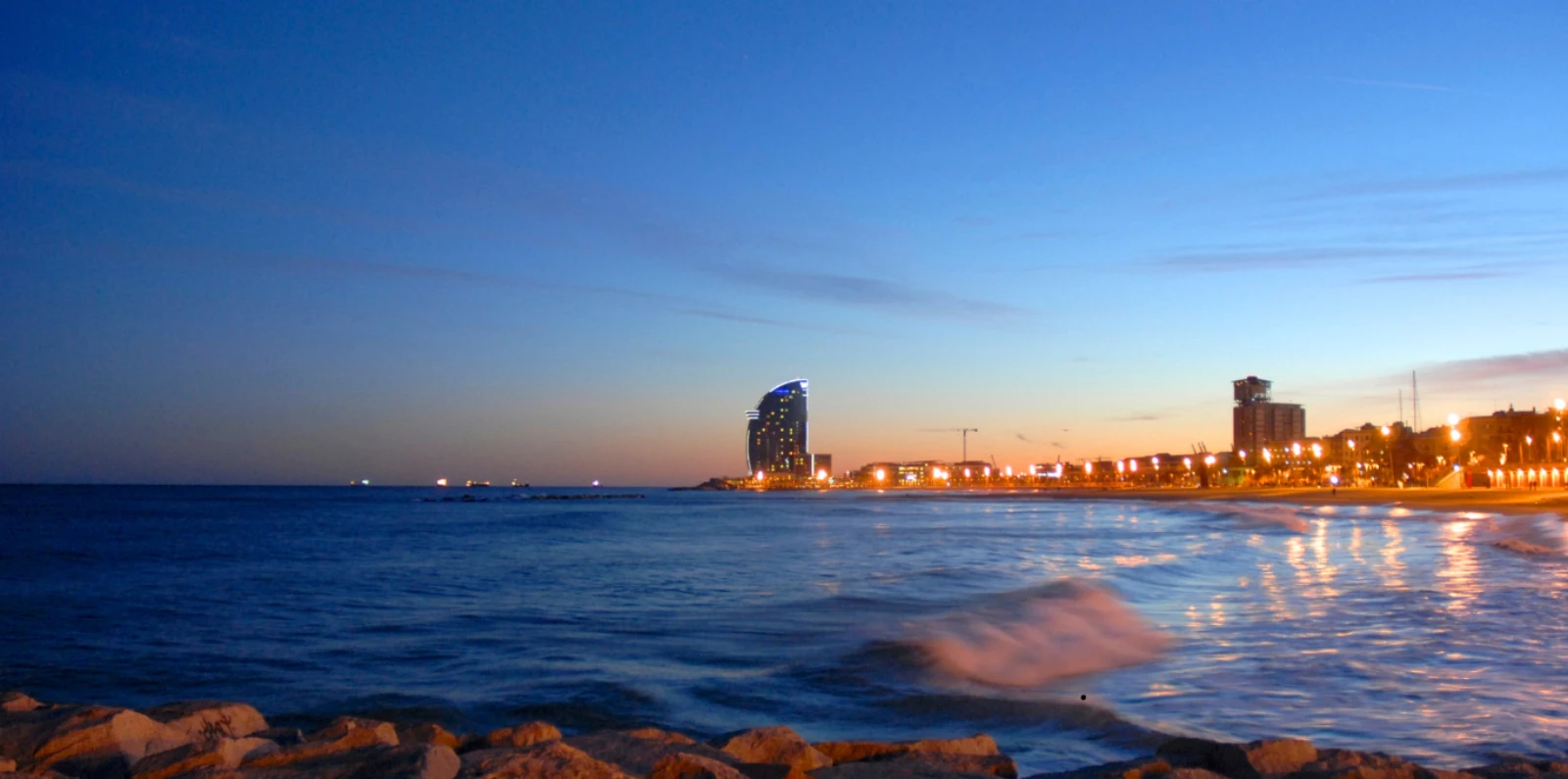

Every evening at Barceloneta, the same scene plays out: someone arrives with a camera, sits facing the sea, waits for the sun to drop toward the water, and it never does. It fades out behind them, between the buildings. It is one of the most common disappointed-tourist moments in Barcelona, and it comes down to a simple piece of geography that no “best sunset beaches” list tells you to your face. Before you pick a beach, you need to know which way this coast faces, because it changes everything.
Does the sun set over the sea in Barcelona? No. The coast faces east and southeast, so the sun sets behind the city, toward Tibidabo, not over the water. From the beach you will see a spectacular sky in oranges and pinks, but not the solar disc dropping into the sea. For that, either take a boat or go to Sitges. And if you want the sun rising out of the water, that is sunrise.
Why the sun does not drop into the sea here
The whole thing comes down to orientation: Barcelona’s coast faces east and southeast, so the sun rises over the Mediterranean and sets inland. This is not a small detail, it is what decides what you will see from the sand. The solar disc sinks toward the northwest, behind the Collserola hills and Tibidabo, and vanishes behind the Eixample skyline long before it nears the sea horizon. From the beach, the sun literally sets at your back.
That does not mean beach sunset is not worth it, it means you should look for something else. According to experts who photograph the city, what the coast does give is a sky washed in orange, pink and violet while warm light bounces off the water and the skyline begins to glow across the city’s 4-plus kilometres of beach. It is an urban sunset, of colour and silhouette, not a postcard of the sun on the waves. Once you accept that, choosing a beach stops being about which is prettiest and becomes about which has the clearest sky and best atmosphere at that hour.
Sant Sebastià, the one that catches the sky best
If you go to only one beach at sunset, make it Sant Sebastià, because it has the widest and most open view of the whole city coast. It sits at the southern end, beside the Hotel W, that 99-metre glass sail that makes a striking silhouette when the sky turns orange. Being broad and unobstructed, it catches the sky’s colour with no buildings in the way, and from here you watch the city light up while there is still daylight. It is the best for photography, for a walk and for an end-of-day picnic.
Next to it, Barceloneta is the most famous and lively, its promenade lined with beach bars, summer music and a great buzz, though the price is the crowds from May to September. If the plan is a calm photo, this is not the one. To know which city beach suits what you want in atmosphere and services, the Barcelona beaches guide compares them one by one. The difference between Sant Sebastià and Barceloneta at sunset is, above all, how many people you want around you.
The twist that changes the plan, go at sunrise
Here is the turn that flips the limitation into an advantage: if you want to see the sun rise straight out of the sea, in Barcelona that moment exists, it is just at dawn. Because the coast faces east, the sun comes up directly over the Mediterranean, the exact effect people wrongly chase at sunset. And at that hour the beaches are nearly empty, the sea calm and the light soft in a way the city does not see all day.
Barceloneta at dawn has a unique feel, with runners, people wading in, surfers and the sky catching fire over the horizon. In summer the sun rises around 6:30 to 7:00 a.m., so it is a plan for early risers, but if you want space and silence, Bogatell and Mar Bella at sunrise are even quieter, perfect for running, yoga or just sitting facing the sea. It is the most underrated beach plan in Barcelona and the only one that actually gives you the sun over the water. For more first-light ideas, the sunrise viewpoints guide rounds out the plan from above.
Bogatell, Mar Bella and Llevant, the sky without crowds
For a calm sunset and clean shots of the horizon, the northern beaches win, because the farther you go from the centre the fewer people and the more space. Bogatell is a favourite among locals: wide, with a local feel, far less touristy than Barceloneta and perfect for sitting to watch the light fade with nobody on top of you. The Escribà beach bar is a classic for a drink at that hour by the sea.
Heading up, Mar Bella has a mostly local crowd, colourful beach bars and a relaxed, diverse feel, with plenty of room across its 500-plus metres of sand. And Llevant, the northernmost in the city, is the most open and quiet: a sense of total space, ideal for minimalist Mediterranean photography with no tourists in the frame. These three share one advantage: the seafront promenade lets you walk for kilometres as the sky changes, so sunset becomes a stroll. They fit the logic of the beaches near Barcelona by train guide, though these are city beaches.
The exact time, the detail that decides
Picking the perfect beach is useless if you arrive late, so the hour matters as much as the spot. Sunset shifts a lot across the year: in summer the sun drops around 9:15 to 9:30 p.m., while in deep winter it sets by 5:30 to 6:00 p.m. The only reliable rule is to check the exact time for the day you go on any weather app, because a half-hour difference between June and September changes the evening plan.
The practical tip is to arrive 30 to 40 minutes before sunset, for two reasons: to get a good spot, especially at Barceloneta, and to catch the golden hour beforehand, when the light is warmer and softer and the sky starts to work. Bring a light layer, because the moment the sun goes the temperature drops noticeably, even in summer. If you are rounding it off with dinner, the Bogatell and Somorrostro beach bars usually have tables by the sea right at that hour. To get the season right, the best time to visit Barcelona guide helps plan.
If you really want the sun on the water
Since the beach will not give you the sun dropping into the sea, there are two ways to get that postcard effect, and it is worth knowing them so you do not end up frustrated. The first is a sunset boat trip: the boats head far enough out that the sun sets over the water with the Barcelona skyline in silhouette behind, one of the finest scenes the city offers. It is a different, slightly pricier plan, but it solves the orientation in one move; the sunset boat trip guide covers it.
The second is to change coasts: in Sitges, about 35 kilometres south, the shoreline’s orientation does let you see the sun sink into the sea at certain times of year, with the old town and the seafront church as a backdrop. It is the classic escape for a real sea sunset, easy by train, and full of photographic potential; the Sitges day-trip guide covers the rest of the day.
Quick pick, what you actually want
- Sun rising out of the sea → sunrise at Barceloneta, Bogatell or Mar Bella, around 6:30-7:00 a.m. in summer
- Best sky colours and city silhouette → Sant Sebastià at sunset, widest open horizon
- Calm sunset, clean photos, no crowds → Bogatell or Llevant at the northern end
- The sun actually dropping into the water → a sunset boat trip, or the train to Sitges
- Lively atmosphere and beach bars → Barceloneta, busiest May to September
The practical bits that save the evening
Three notes close the plan. Orientation: remember that on the beach you are after the sky’s colour and the city’s silhouette, not the sun over the sea; if you want the solar disc dropping, it is a boat, Sitges or a viewpoint. Season: according to experts, the most intense sunsets tend to come in the 3 windows of April and May, late August and September, and October, when the sun drops at an angle that gives richer colours and there are fewer people. Gear: you do not need a professional camera; playing with backlit silhouettes, the sky reflected in the water and the skyline behind gives powerful images even on a phone.
One last reminder so you do not get it wrong: in Barcelona, the best sun-and-sea beach plan is not sunset but sunrise, and the best beach sunset is the one of sky and city, not sun on the waves. Choosing right between the two is the difference between the photo you imagined and the letdown of waiting for a sun that sets behind you. Before heading out at night or before dawn with a camera, a look at the Barcelona safety guide never hurts.
Frequently asked questions about beach sunset in Barcelona
Does the sun set over the sea in Barcelona?
No. Barcelona’s coast faces east and southeast, so the sun rises over the sea and sets behind the city, toward the Collserola hills and Tibidabo. From the beach you will see the sky turn orange and pink, but the solar disc disappears behind the buildings long before it reaches the water.
Which Barcelona beach is best for sunset?
Sant Sebastià, beside the Hotel W. It is the widest and least obstructed toward the horizon, so it catches the sky colours best as the city lights up. For a quieter feel and clean photos, Bogatell or Llevant at the northern end, with far fewer people.
What time does the sun set in Barcelona?
It depends on the season: in summer around 9:15 to 9:30 p.m., and in deep winter closer to 5:30 to 6:00 p.m. Check the exact time for the day you go and arrive 30 to 40 minutes early to get a spot, especially at busier beaches like Barceloneta.
Where can you watch the sun drop into the sea near Barcelona?
In two places. On a sunset boat trip, which heads out from the coast and gives you the sun over the water with the skyline behind. Or in Sitges, about 35 km south, where the coastline’s orientation does let you see the sun sink into the sea at certain times of year.
Is sunrise better than sunset at Barcelona’s beaches?
For seeing the sun over the sea, yes, without question. Because the coast faces east, sunrise on the beach gives you the sun rising straight out of the water, the effect people wrongly expect at sunset. Barceloneta, Bogatell or Mar Bella at dawn, nearly empty, are among the best scenes in the city.
In Barcelona, the sun says goodbye over the city, not the sea, and knowing that separates the good photo from the wasted evening.