
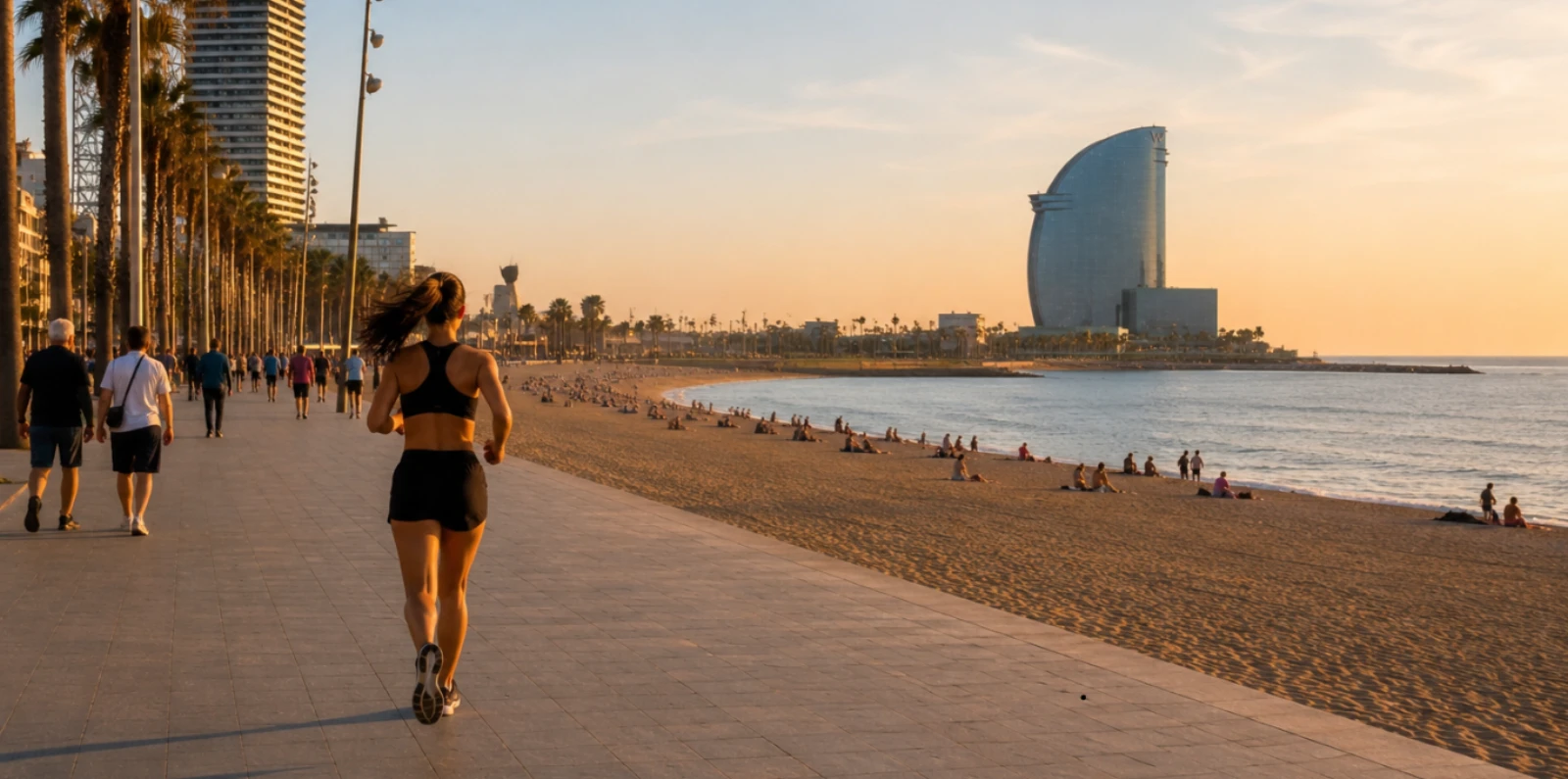

There are few European cities where you can run six kilometres straight by the sea without crossing a single traffic light. Barcelona’s seafront is exactly that: a flat, paved ribbon running from the Barceloneta to the Fòrum, separated from traffic, with fountains, shade and the Mediterranean setting the pace. The key lies in which stretch to choose by distance, and when to head out to have it almost to yourself.
Where do you run by the sea in Barcelona? On the seafront promenade, about 6 km one way, flat and traffic-light-free between Columbus and the Fòrum, or 10 km there and back from the Aquarium. Head out before 8:30, or in summer after 20:00, to dodge the tourists. The runners’ favourite beach is Bogatell, not the Barceloneta. There are fountains, shade and stretching areas along the way.
Quick decision by your goal
- You’re starting or want an easy run → 5 km, Hotel W to Port Olímpic, almost no gradient
- The locals’ favourite distance → 10 km, Hotel W to Fòrum, flat there and back
- Training for a half or marathon → 15-20 km, extending to Badalona along the coast
- You want quiet → northern stretch, Diagonal Mar and Fòrum, wider and emptier
- You want elevation and strength → Montjuïc on the sea side, hills and views
- You want to run in a free group → parkrun Ciutadella, Saturdays at 9:00, 5K for all
When to run, and the beach that surprises
Timing matters as much as the route, so it comes first here. The consensus among runners is firm: early. According to experts in local running, before 8:30 the promenade is clear; after that, tourists and pedestrians make it hard to hold a pace, especially in summer and at weekends. In the hot months it is best to head out before 9:00 or after 20:00 to avoid the humidity. Sunrise is the local favourite, with less heat, almost no one around and a calm sea.
And here is the detail that reorders the coast. Although the Barceloneta is the most famous of the 9 beaches on the coast, it is not the one runners prefer: the favourite is Bogatell. They choose it for its fewer tourists, wider promenade, sporty atmosphere and fewer interruptions, and it is one of the areas where the most organised training takes place. The logic is simple: the further north of the Port Olímpic, the more space and the fewer people.
| Stretch | Best time | Atmosphere |
|---|---|---|
| Barceloneta | Before 8:00 | Lively, touristy, historic |
| Port Olímpic | Sunrise / sunset | Sporty, busy, central |
| Bogatell | Early morning | Runners’ favourite, wide |
| Diagonal Mar / Fòrum | Mid-morning OK | Quiet, modern, empty |
The classic route, from Port Vell to the Fòrum
The reference route starts near the Aquarium, by the Port Vell, and stretches north along the sea. According to official data, it is about 6 km continuous one way to the Fòrum area, or about 10 km there and back, on a paved and completely flat surface. The lane is separated from the road, so there are no cars or traffic lights to break the rhythm, and the promenade is over six metres wide in places, letting you run freely even on busy days.
The route runs south to north past the beaches of Sant Sebastià, Barceloneta, Somorrostro, Nova Icària and Bogatell, to the Parc del Fòrum. Each stretch has its mood: the Barceloneta is the liveliest and most touristy, while the northern end is calmer. It pairs perfectly with the Barcelona beaches guide, since you run past most of them, and suits anyone following the first-time visitor guide to Barcelona who wants to train.
The seafront is also the closest thing to a rehearsal for the Barcelona Marathon, run on 14 March 2027 from Passeig de Gràcia, where 2:04:57 and 2:10:51 were run in 2026.
Which route to choose by your distance
Here is the real decision, because the same promenade gives several routes depending on where you start and stop. To begin or for an easy run, the 5 km from Hotel W to Port Olímpic are ideal, with very little gradient. The favourite distance among Barcelona runners is the 10 km from Hotel W to the Fòrum and back: completely flat, with constant views, plenty of fountains and easy to control your pace.
Anyone training for a half or full marathon can add more. Continuing beyond the Fòrum towards Badalona along the coastal path builds up 15-20 km without leaving the sea and almost without interruption. The cumulative elevation is under 20 metres on many 10 km routes, which makes it perfect for recovery runs, long intervals or heart-rate training, though not for hill work. For that, the sea side of Montjuïc offers a star route that climbs from the promenade to the Castell in about 8 km, in the spirit of the best time to visit Barcelona guide for picking your season.
The open-air museum you run through
One bonus of the seafront is that the training doubles as a public-art trail. By the Barceloneta beach stands L’Estel Ferit, Rebecca Horn’s tower of misaligned cubes, a tribute to the old fishing quarter. Further on, the Cap de Barcelona, Roy Lichtenstein’s pop work inspired by Gaudí, adds colour to the route, and at the Port Olímpic appears El Peix by Frank Gehry, a 56-metre sculpture with golden scale cladding.
They are not the only ones: in the Plaça dels Voluntaris Olímpics stand the sculptures David i Goliat and Marco, and in the Port Vell, Mariscal’s Gamba. Running here is, in passing, a cultural visit, something that connects with what the Barceloneta neighbourhood guide covers. To extend the run with a park, the Parc de la Ciutadella is a step away and has a dirt path on its east side, softer on the joints, much like the green spaces in the things to see in Barcelona guide.
Services, climate and the hilly variant
The promenade is well equipped for a long session. There are drinking fountains, benches and stretching areas along the way, and the public toilets at several beaches run according to the bathing season, with extended hours in summer. It is worth checking the city council portal for the exact status of showers and toilets. With over 300 days of sun a year, the best seasons are spring and autumn, with temperatures of 12 to 22 degrees that let you train comfortably almost all year.
If the flat asphalt feels too easy, the sea-facing slope of Montjuïc is the variant with elevation, and it is the natural complement to the coast. A popular route links the promenade to the Castell, swapping flat kilometres for hills and the most cinematic views of the Barcelona skyline meeting the sea. Many runners alternate flat coastal sessions with strength work on the hill, building both endurance and power without ever leaving the city, a balance the seafront makes unusually easy.
The sea is one surface among four. Collserola offers 10 km of compacted dirt and Montjuïc the hills, sorted by surface and distance in where to run in Barcelona.
For days when the seafront is not an option, the city has 100 free outdoor exercise stations across 65 points, the nearest one 402 m from la Sagrada Família.
Frequently asked questions about running by the sea in Barcelona
How many kilometres can you run uninterrupted by the sea in Barcelona?
The seafront promenade lets you run about 6 km continuously one way between the Columbus Monument and the Fòrum area, or about 10 km there and back if you start from the Aquarium. The classic Barceloneta-Fòrum stretch is about 4 km one way. Anyone wanting more can continue towards Badalona along the coastal path and add 12-15 km without leaving the sea.
What is the best time to run on Barcelona’s seafront?
Before 8:30 in the morning, when there are no tourists or pedestrians to break your rhythm. In summer it is best to head out before 9:00 or after 20:00 to avoid the humid heat. Sunrise is the local runners’ favourite moment, with less heat, almost no one around and a calm sea.
Is the seafront promenade a flat running route?
Yes, it is completely flat, with cumulative elevation under 20 metres on many 10 km routes. The surface is asphalt and paving, the lane is separated from the road and there are no cars or traffic lights. It is ideal for easy runs, intervals and half-marathon training, but not for elevation work; for that there is Montjuïc.
Which is the runners’ favourite beach in Barcelona?
Surprisingly it is not the Barceloneta but Bogatell. Runners prefer it because it has fewer tourists, a wider promenade, a sporty atmosphere and fewer interruptions. It is one of the areas where the most organised training sessions take place, especially at sunrise and sunset.
In Barcelona, running by the sea comes down to heading out early and letting the Mediterranean set the pace.