
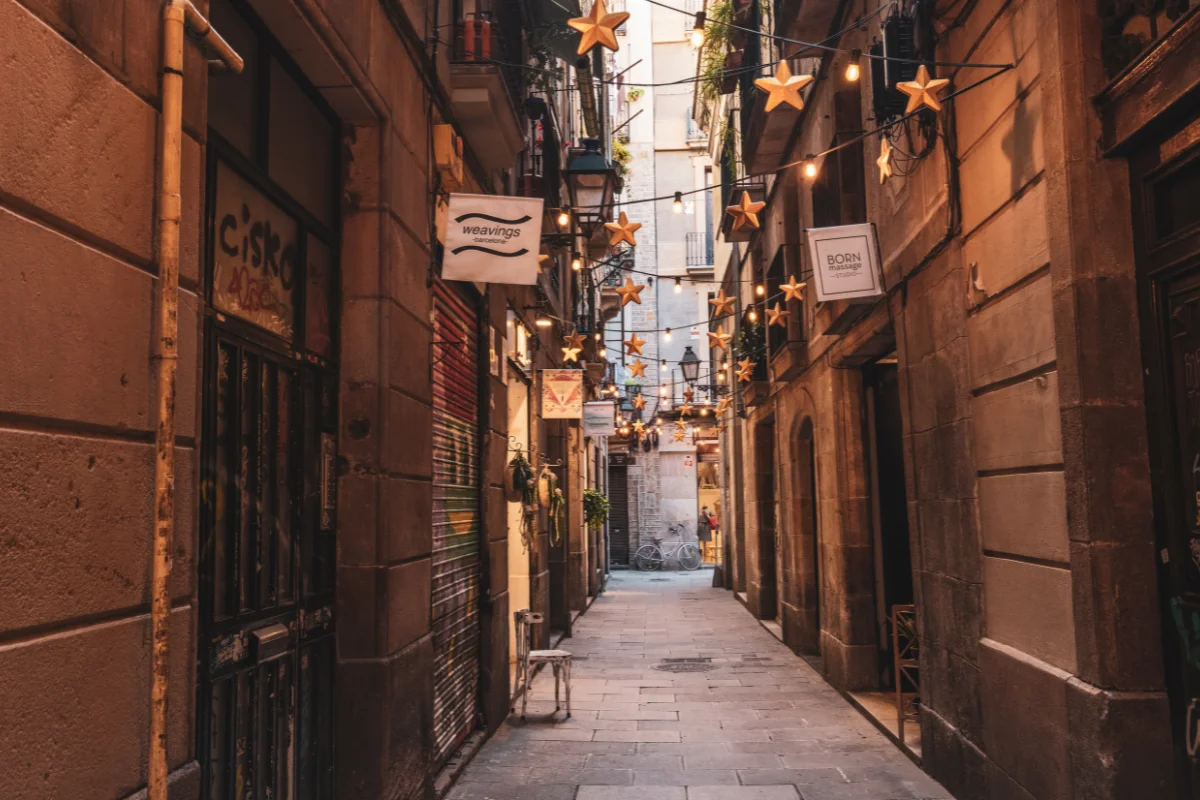

El Born contains more history per square meter than any other Barcelona neighborhood. Within two city blocks: the most stylistically unified Gothic basilica in Catalonia, the excavated remains of a neighborhood demolished by royal order in 1714, the best-preserved medieval street in the city, and some of the most-cited bars in the country. The 2-hour walking route that follows is completely self-contained — no metro, no taxi, no losing the thread. Metro L4, Jaume I stop.
If you want the nighttime version first, the El Born Barcelona nightlife guide covers the bar circuit in detail. This is the daytime route.
Carrer Montcada — Always Start Here
Carrer Montcada is the natural starting point of any Born visit. For centuries it was the main artery of Barcelona’s nobility — merchants enriched by maritime trade built their palaces here following the Catalan Gothic model, with porticoed courtyards and monumental staircases still visible from the street today.
The street now contains the Picasso Museum (five medieval palaces documenting the artist’s formative Barcelona years), the MOCO Museum in the Palau Cervelló (contemporary art in a 15th-century building), and the Palau Dalmases (flamenco performances in a Baroque palace). To understand the neighborhood’s evolution in ten minutes, walk the full length of the street and look into the courtyards.
El Xampanyet is at number 22. Open since 1929, same family, same zinc bar. If the route starts at 19:00, a stop here with the house xampanyet cava and anchovies sets the tone for everything after. For the vermouth culture in Barcelona, this is the Born’s definitive reference point.
Time: 20–25 minutes.
Quick Decision — How to Approach the Route
- 1 hour → Carrer Montcada (palace exteriors) + Santa Maria del Mar (interior) + Fossar de les Moreres — complete historical core
- 2 hours → Full route with Born CCM on the upper walkways (free) + El Xampanyet or Bar del Pla stop
- Half day → Add the guided terrace visit at Santa Maria del Mar (~55 min, ~€10) + Born CCM underground visit (€5.50–8.80) + Cal Pep for lunch
- With children → Born CCM free walkways + Museu de la Xocolata in the former Sant Agustí convent — both visually engaging for younger visitors
- For museums → Picasso Museum (five medieval palaces, book online) + MOCO Museum — medieval architecture and Banksy in the same radius
- For the nightlife route → El Born at night: El Xampanyet, Bar Brutal, Marlowe Bar, Paradiso
Santa Maria del Mar — Built by the Stevedores
Santa Maria del Mar was constructed between 1329 and 1383 — 54 years, a record pace for medieval engineering that explains its unmatched stylistic unity. It was not funded by royalty or high nobility: it was built by the neighborhood guilds of La Ribera, particularly the bastaixos, the port stevedores who carried the Montjuïc stone on their backs. Their sacrifice is recorded in the bronze reliefs on the main door.
The interior surprises by what it doesn’t have: none of the heavy ornamentation of European Gothic, no flying buttresses, no visual division between naves. The 16 octagonal columns at 13-meter intervals create a space of radical clarity — three naves of nearly equal height defining what is called pure Catalan Gothic. A stained glass window with the FC Barcelona crest in the second-floor gallery is a detail almost no one locates: the club funded part of the post-1936 fire restoration, and artist Pere Cánovas embedded the emblem.
The basilica terraces offer 360-degree views over the Born and are visited with a guide (approximately 55 minutes, ~€10). Interior entry in cultural hours has an admission fee; during worship hours it’s free.
Time: 20–25 minutes for the interior and square.
Fossar de les Moreres — The Weight of 1714
Directly beside Santa Maria del Mar is a plaza that most tourists cross without stopping: the Fossar de les Moreres (the Mulberry Tree Burial Ground). It’s a medieval cemetery over which the basilica was partially built, and where the defenders of Barcelona killed in the 1714 siege were buried. The verse by Pitarra carved on the red granite wall states that no traitor can lie here — the mulberry trees, says the legend, turn red with the blood of the fallen. The eternal flame in the center of the pavement has been burning since the monument’s inauguration in the 1980s.
On September 11 (Catalonia’s National Day), this square becomes the focal point of Catalan historical memory — the date commemorates the fall of Barcelona to Felipe V’s troops after more than a year of siege. The rest of the year it’s a quiet plaza, somewhat removed from the main tourist flow, where the history beneath it is worth sitting with for a few minutes.
Time: 10 minutes.
Born CCM — The Excavated City
The Born Centre de Cultura i Memòria occupies the iron structure of the former Mercat del Born, designed by Josep Fontserè in 1876 — the first of its type in Barcelona. When renovation work began in 2001, excavations found something unexpected: the intact street plan of an entire 18th-century neighborhood, preserved under the floor level.
Felipe V ordered the demolition of over a thousand homes in the La Ribera neighborhood to build the Ciutadella fortress that would monitor the rebellious city. The archaeological site allows you to see today the streets of that destroyed neighborhood, the foundations of the houses, the wells. It is the only place in Barcelona where the trauma of 1714 has direct physical presence.
Free access to the upper walkways (Tuesday–Sunday, 10:00–20:00) to see the site from above. Guided visits to the excavation level require advance booking and cost €5.50–8.80. Sunday afternoons free entry — still worth booking. For the broader context of hidden museums in Barcelona, Born CCM has more verifiable historical density per square meter than any alternative in the city.
Time: 20–25 minutes on walkways, 60–75 minutes with guided visit.
The Carasses, the stone faces on the street corners
Beyond Santa Maria del Mar and the Born CCM, the neighbourhood hides the Carasses — carved stone faces embedded in street corners throughout El Born.
At certain corners in the Born there are stone faces carved into the building angles. In the 17th and 18th centuries, these served as location markers for brothels — visual signals for sailors who didn’t speak the local language. The Papamosques on Carrer de les Mosques is the most famous — the open mouth appearing to catch flies was a visual sign of what happened in that alley. The one at the corner of Carrer dels Mirallers and Vigatans depicts a female face with blank eyes.
These are not decorative Gothic ornaments — they’re a mapping system for an economy that was tolerated, regulated, and visually coded into the medieval street fabric. Walk the neighborhood looking specifically at building corners and you’ll find more of them than any guide mentions.
The Passeig del Born — Where the Route Ends
The Passeig del Born is the axis that closes the circuit. Its name describes what it was: the space where medieval Barcelona’s jousting tournaments and knightly competitions took place. Later used for Holy Week processions and the city’s first carnivals. Today it has terraces, bars, and the rhythm of a neighborhood that knows it’s beautiful but doesn’t perform that fact.
La Vinya del Senyor has the best wine list with direct views of Santa Maria del Mar’s facade — for anyone wanting a stop at the best wine bars in Barcelona with exceptional architectural context.
Cal Pep (Plaça de les Olles, 8): no written menu, the staff proposes based on that day’s market. The most consistently cited tapas counter in Barcelona. Arrive at opening (13:00) or reserve. Closed Sundays.
Casa Gispert (Carrer dels Sombrerers, 23): a nut and dried fruit shop open since 1851. If the route runs in the afternoon without a meal planned, the detour is worth it for the smell alone — they roast in an original wood-fired oven and the aroma reaches the street from twenty meters away.
Practical Notes
- Metro: L4, Jaume I — 5 minutes on foot to Carrer Montcada
- Best timing: from 17:00 for better light on Gothic facades and the food scene activating. Weekday mornings for museums without queues
- Picasso Museum: requires advance online booking. Thursday free afternoons have places that sell out weeks ahead
- El Xampanyet closes at 23:00 — plan it as the opening stop, not the closing one
- Paradiso (world top-50, enter through the fridge in the pastrami bar): opens at 18:00, no reservations, weekend queues; weeknights before 21:00 the wait is minimal
- Cobblestone and stone pavement: slippery when wet — shoes with grip
El Born works best without a fixed plan. Start on Carrer Montcada, enter Santa Maria del Mar, stop at the Fossar, walk around the Born CCM upper walkways, and end on the Passeig del Born with whatever the moment calls for. In two hours the neighborhood will have told you enough to want to come back.
To extend the day: the El Born Barcelona guide covers the museums in more depth. For the Gothic Quarter which connects directly from Carrer de la Palla, the full historic center circuit is within walking distance. And for the Barceloneta to the south, the beach neighborhood is 10 minutes on foot from the Passeig del Born.