
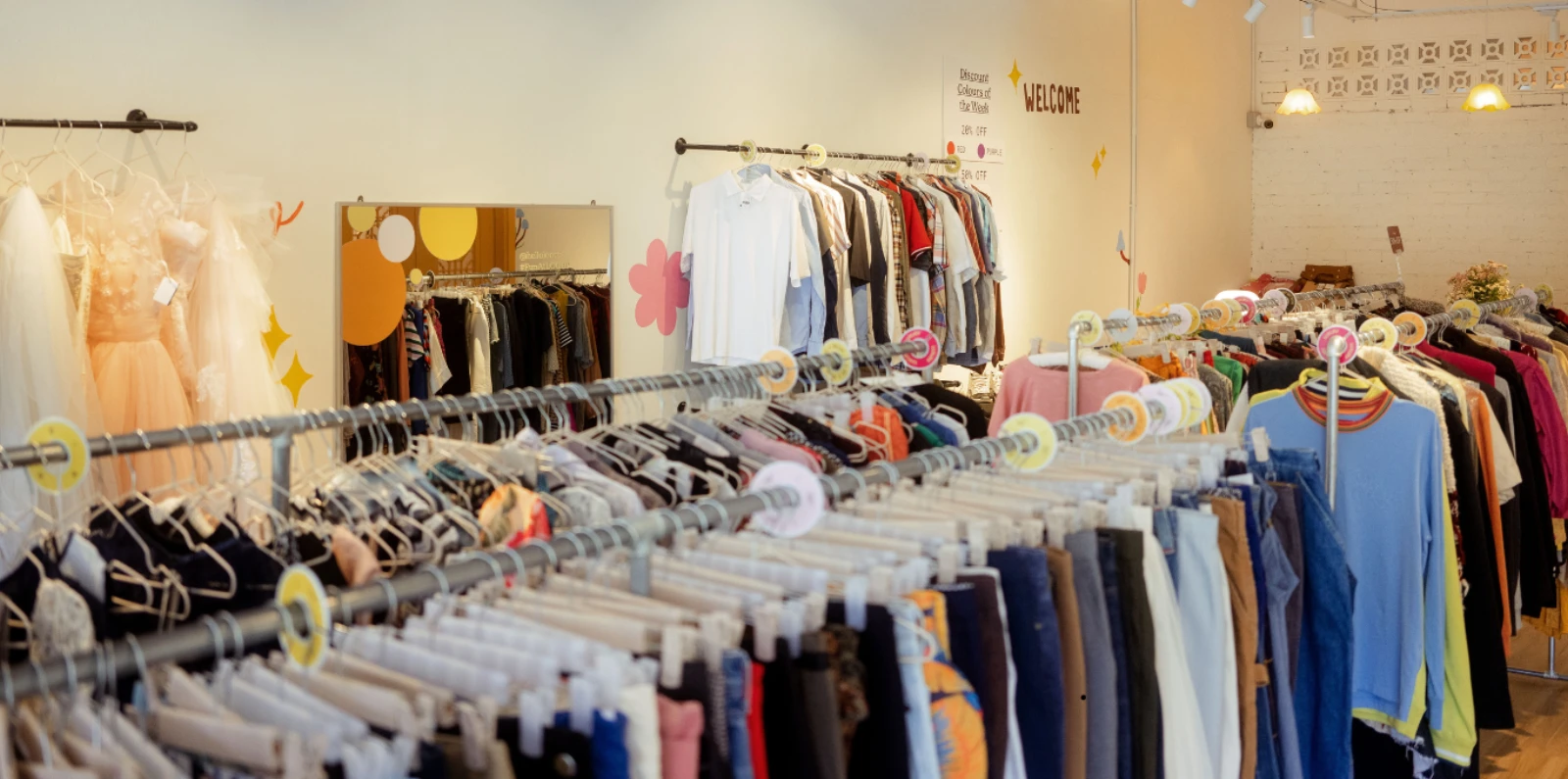

Pick up a souvenir in the streets around La Rambla and there is a good chance it was printed thousands of kilometres away and sold under a Barcelona logo. A few blocks east, in El Born, the logic flips. A shop barely forty square metres holds prints by illustrators who live ten minutes away, bags from a Barcelona label, ceramics from a neighbourhood studio. To reach those shelves, a maker has to both design and produce the object in the city. That single rule is the cleanest test there is for telling real Barcelona design from an imported keepsake wearing the city’s name.
Where to shop for design and local products in Barcelona
Barcelona’s design retail splits across four neighbourhoods with distinct personalities. El Born is the highest concentration of concept stores and author gifts, Gràcia the densest cluster of craft studios, El Raval the home of graphic design and illustration, and Poblenou the place for avant-garde showrooms in former 22@ factories. The reference point for genuinely local goods is OMG BCN, where around 90% of the catalogue is made in the city.
Quick decision by what you want
- You want a souvenir that doesn’t look like one → OMG BCN (Born and Gothic Quarter) — 90% made in Barcelona, prints from €15
- You love graphic design and illustration → Hey Shop in El Raval — the studio shop of Verónica Fuerte with in-house prints and specialty coffee
- You want jewelry made in front of you → Pithy Lab (Gràcia) — Rita produces the minimalist earrings in the same space she sells them
- You collect furniture or work in interiors → BD Barcelona Design (Poblenou) — 600 m² space with Dalí, Gaudí and Tusquets pieces
- You travel with kids and want design childrenswear → tinycottons and Little Creative Factory (Born) — made-in-Barcelona labels in natural fabrics
- You hunt for little-known emerging brands → Nuovum (Born and Raval) — unusual homeware from young designers
- You want Mediterranean-identity ceramics and textiles → Gràcia and Gothic Quarter craft shops — local production, short runs
The word “local” is unregulated, so use a different filter
The word “local” is unregulated, so a shop can stack imported goods beside a Catalan flag and still call itself authentic. The useful filter is not the storefront or the marketing — it is the sourcing rule. OMG BCN states it plainly: a maker is only stocked if they design and produce in Barcelona or its surroundings. That is a verifiable standard, not a slogan, and it is why roughly 90% of the shop is genuinely city-made.
Most published guides also lean on a figure — “over 100 local designers” — that circulates widely but does not appear on the shop’s own pages. Treat headcounts as marketing and the production rule as fact. According to people working in the sector, the honest signal of a local design shop is curation under a concept rather than volume: limited runs, named makers, and pieces you cannot find in the identical shop in three other capitals. When in doubt, ask where a specific object was produced. A real local shop answers instantly.
El Born, the city’s densest cluster of concept stores
El Born holds the highest concentration of independent design shops in Barcelona, packing author gifts, ceramics, jewelry and illustration into a few walkable blocks. It is the natural starting point with only an afternoon to spare, and its flagship, OMG BCN, sets the standard for city-made goods across two branches a short walk apart.
OMG BCN opened in 2013, founded by Estela Portolés and Iu Bartolomé, and its premise allows no exceptions: a maker only joins if they design and produce in Barcelona or nearby. The result is a window into the city’s visual culture — prints, stationery, ceramics, clothing and accessories — with about 90% of stock made locally. The original shop sits at Corders 7; the second, sharing only around 10% of the same selection, is at Palla 19 in the Gothic Quarter, so visiting both genuinely doubles what you see.
Beyond OMG BCN, the neighbourhood stacks up its own characters. Nuovum, with branches in Born and Raval, specialises in unusual homeware from emerging designers. In childrenswear, tinycottons runs a concept store on Passeig del Born and Little Creative Factory works natural fabrics on Carrer del Rec, both made-in-Barcelona labels. A short walking route through El Born’s medieval streets threads past many of these doors on the way to Santa Maria del Mar.
Gràcia, the neighbourhood of studios and short runs
Gràcia delivers the most hands-on stretch of the circuit, with studios where the maker produces and sells in the same room and an unusually high density of independent designers. Where Born skews international, Gràcia keeps a residential feel, with small windows and projects that defend the short run over the mass catalogue.
The clearest example is Pithy Lab on Carrer de Sant Lluís, where Rita designs and produces minimalist earrings on-site and rents part of the workshop to other jewelers, building a small community of makers. Nearby, wood and alabaster studios turn out made-to-measure furniture and homeware from noble timbers chosen piece by piece, some with more than twenty years behind them and a belief that being intensely local is the surest route to being universal.
Colour has its corner too. Leopardo Leopardi, on Gran de Gràcia, is the stop for handmade candles and costume jewelry in pastel tones, plus bright prints. And RS Barcelona, known for its premium foosball tables and design furniture, keeps a 300 m² concept store on Carrer de la Llibertat where its icons share space with notebooks, backpacks and small author objects. It pairs naturally with an afternoon wandering Gràcia’s squares between shops.
El Raval, graphic design, illustration and handmade neon
El Raval concentrates the city’s graphic design and illustration, in shops that double as creative meeting points. This is where objects meet editorial culture and image-making, and the epicentre is Carrer del Doctor Dou, a short street with several heavyweight stops within metres of each other.
The anchor is Hey Shop, the physical space of Hey Studio — the practice of Verónica Fuerte and one of Barcelona’s most recognised graphic design names. It combines shop and specialty coffee, selling in-house prints, books and graphic tees, bringing the world of its Poblenou studio into the centre. Part of the showroom works by appointment.
On the same street, a neon-dedicated space gathers around a hundred handmade light pieces, lamps and custom commissions, one of the most photographed windows in the area. Nuovum’s Raval branch and shops blending ceramics, prints, vintage clothing and organic tea from small labels complete the map for out-of-the-ordinary gifts. Before or after the shopping loop, it helps to know which parts of El Raval to enjoy and which to skip after dark, because the neighbourhood shifts noticeably by street and hour.
Poblenou and Eixample, avant-garde and signature Catalan design
Poblenou has become Barcelona’s most forward-looking design neighbourhood, with showrooms and concept stores installed in former industrial units of the 22@ district. It is also home to the most iconic Catalan design brand open to the public, BD Barcelona Design, in a 600 m² space at Ramon Turró 126.
BD Barcelona Design was founded in 1972 by architects and designers Pep Bonet, Cristian Cirici, Lluís Clotet, Mireia Riera and Oscar Tusquets, and won Spain’s Premio Nacional de Diseño in 1989. Its showroom works as a hybrid of shop and gallery, with historic pieces by Salvador Dalí, Antoni Gaudí, Oscar Tusquets and Jaime Hayón. A quirk worth knowing: the original “B” stood not for Barcelona but for Bocaccio, the nightclub favoured by the city’s left-wing intellectuals in the final years of the Franco dictatorship.
In the Eixample, heritage brands sit alongside author fashion. Santa & Cole, a lighting and furniture editor founded in 1985, carries more than 80 recognised designers such as Antoni Arola, Miquel Milà and André Ricard, and keeps a gallery near Avinguda Diagonal. Streets like Enric Granados concentrate author fashion boutiques producing in Spanish workshops, and the neighbourhood’s Modernista passages hide interior-design showrooms inside former textile factories. To understand why the grid works this way, read how the Eixample is laid out and what makes it unique.
Comparison table of Barcelona design shops by neighbourhood
| Shop / Area | Neighbourhood | What you’ll find | Best for | Note |
|---|---|---|---|---|
| OMG BCN | Born and Gothic Quarter | Prints, ceramics, stationery, accessories | A souvenir actually made in Barcelona | 90% local, two shops |
| Hey Shop | El Raval | Graphic prints, books, tees | Graphic design lovers | Shop + coffee, showroom by appointment |
| Pithy Lab | Gràcia | Minimalist studio jewelry | Jewelry made in front of you | Produced on-site |
| Nuovum | Born and Raval | Unusual homeware | Little-known emerging brands | Two branches |
| BD Barcelona Design | Poblenou | Signature furniture and objects | Collectors and interior designers | 600 m², since 1972 |
| Santa & Cole | Near Diagonal | Edited lighting and furniture | Recognised Catalan design | Editor since 1985 |
| Leopardo Leopardi | Gràcia | Candles, jewelry, pastel prints | Colour-forward shoppers | n/a |
What to buy and what it costs
Barcelona’s most sought-after local product pairs Mediterranean identity with an accessible price, and the illustrated print is the star piece under €35. Visitors who want a meaningful keepsake tend to choose graphics, author ceramics, handmade candles, minimalist jewelry and design stationery over the industrial souvenir.
As a price guide, a print runs about €15-35, studio jewelry starts around €25-60, author ceramics move between €20 and €90 depending on the piece, and linen or organic-cotton textiles begin near €30. The big jump comes with heritage furniture: a piece edited by BD Barcelona or Santa & Cole sits in the hundreds-to-thousands range, closer to collecting than to travel mementoes. It is worth setting these figures against a realistic daily budget by traveler type, because an afternoon of design shopping can match the cost of a good dinner out.
Official maps and design markets
In 2026, the most reliable way to map local design is the Barcelona Independent Design Shopping Map app, backed by the FAD design foundation, which geolocates around 30 shops selected for design quality, ties to the city and having their own point of sale. It updates periodically, which sidesteps the common problem of lists sending visitors to shops that have already closed.
Two strong circuits sit alongside it. The Disseny Hub at Plaça de les Glòries, home of the Design Museum, hosts the FAD’s design market, where a committee filters fashion, contemporary jewelry, furniture and illustration. And the Palo Alto Market, in a former Poblenou factory, combines direct sales from designers, food and workshops across periodic editions. According to municipal data, the latest round of local-commerce grants approved 199 projects — a sign the fabric of author shops is still growing rather than thinning.
Frequently asked questions about Barcelona design shops
Where can I buy products actually made in Barcelona, not mass-produced souvenirs?
OMG BCN is the benchmark, with roughly 90% of its stock made in Barcelona and a rule that makers must both design and produce in the city to be stocked. It runs two shops, at Corders 7 in El Born and Palla 19 in the Gothic Quarter, open daily.
Which Barcelona neighborhood has the most independent design shops?
El Born has the highest concentration of concept stores and author boutiques, while Gràcia holds the most craft studios with local production. El Raval leads on graphic design and illustration, and Poblenou on showrooms inside former 22@ factory buildings.
How much do local design objects cost in Barcelona?
An illustrated print runs about €15-35, studio jewelry starts around €25-60, and author ceramics range from €20 to €90 depending on the piece. Furniture from heritage brands like BD Barcelona or Santa & Cole sits in the hundreds-to-thousands range, closer to collecting than souvenirs.
Is OMG BCN worth visiting for design shopping?
Yes, if you want a souvenir that is genuinely local rather than imported. It is small but tightly curated, every maker designs and produces in Barcelona, and the two branches share only about 10% of their stock, so visiting both doubles the selection.
Where can I see famous Catalan design brands like BD Barcelona and Santa & Cole?
BD Barcelona Design shows in a 600 m² industrial space at Ramon Turró 126 in Poblenou, with pieces by Dalí, Gaudí, Tusquets and Hayón. Santa & Cole, a design editor since 1985 with over 80 designers, keeps its gallery near Avinguda Diagonal.
With one afternoon, start in El Born and reach OMG BCN before crossing to Gràcia: the first gives you the whole picture of local design in four blocks, the second shows you the maker building what they sell. In Barcelona, the keepsake worth carrying home is the one signed by someone who lives around the corner.