
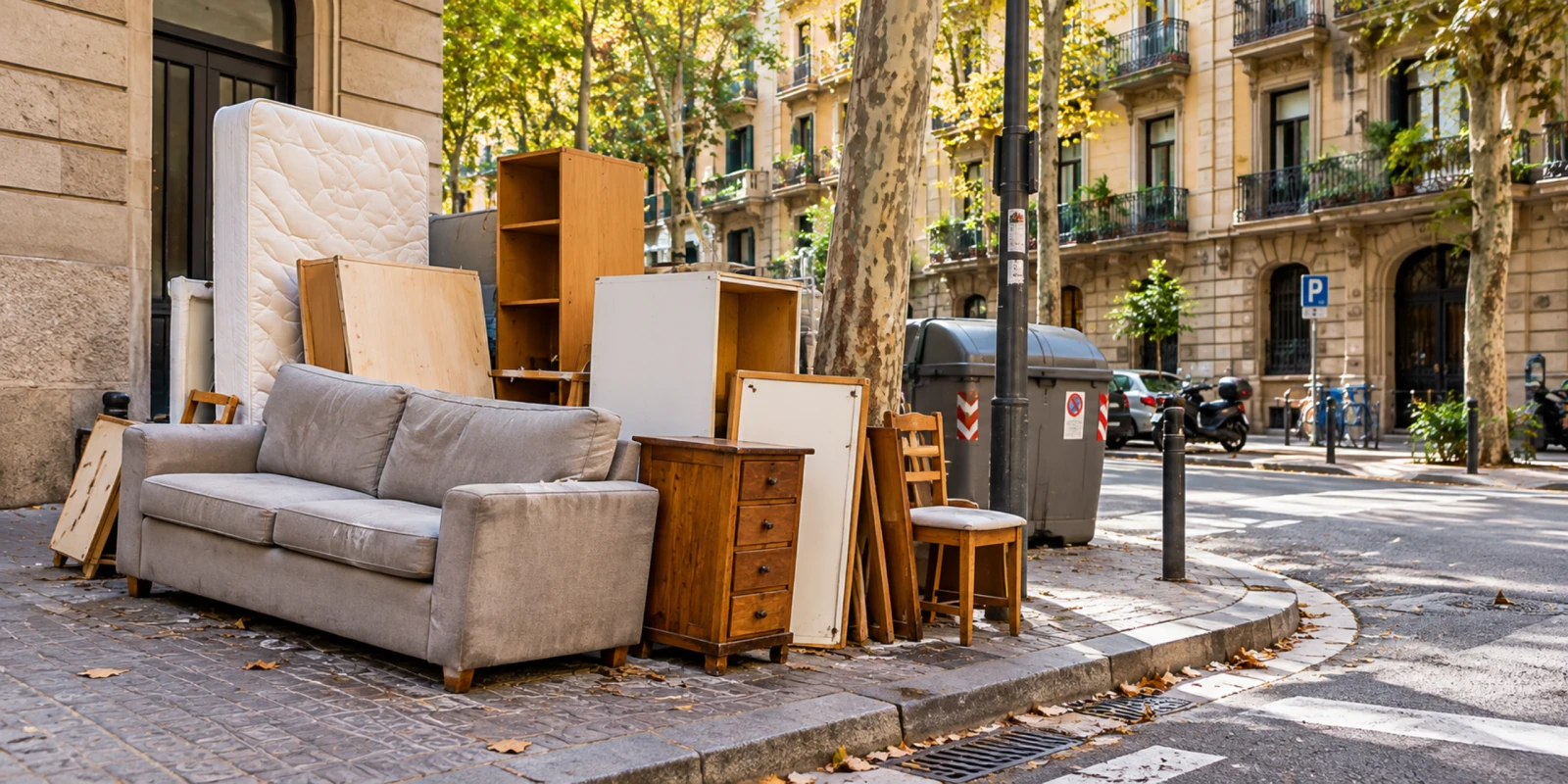

Putting a sofa on the Barcelona pavement on the wrong evening is a listed offence, not an oversight. The object is sitting there with a date on it, which is the entire evidence required. The collection itself is free, and there are exactly two conditions to get right: every street has one assigned day, and the window is 20.00 to 22.00, in front of your door. A third condition catches people out in two kinds of zone, where you must phone 900 226 226 first — there, only what has been reported gets taken. And there is a home-collection service that arrives in under 36 hours and costs 0 euros if you cannot carry the furniture down yourself. Anything the round will not take — fridges and air conditioning with CFCs — goes to one of the city’s 134 green points, and leaving anything out at the wrong hour falls under the Environment Byelaw.
How do you throw out furniture in Barcelona? The service is free. Every street has an assigned day and items go out between 20.00 and 22.00 in front of the building door. In prior-notice zones you must call 900 226 226 first, and only reported items are collected.
Before anything, find your street’s day
Three channels give it, and they are not equivalent:
- The council’s waste finder, searched by address.
- The 010 information line.
- The free civility line 900 226 226 — the least known of the three and the one that does most, because it both gives the day and books the collection where notice is compulsory.
The call takes a couple of minutes and is best made on the day itself rather than the night before.
Three regimes, two of which need that call
| Regime | When items go out | Call required? |
|---|---|---|
| General | Your street’s assigned day, 20.00 to 22.00 | No |
| Prior notice, collected the same night | Monday, 20.00 to 22.00 | Yes, 900 226 226 |
| Prior notice, collected next day | Tuesday, from 20.00 | Yes, 900 226 226 |
In both notice regimes the rule is absolute: only furniture reported by phone is removed. Putting it out without calling changes nothing except leaving the item on the pavement, attributable to whoever carried it down.
What goes and what does not
| Accepted | Not accepted |
|---|---|
| Sofas | Rubble and bathroom fittings from building work |
| Doors and furniture | Fridges and freezers containing CFCs |
| Chairs | Air conditioning units containing CFCs |
| Boxes and wooden battens | n/a |
| Blinds | n/a |
Fridges and air conditioning go to a green point, and the reason is environmental rather than about size: those gases cannot end up in a bulky waste truck. The municipal network has 134 green points across three tiers — 7 zone sites, 27 neighbourhood sites and 100 mobile ones.
Rubble is excluded too and runs on its own circuit.
If you cannot carry it down
For large volumes there is a paid door-to-door service, Monday to Friday, which collects in under 36 hours. Households, shops, offices and small industrial users can all use it.
Two situations make it free, and neither depends on income:
- Anyone with a certified disability.
- Anyone with restricted mobility who has nobody to carry the items down and can evidence it.
For a move-out on a deadline, that under-36-hour window is often the only thing that fits, because the ordinary collection only comes on one fixed evening a week.
Builder’s bags have their own rules
If you have had work done, rubble goes in approved metal skips and bags, marked with the holder’s company name and phone number, the firm’s approval codes and the identifier proving the municipal charge has been paid.
There is a list of places they may not be put, and it is where most disputes start: pedestrian crossings, vehicle entrances, no-parking zones, utility access covers and tree pits. They must not block surface water drainage either.
Blocking a vehicle entrance matters more than it looks, because that is a licence somebody pays for annually, in the same way the resident rate applies in the blue and green parking zones. Responsibility sits with the company whose name is printed on the bag; if they do not respond, the incident is reported to 900 226 226.
Why this is enforced
Leaving furniture out on the wrong day falls under the Environment Byelaw, the same instrument that covers putting household rubbish out before the permitted hour. It sits alongside the wider rules in street fines, where dropping anything at all reaches 750 euros.
Where the network is thin
Green points are not spread evenly, and that changes the practical effort. Three districts — Ciutat Vella, the Eixample and Sarrià-Sant Gervasi — have no zone-level green point at all, and 546.125 people live across them. In Nou Barris, with 183.280 residents, the local network looks nothing like Ciutat Vella’s; how the city divides is in Barcelona’s districts.
If you have just arrived, living in Barcelona orders the rest, registering on the padrón is the first step and closes at a citizen advice office. Which neighbourhood to land in is compared in best neighbourhoods to stay, the airport reaches the centre in about 35 minutes, and the travel pass that suits is a 13-euro calculation, and tap water is safe to drink so the flat needs no bottled water budget.
Check your street’s day before you move the sofa.
Frequently asked questions about bulky waste collection
Which day does my street get furniture collection?
Every street in Barcelona has one assigned day, with no exceptions. Check it on the council’s waste finder by address, on 010, or on the free civility line 900 226 226, which is also the number that books collection in the zones where notice is compulsory.
What time do I put it out?
Between 20.00 and 22.00, in front of your building door. Outside that window, or on the wrong day, it is a listed offence under the Environment Byelaw rather than a mistake, and nobody needs to see you do it.
Does it cost anything?
The ordinary collection is free. A paid alternative exists for large volumes and comes to the door in under 36 hours, Monday to Friday, but it is free for anyone with a certified disability and for anyone who cannot carry the items down and has nobody to help.
Can I put the fridge out with the furniture?
No. Fridges, freezers and air conditioning units containing CFCs go to a green point, for environmental reasons rather than size. Building rubble is also excluded and has its own separate route.
What if my zone requires prior notice?
Call 900 226 226 first. In those zones the rule is absolute: only items reported by phone are taken. Putting the sofa out without calling does not speed anything up, it just leaves it on the street and you exposed.