
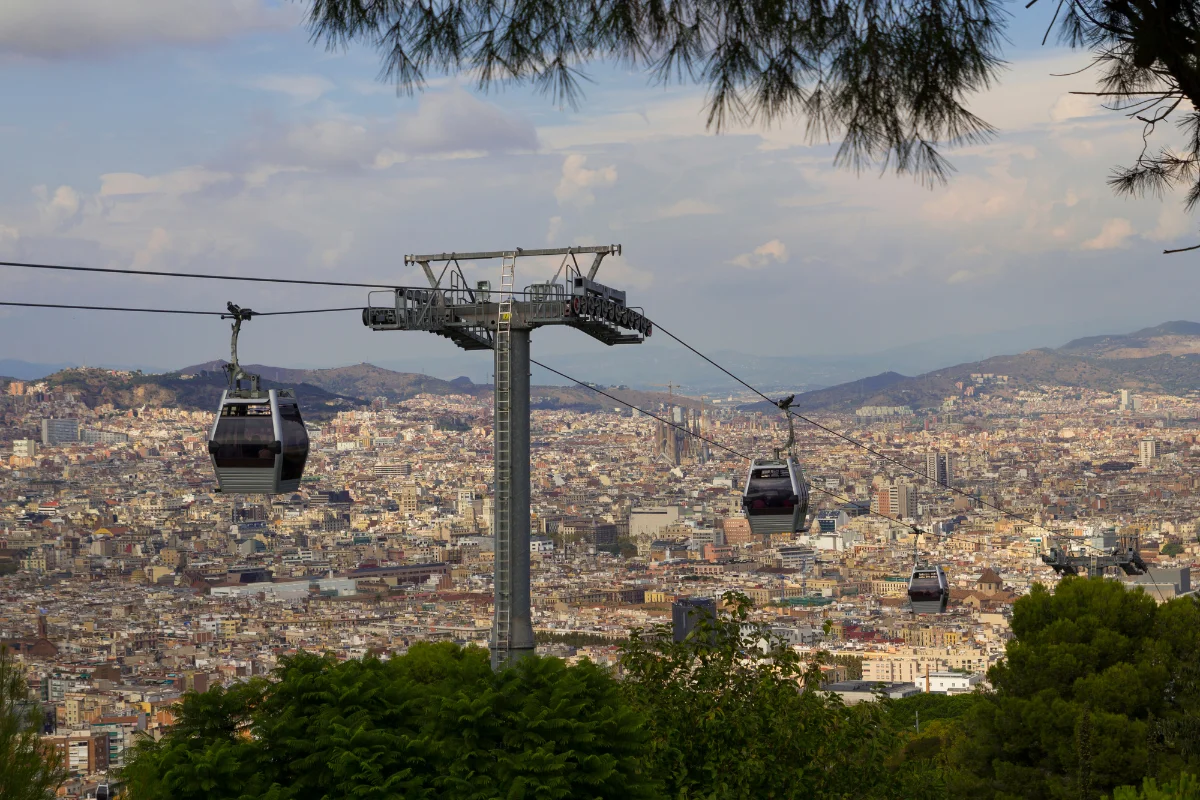

Barcelona has two cable cars that climb to the same mountain by completely different routes, with different prices and visual experiences that share almost nothing. The Montjuïc cable car costs €17.10 return online (€19 at the box office) and runs modern 8-person cabins along the hillside to the castle. The Harbor cable car — the Transbordador Aeri del Port — costs €20 return, dates from 1929, and crosses Port Vell at 70 meters above the water from the Barceloneta beach to Montjuïc’s south face. Choosing the wrong one for what you want is the most common mistake visitors make.
Which Barcelona cable car should I take? It depends entirely on what you want to see. The Montjuïc cable car serves visitors going to the Castle — it drops you at the entrance, it’s comfortable, accessible, and unaffected by wind. The Harbor cable car is for the visual experience itself: crossing above the port at 70 meters offers views unavailable from any land viewpoint. The Harbor cable car costs more and can close in strong wind. Both leave from Montjuïc’s south side, but the Harbor cable car also starts from Barceloneta beach.
Quick Decision
- Going to the Montjuïc Castle → Montjuïc cable car — drops at the Castle entrance, comfortable seated cabins, €17.10 return online
- Best view experience in Barcelona → Harbor cable car — crossing over the port at 70m with cruise ships below is impossible to replicate from land; €20 return
- Travelling with a pushchair or wheelchair → Montjuïc cable car — fully accessible; the Harbor cable car is standing-only
- Vertigo concerns → Montjuïc cable car — smaller cabin, stable, no swaying; the Harbor cable car has more movement and exposure over water
- Strong wind today → Only the Montjuïc cable car — the Harbor cable car suspends service above 40–50 km/h gusts; check before traveling to Barceloneta
- Saving money → Montjuïc cable car online (10% discount, €17.10) vs Harbor cable car (always €20 full price, no tourist card discounts)
- Sunset photography → Harbor cable car — the sun sets over the sea on this trajectory; the light over the Mediterranean from the cabin is the best available
Montjuïc Cable Car — The Castle Route
The current system, rebuilt in 2007, runs 55 glass-walled cabins for 8 seated passengers in a continuous loop — minimal waiting in average season. Three stops:
Parc de Montjuïc — the base station on Avinguda Miramar. This is where the Montjuïc funicular connects from Paral·lel metro (L2 and L3). The funicular has a separate ticket — it is not included in the cable car price.
Mirador — the intermediate stop on the hillside. Access to the Jardins de Joan Brossa and the Mirador de l’Alcalde, known for its mosaic-paved waterfall terraces. The least-visited stop and therefore the quietest for photography.
Castell — the upper station, adjacent to the main entrance of Montjuïc Castle. The fortress has a separate admission fee. For the castle’s full history as a political prison and cultural space, the Montjuïc Castle guide covers the transformation in detail.
Hours:
| Season | Opens | Closes |
|---|---|---|
| January–February | 10:00 | 18:00 |
| March–May | 10:00 | 19:00 |
| June–September | 10:00 | 21:00 |
| October | 10:00 | 19:00 |
| November–December | 10:00 | 18:00 |
Last access 15 minutes before closing; 20 minutes if doing the full return trip. Annual technical closures typically January or February, approximately three weeks. Check TMB for current funicular status — it has been temporarily out of service in recent periods with a replacement bus from Paral·lel.
Prices: €19 adult return (box office); €17.10 online (10% discount). One-way: €12 adult, €10 children 4–12. Under-4 free.
Harbor Cable Car — The 1929 Original
The Transbordador Aeri del Port was built in 1929 for the International Exhibition. Its red cabins cross Port Vell at 70 meters height on a 1,292-meter span between Barceloneta beach (Torre de Sant Sebastià) and Montjuïc’s south face (Miramar station). The intermediate Torre de Jaume I at 107 meters — visible from the sea — is closed to passengers; it serves only as a cable support structure.
Each cabin carries 19 passengers plus an operator, standing. It is not accessible for wheelchairs except at Torre de Sant Sebastià, which has elevator access during limited hours. Cabins depart approximately every 15 minutes. In high season, the wait at Torre de Sant Sebastià can reach 45 minutes.
What differentiates this experience: the Harbor cable car doesn’t cross the mountain — it crosses the harbor. From the cabin: cruise ships directly below, Barceloneta in aerial plan view, the Cathedral and Santa Maria del Mar towers to the north, and the Columbus Monument marking the start of Las Ramblas. On exceptionally clear days — particularly after tramuntana north wind — the Montserrat silhouette is visible on the horizon.
Prices: €12.50 one way; €20 return. Under-6 free. Does not accept public transport cards or TMB discounts.
Hours:
| Season | Opens | Closes |
|---|---|---|
| Winter (Jan–Feb / Nov–Dec) | 11:00 | 17:30 |
| Spring (Mar–May) | 10:30 | 19:00 |
| Summer (Jun–Sep) | 10:30 | 20:00 |
| Autumn (Oct) | 10:30 | 19:00 |
Closed December 25. Service may cancel due to wind — gusts above 40–50 km/h stop the cabins. Check current status on the official website or social media before traveling from Barceloneta.
The two cable cars show you completely different things
Price and route are the easy part. What decides which to take is the visual difference between what you see from each one.
From the Montjuïc cable car: as the cabin climbs from Avinguda Miramar, the horizon expands east and north. The Sagrada Família emerges above the Eixample grid with a clarity unavailable from city-center viewpoints. Torre Glòries and the 22@ district are visible to the right. The port and Hotel W mark the southern limit. What it doesn’t provide: it doesn’t fly over the city, doesn’t pass between buildings, doesn’t cross the sea. It’s a moving viewpoint along one side of Montjuïc’s hill — wide views but from a single angle.
From the Harbor cable car: the movement is horizontal above water — from the beach to the mountain crossing the port. The 70-meter height above the sea produces an exposure sensation the Montjuïc cable car doesn’t have. Views of the port frontage, the cruise ships, and Barceloneta from directly above are impossible to achieve from any other point in the city. Honest counterpoint: with haze or overcast sky, the visual impact drops significantly — the experience depends heavily on visibility conditions.
| Montjuïc Cable Car | Harbor Cable Car | |
|---|---|---|
| Price (return) | €17.10 online / €19 box office | €20 |
| Year built | 2007 (rebuilt) | 1929 |
| Route | 752m along hillside | 1,292m across harbor |
| Height | Along hillside | 70m above water |
| Cabin capacity | 8 seated | 19 standing |
| Accessibility | Full wheelchair access | Limited (elevator at Sant Sebastià) |
| Wind sensitivity | Low | High — closes above 40–50 km/h |
| Tourist card discount | 15% with Barcelona Card | None |
| Destination | Castle entrance | Miramar (15min walk to Castle) |
| Best for | Castle access, comfort | The view experience itself |
Combining Both in One Day
The most efficient circular route: Harbor cable car from Barceloneta to Miramar, walk 10 minutes to the Montjuïc cable car base station, ride up to the Castle, descend on foot through the Jardins de Laribal toward the Magic Fountain and Plaça d’Espanya. The reverse also works but involves descending from Miramar to the port, which adds transit time.
For the Harbor cable car leg, buy at the Torre de Sant Sebastià box office. For the Montjuïc cable car, buy online for the 10% discount. Total daily cost combining both: €29–37 per adult depending on purchase channel.
Discounts and Tourist Cards
The Barcelona Card includes 15% off the Montjuïc cable car and free access to several surrounding museums — MNAC, Fundació Joan Miró. If the plan includes two or more Montjuïc museums plus the cable car, the card can pay for itself. The Go City All-Inclusive Pass includes the Montjuïc cable car with potential savings of 30–40% over individual purchase. The Harbor cable car is not included in any standard tourist pass — it’s always a separate payment.
The Montjuïc funicular requires a separate integrated transport ticket — standard T-Casual or metro card works.
Can I reach Montjuïc Castle without the cable car?
Yes. Bus 150 goes directly to the Castle from Plaça d’Espanya with an integrated transport ticket (T-Casual or equivalent). The cable car adds the visual experience of the journey, not just the destination. If budget is tight, taking the bus up and the cable car down for the views on one leg makes sense.
Does the Harbor cable car reach the Castle?
Not directly. It arrives at Miramar on the mountain’s south face. From Miramar it’s a 15–20 minute uphill walk to the Castle, or connection with the Montjuïc cable car from its base station — about 10 minutes’ walk from Miramar.
The two cable cars solve different problems. One gets you to a specific destination comfortably. The other gives you a specific visual experience — crossing a harbor at 70 meters — that nothing else in the city replicates. Knowing which problem you’re trying to solve before buying the ticket is the whole decision.
For the complete Montjuïc plan around the cable car: the Montjuïc Barcelona complete guide covers the full hill itinerary. For the Barceloneta end of the Harbor cable car route, the Barceloneta Barcelona guide covers the neighborhood and beach. And for the secret viewpoints in Barcelona that don’t cost €17–20, the guide maps free panoramas that rival both cable car routes.