

Most museums walk you through time, from the oldest object to the newest. The Barcelona Design Museum does something else, and that throws visitors who arrive expecting the usual. Here the main hall is not arranged by century but by material, so an eighteenth-century chair can sit beside a recent mobile phone because both tell the same story: about plastic, about wood, about how the things we use every day shape the planet. Grasping that inverted logic is the key to making the visit work instead of getting lost in it.
What is the Barcelona Design Museum? It is the city’s museum of design and the applied arts, inside the Disseny Hub building in Plaça de les Glòries. It holds over 70,000 pieces across four disciplines, product, graphic, fashion and decorative arts, with an approach that explains how design shapes daily life. It opens Tuesday to Sunday from 10am to 8pm and is free on Sunday afternoons.
The stapler, a building that is half the visit
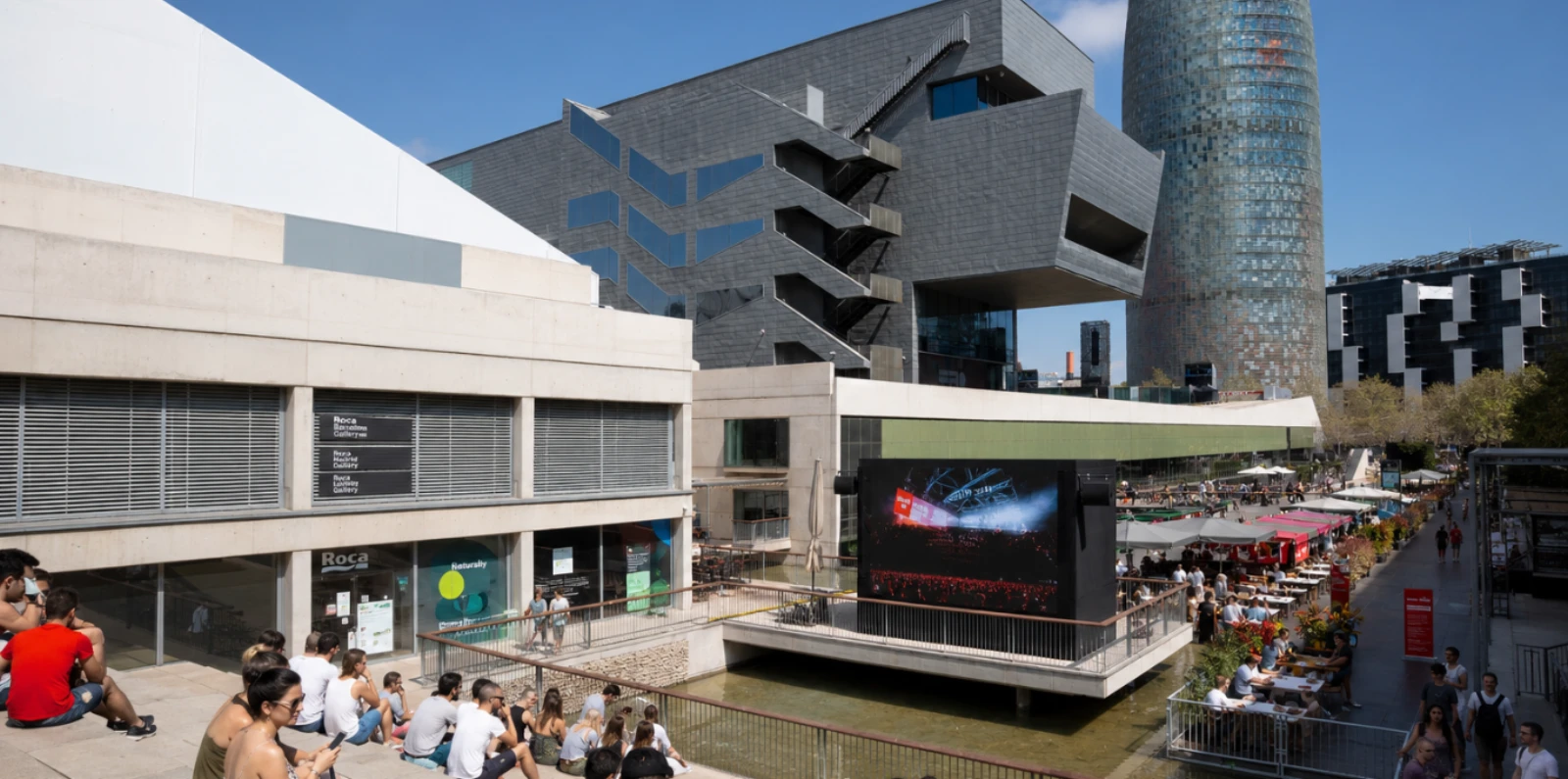
Before you step inside, the container already tells a story. The museum occupies the Disseny Hub Barcelona building, in Plaça de les Glòries, next to Jean Nouvel’s Torre Glòries, designed by the MBM Arquitectes studio after winning the city competition at the start of the century. Its defining feature is a huge volume that juts out on a cantilever 14.5 metres above the square, a form so emphatic that locals soon nicknamed it the stapler.
That geometry is not only aesthetic. The building has two parts, an underground section that uses the slope of the square and another projecting into the void, so the galleries stack upward to free public space below. A suspended walkway crosses over a pond from the entrance, and at dawn or at night with the lighting on it is one of the most photographed spots in the new Glòries. That is why it appears in guides as an architectural landmark in its own right, not merely as the shell of a museum, and pairs naturally with the budget guide for a Barcelona trip.
Matter Matters, why ordering by material changes everything
Here is the heart of the museum and its biggest difference. The main exhibition, Matter Matters, is not organised by period or style but by the material objects are made of: wood, plastic, glass, metal, ceramic, and also lithium or cobalt, up to 7 families of material that structure the technological era. Each material opens a chapter explaining how it shapes the planet, society and the economy, from the petrochemical to the microbiological.
That shift turns the visit into more than admiring pretty pieces. Instead of asking when an object was made, the museum asks what it is made of and what consequences that carries, and that lens of sustainability and material footprint runs through the whole show. According to official data, it is the exhibition that anchors the permanent collection, alongside Common Objects, a reflection on local industrial design with global reach. For anyone after a visit that makes them think, it fits better than a standard chronological tour, and rounds out the first-time visitor guide to Barcelona.
Four museums in one, where the collection comes from
The richness of the holdings makes sense once you know their origin. The museum was born from the merger of four historic city institutions: the Museum of Decorative Arts, the Ceramics Museum, the Textile and Clothing Museum and the Graphic Arts Cabinet. That union explains why it holds over 70,000 pieces ranging from the fourth century BC to contemporary design, with gems like medieval textiles and sixteenth-century Catalan enamelled glass.
The result is a tour through four disciplines that once lived apart and now speak to each other under one roof. According to experts in museography, this concentration makes it one of the most complete holdings of object culture in the Iberian sphere, where design stops being a set of isolated niches and reads as a single language. Below is how the permanent collection breaks down, the shortcut to deciding where to spend your time.
| Discipline | What it covers | Span |
|---|---|---|
| Product design | Furniture, lamps, appliances, icons | Craft to industry |
| Graphic design | Posters, typography, visual identity | 1980–2003 boom |
| Fashion | Silhouette, tailoring, the dressed body | 1550–2015 |
| Decorative arts | Glass, ceramics, tapestry, furniture | Antiquity to 20th c. |
Fashion and graphics, two collections with their own pull
Beyond the materials, two collections are worth a stop on their own. The Dressed Body runs through five centuries of fashion, from 1550 to 2015, not as a parade of dresses but as a study of how clothing has compressed, exaggerated or freed the human silhouette over time. Corsets, tailoring and contemporary garments read as technology applied to the body, which makes it especially interesting to a design eye.
The other gem is the graphics. Do You Work or Design? documents the rise of Spanish graphic design between 1980 and 2003, the years when Barcelona became a world reference in posters, typography and visual identity. It is the collection that connects most with today’s creators, because it captures the moment the graphic craft became a profession. Both show the museum covers the object in all its forms, from chair to poster, and enrich any Gothic Quarter walking route extended into a design-themed day.
When to go and what it costs, the practical part
Planning the visit well saves money and queues. The exhibitions open Tuesday to Sunday from 10am to 8pm, with Mondays closed except on holidays, and it is worth not confusing these hours with those of the DHub building, which are wider, a common mistake in tourist guides. General admission to the permanent collections is €6.20 and reduced is €4.20, the latter for people aged 16 to 29, over 65s, the unemployed and large families.
The trick is in the Sundays. It is free on Sunday afternoons from 3pm to 8pm and every first Sunday of the month, an ideal window to enter without paying, plus the open days of Santa Eulàlia and La Mercè. The museum closes on 1 January, 1 May, 24 June and 25 December. To make the most of those free slots, line the plan up with the best time to visit Barcelona guide and the wider things to see in Barcelona.
Getting there and what is nearby
The location lets you chain the visit with other plans. The museum sits at Plaça de les Glòries Catalanes 37-38, in the Glòries district, next to Poblenou and the 22@ tech district. It is an easy ride on metro line L1 to Glòries, or on tram T4, T5 and T6, and the area has spent a decade in full urban transformation around the square.
The best part is the heavyweight neighbours within a few metres. Jean Nouvel’s Torre Glòries dominates the skyline, the Els Encants market spreads its mirrored canopy right beside it, and the Parc del Centre del Poblenou is close, so you can build a full morning without taking transport. That cluster of landmarks makes Glòries a rounded stop, combining design, contemporary architecture and a historic market in a single walk.
A few streets away stands the largest surviving civil Gothic building in the world, raised in the late 13th century to build galleys: the Maritime Museum guide explains what survives of the Royal Shipyards.
A further museum is on the way, dedicated to Gaudí inside the Col·legi de les Teresianes: where it is and when it opens are in the Teresianes museum guide.
Frequently asked questions about the Barcelona Design Museum
How much is admission to the Barcelona Design Museum and when is it free?
General admission to the permanent exhibitions is €6.20 and reduced is €4.20. It is free on Sunday afternoons from 3pm to 8pm and every first Sunday of the month, plus the open days of Santa Eulàlia on 12 February and La Mercè on 24 September.
What are the opening hours of the Barcelona Design Museum?
The exhibitions open Tuesday to Sunday from 10am to 8pm, and Monday is closed except on public holidays. Do not confuse this with the wider hours of the DHub building. It closes on 1 January, 1 May, 24 June and 25 December.
Why is the Barcelona Design Museum organised by material instead of period?
Its main exhibition, Matter Matters, groups pieces by the material they are made of, such as wood, plastic, glass, metal, lithium or cobalt, to show how each material affects the planet, society and the economy. It is a more reflective approach than the usual chronological one.
What is the stapler of Glòries and who designed the building?
It is the popular nickname of the Disseny Hub building, for its huge volume suspended on a cantilever 14.5 metres above Plaça de les Glòries. It was designed by the MBM Arquitectes studio, built between the late 2000s and early 2010s, and has become a photographic icon of the Glòries transformation.
At the Barcelona Design Museum you do not look at the past, but at what the present is made of.