
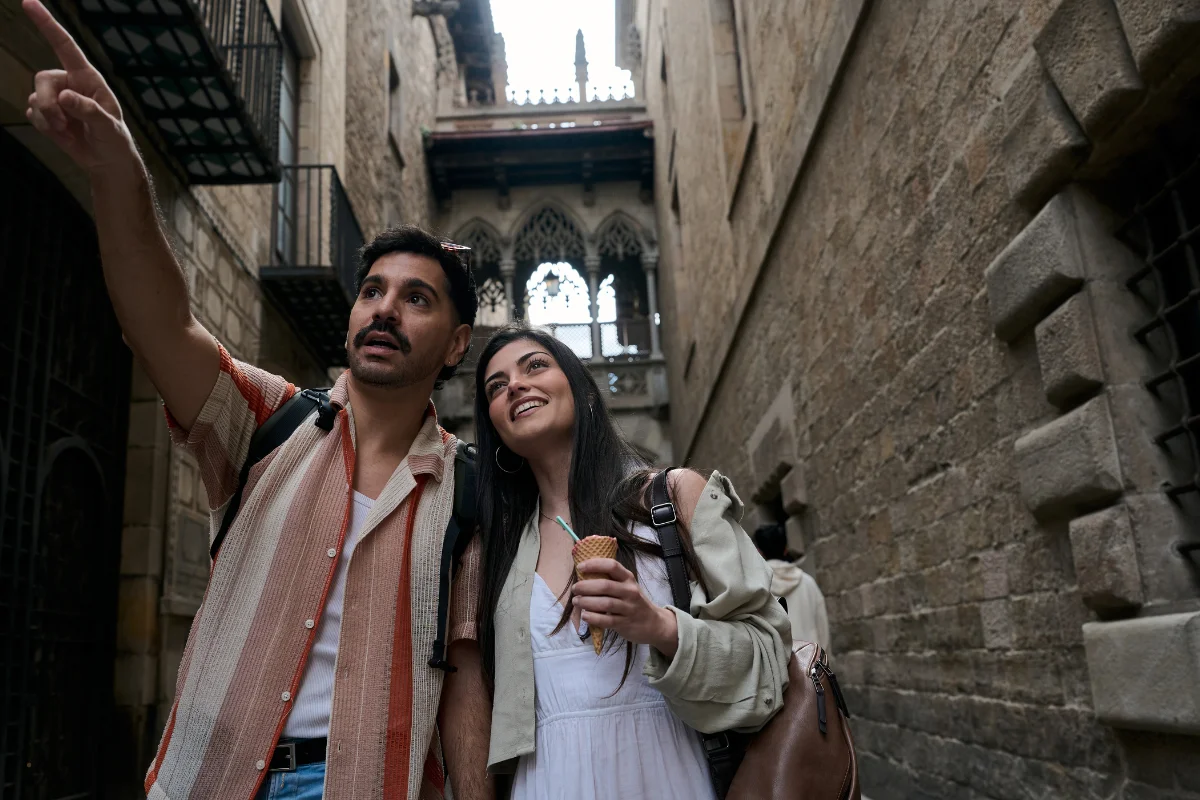

The Gothic Quarter is not mostly Gothic. Much of what looks medieval was built or “medievalized” between 1890 and 1929 to give Barcelona a coherent historic center for the tourist era. The Pont del Bisbe is from 1928. The Cathedral’s facade was completed in 1913. Beneath that neo-Gothic layer lie Roman, medieval, and Republican strata that the standard tourist circuit never reaches. This 3-hour walking route works through those layers. Metro L4, Jaume I stop.
The route starts at the Temple of Augustus on Carrer del Paradís, 10 — four Corinthian columns from the 1st century BC preserved inside a medieval building. You have to descend a staircase to reach them; nothing from the street signals their presence. Free entry. Monday closes at 14:00; all other days until 19:00–20:00.
Quick Decision — How to Use the Route
- 1 hour → Temple of Augustus + Plaça de Sant Felip Neri — the two points with the highest historical density in the shortest distance
- 2 hours → Add the Call (Carrer de Marlet 5) and Carrer del Bisbe — the full Roman + Jewish + neo-Gothic sequence
- 3 hours → Complete route: add Plaça de Sant Just, the hotel garden, and Carrer de la Palla
- With children → Temple of Augustus first (Roman columns inside a building surprises them), then Sant Felip Neri square with the fountain, then Sant Just bell tower (€2, good views)
- Photography → Sant Felip Neri before 10:00 or after 18:00 — lateral light on the facade with the shrapnel marks, almost no one there
- Combining with El Born → Carrer de la Palla leads directly to El Born and Santa Maria del Mar in 5 minutes on foot
The Call — The Jewish Quarter and the 692 AD Gravestone
The Call was Barcelona’s Jewish neighborhood until the 1391 pogrom. Its streets — Carrer del Call, Sant Domènec del Call, Marlet — preserve the oldest street plan in the neighborhood.
At Carrer de Marlet, 5: two things layered on top of each other. The Major Synagogue — one of the oldest in Europe, with structures dating to the 3rd century AD beneath the medieval building — and attached to the exterior wall, a Jewish gravestone from 692 AD that most passersby mistake for decoration. The synagogue had legally mandated small dimensions: it could not be larger than the smallest Christian church in the city. Entry: approximately €2.50.
What almost no one knows: when the Jewish cemetery on Montjuïc was dismantled after the expulsion, the tombstones were reused as construction material. Some blocks with Hebrew inscriptions remain embedded in building facades throughout the neighborhood — in Plaça del Rei and Plaça de Sant Iu they can be identified if you know what to look for. Words like “Yosef” and references to funeral laments remain in the walls of the city that expelled them.
Time here: 20 minutes.
Plaça de Sant Felip Neri — The Quietest Square with the Hardest History
Plaça de Sant Felip Neri is the most peaceful square in the Gothic Quarter at any hour. Baroque, small, with an octagonal fountain installed in 1962.
What the signs don’t explain clearly: the marks on the church facade are shrapnel impacts from January 30, 1938. An Italian Air Force bombing raid — Italy was allied with Franco’s forces — killed 42 people, most of them children who had taken shelter in the oratory. The pockmarks in the stone were deliberately preserved as a memorial. There are no crowds here. There is no admission charge. The historical weight and the silence are the whole experience.
To get there: from the Cathedral, go down Carrer del Bisbe and turn right on Carrer de Sant Sever. The square appears at the end of a narrow alley.
Time here: 15 minutes.
The Pont del Bisbe — The Skull Under the Bridge
Carrer del Bisbe is one of the most-photographed streets in the neighborhood but most photographs are taken looking up at the bridge. The detail almost nobody notices: beneath the bridge arch there is a skull pierced by a dagger.
The Pont del Bisbe was built in 1928 by Joan Rubió, a Gaudí disciple, in flamboyant neo-Gothic style, to connect the Palau de la Generalitat with the Casa dels Canonges. Le Corbusier, visiting Barcelona that same year, called it a “rotten” work — not for technical execution but for the historical dishonesty of a new building disguised as medieval. Local superstition says if the bridge falls, Catalonia loses its autonomy.
The skull has two readings: popular tradition holds that looking at it while crossing brings bad luck. A Masonic reading frames the threshold as initiatory death — crossing it symbolizes the passage to knowledge. The neighborhood has more Masonic symbols distributed throughout: in the Cathedral a chapel with compass and rose, and on Carrer de la Portaferrissa a frieze of children handling rulers and triangles.
Time here: 10 minutes.
The reused gravestones, and where to find them
Beyond the neo-Gothic construction timeline, the detail worth carrying is the gravestone reuse, which is specific and locatable.
After the expulsion of Jews from Barcelona’s Call in 1391 and from Spain in 1492, the Jewish cemetery on Montjuïc was seized and dismantled. The tombstones — carved limestone slabs with Hebrew epitaphs — were not destroyed: they were sold or donated as construction material and incorporated into building foundations, walls, and pavements throughout the city. Several have been identified and catalogued in the Gothic Quarter. The Archaeological Museum of Catalonia has some of the recovered pieces. But others remain embedded in walls that tourists walk past daily without any indication of what they’re seeing.
It’s not just a historical fact — it’s a navigational clue. When you see an unusual stone block in a Gothic Quarter wall with faint carved markings, there’s a real chance you’re looking at repurposed funerary material from a demolished medieval cemetery.
Plaça de Sant Just — The Fountain Where Trade Between Jews and Christians Was Legal
Plaça de Sant Just is one of the few squares where tourism hasn’t completely displaced daily life. The 14th-century Gothic fountain at the center was the only point in the medieval city where law permitted legal commerce between Jews and Christians — a regulated exchange that made this square a space of forced but real coexistence.
The Basílica dels Sants Just i Pastor (rebuilt in Gothic in 1342 over a temple some studies place in the 4th century) was the cathedral seat before La Seu was built. For €2 you can climb the bell tower at sunset. For the hidden churches in Barcelona category, Sant Just is the most undervalued in the historic center — almost always empty, almost always open.
Time here: 15 minutes.
The skull on the Bishop’s Bridge and the bomb scars of Sant Felip Neri come with stories that are only half true, and the Gothic Quarter legends separate fact from invention.
The Secret Garden and Carrer de la Palla
The Jardí de la Casa Ignasi de Puig is accessible through the hotel lobby at Carrer d’en Quintana, 4, or via an elevator on the street that looks out of service but works. Fountain, benches, plants. Almost always empty. Opens at 10:00, free entry.
Carrer de la Palla connects the Cathedral to the Basílica de Santa Maria del Pi through a street of antique dealers and secondhand booksellers. Halfway along, behind a metal gate, a section of the 4th-century Roman wall with two square defensive towers is visible. For the best flea markets in Barcelona broader context, this street has shops open during the week that weekend markets don’t cover.
Mesón del Café (Carrer de la Libretería, 16) has been serving coffee since 1929. Small space, no music, lever espresso machine. The natural close to the route — coffee before starting or after finishing, before crossing into El Born.
Practical Notes
- Shoes: irregular cobblestones throughout — nothing with heels or smooth soles
- Temple of Augustus: closes Monday at 14:00 — start there first if you’re going on a Monday
- Pickpockets: the Call and Cathedral areas have high incidence — bag in front, nothing visible on terrace tables at peak hours
- Synagogue Major: entry approximately €2.50; the 692 AD gravestone is free on the exterior wall
- Sant Just bell tower: €2, worth it at sunset specifically
- MUHBA (Plaça del Rei, €7.30): Roman layer archaeology over 4,000 m² underground — add it if the archaeological interest justifies the time investment
The Gothic Quarter works best without hurrying. Its best details are at eye level or in the ground, not in main facades. The bridge skull, the 692 AD gravestone, the 1938 shrapnel marks, and the 1st-century BC columns are all within 10 minutes’ walking of each other. The problem isn’t finding them — it’s having time to actually look.
To extend the day: El Born is 5 minutes on foot from Carrer de la Palla — Santa Maria del Mar closes the historical sequence well. For the full Gothic Quarter neighborhood guide including the main circuit sites, the guide covers everything comprehensively. And for a Barcelona first-time visitor itinerary that integrates the Gothic Quarter efficiently, the guide places it within a timed full-day circuit.