
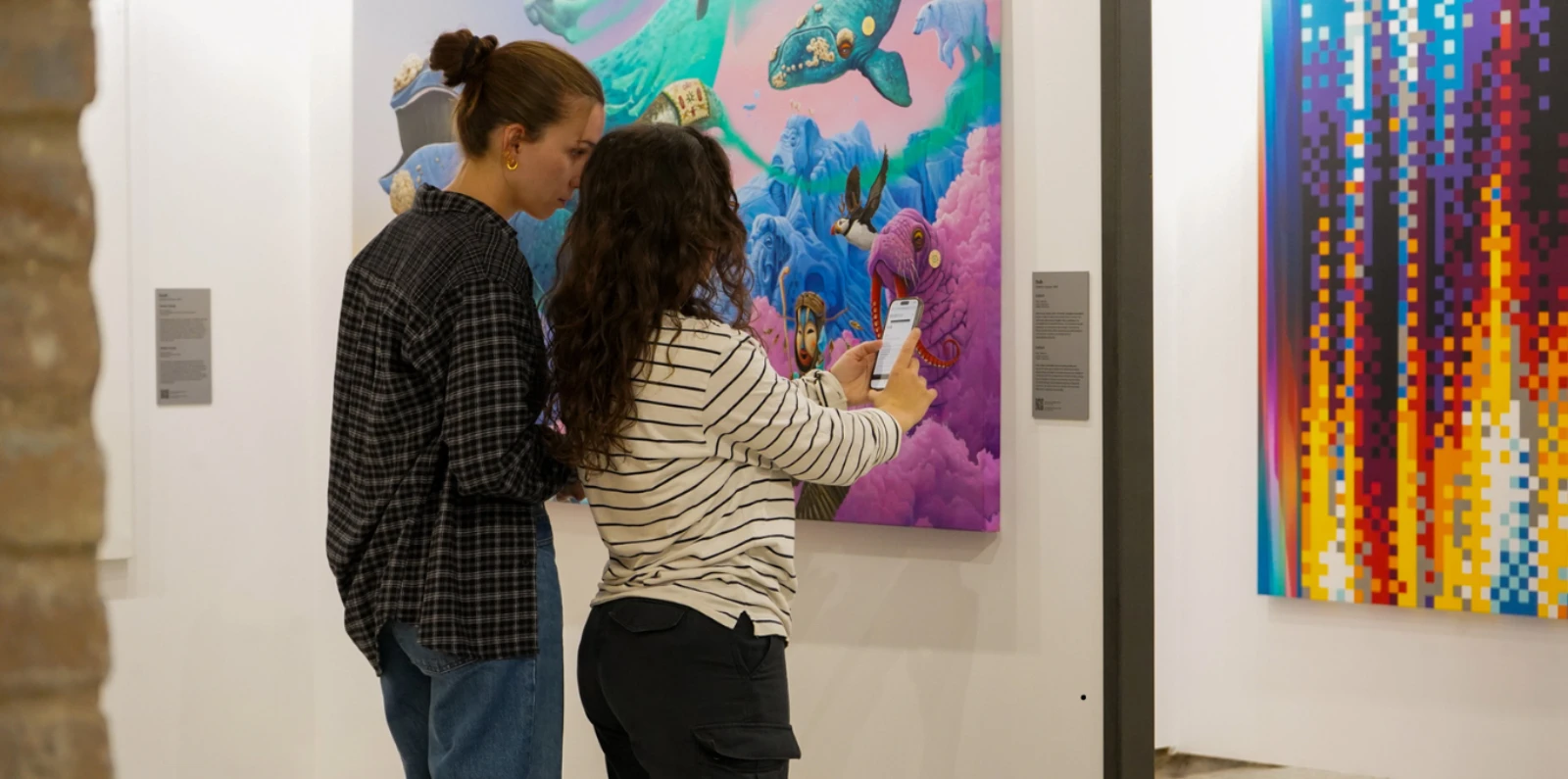

There is a museum in Barcelona that opens by denying it is a museum. The BAS Museum, the city’s first major space devoted to street art, starts from a provocative thesis: the city is the real museum, and they are only the door in. The idea is to bring the language born on the street, free, critical and political, into a curated setting without taming it, and to do so in the middle of the Barri Gòtic, where contemporary graffiti clashes with medieval stone.
What is the BAS Museum in Barcelona? It is the city’s first major street-art museum, recently opened in the Barri Gòtic. It gathers over 35 works across seven rooms by artists such as Okuda, Aryz, Felipe Pantone and OsGêmeos. It opens Tuesday to Sunday from 11 to 20 h, general entry is €11 and the visit takes about 45 minutes. Its motto, born on the street, made for the city.
The names on the walls
The line-up of artists explains why this museum matters, so it comes first. It gathers top national and international figures of the movement: OsGêmeos, the Brazilian twins whose yellow figures are recognised worldwide; Okuda San Miguel, the Asturian of multicolour pop surrealism; Aryz, the Catalan of large-format murals; and Felipe Pantone, a master of kinetic art and impossible gradients. To them add more than 30 leading artists such as PichiAvo, the Valencian duo fusing graffiti and classical painting; the Portuguese Vhils, known for portraits carved into walls; Bordalo, who builds animals from waste; and the designer Mariscal, alongside Sebas Velasco, Sixe, Seth, Dran and Escif, spanning from graffiti pioneers to emerging creators.
The museum adds a technological layer that helps you understand the works. Beside many of them are QR codes giving access to videos about the artists and their creative processes, turning the visit into an act of understanding, not only looking. According to official data, it is a living museum, with a permanent collection but a display that constantly evolves, and one room is reserved for emerging artists to boost their careers. It is a reading of street art that suits anyone already exploring the scene in the Barcelona art galleries guide.
Prices, hours and how to get there
Here is the practical detail, since it decides a visit. The table below sums up what you need before going, from the entry rates to the opening hours and the nearest metro.
| Detail | Information |
|---|---|
| Hours | Tuesday to Sunday, 11 to 20 h (closed Monday) |
| General entry | €11 |
| Reduced (residents, students, over-65s) | €7 |
| Young (7-13 years) | €9.50 |
| Children (0-6) | Free |
| Address | Carrer d’en Carabassa, 10, Barri Gòtic |
| Metro | Jaume I (L4), Liceu (L3) |
| Duration | About 45 minutes |
The location is part of the appeal, on a narrow street of the Barri Gòtic, in the Ciutat Vella district. The museum occupies an old Gothic building fully refurbished by architect Carles Soler, setting contemporary art against medieval stone, and it sits a step from the Museu Picasso and metres from the Pont de l’Avinyó, the corner that inspired Picasso’s Les Demoiselles d’Avignon, so you can combine both in a single day, as the best things to see in Barcelona guide suggests. Tickets are bought online or at the desk, with a maximum of 19 per time slot online for groups, and it is a cost that fits within the Barcelona travel budget guide.
Seven rooms for one thesis, the street enters the museum
The museum’s argument unfolds across seven rooms with over 35 original works, arranged not by chronology but by themes and languages. One room is devoted to works using humour, irony and paradox to question power structures, with pieces by Okuda, Aryz, Escif and Dulk. Another explores colour, geometry and rhythm, tied to abstraction and contemporary visual culture, with Mina Hamada, Kenor and Felipe Pantone. A third reinterprets the references of art history and classical iconography through a contemporary eye.
According to experts in contemporary art, what makes this approach distinct is the ambition to contextualise rather than only hang pictures. Street art has moved over recent decades from the street to conquer galleries, fairs and museums worldwide, and the BAS wants to explain that leap. The programming rotates temporary exhibitions every few months, so the museum changes between visits. It is a reading that complements experiencing it in its natural habitat, which the first-time visitor guide to Barcelona frames as part of the city’s creative fabric.
What else it offers, from free access to the shop
Not all the museum is paid, and that is a gesture true to its philosophy. To bring art to every audience, the BAS has a free-access zone showing 2 large-scale works of strong visual impact, meant for anyone wanting a glimpse without buying a ticket. It is a way of keeping the free spirit of the street inside a building, faithful to the idea that street art should not be entirely locked away.
The space is completed by a creative shop where the work becomes editions, publications, books and art objects, beyond the usual souvenir. The museum also runs guided visits, workshops and talks, and seeks synergies with local artists and galleries, positioning itself as a meeting point rather than only a display. For anyone building a cultural route through the centre, it fits with the best time to visit Barcelona guide for planning the season of the trip.
Frequently asked questions about the BAS Museum in Barcelona
What is the BAS Museum in Barcelona?
The BAS Museum (Barcelona Art Street) is the city’s first major museum devoted to urban and contemporary art, recently opened in the Barri Gòtic. It gathers over 35 original works across seven rooms by artists such as Okuda San Miguel, Aryz, Felipe Pantone and OsGêmeos, and reclaims street art as a museum discipline, not only a street one.
How much is entry to the BAS Museum and what are its hours?
General entry costs €11. There is a reduced rate of €7 for Catalonia residents, students, people with disabilities, the unemployed and over-65s, and a €9.50 rate for young people aged 7 to 13. Children aged 0 to 6 enter free. It opens Tuesday to Sunday from 11 to 20 h, and closes on Mondays.
Where is the BAS Museum and how do you get there?
The BAS Museum is at Carrer d’en Carabassa, 10, in the Ciutat Vella district, within the Barri Gòtic. The nearest metro stops are Jaume I (L4) and Liceu (L3), a few minutes on foot. It is very close to the Museu Picasso, which lets you combine both visits in a single day through the old town.
How long does it take to visit the BAS Museum?
The standard route is designed to take about 45 minutes, making it an easy visit to fit into a morning or afternoon in the centre. The museum is accessible for people with reduced mobility, with the route adapted for wheelchairs, though it has no lift.
How does the BAS differ from the Moco Museum in Barcelona?
They are different and complementary. The BAS focuses on street art, led by Spanish and local artists like Okuda, Aryz and PichiAvo, in the Barri Gòtic and with entry from €11. The Moco, in El Born, gathers international contemporary art by established names like Banksy, Warhol and Kusama, with immersive digital rooms and entry from around €15. For art from the street, choose the BAS; for icons of global contemporary art, the Moco.
In Barcelona, the BAS Museum does not want to be the final destination of street art, but the door that leads back to the street.