
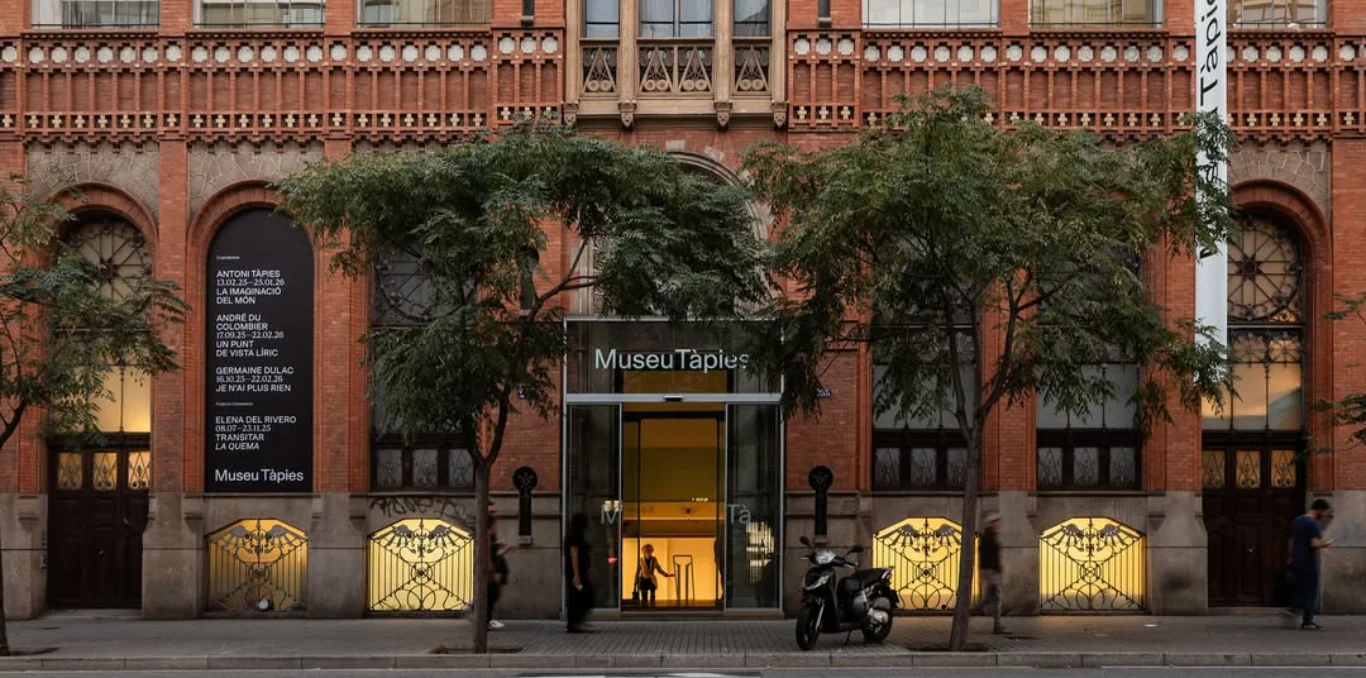

The Museu Tàpies holds the most complete collection of Antoni Tàpies, one of the defining figures of twentieth-century European art, inside a building that is itself a founding piece of Catalan Modernisme. It occupies the former Montaner i Simón publishing house, built by Lluís Domènech i Montaner between 1880 and 1882 — one of the first buildings in the Eixample to bring exposed brick and industrial iron into the city centre. Until 2024 it was known as the Fundació Antoni Tàpies, the name the artist gave it when he founded it in 1984.
A building that predates Gaudí’s Modernisme
The building is the museum’s first surprise, because it comes before much of the work that made Catalan Modernisme famous. Domènech i Montaner — also responsible for the Palau de la Música Catalana and the Hospital de Sant Pau — designed it for the Montaner i Simón publishers, one of Catalonia’s most prestigious art presses, embedding visible industrial structure into the urban fabric when that was still a rarity.
What is the Museu Tàpies and why does it stand out? It is the museum dedicated to Antoni Tàpies, in Barcelona’s Eixample, with €15 general admission. It gathers over 360 of the artist’s works inside a modernista building by Domènech i Montaner from 1880-1882, crowned by the wire sculpture Núvol i cadira. It pairs a permanent collection with temporary contemporary art exhibitions.
The façade combines red exposed brick with wrought iron and Mudéjar touches, with a structural lightness that was revolutionary for its time. Cast-iron columns and iron beams allowed open floors and high ceilings — first for the basement printing presses, a century later for the exhibition halls. Against Gaudí’s organic, expressionist path, Domènech i Montaner represented the movement’s decorative rationalism.
Reading the matter painting, the key to Tàpies
Tàpies’s work makes more sense through a single idea: according to specialists in his work, he does not paint a wall — he turns the canvas into one. That is the origin of the term matter painting, and of its link to the artist’s surname, since tàpies means walls in Catalan. That painted wall carries memory, resistance and personal trace.
Technically, he worked the canvas flat and built the surface from a mix of marble dust, sand, earth and binders over oil, in a restricted range of ochres, greys and browns. Before it dried, he cut grooves, incisions and cracks with punches or knives, and added recurring signs — the cross, the letter X, numbers, fragments of words. The result is a hermetic language that crosses European informalism with the influence of Eastern thought.
What to see inside
The museum concentrates its highlights in a handful of elements worth seeking out.
- Núvol i cadira (Cloud and Chair, 1990): the tangle of wire over the roof, visible from Carrer d’Aragó — an aluminium and steel structure Tàpies installed to solve a scale problem with the taller neighbouring buildings. The chair is a recurring motif of contemplation and humility.
- Mitjó (Sock): a 2.75-metre sculpture on the upper terrace, a reduced version of a piece once projected at 18 metres and rejected for its size — raising a humble everyday object to the level of art.
- The matter paintings: a rotating selection of his dense surfaces with crosses, incisions and signs, the core of the permanent display.
Who Antoni Tàpies was
Antoni Tàpies (Barcelona, 1923-2012) is regarded as the leading figure of Spanish matter informalism and one of the most influential Catalan artists after Picasso and Miró. A lung illness in his youth, which forced a long convalescence, shaped the introspective origin of his work.
In the late 1940s he co-founded the avant-garde group Dau al Set alongside the poet Joan Brossa. A grant took him to Paris in the early 1950s, where he met Picasso and encountered art brut and Dubuffet’s informalism. Under the Franco dictatorship his work took on a tone of protest that made the artist a symbol of Catalan cultural resistance. His pieces are now held at MoMA in New York, the Tate in London and the Reina Sofía in Madrid, alongside this museum.
The collection and the library
The permanent collection gathers more than 360 original works — paintings, sculptures, drawings and prints — plus around 1,000 prints and artist’s books, donated by Tàpies and his wife, Teresa Barba. It spans the 1940s drawings to his final decades, tracing the artist’s full evolution. The display rotates, so the route changes between visits and it is worth checking the programme beforehand.
The building also houses an internationally significant library specialising in modern and contemporary art, with a notable holding on Asian, African and Oceanic cultures — a reflection of the artist’s personal interest in Eastern thought. To place the museum among the city’s major ones, this round-up of the best museums in Barcelona helps.
Museu Tàpies exhibitions and what’s new
The 2026 season keeps two exhibitions running, both included with general admission. “Antoni Tàpies. The Perpetual Movement of the Wall”, curated by Imma Prieto and Pablo Allepuz, runs from 13 February to 6 September 2026 and reconstructs four solo shows the artist staged in the 1950s at the Galerías Layetanas, the Sala Gaspar and the Galerie Stadler in Paris, examining how the display itself shapes how the work is read.
Running alongside it, “Àngel Jové. De intactu”, curated by Maria Josep Balsach, is on from 19 March to 27 September 2026 — the first major retrospective of this multifaceted Catalan artist who died in 2023. A programme cycle, “Following the Sun”, adds interventions across Saturdays between March and December. The renaming from Fundació to Museu, in 2024 and tied to the centenary of the artist’s birth, marked this more open, contemporary-facing chapter.
Prices, hours and how to get there
General admission is €15, with a reduced rate of €9 for students and over-65s, and free entry for under-16s, registered unemployed visitors and Friends of the Museum. It is included in the €38 Articket Barcelona, the pass covering six major art museums for twelve months.
| Ticket type | Price |
|---|---|
| General | €15 |
| Reduced (students, 65+) | €9 |
| Under-16s, unemployed, Friends | Free |
| Articket Barcelona (6 museums) | €38 |
Opening hours are Tuesday to Saturday 10:00 to 19:00 and Sundays 10:00 to 15:00, closed on Mondays, 1 and 6 January and 25 and 26 December. The museum is at Carrer d’Aragó 255, in the heart of the Eixample, a few minutes’ walk from Casa Batlló and La Pedrera. The nearest metro is Passeig de Gràcia (lines L2, L3, L4); buses 7, 22, 24, H10, V15 and V17 stop nearby, with Bicing stations in the area. It is also one of the strongest indoor options on a rainy day in Barcelona.
Is the Museu Tàpies worth it?
It is a strong stop for anyone drawn to contemporary art, modernista architecture or a museum less crowded than the city’s headline icons. The building justifies the visit on its own, and the collection lets you understand Tàpies in depth rather than in passing. Its intimate scale is part of the appeal.
It is the wrong call if your trip is very short and centred on the classic Gaudí circuit, or if you have little affinity for abstract art, since the content is conceptual and demanding — closer to a wall than to a narrative picture. Guided visits help in that case, and it is worth weighing against the best things to see in Barcelona first. For those who connect with his work, few museums in the city leave such a physical impression.
FAQ
How much does the Museu Tàpies cost?
General admission is €15, with a reduced rate of €9 for students and over-65s. Under-16s, registered unemployed visitors and Friends of the Museum enter free. It is included in the €38 Articket Barcelona, which covers six of the city’s art museums for a year.
What are the Museu Tàpies opening hours?
Tuesday to Saturday from 10:00 to 19:00, and Sundays from 10:00 to 15:00. It closes on Mondays, 1 and 6 January and 25 and 26 December. Last admission is 15 minutes before closing. The specialist library keeps its own schedule, Tuesday to Friday.
What can you see at the Museu Tàpies?
The most complete collection of Antoni Tàpies — over 360 original works plus around 1,000 prints and artist’s books — alongside temporary exhibitions. Highlights include the rooftop sculpture Núvol i cadira, the Mitjó piece on the terrace, and a rotating selection of his matter paintings with their crosses and signs.
Why is Tàpies’s work called matter painting?
Because Tàpies does not depict a wall — he turns the canvas into one. He mixes marble dust, sand and earth into the oil to build dense surfaces, then cuts incisions, cracks and signs into them. The surname Tàpies means walls in Catalan, giving that painted wall a personal meaning.
Why did it change its name from Fundació Antoni Tàpies to Museu Tàpies?
In 2024, marking the centenary of the artist’s birth, the institution was officially renamed Museu Tàpies. The change reinforces its standing as a contemporary art museum rather than a single-artist archive, while keeping the foundation Tàpies himself created in 1984.
How long do you need to visit the Museu Tàpies?
Around 1.5 to 2 hours to combine the permanent collection, a temporary exhibition and the rooftop terrace. Consulting the library or joining a mediation activity can extend it to half a day. It is one of the least crowded museums in the Eixample.
Tàpies spent his life turning walls into paintings, and left his finest wall on the roof of a building that was already a statement in itself.