
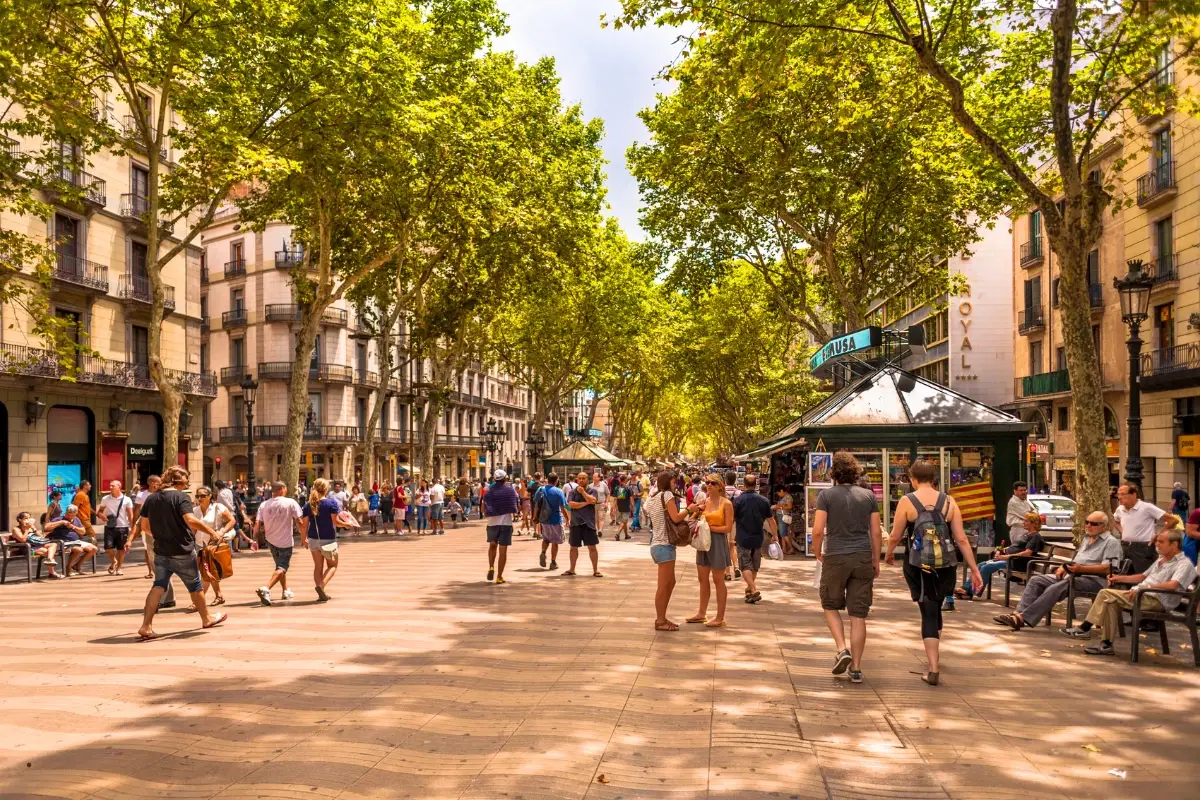

A free afternoon in Barcelona can run three hours or it can run until the last bar closes. The difference is knowing what works at each hour, what requires advance booking, and what closes earlier than it seems. The Búnkers del Carmel enforces closing time with police; the Museu Picasso turns free at 16:00 on Thursdays with no reservation needed; the MACBA has a free Saturday window. None of these facts appear in the standard “what to do in Barcelona” circuit — but all of them determine whether an afternoon actually works.
This guide organizes the afternoon by state of mind, not by map position.
If You Want Fresh Air and a View
Búnkers del Carmel (Turó de la Rovira) — the 360° viewpoint at 262 meters with the most complete panorama of the city. Free always. The timing is the entire plan: closes at 17:30 in winter, 19:30 in summer (after the clocks change in late March). Police enforce the closing with active patrol. Arriving “at sunset” on many days means arriving as the site empties.
The correct approach: check the closure time before leaving, subtract 60 minutes, that’s when you arrive. Bring something to eat and drink — no bar service. The open areas outside the fenced battery zone have no closing time and offer partial views without restriction.
Transport: Metro L4/L5 to Alfons X, then bus V17 or 119, then 15 minutes uphill on foot.
Parc de la Ciutadella — the most central large green space in the city. Free always, open until 21:00 in summer. The rowing lake (from €6 for 30 minutes) is the plan. The cascade monument — designed by Fontserè with contributions from a young Gaudí — provides the architectural backdrop. The park exits directly into El Born for the evening.
Montjuïc in descent — take the funicular from Paral·lel metro station (metro ticket covers it), then walk down through the gardens. The Jardí Botànic, the Jardins de Laribal and the Mirador del Migdia on the southern face (sea views, almost no tourists) are three stops most visitors skip because they don’t come down on foot. The descent takes 45–60 minutes. It ends at Poble Sec and the Carrer de Blai pintxos circuit.
If You Want Culture Without the Museum Queue
Santa Maria del Mar (Plaça de Santa Maria, Born) — the Gothic basilica built between 1329 and 1383 by the neighborhood’s own workers and harbor stevedores, without a principal architect. Free during religious hours. The afternoon light enters laterally through the rose windows with a quality that changes entirely from morning. No queue, no mandatory ticket in religious hours.
Museu Picasso free Thursday — entry is free from 16:00 on Thursdays, without reservation, without a queue at that hour. The collection focuses on the artist’s formative years in Barcelona — over 4,000 works tracing the development from childhood drawings through the Las Meninas series (58 canvases reinterpreting Velázquez). Standard ticket at other times: €14.
MACBA free Saturday — the Museu d’Art Contemporani de Barcelona is free from 16:00 on Saturdays. No booking required. The CCCB next door has its own free access days. Both share the Plaça dels Àngels in El Raval — doing both in sequence covers a full free cultural afternoon.
Gothic Quarter at 17:00 — the Gothic Quarter has a window between 17:00 and 20:00 when the organized tour groups have left and the evening crowds haven’t fully arrived. The Plaça de Sant Felip Neri (Civil War shrapnel marks still visible in the church wall), the Call (medieval Jewish quarter) and the access to the Roman temple of Augustus are the three stops most people walk past without knowing they exist, three minutes from the Cathedral.
Best Strategy by Time Available
90 minutes → El Born circuit on foot: Santa Maria del Mar (15 minutes) → Carrer de Montcada with the medieval palaces → Born CCM exterior view → Passeig del Born for something to drink. No transport, no queues, covers medieval history and neighborhood life in the smallest possible space.
3 hours → Búnkers del Carmel + descent to Gràcia for dinner. Arrive at the Búnkers 60 minutes before closing, stay until the crowd thins, walk down to the Gràcia neighborhood for vermouth or dinner on the plazas.
Full afternoon into evening → Parc de la Ciutadella (lake, cascade) → El Born (Santa Maria del Mar, Carrer de Montcada) → cocktail bar in the Born → dinner. All walkable, all connected, no planning overhead.
If You Want Neighborhood Food and Atmosphere
Carrer de Blai pintxos (Poble Sec) — a pedestrian street with 40+ bars serving Basque-style pintxos at €1–2 per piece. The format is standing and itinerant — order, eat at the bar, move to the next place. For groups: nobody has to agree on a single restaurant. For individuals: no minimum, no table reservation, no pressure. Weekday evenings have better bar space than weekend nights.
Vermouth in Gràcia — Gràcia has the highest concentration of genuine neighborhood wine shops in the city. The Plaça del Sol and the Plaça de la Virreina are the axes. Vermouth from the tap with olives and anchovies: €3–5. The bodegas that serve it don’t stop at 13:00 — the ritual extends into the afternoon at several places.
Mercat de Santa Caterina (Avinguda de Francesc Cambó, Born) — the local alternative to La Boqueria, with a multicolor undulating ceramic roof by Enric Miralles and Benedetta Tagliabue. Barcelonins shop here. Open until 20:00 on Tuesdays and Thursdays, until 20:30 on Fridays. Bar counters inside serve food and drinks within the market itself.
Sant Antoni midafternoon — the area around the Mercat de Sant Antoni has the highest density of specialty coffee shops in the city. Federal Café, Primate Bakehouse, Bar Calders. The atmosphere is young residents and creatives — it’s the neighborhood plan that looks most like the Barcelona that actually lives here. For the best cafés to work in Barcelona, several Sant Antoni options are on the list.
If You Want the Warmup Before Evening
Rooftops of the Eixample — the Eixample has the highest density of accessible rooftop bars in the city. From 17:00 to 20:00, prices are lower and the atmosphere calmer than post-dark. The Hotel Pulitzer (near Plaça Catalunya) runs DJ sessions from Wednesday to Sunday without door charge. The Barceló Raval has a 360° terrace with free access and beers from €5.
CaixaForum (Avinguda Francesc Ferrer i Guàrdia, Montjuïc) — the Fábrica Casaramona by Puig i Cadafalch, converted into a cultural center. Some days have free exhibition access. The Modernista industrial building is part of the visit regardless of what’s inside. Connects to the Fuente Mágica at the foot of Montjuïc — which runs free Thursday to Saturday from 20:00 in spring.
Parc del Laberint d’Horta — if the afternoon falls on a Wednesday or Sunday, the entry is free (€2.23 on other days). The oldest garden in Barcelona, 1791, with a cypress maze limited to 750 simultaneous visitors. Arrive before 10:30 on free days for the least crowded version. For an afternoon instead of morning: the light quality in the neoclassical garden section is better in afternoon than morning.
The Free Afternoon Option: Full Day Under €5
This sequence costs nothing except food:
15:30 — Museu Picasso (free from 16:00 Thursday) or MACBA (free from 16:00 Saturday). Enter as close to opening as the free window allows.
17:30 — Walk through the Gothic Quarter to Santa Maria del Mar. The 10-minute walk passes through Carrer de Montcada, which is the argument by itself.
18:30 — Born CCM elevated walkways (free, the 1714 archaeological site). The combination of the iron market structure above and the preserved medieval street grid below is one of the most historically layered spaces in the city.
19:30 — Passeig del Born for a drink. The evening light on the Born CCM exterior and Santa Maria del Mar’s facade happens to be the best light of the entire itinerary.
Total transport cost: €0 (everything walkable from Jaume I metro). Total entry cost: €0 (free windows). Total food/drink: whatever you choose.
Mistakes to Avoid
- Arriving at the Búnkers del Carmel at sunset without knowing the closure time — on many evenings, sunset and closing coincide. The police enforce the closure. Check the time before leaving, and arrive with margin.
- Going to La Boqueria for a midafternoon food stop — the market is primarily for tourist consumption by midafternoon; most quality produce stalls close or are depleted. Santa Caterina is 10 minutes away and has a functioning afternoon market until 20:00.
- Treating the Museu Picasso Thursday free window as something to “check” — it’s a full museum visit, not a promotional entry. The collection deserves at least 90 minutes. The free Thursday window starts at 16:00; arrive then and plan to stay until closing.
- Planning the Eixample rooftops for a Monday — several are closed on Mondays or have reduced hours. Tuesday through Sunday is the reliable window.
- Filling the afternoon with too many zones — an afternoon in Barcelona that covers the Búnkers, La Barceloneta, Park Güell and the Born is an afternoon of transport, not experience. Choose one geographic cluster and go deeper in it.
Who Is This For
Visitor with one free afternoon between fixed plans → El Born circuit (Santa Maria del Mar + Born CCM + Carrer de Montcada + Passeig del Born). 90 minutes, zero planning, zero cost.
Visitor who wants city views at no cost → Búnkers del Carmel, arriving 60 minutes before closing. Combine with descent to Gràcia for dinner.
Culture-focused afternoon → Museu Picasso (Thursday 16:00 free) or MACBA (Saturday 16:00 free), then Gothic Quarter walk, then Santa Maria del Mar.
Gastronomy afternoon → Carrer de Blai pintxos → vermouth in Gràcia or Sant Antoni → dinner in the Born or Poble Sec.
No budget at all → Gothic Quarter from 17:00 + Santa Maria del Mar + Born CCM walkways + Passeig del Born terrace. Everything free except a drink.
Final Insight
The Museu Picasso on a Thursday afternoon at 16:01 — the moment the free window opens — is one of the most civilized things you can do in Barcelona. The queue that formed at 15:50 moves through in minutes. The galleries are not crowded in the way they are on a Saturday morning. The collection is the same. The only difference is the time of day and the knowledge that the window exists. That gap between what the city offers and what most visitors know to ask for is the defining feature of every good Barcelona afternoon plan.
For extending the afternoon into evening — which rooftops stay open and which bars have the right timing — the best sunset spots in Barcelona guide covers the transition hour. And for the full nightlife sequence that follows, the Barcelona at night guide organizes the evening by type.