
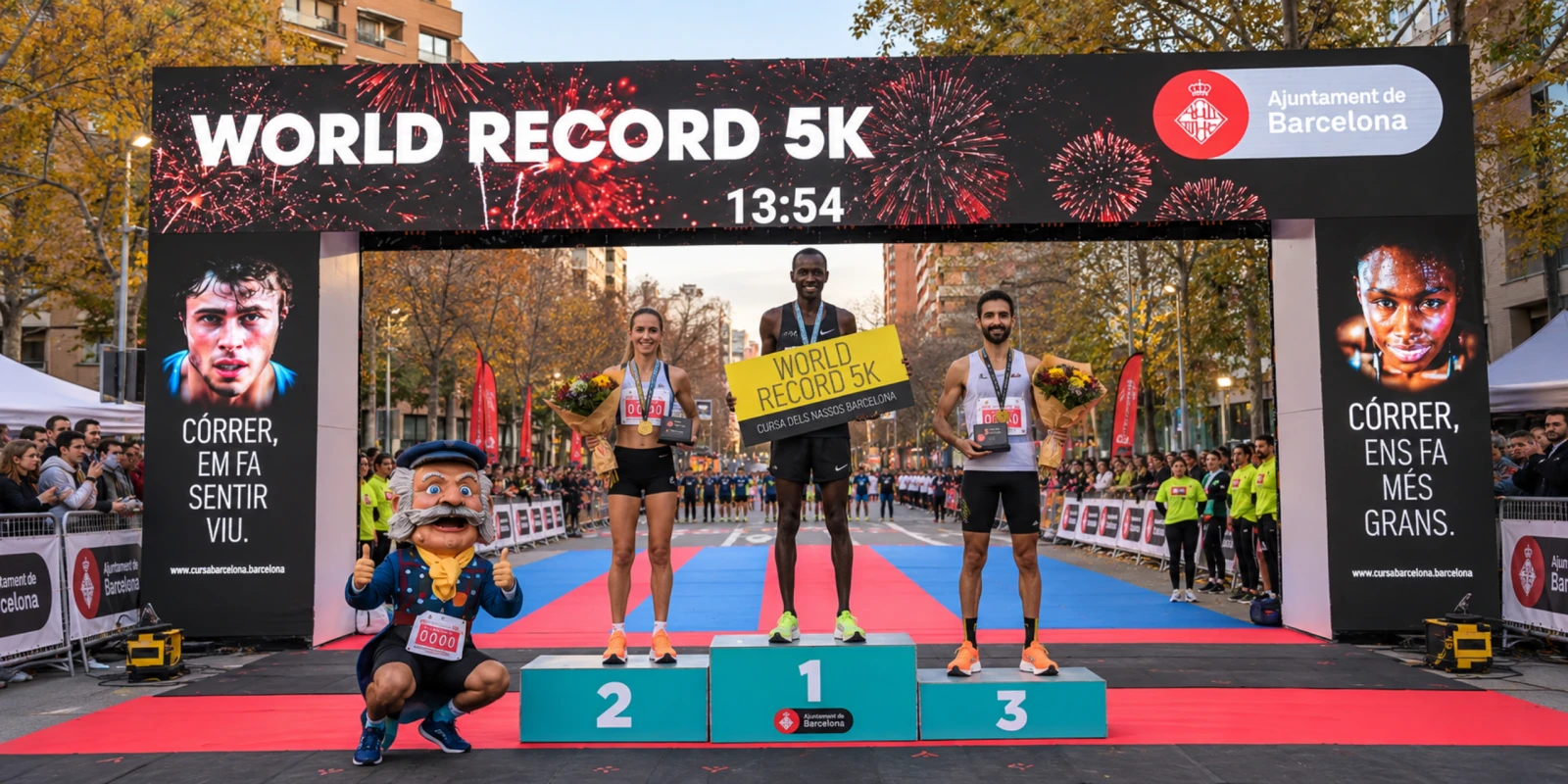

Barcelona’s New Year’s Eve race is called the Cursa dels Nassos, the race of the noses, and it is the city’s San Silvestre: a flat 10 km through the Poblenou and along the seafront on the afternoon of 31 December, starting at 17:15 from Carrer de Selva de Mar and closing at 19:10, early enough to shower before dinner. For a visitor the entry itself is easy, €18.50 online and open to any nationality, and the three things that go wrong are the same every year: the race sells out weeks ahead, the bib can only be collected on 28, 29 and 30 December at a school near the start, and the timing chip is compulsory, which for anyone without a Spanish chip means renting one for €2. This guide covers the form, the chip, the collection slots, the course and the limit of 1 hour 30 minutes, which is 9 minutes per kilometre.
How do I enter Barcelona’s New Year’s Eve run and what does it cost? Online at cursadenassos.barcelona, €18.50 with the booking fee, plus €2 to rent a timing chip and €5 for the optional medal; 14,000 expandable places that sell out every year. The 10 km starts on 31 December 2026 at 17:15 on Carrer de Selva de Mar, 1 h 30 min limit, bib collection only on 28 to 30 December.
Entering from abroad, the chip and what the form asks
The entry form on xipgroc.cat has one price, €18.50 with the booking fee, and a set of choices that decide the final bill. The chip is the one a foreign runner has to think about: Spanish club runners own a yellow chip and enter its number, while everyone else picks either the new virtual chip on a phone for €1 or the white single-use rental for €2, which comes with the bib and is handed back at the finish. The finisher medal is €5 and sells out, the race sunglasses €10, and there is a box for a donation to the A. Bosch Foundation for children’s cancer research at Vall d’Hebron hospital. You choose a T-shirt size, which cannot be changed and disappears from the form once that size is gone, and a bib collection slot, which matters more than it looks. The usual visitor’s total, entry plus rental chip plus medal, is €25.50.
The form in five steps, for anyone entering from outside Spain:
- Open the entry at cursadenassos.barcelona, which links to the xipgroc.cat form, and pick the 10 km.
- Fill in an ID document number; the country list on the form covers any nationality.
- Choose the chip: rental at €2 unless you own a Spanish yellow chip.
- Pick a T-shirt size and a bib collection slot on 28, 29 or 30 December that matches your arrival.
- Add the medal if you want one, pay by card and keep the confirmation e-mail: it is what you show at Escola Grèvol. Nothing is refundable for reasons outside the organisers’ control, and the rules exclude Spanish athletes on federation grants and foreign athletes with results worth 950 or more World Athletics points in the last two years, who are steered to the invitation-only 5 km. For a comparison of what the city costs around the race, see the daily budget guide.
| Item | Price | Terms |
|---|---|---|
| Basic entry with booking fee | €18.50 | bib, T-shirt and goody bag |
| Own yellow chip | €0 | enter its number on the form |
| Virtual chip | €1 | new in 2026 |
| Rental chip, white | €2 | returned at the finish |
| Finisher medal | €5 | optional, while stocks last |
| Race sunglasses | €10 | optional, while stocks last |
| Donation to the A. Bosch Foundation | any | children’s cancer research, Vall d’Hebron |
| Refund | none | for reasons beyond the organisers’ control |
Bib collection on 28, 29 and 30 December, and why the slot matters
Bib, chip and T-shirt are collected at Escola Grèvol, a school at Carrer de Provençals 9 about five minutes’ walk from the start, on 28 December from 15:00 to 19:00 and on 29 and 30 December from 10:00 to 15:00 and 15:00 to 19:00. The slot is chosen on the entry form and checked at the door, so a runner landing on the 30th picks a 30th slot and does not gamble. Someone else can collect for you with the confirmation e-mail and your ID, in the same slot. The rules are blunt: failing to collect on the set days counts as withdrawing, with no refund of money or kit, and there is no collection on the 31st. On race day a free bag drop operates next to the Selva de Mar metro station, ticked in advance on the form, with bags in a closed holdall; chemical toilets are at the start and at km 6, and the official refreshment is at the finish. Tap water in Barcelona is safe to drink, so the bottle you carry fills anywhere. The neighbourhoods guide shows how close Poblenou and the Vila Olímpica are to the start, which is the sensible place to sleep that week.
Who can run, the four waves and the 9-minute-per-kilometre limit
Minimum age is 16 on race day, with a signed parental consent at registration for 16 and 17-year-olds. The start is split into colour-coded corrals by your best 10 km time in the last 24 months from a chip-timed race; without one you can show a result from any official race at bib collection, downhill courses excluded, and otherwise you start at the back. The wheelchair category leaves at 17:14 and the four mass waves at 17:15, 17:21, 17:28 and 17:35, timed individually, so the wave you start in does not cost you time. The limit is 1 hour 30 minutes from the last wave, with the course closed at 19:10, which works out at 9 minutes per kilometre or 14:29 per mile: a brisk walk with running spells finishes, a stroll does not. There are age-group classifications with no physical trophies, and a protest costs a €60 deposit within 30 minutes of finishing. Before the race, the seafront running routes cover the same flat ground.
The course, the records and the elite 5 km beforehand
The 10 km starts and finishes on Carrer de Selva de Mar at Plaça de Ramon Calsina, drops to the sea along Passeig de Garcia Faria and Passeig Calvell, turns at the Llacuna roundabout and follows Salvador Espriu, Plaça dels Voluntaris and Doctor Aiguader to Plaça de Pau Vila, Pla de Palau and Avinguda del Marquès de l’Argentera, where a 180º turn on Passeig de Picasso sends the field back the way it came. It is flat with few corners, which is why 2025 produced a race record of 27:59 by Abdessamad Oukhelfen, beating Carles Castillejo’s 28:29 from 2009, a Catalan record of 31:33 by Marta Galimany, and 23 men under 30 minutes. An hour earlier, at 16:20, an invitation-only international 5 km starts outside the CEM Nova Icària sports centre on Avinguda d’Icària and finishes at the same Selva de Mar line; it requires times under 14:00 for men and 16:30 for women, and since 2021 it has produced four world records, including Berihu Aregawi’s 12:49. Spectators get the elite finish and then the mass start within an hour, on the edge of Poblenou, whose nightlife is where many runners end the year.
After the finish, the metro, dinner and the New Year
Metro line 4 at Selva de Mar is beside the finish, a single ticket is €2.90 and the ten-journey T-casual €13, and on 31 December the network runs until 2:00, the eve-of-holiday timetable, so the race and a late dinner both fit without a taxi. Dinner in Barcelona is served from about 20:30 and on New Year’s Eve most restaurants sell a fixed menu that must be booked ahead; the Christmas opening hours guide covers what is open on the 31st and closed on 1 January, and the Christmas guide the traditions of the night, twelve grapes included. For the shower, municipal pools publish their own 31 December hours.
Frequently asked questions about Barcelona’s New Year’s Eve run
What is the Cursa dels Nassos and when is it?
Barcelona’s New Year’s Eve road race, the local equivalent of a San Silvestre: a 10 km through the Poblenou and the seafront on 31 December, organised by Barcelona City Council with La Sansi. In 2026 the wheelchair start is at 17:14 and the mass waves at 17:15, 17:21, 17:28 and 17:35 from Carrer de Selva de Mar, at Plaça de Ramon Calsina, with the course closing at 19:10. The name means race of the noses, after the Catalan New Year’s Eve character with as many noses as days left in the year.
How much does it cost and what do I need to enter from abroad?
€18.50 including the booking fee, which covers bib, T-shirt and goody bag. Timing chips are compulsory: if you have no Spanish yellow chip, rent a single-use one for €2 and return it at the finish, or take the virtual chip for €1. The finisher medal is optional at €5 and race sunglasses at €10, both while stocks last. Entry is online at xipgroc.cat via cursadenassos.barcelona, any nationality, minimum age 16 with parental consent for 16 and 17-year-olds. No refunds.
When do I collect my bib, and can I do it on race day?
Never on race day. Bib, chip and T-shirt are collected at Escola Grèvol, Carrer de Provençals 9, five minutes’ walk from the start, on 28 December from 15:00 to 19:00 and on 29 and 30 December from 10:00 to 15:00 and 15:00 to 19:00, in the time slot you pick when entering; you must show that slot at the door. Someone else can collect it with your confirmation and ID. Not collecting it means you forfeit the race and the fee.
Will the race sell out, and how fast is it?
Yes, every edition since 2019 has sold out before the day; in 2025 more than 13,000 bibs went twelve days early. The rules set 14,000 entries, expandable, and the organisers have announced more than 15,000 for 2026, with no closing date other than the sell-out. The course is flat and was the scene of a race record of 27:59 by Abdessamad Oukhelfen and a Catalan record of 31:33 by Marta Galimany in 2025; 23 men broke 30 minutes.
How do I get to the start and what about my bag?
Metro line 4 to Selva de Mar, which is beside the start and the finish; a single ticket costs €2.90 and the T-casual multi-ride card €13. A free bag drop sits next to that station and must be ticked on the entry form; bags go in a closed holdall. Chemical toilets are at the start and at km 6, water is at the finish. On 31 December the metro runs until 2:00, as on the eve of any public holiday, so the race and the dinner afterwards both work without a taxi.
Enter before it sells out, rent the €2 chip, book a 30 December slot: the last 10 km of the year costs €25.50.