
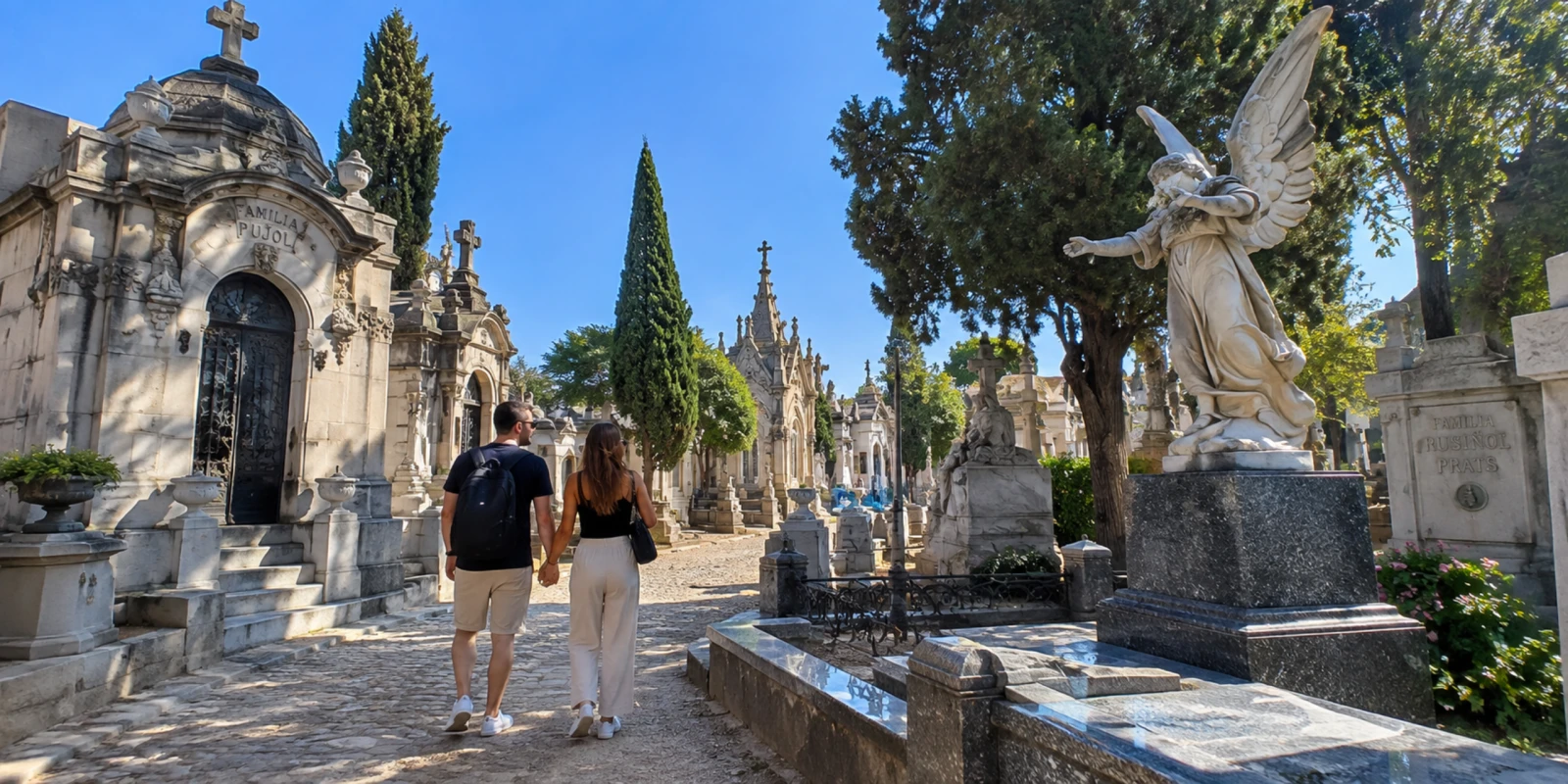

Montjuïc Cemetery is the one museum on Montjuïc that never charges: it opens every day from 8:00 to 18:00, its terraces hold the Modernista pantheons that Barcelona’s industrial families commissioned between 1883 and 1936, and the views drop straight to the port. The catch for an English-speaking visitor is that the city’s guided tours, run by the municipal company Cementiris de Barcelona, are in Catalan and Spanish only, on a fixed rota of Sundays at 10:30, so the practical question is not which tour to book but how to see the place well on your own. This guide gives the hours, the gates, the bus that actually stops there, the free collection of thirteen historic hearses that most visitors miss, and the flat, walled alternative in the Poblenou, the 1819 original by the sea.
Is Montjuïc Cemetery in Barcelona free, and how do you get there? Yes: it opens daily from 8:00 to 18:00 with no ticket, and the Hearse Collection is free on Saturdays and Sundays from 10:00 to 14:00. Bus 21 from Paral·lel stops at the gate on Mare de Déu de Port. Guided tours cost €10, run on Sundays at 10:30 and are in Catalan or Spanish only.
How to visit on your own, since the tours are not in English
The hours are the whole plan. Nothing in Barcelona opens as long as the cemetery, 8:00 to 18:00 every day including holidays, so the visit fits before a museum or after a beach, and it costs nothing. Enter by the main gate on Mare de Déu de Port; the Sant Lluís gate is a second entrance that closes at 17:30, half an hour before the rest, which matters if you plan to leave that way. It is a working cemetery, quiet and safe by day, and the site is built in terraces up the hillside, with the pantheons of the 1883–1936 period, the years the official tour is built around, lining the main avenues and the niches stacked in the walls, so the rule of thumb is to climb early while you have legs and drift down towards the sea. There is nowhere to eat or buy water inside, and in Barcelona lunch is served from about 14:00, so a morning visit that ends at the hearses at 12:00 lands you back in the Poble-sec or the Paral·lel at the right hour. The one indoor stop is the Hearse Collection, open only on weekends, and it is the reason to come on a Saturday or Sunday rather than a weekday. If you want the city’s other free days, the free museums calendar and the free Barcelona guide cover what the cemetery does not.
| What | When | Cost |
|---|---|---|
| Montjuïc and Poblenou cemeteries, entry | daily 8:00–18:00; Sant Lluís gate at Montjuïc until 17:30 | free |
| Hearse Collection, Montjuïc | Saturday and Sunday 10:00–14:00, no booking | free |
| Guided visit to the hearses | Saturday 12:00 in Catalan, Sunday 12:00 in Spanish, 1 hour | free |
| Montjuïc daytime tour | 2nd and 4th Sunday, 10:30, 2 h 30 min, Catalan or Spanish | €10 |
| Poblenou daytime tour | 1st and 3rd Sunday, 10:30, 2 h, Catalan or Spanish | €10 |
| Religions route, Montjuïc | 3rd Saturday, Catalan | €5 |
| Children under 6 on any tour | email comunicacio@cbsa.cat | free |
The Hearse Collection, the part of Montjuïc nobody expects
Thirteen original hearses, horse-drawn and motorised, that carried Barcelona’s dead for 90 years make up the Col·lecció de Carrosses Fúnebres. Cementiris de Barcelona first showed them in 1970 in the basement of its headquarters at Joan d’Àustria 130 and later moved them up to Montjuïc, where they now sit inside the cemetery at Mare de Déu de Port 56-58. It opens on Saturdays and Sundays from 10:00 to 14:00 with no booking and no charge, and a free one-hour guided visit starts at 12:00, in Catalan on Saturday and Spanish on Sunday; the pieces speak for themselves even without the language, and the company’s own description stresses five of the thirteen for their artistic value. It is the only part of the visit with a roof and a fixed explanation, and the only Barcelona museum of its kind. Pair it with the Fundació Joan Miró or the castle on the other side of the hill and Montjuïc becomes a full day with one paid ticket at most.
Which Sunday the guided tours run, if you read Spanish
If your Spanish is good enough for two hours of stories, the rota is fixed and worth knowing: the Poblenou tour takes the odd Sundays of the month, the first and third, and Montjuïc the even ones, the second and fourth, always at 10:30 and always €10, with the language of each session, Catalan or Spanish, stated on the booking page. The Montjuïc tour covers 1883 to 1936, the decades in which the city’s new bourgeoisie built the pantheons, and lasts two and a half hours on a slope; the Poblenou tour reconstructs two centuries of Barcelona through the people buried there and takes two hours on the flat. The Religions route, €5 on the third Saturday, walks through the sections of different faiths at Montjuïc. Tickets are booked on the company’s cultural agenda; children under 6 are free if you email first.
Getting there, and why bus 21 is the answer
Neither cemetery has a metro station at the gate, which is the main reason visitors give up on Montjuïc. Bus 21 solves it: it runs every day between Paral·lel and El Prat de Llobregat and stops on Mare de Déu de Port at the cemetery, on the seaward slope of the hill, well away from the cable cars and the castle side that the Montjuïc guide covers. The bus takes any integrated ticket: a single ticket is €2.90 and the ten-ride T-casual multi-ride card, €13, covers it and every other metro and bus ride in the city, so there is no separate fare to work out. By car, take exit 13 of the Ronda Litoral. Poblenou Cemetery is the easy one: on Avinguda d’Icària in the Vila Olímpica, on daily bus lines 14, 26, 36 and 41 and a short walk from the Poblenou beaches, and it is flat, walled and small enough for an hour. Opened in 1819 to a design by the Italian architect Antoni Ginesi, it was the first cemetery outside the city walls and holds more than 34,000 graves on 52,700 square metres; Montjuïc, opened in 1883 under mayor Rius i Taulet as part of his programme to enlarge the city, is the one with the views.
When to go, between Viu Montjuïc in October and All Saints
On 3 and 4 October 2026 Cementiris de Barcelona joins the sixth Viu Montjuïc weekend with its own programme, and it is the closest thing to an English-friendly visit because most of it is visual: on Saturday, a funerary botany walk at 9:00 and 11:30 that reads the trees and the plant symbolism carved on the monuments, and the hearse visit at 12:00; on Sunday, a route to the Fossar de la Pedrera, the memorial to the victims of the Franco repression with the Holocaust memorial linked to Francesc Boix, the Barcelona photographer who survived Mauthausen, a sketching workshop from 10:30 to 13:30 and, at 18:30, a Catalan-language play adapted from Max Porter’s Grief Is the Thing with Feathers. The other date to know is All Saints’ Day, 1 November, a Sunday in 2026: it is the busiest day of the year at every cemetery, special hours and extra buses are announced in October, and it is the worst day for sightseeing and the best for understanding what these places are for. The Castanyada falls the same week, and Halloween the days before.
Frequently asked questions about Montjuïc and Poblenou cemeteries
Is Montjuïc Cemetery free to visit and what are the opening hours?
Yes. Both Montjuïc and Poblenou cemeteries open every day of the year from 8:00 to 18:00, weekends and holidays included, with no ticket. At Montjuïc the Sant Lluís gate closes earlier, at 17:30. The information offices keep their own hours: Montjuïc Monday to Friday 8:30–17:30 and Saturday 8:00–14:30; Poblenou Monday to Friday 8:30–14:30 and 15:30–17:30. The phone number for both is +34 934 841 999.
Are there guided tours of Montjuïc Cemetery in English?
No. Cementiris de Barcelona runs its daytime tours in Catalan or Spanish only, on Sundays at 10:30: the first and third Sunday of the month at Poblenou and the second and fourth at Montjuïc, €10, about two and a half hours at Montjuïc and two at Poblenou. The Religions route at Montjuïc runs on the third Saturday for €5. Children under 6 join free if you email comunicacio@cbsa.cat. English speakers visit on their own, which the 8:00–18:00 hours make easy.
What is the Hearse Collection at Montjuïc Cemetery?
Thirteen original horse-drawn and motor hearses that served Barcelona for 90 years, first shown in 1970 in the basement of the cemetery company’s headquarters at Joan d’Àustria 130 and now displayed at Montjuïc Cemetery, Mare de Déu de Port 56-58. It opens on Saturdays and Sundays from 10:00 to 14:00 with no booking and no charge, and there is a free one-hour guided visit at 12:00, in Catalan on Saturday and Spanish on Sunday.
How do I get to Montjuïc Cemetery by public transport?
Take bus 21, which runs daily between Paral·lel and El Prat de Llobregat and stops at Mare de Déu de Port; there is no metro station at the cemetery. By car, leave the Ronda Litoral at exit 13. Poblenou Cemetery is on Avinguda d’Icària in the Vila Olímpica, served by daily bus lines 14, 26, 36 and 41 and a short walk from the Ciutadella-Vila Olímpica metro area.
Which is better to visit, Montjuïc or Poblenou Cemetery?
Montjuïc for the architecture and the views: it opened in 1883, climbs the seaward slope in terraces and holds the Modernista pantheons and the Hearse Collection, but it is huge and steep. Poblenou for an easy hour: it opened in 1819 as the first cemetery outside the city walls, designed by Antoni Ginesi, flat and walled, with over 34,000 graves on 52,700 m², next to the beach. Both are free.
Go on a weekend morning, take bus 21, and let the hearses be the museum: the rest of Montjuïc Cemetery explains itself.