
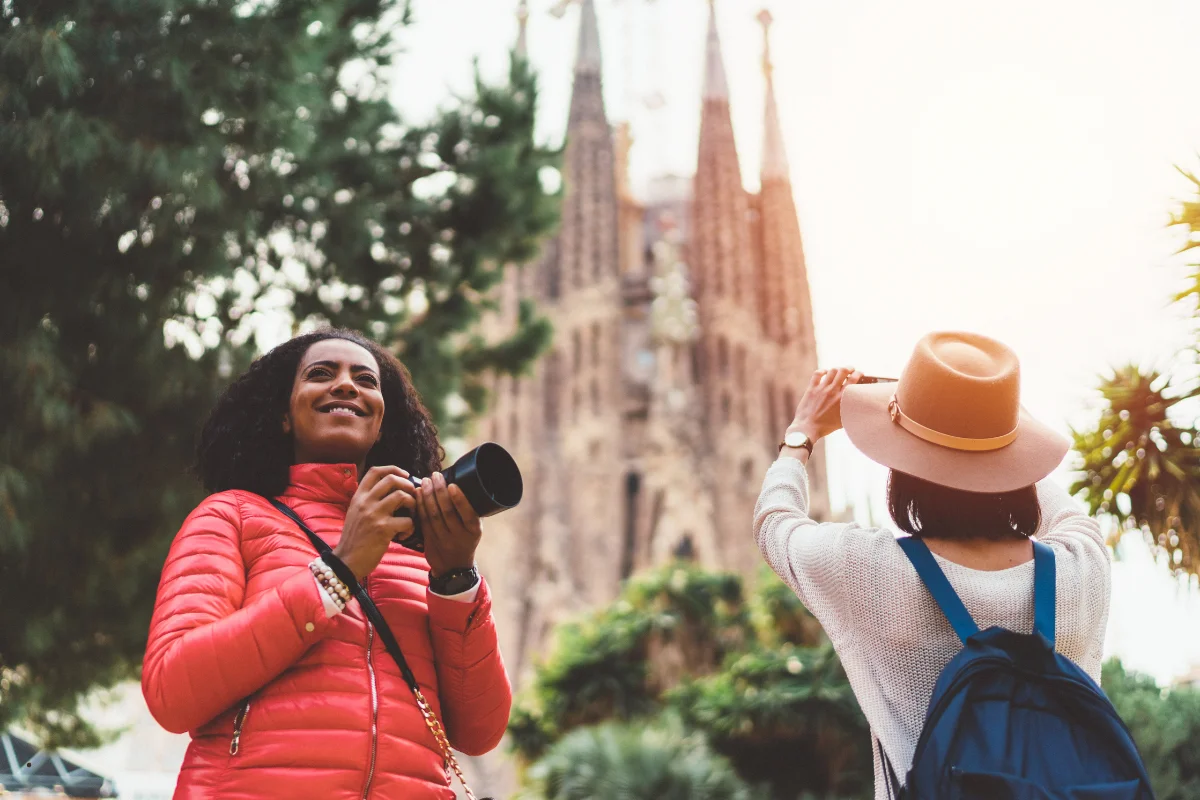

Barcelona has a photography problem — not a lack of locations, but a surplus of wrong information about them. The same twelve spots circulate in the same order with the same golden-hour tip, and what goes unsaid is that the Bunkers del Carmel close at 19:30 (before the actual sunset in summer), that the Encants mirror roof only works between 10:00 and 14:00, or that the Pont del Bisbe isn’t medieval — it was built in 1928 for an exhibition. Twelve locations, two geographic blocks, organized so you don’t cross the city twice, with the technical constraints that make or break the shot.
The fastest version: Sagrada Família and Encants in the morning, Gothic Quarter and Passeig de Gràcia mid-morning, Parc Güell before noon, Laberint d’Horta after lunch, Mossèn Costa i Llobera in mid-afternoon, Bunkers del Carmel to close at golden hour — arrive 45 minutes before sunset, not at it.
Quick Decision — what you’re actually looking for:
- Skyline panorama → Bunkers del Carmel (360°, no obstacles, tripod allowed)
- Architecture detail → Sagrada Família east façade or Casa Batlló morning
- Crowd-free garden → Laberint d’Horta (750-person capacity limit, enforced)
- Unique structure shot → Encants mirror roof (10:00–14:00 only)
- Street texture → Gothic Quarter before 8:30
- Coastal + architecture → Barceloneta at dawn, L’Estel Ferit sculpture
- Drone footage → Laberint d’Horta only (with prior AESA accreditation)
- Night photography → Torre Glòries post-sunset, blue hour
Block 1 — Centre and architecture (morning)
Sagrada Família: detail over façade
The standard shot — full façade from the pavement opposite — is also the most competed-over frame in Barcelona. The real photographic value is elsewhere.
From Avinguda de Gaudí, the Recinto Modernista de Sant Pau creates a two-kilometre modernisme axis that frames the Nativity Tower at the end of the street. From the northeast corner, the Evangelists’ towers stack against the 172.5-metre Torre de Jesucristo in a vertical compression that’s physically impossible to achieve from the south side. Inside, the east-facing stained glass produces cold morning light; the west-facing glass produces warm afternoon light — two completely different palettes in the same building on the same day.
Technical constraints: no tripods or flash inside. ISO 1600 minimum for the nave. No selfie sticks. The Silent Hour (9:00–10:00) restricts group movement — the best window for interior photography without interference.
Cost: exterior free. Interior from €26 with tower access.
📍 Metro L2/L5, Sagrada Família.
Arc de Triomf and Passeig de Lluís Companys: converging lines
The Arc de Triomf was built as the entrance gate for the 1888 Universal Exhibition — not a war monument. The neo-Mudéjar brick construction reads very differently in low lateral light (early morning or late afternoon) when the red-earth tones saturate without losing surface texture.
The Passeig de Lluís Companys, connecting the arch to Parc de la Ciutadella, has moderniste lampposts and enough pedestrian width to build long vanishing-point compositions. Low angle with wide-angle lens to emphasize the arch’s height against the sky. At the far end of the promenade, the Monumental Cascade in the park allows slow shutter speeds for silk-water effects.
📍 Metro L1, Arc de Triomf.
Mercat dels Encants: the mirror roof
The Encants — Barcelona’s oldest flea market, documented since 1300 — has a canopy of angled stainless-steel panels at 25 metres that reflects the market from above. The effect only works between 10:00 and 14:00, when the sun angle activates the reflection in the panels. Before and after that window, the roof returns a dark, flat reflection with no visual interest.
The defining shot: stand in the centre under the structure, wide-angle pointing up, the market reflected overhead and sky visible at the edges. It’s one of the few locations in Barcelona where overhead photography works without a drone.
Market days: Monday, Wednesday, Friday, Saturday. Closed Tuesday, Thursday, Sunday.
📍 Metro L1, Glòries. For a broader Barcelona flea market and secondhand guide, the Encants is the logical starting point.
Block 2 — Gothic Quarter and Eixample (mid-morning)
Pont del Bisbe and Plaça de Sant Felip Neri
The Pont del Bisbe connects the Palau de la Generalitat to the Casa dels Canonges. It looks medieval; it was built in 1928 — a 20th-century neo-Gothic interpretation integrated into a fabric that genuinely dates to the 14th century. For a clean shot without people, arrive before 8:30 when lateral light picks up the relief in the stonework.
Plaça de Sant Felip Neri is three minutes on foot. It’s the least signposted square in the Gothic Quarter and the most photographically interesting — specifically because of what’s on the church wall: shrapnel marks from 30 January 1938, when a bomb killed more than 40 people during the school day. The scars are still in the stone. That kind of detail turns a travel photograph into a document. The Gothic Quarter has more of these layers off the main tourist streets.
Technique: spot metering on the mid-tones of the stone to manage the contrast between shadow and open sky.
Passeig de Gràcia and Casa Batlló: what nobody frames
The Casa Batlló façade behaves completely differently depending on time of day. In the morning, the trencadís blues and greens mirror the sky. At midday, flat light kills the texture. At dusk, the light mapping system transforms the building into a projection surface.
What most people don’t photograph: the rear façade and the interior courtyard, which recovered their original anthracite black after restoration — replacing the cream stucco that had covered the intervention for decades. The contrast between the dark courtyard and the tiles that graduate darker toward the top creates a chromatic composition that doesn’t exist in any pre-2024 image archive of the building.
The pavement opposite is the standard position for the full façade. Early morning, foot and vehicle traffic is minimal.
📍 Metro L2/L3/L4, Passeig de Gràcia. For a focused visit, the Casa Batlló visit guide covers the interior photography conditions in detail.
Block 3 — Green and elevated (afternoon)
Parc Güell: the first time slot
The monumental zone — the Plaça de la Natura with the serpentine trencadís benches, the staircase with the salamander, the Pòrtic de la Bugadera — requires timed-entry tickets from 8:00. The first slot is the only one where photography without crowds is realistic. After 10:00, the flow becomes unmanageable for clean compositions.
The salamander has been subject to conservation work recently — verify its condition if that’s the primary reason for the visit. The skyline view from the Plaça de la Natura frames the Sagrada Família between the entrance pavilions: one of the few points in the city where the basilica appears contextualised within the complete urban fabric.
Cost: €18, or €13.50 reduced. Book at least one month in advance in high season.
📍 Bus 24 or 92 from Passeig de Gràcia.
Laberint d’Horta: the oldest garden and the least photographed
The Laberint d’Horta has a maximum capacity of 750 simultaneous visitors — the quietest location on this route by policy, not by obscurity. The cypress maze generates straight-line shadows that create geometric patterns in the morning, when the sun is low and shadows are long.
It’s the only green space in the city where aerial drone photography is permitted — with prior accreditation and payment of rights. For editorial or commercial productions, the permit must be requested from the Ajuntament in advance; in 2026 the process is online. Without accreditation, drones are prohibited as in the rest of the urban core.
The neoclassical pavilions with Tuscan columns work well as framing for editorial portraiture. The 19th-century Romantic zone — with the artificial cascade and the Venetian canal — provides water compositions without going to the coast.
Cost: €2.23. Free on Wednesdays and Sundays.
📍 Metro L3, Mundet. For the full neighbourhood context, the Horta-Guinardó guide covers how to combine the garden with the rest of the district.
Jardins de Mossèn Costa i Llobera: Barcelona’s desert garden
On the south face of Montjuïc, oriented toward the sea, the Jardins de Mossèn Costa i Llobera hold one of the largest outdoor cactus and succulent collections in Europe — over 800 species in a microclimate that doesn’t exist anywhere else in the city. The visual result is completely unlike the rest of Barcelona: arid, geometric, with a look that recalls the North African coast with the Mediterranean behind it.
Midday light — which flattens every other green space — works here. Columnar cacti cast short shadows that reinforce vertical geometry. Backlit photography with the low sun over the sea behind is the most sought-after composition.
Access: free. Bus 193 from metro Paral·lel.
Block 4 — Viewpoints and coast (late afternoon to night)
Bunkers del Carmel: the 360° viewpoint with a history
At 262 metres, the Bunkers del Carmel offer the widest unobstructed view in Barcelona. The frame includes the complete Eixample grid, the Sagrada Família, Montjuïc, the port, and the Mediterranean in a single composition. With a telephoto lens (100–400mm), it’s possible to compress the planes until the basilica, the Hotel W, and the Vila Olímpica towers align in one shot.
The detail underfoot: the concrete platforms where visitors stand are the original foundations of a 1937 anti-aircraft battery with four 105mm guns. The graffiti on deteriorated concrete in the foreground against the lit city behind is a narrative contrast that no other viewpoint in Barcelona offers — and it’s what separates a postcard from a photograph.
Closing time: 19:30. Arrive 45 minutes before sunset to secure position and shooting time. Tripod permitted — one of the few elevated locations in the city without restrictions. The blue hour, 15–20 minutes after sunset, is technically the most demanding and visually the most interesting window: the Sagrada Família illuminates while the sky retains a colour gradient.
📍 Bus V17 or 119 from El Coll / La Teixonera (L5). For a map of secret viewpoints in Barcelona, the Bunkers are the reference point — but several lesser-known alternatives avoid the crowds entirely.
Barceloneta and L’Estel Ferit: dawn at the coast
Rebecca Horn’s L’Estel Ferit (1992) — the glass and steel cube structure on the Barceloneta beach front — reflects sky and sea differently from every angle of approach. No two shots are the same from different positions around it.
Dawn is the optimal technical window: the sun rises directly from the sea, silhouettes the beach structures, and creates reflections on wet sand. A graduated neutral-density filter balances the sky against the shoreline detail. At this hour, Barceloneta is empty — it’s the neighbourhood in this route that changes most dramatically between 6:00 and 10:00. Frank Gehry’s copper fish sculpture at 50 metres beside the Hotel Arts is 10 minutes on foot and works as an architectural counterpoint in the same session.
📍 Metro L4, Barceloneta. For the neighbourhood beyond the beach, the Barceloneta guide covers the residential and historic layers.
Torre Glòries: night photography
The Torre Glòries — Jean Nouvel’s design, known locally as Torre Agbar — has an exterior LED system that activates colour patterns after sunset. Night photography from Parc del Clot or from Avinguda Diagonal captures the building while the sky still holds a blue gradient — a 15–20-minute window after sunset.
The building has no public viewpoint. The photograph is always exterior. The cleanest perspective is from the north end of Avinguda Diagonal, where the urban axis creates a vanishing line toward the tower.
📍 Metro L1, Glòries.
Technical reference table
| Location | Best time | Key restriction | Access |
|---|---|---|---|
| Sagrada Família | 9:00–10:00 interior | No tripod or flash inside | L2/L5 Sagrada Família |
| Arc de Triomf | Morning or golden hour | None | L1 Arc de Triomf |
| Mercat dels Encants | 10:00–14:00 | Closed Tue/Thu/Sun | L1 Glòries |
| Pont del Bisbe | Before 8:30 | None | L4 Jaume I |
| Casa Batlló | Early morning | No tripod exterior | L2/L3 Passeig de Gràcia |
| Parc Güell | From 8:00 | Advance booking required | Bus 24/92 |
| Laberint d’Horta | Morning | Drone with prior permit only | L3 Mundet |
| Mossèn Costa i Llobera | Midday | None | Bus 193 |
| Bunkers del Carmel | Golden hour, closes 19:30 | Arrive 45 min before sunset | Bus V17/119 |
| Barceloneta / L’Estel Ferit | Dawn | None | L4 Barceloneta |
| Torre Glòries | Post-sunset blue hour | No interior access | L1 Glòries |
The Bunkers close at 19:30, which costs you the July sunset
The Bunkers lead every photography shortlist. The part that decides the shot is that the viewpoint closes at 19:30 — which in July means you lose the actual sunset by more than an hour. The practical consequence: during summer, the golden hour at the Bunkers doesn’t exist unless you redefine it as the 45 minutes before closing, which is still excellent light but requires calculating sunset time for the specific date and subtracting accordingly.
The second omission: the Encants mirror roof has become one of the most recognisable architectural photographs of Barcelona in the last five years, but the window in which it actually works — 10:00 to 14:00 — appears in none of the photography guides currently ranking in the top five results in English. Outside that window, the solar angle doesn’t reach the panels and the reflection is flat. The shot simply doesn’t exist in the afternoon.
The third: the Pont del Bisbe is consistently described as “medieval” in English-language content. It was designed by Joan Rubió i Bellver and completed in 1928. The actual medieval fabric around it is real — but the bridge itself is a 20th-century addition. That distinction matters for anyone photographing it as an architectural document rather than a travel postcard.
Mistakes to Avoid
- Arriving at Parc Güell without a timed ticket. The monumental zone has been access-controlled since 2013. Without a reservation, you get the perimeter paths — which are free and genuinely good — but not the Plaça de la Natura or the salamander staircase.
- Planning the Bunkers as a sunset spot without checking closing time. 19:30 is the hard close. In summer, sunset is around 21:30. Adjust expectations accordingly — or plan for the golden light in the hour before 19:30, which is still usable.
- Using the Sagrada Família’s south façade as the main subject. The Nativity façade (north) and the interior glass are photographically richer. The south (Passion) façade is architecturally interesting but geometrically harsher in most light conditions.
- Visiting Mossèn Costa i Llobera in the afternoon in winter. The garden faces south but the sun drops behind Montjuïc early; by 15:00 in December the light is gone. Midday is the only reliable window year-round.
- Scheduling the Encants on a Tuesday, Thursday, or Sunday. The market is closed. The structure is visible but the reflective surface, without the market activity below, has no subject.
- Underestimating travel time between blocks. This route crosses the city from the northeast (Laberint d’Horta) to the southwest (Mossèn Costa i Llobera) to the north (Bunkers). On foot, that’s not realistic. Plan for metro or bus between blocks 3 and 4.
How to run this route
Full day (realistic split):
Day 1 — Centre and Eixample: Sagrada Família (9:00) → Encants (10:00–14:00) → Arc de Triomf → Gothic Quarter → Passeig de Gràcia
Day 2 — Height and coast: Parc Güell (8:00 first slot) → Laberint d’Horta → Mossèn Costa i Llobera → Bunkers del Carmel (arrive by 18:45)
Optional extensions: Barceloneta at dawn on either day. Torre Glòries at blue hour the night before.
If you only have one day: prioritise Encants (morning, irreplaceable window), Laberint d’Horta (afternoon, least crowded), Bunkers del Carmel (closing). Everything else can be revisited — those three cannot if you miss the timing.
Barcelona doesn’t reward the photographer who arrives at the famous spot at the same time as everyone else. It rewards whoever calculated what the light actually does at that hour, on that façade, facing that direction. The difference between a generic Barcelona photograph and a useful one is almost always a matter of 45 minutes and one piece of information nobody published.
For a broader frame on what the city looks like away from the standard circuit, the hidden places guide covers locations that don’t appear on any photography route — which is, increasingly, the only criterion that matters.