
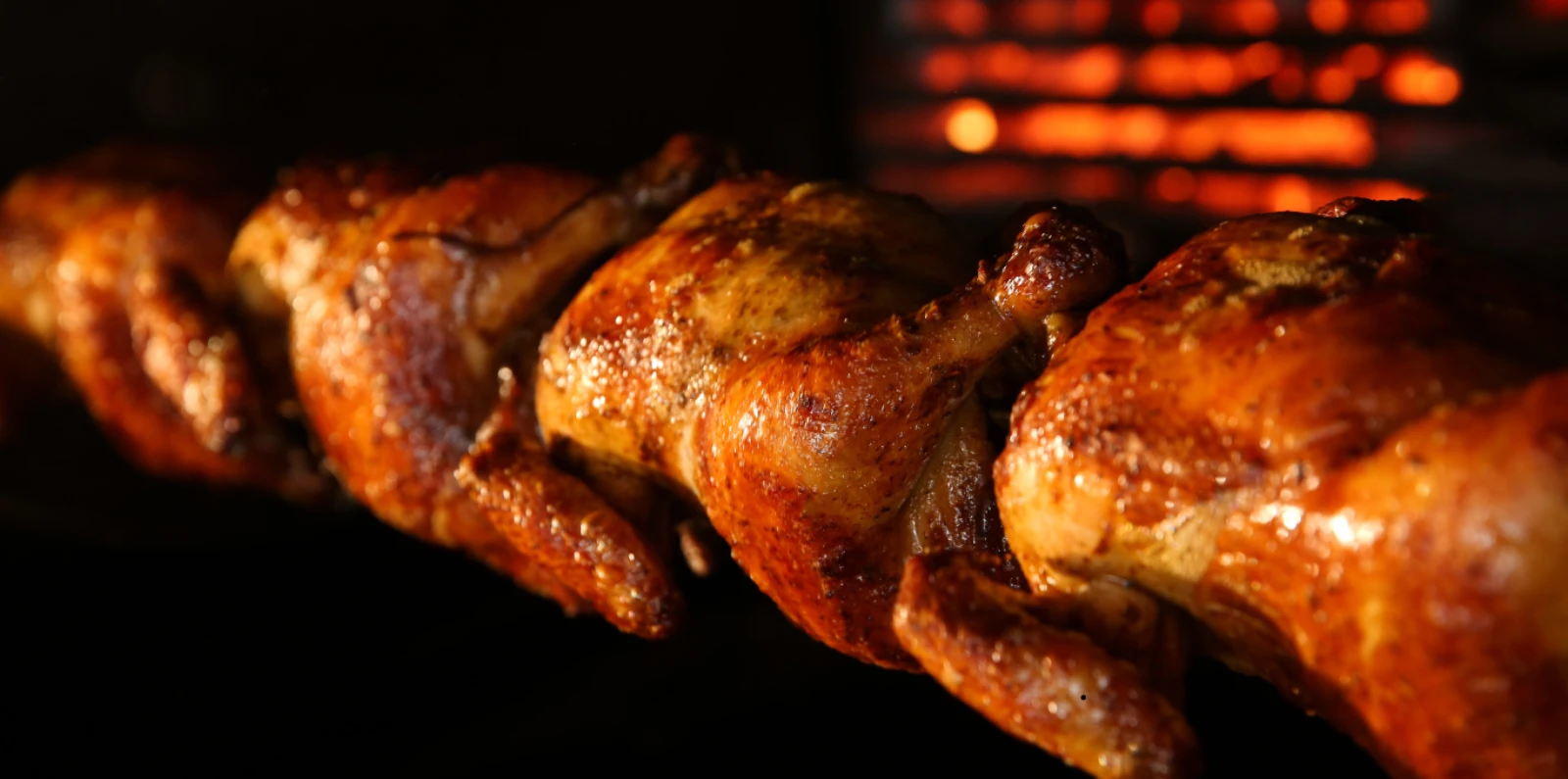

In Barcelona, a Sunday without pollo a l’ast is close to a gastronomic heresy. Whole families will cross half the city and stand in a long queue to secure the best bird for the table, in a ritual that smells of aluminium boxes, roast potatoes and allioli. The problem is that the rush to sell cheaper is wrecking the quality, so finding a good rotisserie is no longer luck but a matter of knowing what to look for.
Where do you eat the best pollo a l’ast in Barcelona? For the gourmet version, A Pluma, run by ex-El Bulli chef Eugeni de Diego, is the most cited. For traditional neighbourhood chicken, Els Pollos de Llull is the most popular, and among the classics Pollería Lisboa and La Brasa stand out, over a century old. A whole chicken costs €13 to €30, and you spot a good one by the slow 60-to-90-minute cooking on the spit.
Quick decision by what you want
- The gourmet version → A Pluma, Groc Català chicken and charcoal oven, lunch from €8.60
- The most popular neighbourhood classic → Els Pollos de Llull, cheap, from €6.80
- Over a century of history → La Brasa in Sant Antoni or Pollería Lisboa in Horta
- Real wood-fired chicken → Can Pollastre, oak wood in the Eixample
- To take home on Sunday → Beltran, running for decades, with cava potatoes
- Eat cheap with quality → the weekday lunch menu at the rotisseries, around €12
When an El Bulli chef roasts chickens
Start with the most unlikely story, because it is the one reshaping the dish. A Pluma is the rotisserie founded by Eugeni de Diego, who was a key member of Ferran Adrià’s team at El Bulli and director of the elBulli Lab, and who decided to apply that technique to the humble roast chicken. The result is Groc Català chicken roasted in a charcoal oven in full view of diners, a proposal Guía Repsol presented as the leap of pollo a l’ast into the gourmet category.
Its real merit goes beyond the quality: it got a rotisserie to work Monday to Sunday, bringing the Sunday festivity into daily life. According to experts in popular cooking, with an average spend under €20 and a weekday lunch of half a chicken with potatoes around €8.60, it has shown that gourmet need not mean expensive. It has three branches, in Santaló, the rambla del Poblenou and Gran de Gràcia, which makes it easy to reach from neighbourhoods like Gràcia. It is an essential stop for anyone after the reinvented classic.
| Rotisserie | Style | Area | Price |
|---|---|---|---|
| A Pluma | Gourmet, modern | Santaló, Gràcia, Poblenou | Under €20 |
| Els Pollos de Llull | Classic, popular | Sagrada Família, Poblenou | €6.80-10 |
| La Brasa | Historic, 100+ years | Sant Antoni | Mid |
| Can Pollastre | Wood-fired | Eixample | Mid |
| Pollería Lisboa | Neighbourhood classic | Horta | Low |
A Catalan ritual that arrived imitating kebabs
Before choosing where, it helps to know why this dish is almost sacred in Barcelona. Pollo a l’ast arrived in Catalonia in the 1960s and boomed in the 1980s, when it became common to see whole families queuing at the roasters to take the chicken home for Sunday lunch. The story has a twist: it was popularised by Joan Casas, who returned from Germany fascinated by how they roasted kebabs there and adapted the idea to the whole chicken.
Its role goes far beyond feeding people. The dish works as a social glue, the meal that brings the family together and sets the rhythm of the week, present at neighbourhood street parties, long lunches and weeknight dinners. It is one more piece of the recipe book the Catalan cuisine in Barcelona guide covers, but with an emotional weight no other dish carries, much like the traditions in the first-time visitor guide to Barcelona.
What separates a great chicken from an ordinary one
Here is the key that saves a disappointment, because not everything turning on a spit is good. An excellent pollo a l’ast is known by the thin, very crisp skin, the meat juicy even in the breast, and above all a slow cooking on a rotating spit of between 60 and 90 minutes. The seasoning should be balanced, with garlic, pepper, rosemary and thyme, without masking the flavour of the bird.
The technical detail almost no one knows comes from A Pluma’s own chef. A good chicken browns in its own juices, not with added pork fat, a common shortcut to cut costs. And there is a sign that dismantles a myth: if a rotisserie smells of chicken from two streets away, it is not a mark of quality but of excess fat. The best houses use yellow Catalan or organic chicken and make the potatoes with the fat the bird releases, not fried separately. This level of detail is the same that sets apart a good table in the best restaurants in Barcelona guide.
Els Pollos de Llull and the neighbourhood classics
Against the avant-garde, tradition keeps its throne, and its great ambassador is Els Pollos de Llull. Open since 1996 in a former salt warehouse on Carrer Llull, where the name comes from, it is probably the most popular rotisserie in the city, with the philosophy of democratising chicken. Its birds are marinated with spices, chopped apple and a splash of white wine and oil as they turn, and you can choose between a standard chicken, the 1.5 kg free-range one from a Lleida farm, or the 2.5 kg organic one. It has branches near the Sagrada Família and in Poblenou.
The real veterans, though, have been going for over a century. La Brasa, in Sant Antoni, passes 100 years of family history, and Pollería Lisboa, in Horta, is an institution serving around 300 chickens each weekend. To them add Can Pollastre, in the Eixample, with its oak-fired chicken and a touch of lemon, and Beltran, running for decades and famous for its cava potatoes. They are the kind of neighbourhood house that connects with a more local Barcelona, the same one you find in the things to see in Barcelona guide.
How to order it, what to pair and how much to pay
To avoid slipping up when buying, a few points help. A whole chicken costs between €13 and €30 by size and place, with half a chicken from around €8-13, and the neighbourhood classics drop to €6.80. The canonical side is the potatoes made with the chicken fat and the homemade allioli, though many houses offer croquettes, cannelloni or escalivada. It sits squarely in the affordable food the best time to visit Barcelona guide frames for planning a trip.
A couple of practical tips seal the deal. Sundays and peak lunch hours mean long queues, so order ahead or go mid-morning, especially at the most famous houses. Many rotisseries deliver through apps, useful if you would rather skip the queue, and it is worth costing it within the Barcelona travel budget guide, where a meal like this works out very well for a group.
Frequently asked questions about pollo a l’ast in Barcelona
How much does pollo a l’ast cost in Barcelona?
A whole chicken costs between €13 and €30 depending on size and place, and many rotisseries sell half a chicken from around €8-13. At neighbourhood classics like Els Pollos de Llull it drops to €6.80-10, while gourmet versions like A Pluma have an average spend under €20 and a weekday lunch of half a chicken with potatoes around €8.60.
What is the best pollo a l’ast in Barcelona?
It depends on the style. For the gourmet version, A Pluma, run by ex-El Bulli chef Eugeni de Diego, is the name most cited by Guía Repsol and Time Out. For traditional neighbourhood chicken, Els Pollos de Llull is the most popular, and among historic classics Pollería Lisboa in Horta and La Brasa in Sant Antoni stand out, with over a century of history.
How do you recognise a good pollo a l’ast?
By the thin, very crisp skin, meat juicy even in the breast, and slow cooking on a rotating spit of between 60 and 90 minutes. A good chicken browns in its own juices, not with added pork fat. According to experts, if a rotisserie smells from two streets away it is not a sign of quality but of excess fat in the bird.
Why do people eat pollo a l’ast on Sundays in Barcelona?
It is a Catalan tradition that arrived in the 1960s and boomed in the 1980s, when families began queuing at rotisseries to take the chicken home for Sunday lunch. It was popularised by Joan Casas, who returned from Germany fascinated by how they roasted there. Today it remains a ritual that brings the family together and sets the rhythm of the week.
In Barcelona, the best pollo a l’ast is not the one that smells most, but the one roasted slowly in its own juices.