
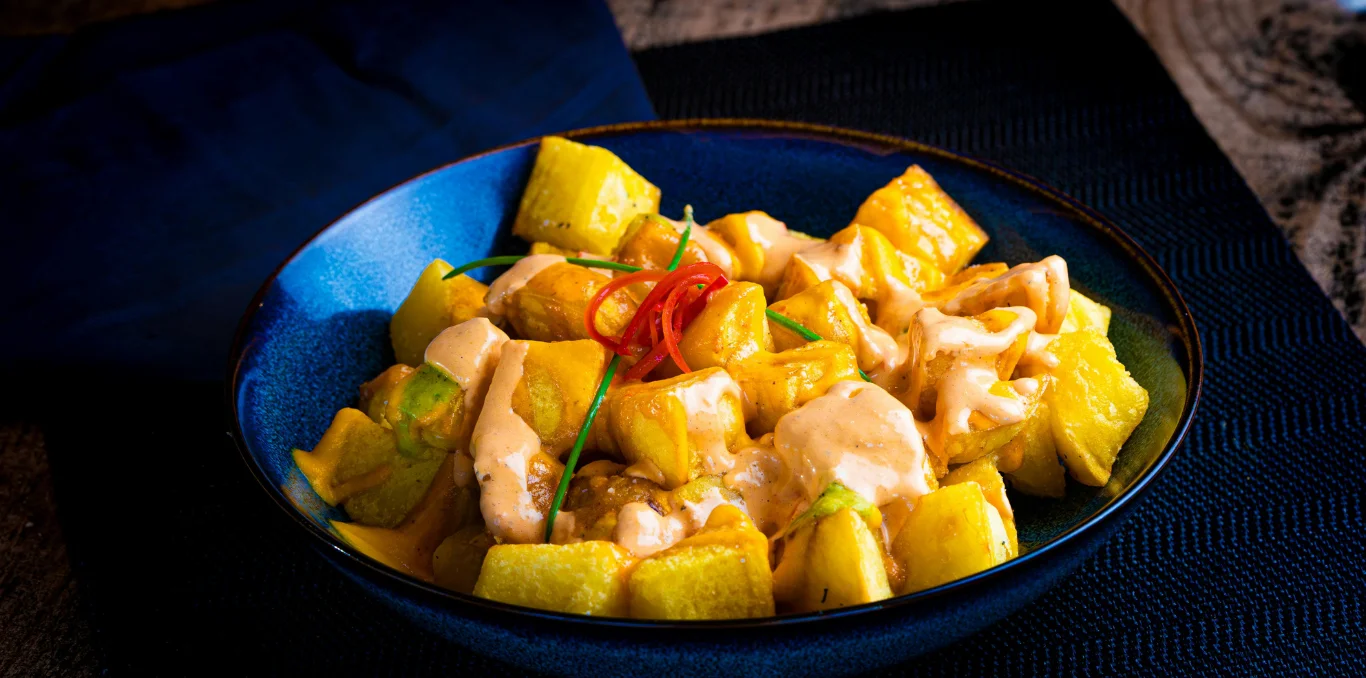

In Barcelona, patatas bravas are not the Madrid version, and that is the first thing worth knowing before you order. Here the dish comes with allioli, not just spicy tomato sauce, and each neighbourhood defends its favourite spot with near-tribal loyalty. The gap between a plate worth crossing town for and a forgettable one is wide, and it comes down to two things: the style you want and who actually nails it.
Where can you eat the best patatas bravas in Barcelona? Bar Tomás in Sarrià is the consensus cult classic, serving Catalan-style bravas (allioli plus a separate spicy oil) for around €4 since 1929. Senyor Vermut in the Eixample and La Esquinica in Nou Barris complete the traditional top tier, while the annual Bravas Fest crowns modern winners each October. Most plates rank among the city’s best at €3-5.
Quick decision by what you want
- First-timer who wants the legend → Bar Tomás (Sarrià) — Catalan style since 1929, plates around €4, closed Sundays
- Vermouth lover → Senyor Vermut (Provença 85) — sauce hotter than the city norm, fried pepper strips on top, arrive before 13:00
- Big appetite on a tight budget → La Esquinica (Nou Barris) — portions twice the usual size from about €4, no reservations, take a number
- Wants both styles side by side → Fàbrica Moritz (Sant Antoni) — Catalan and Madrid versions on the same menu, around €5
- Looking for author cooking → Bar Omar (Sant Gervasi) — saffron allioli over a prawn-head sofrito, around €7-10
- Tourist staying near the centre → Bar del Pla (El Born) — a mild, refined plate that suits every palate, around €6
- Wants the current award winner → Món Viêt (Sepúlveda 64) — most recent Bravas Fest jury winner, curry mayonnaise and peanut sauce
The Catalan brava and why it is not the Madrid one
Barcelona’s brava is not the Madrid brava, and this is the single most useful thing to know before you order. The Catalan version, which locals call the bravioli, pairs creamy allioli with a separate spicy oil or sofrito. The Madrid version uses mayonnaise and a spicy tomato sauce. Bravas arrived in Catalonia with 1970s migration from a 1960s Madrid original, and the city quietly rebuilt the recipe around allioli.
In Barcelona, the Catalan bravioli wins as the home standard, and according to local bravas guides anyone who defaults to the tomato-only version is missing the point of the city’s plate. The nuance worth keeping is that the Madrid style is not wrong, only different, and the best place to settle the argument for yourself is Fàbrica Moritz, which lists both versions as “ours” and “theirs” so you can taste them on the same table. For the wider context of how the dish sits inside the city’s tapas culture, the guide to the best tapas in Barcelona maps where bravas fit among the rest.
There is also a craft consensus on what a serious plate should look like. According to Barcelona food critics who rank the scene, four signals separate a memorable brava from a tourist plate.
- Double-frying — a low-temperature poach first, then a high-heat second fry, giving a soft interior and a rigid crust that keeps oil out
- Sauce on contact — hot sauce poured over hot potato, never a cold dressing on a cooling plate
- Salt at the end — added after frying so the crust stays crisp rather than going soggy
- A dry plate — no pool of oil at the bottom, which is the clearest sign the kitchen rushed the fry
A house sauce that pairs with vermouth rather than fighting it is the final test, and the vermouth bars of Barcelona overlap heavily with the best brava addresses.
The cult classics worth the queue
Four bars define the traditional brava in Barcelona, and three of them sit in the upper Sarrià–Sant Gervasi district. Bar Tomás (since 1929) and Bar Mandri (since 1966) are the eternal rivals, Marcel Santaló is the neighbourhood specialist that has taken the Bravas Fest public vote, and La Esquinica in Nou Barris draws constant queues for portions twice the usual size. All four sit in the €3-5 range.
Bar Tomás on Carrer Major de Sarrià 49 is the name every list reaches for first. The potatoes are cut by hand, fried in olive oil to an irregular gold, and finished with a generous allioli over a secret spicy oil. It uses Kennebek potatoes from Prades, opens Monday to Saturday only, and closes Sundays plus around eight days at Easter. The plates are small and cheap, and the bar makes a point of caring nothing for presentation. Honesty matters here, some reviewers argue it now lives on its reputation, so manage expectations and go for the recipe rather than the legend.
Bar Mandri, open since 1966, offers the cleaner alternative, a homogeneous cut, a creamier allioli and far less oil on the plate, which is why purists in the upper city often rate it above Tomás. Marcel Santaló keeps the spicy oil front and centre in a true neighbourhood bar. La Esquinica, an Aragonese institution on Passeig de Fabra i Puig since 1972, trades refinement for volume, with huge plates from about €4, no reservations and a take-a-number system. Three of these cluster in one district, so the Sarrià neighbourhood guide is the cleanest way to plan the route between them.
The modern and author versions
Beyond the classics, a wave of bars treats the brava as author cooking, with plates running €6-10. Bar Omar in Sant Gervasi builds a saffron allioli over a sofrito made with prawn heads, Elsa y Fred near the Arc de Triomf finishes a roasted-garlic allioli with black pepper, Bar del Pla in El Born serves a mild crowd-pleaser, and Rooster & Bubbles took a recent Bravas Fest jury prize for its modern recipe.
The split between these is mostly about how far the kitchen pushes the sauce. BORO Bar in the Eixample, rated 4.7 across thousands of reviews, leans into a deep smoky sauce that goes past the classic. La Porca in Poble-sec runs a rougher, more playful version with a chipotle edge. Bar del Pla is the one to send anyone who wants a refined plate without heat, which makes it the safest central pick for a mixed group, and the El Born guide places it alongside the rest of the neighbourhood’s tapas. These versions cost more than the classics, but they are where the dish is actually evolving rather than repeating.
How the top bravas bars compare
The traditional bars win on price and consistency, while the modern ones win on invention, and the table below makes the trade-off visible at a glance. Across all of them a plate ranges from €3 to €10, with the cheapest at the old-school addresses and the most expensive at the author kitchens.
| Bar | Neighbourhood | Style | Price (plate) | Best for |
|---|---|---|---|---|
| Bar Tomás | Sarrià | Catalan, allioli + spicy oil | €3-4 | The original recipe |
| Bar Mandri | Sarrià-Sant Gervasi | Catalan, creamy allioli | €4-6 | Purists who dislike oil |
| Marcel Santaló | Sarrià-Sant Gervasi | Catalan, spicy oil forward | €4-6 | Neighbourhood feel |
| La Esquinica | Nou Barris | Traditional, large portions | €3-4 | Volume on a budget |
| Senyor Vermut | Eixample | Catalan, very spicy | €3-5 | Vermouth and heat |
| Fàbrica Moritz | Sant Antoni | Both Catalan and Madrid | €5 | Comparing two styles |
| Bar del Pla | El Born | Mild, refined | €6 | Tourists and mixed groups |
| Bar Omar | Sant Gervasi | Author, saffron allioli | €7-10 | Creative cooking |
| Món Viêt | Eixample | Author, curry and peanut | €6-9 | Current award winner |
| Rooster & Bubbles | Eixample | Modern, jury-awarded | €6-9 | Trend-led recipes |
Who is this for
The right bar depends less on a ranking than on what you actually want from the plate, and the profiles below map directly onto the addresses above. Five reader types cover almost every visitor who searches for bravas in the city.
- Purists who want the original recipe → Bar Tomás or Bar Mandri, the two oldest names at €3-6
- Spice seekers → Senyor Vermut, where the house sauce runs hotter than the city norm
- Foodies chasing creativity → Bar Omar or Món Viêt, the author and award-winning kitchens
- Tourists who want mild and central → Bar del Pla in El Born, refined and easy on heat
- Groups wanting volume and low cost → La Esquinica, with the largest plates from about €4
Where to eat bravas by neighbourhood
The best bravas are spread across at least five districts, which makes a single route the efficient way to taste the range in one day. Sarrià holds three of the classics, the Eixample concentrates the vermouth and modern bars, El Born covers the central and refined plates, and Sant Antoni lets you finish on a two-style comparison.
- Sarrià — start at Bar Tomás or Bar Mandri for the original Catalan recipe, plates around €4
- Eixample — drop to Senyor Vermut on Provença 85 for a vermouth and the city’s hottest sauce
- El Born — stop at Bar del Pla on Montcada 2 for a refined plate that resets the palate
- Sant Antoni — close at Fàbrica Moritz on Ronda de Sant Antoni 41 to taste Catalan and Madrid side by side
La Esquinica sits apart in Nou Barris, 30 to 45 minutes from the centre, so it works best as its own trip rather than a stop on this loop. The local tapas guide to the Eixample covers the central leg in detail, and reaching Nou Barris is straightforward with the Barcelona public transport guide.
Is the trip to the classics worth it
Yes for Bar Tomás and Senyor Vermut, with conditions. Both deliver a plate that justifies the detour if you go at the right time, midweek and outside the lunch rush, and treat the bravas as the reason rather than a full meal. According to the bars’ own hours and the local food press, both are small, busy and cash-friendly old-school rooms where the plate, not the setting, is the point.
It is not worth it in two cases. A peak weekend queue at Bar Tomás for a small plate is a poor use of an afternoon when several bars across the city now match the recipe without the wait. And La Esquinica, at 30 to 45 minutes from the centre, is hard to justify on a single-day visit unless you are already in the north of the city. If your time is genuinely tight, the city’s headline sights covered in the best things to see in Barcelona guide earn the hours more reliably than a cross-town brava run.
Mistakes to avoid
Most disappointing brava visits come down to a handful of avoidable errors, each tied to a real decision about where and when to go. All six below cost either money, time or the quality of the plate.
- Ordering the tomato-only Madrid version expecting the local style, when the Barcelona standard is allioli plus a separate spicy oil
- Going to Bar Tomás on a Sunday when it is closed, or during Easter week when it shuts for around eight days
- Arriving at Senyor Vermut after 13:00 expecting a quiet table, when it fills fast and closes early in the week
- Judging by Instagram photos instead of the plate, since the best bravas are dry, hot and free of an oil pool, not styled
- Asking for “very spicy” before tasting the house sauce, which is already hotter than average at several of these bars
- Treating La Esquinica as central when it is 30 to 45 minutes from the centre by metro
Patatas bravas in Barcelona in 2026
In 2026 the brava scene is busier and more contested than ever, and the festival circuit has become the clearest barometer of where it is heading. The most recent Mahou Bravas Fest, the fourth edition held in October 2025 at Poble Espanyol, named the Vietnamese restaurant Món Viêt on Carrer de Sepúlveda 64 the jury’s best brava in the city for a recipe of spicy curry mayonnaise and peanut sauce, while the gastrobar XinVic took the public vote. The festival drew around 30,000 attendees and cooked roughly 10.5 tonnes of potatoes over three days.
The next edition returns to Poble Espanyol in early October 2026, free for residents of Catalonia with advance registration and limited capacity. Prices at the classics now sit around €3-5 a plate, with author versions reaching €10, in line with the wider rise in Barcelona hospitality costs. For anyone building a first visit around food, the Barcelona first-time visitor guide sequences a bravas stop alongside the rest of the essentials.
Frequently asked questions about patatas bravas in Barcelona
What are the best patatas bravas in Barcelona?
Bar Tomás in Sarrià is the consensus cult classic, open since 1929 and serving Catalan-style bravas for around €4. Senyor Vermut in the Eixample and La Esquinica in Nou Barris complete the traditional top tier. For modern recipes, Bar Omar, Rooster & Bubbles and the latest Bravas Fest jury winner Món Viêt lead the field, most at €3-10 a plate.
What is the difference between Catalan and Madrid style patatas bravas?
The Catalan version, nicknamed the bravioli, combines creamy allioli with a separate spicy oil or sofrito. The Madrid version uses mayonnaise and a spicy tomato sauce. Bravas arrived in Catalonia in the 1970s from a 1960s Madrid original, and the city rebuilt the recipe around allioli, which is now the home standard in Barcelona.
How much do patatas bravas cost in Barcelona?
A plate at the traditional bars runs €3-5, with Bar Tomás and Senyor Vermut among the cheapest at around €3-4. Author and modern versions at places like Bar Omar or Món Viêt reach €7-10. The general rule holds across the city, plates get cheaper the further you move from the main tourist promenades.
Where can I try both styles of patatas bravas in one place?
Fàbrica Moritz on Ronda de Sant Antoni 41 serves both versions on the same menu, the Catalan style with allioli and spicy oil and the Madrid style with mayonnaise and spicy tomato sauce. A plate runs around €5, which makes it the simplest single stop to taste the difference side by side.
Is Bar Tomás worth the trip for patatas bravas?
Yes for first-timers who want the original Catalan recipe, served since 1929 for around €4. It opens Monday to Saturday, 12:30 to 16:00 and 18:30 to 22:00, and closes Sundays and roughly eight days at Easter. Queues are common at weekends and the plates are small, so go midweek and order more than one.
In this city the sauce is the argument, not the potato, and the bars that still remember it are the ones worth crossing town for.