
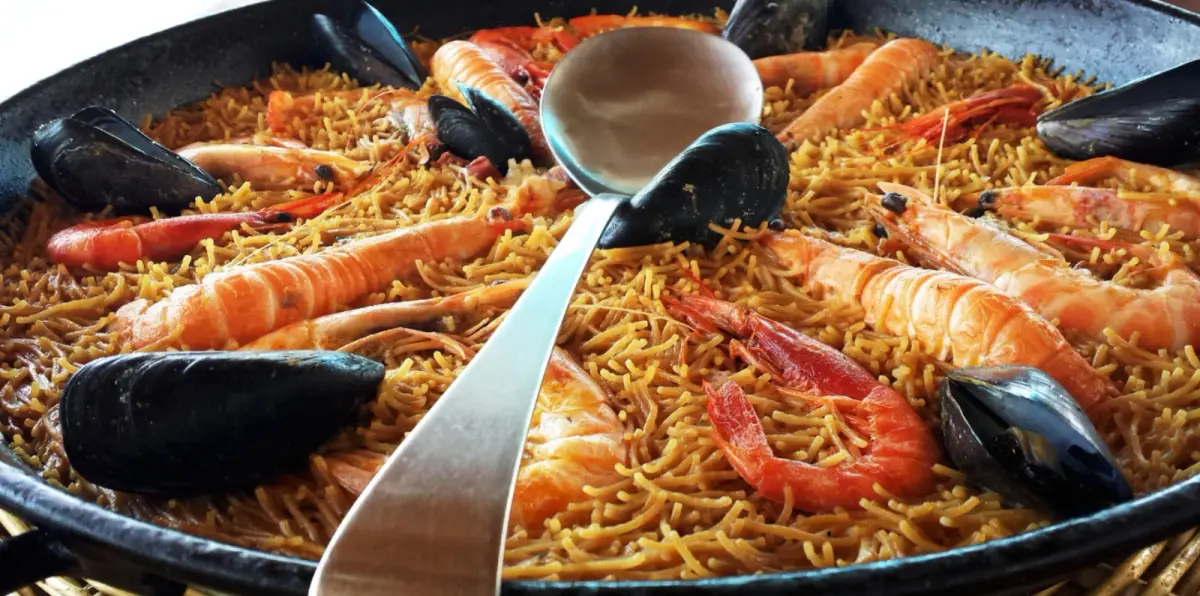

Start with the uncomfortable truth: fideuà is a narrower field than paella, and most of the good ones live in two specific parts of Barcelona. It is not a dish cooked well just anywhere because it appears on the menu, since it demands a technique of its own that has little to do with simply swapping rice for noodles. Knowing what sets it apart and where it is cooked well is the difference between a memorable fideuà and a passable tourist-menu one.
Where do you eat the best fideuà in Barcelona? In the Barceloneta and the Poblenou seafront, thanks to the closeness to the fish auction. Can Solé, since 1903, and La Mar Salada are the most recommended by critics and locals; 7 Portes is the historic-centre classic and Xiringuito Escribà the seafront reference. Budget €20-25 a head, most made for two, and book at weekends.
Quick decision by what you want
- Sea flavour and pure tradition → Can Solé — concentrated fumet, open since 1903
- The critics’ top pick → La Mar Salada — refined kitchen, weekday lunch menu around €19.50
- A historic experience in the centre → 7 Portes — an institution since 1836, with traditional allioli
- Fideuà by the sea → Xiringuito Escribà — on Bogatell beach, open kitchen
- Black fideuà → Can Solé or Xiringuito Escribà — the squid-ink version
- The widest choice → L’Arrosseria Xàtiva — the broadest fideuà menu in the city
Why fideuà is not paella with noodles
The most common confusion ruins the expectation, so it is worth clearing up first. According to experts in seafood cooking, fideuà was born on the Valencian coast as an alternative to paella when fishermen ran out of rice, but it evolved into a technique of its own that often demands more than rice does. The noodle is toasted in olive oil until golden before being hydrated, with a slow sofrito of up to 60 minutes, a stage that creates a starch shield on its surface and makes the noodle keep its firmness and stand on end at the end of cooking, the famous noodles-on-end effect.
The other pillar is the stock. A good fideuà demands a fumet of rockfish and crustaceans cooked with care, controlling the time so the bones do not release bitterness. That concentrated stock is the soul of the dish and what separates a fideuà made with craft from a generic one. The table below sorts the city’s references by what each does best.
| Restaurant | Area | Open since | Best for |
|---|---|---|---|
| Can Solé | Barceloneta | 1903 | Concentrated fumet, black fideuà |
| La Mar Salada | Barceloneta | 1993 | Critics’ favourite, lunch value |
| 7 Portes | El Born | 1836 | Historic institution |
| Xiringuito Escribà | Bogatell | 1992 | Seafront, mantis-shrimp stock |
| L’Arrosseria Xàtiva | Gràcia | n/a | Widest range of styles |
The Barceloneta, the epicentre of rigour
According to official data, the old fishing quarter holds the highest density of quality fideuà in the city. The reason is logistical: the closeness to the fish auction guarantees daily produce, and that sustains family houses with decades, even more than a century, of craft. The reference most cited by food critics and locals is La Mar Salada, on the Passeig de Joan de Borbó, run by chefs Marc Singla and Albert Enrich, with a fideuà of springy noodle soaked in an excellent fumet and a lunch menu around €19.50.
The other great name is Can Solé, on Carrer Sant Carles, open since 1903 and now in its fourth generation, famous for a fumet of extreme briny concentration; its seafood fideuà runs around €23.40 and the lobster one €35.50. A few streets away, several historic houses keep the canon: Can Majó, a seafront rice reference; Can Ros, with its Repsol Solete; and Casa Maians, an informal tavern that fills with locals at lunch, a good sign of authenticity. It is the heart of what the Barcelona beaches guide frames, applied to the noodle.
The Poblenou seafront, fideuà with your feet in the sand
The other strong area swaps the classic dining room for the beach. The Poblenou coastline has raised the beach shack to fine cooking, with design-led spaces cooking fideuà alongside their rices and intensified stocks. The reference name is Xiringuito Escribà, on Bogatell beach since 1992, from the family behind the famous pastry dynasty, with an open kitchen and a highly regarded black fideuà made with mantis-shrimp stock, a crustacean that adds a powerful briny sweetness.
Beside it, Can Fisher represents the modern version, with a Repsol Solete, intensified stocks and a standout monkfish fideuà. Both prove that a beach setting is not at odds with technical rigour, as long as the stock is taken seriously. Eating fideuà here pairs well with a coastal day, in the spirit of the first-time visitor guide to Barcelona and a walk through the Barceloneta neighbourhood.
Away from the sea, when you leave the beach
The sea breeze is no requirement for a good fideuà, and some specialists prove it inland. In the historic centre, 7 Portes is the institution par excellence, founded in 1836 in El Born, with chequered floors and an unchanging traditional recipe served with allioli; figures like Picasso passed through its dining room. It is the choice for anyone after an institution experience rather than a beach one, with the regularity of a place that has served the same dish for almost two centuries.
For anyone prioritising variety, L’Arrosseria Xàtiva, with houses in Gràcia and Sant Antoni, offers the city’s broadest fideuà menu, from the marinera to black, soupy and creative versions, while also handling allergen control with gluten-free options. These options suit anyone exploring the food scene beyond the beach circuit, as in the best restaurants in Barcelona guide.
How to spot a good fideuà and order it well
Knowing what to look for in the dish saves you a disappointment. A fideuà made with craft is known by the noodle whole and lightly toasted, loose and soaked in stock without being dry or overcooked, with a deep-flavoured sofrito base that brings sweetness without acidity. The noodle should stand on end, a sign of correct toasting, and the stock should taste of clean sea, not of salt. The allioli is served on the side so each diner can adjust the intensity.
A couple of practical keys make the difference. Fideuà is almost always ordered for a minimum of 2 people, and at many houses it is worth ordering ahead, especially the lobster or mantis-shrimp versions. Booking is strongly advised at weekends, since these temples fill every service. And one cross-cutting tip: avoid the photo-menu terraces in the most touristy areas, where the noodle’s texture is rarely respected, a criterion that the best tapas in Barcelona guide also applies.
Frequently asked questions about fideuà in Barcelona
What is the difference between fideuà and paella?
Fideuà uses noodles instead of rice, and that changes the whole technique. The noodle is toasted in oil before being hydrated, which creates a starch shield and makes it stand on end at the end of cooking. It is cooked with rockfish stock and served traditionally with allioli. It was born on the Valencian coast as an alternative to paella.
Where do you eat the best fideuà in Barcelona?
Most of the best are in the Barceloneta, the old fishing quarter, and along the Poblenou seafront, thanks to the closeness to the fish auction. Can Solé, open since 1903, and La Mar Salada are the names most repeated by critics and locals; 7 Portes is the historic-centre classic and Xiringuito Escribà the seafront reference on Bogatell beach.
How much does a fideuà cost in Barcelona and for how many people is it ordered?
A seafood fideuà costs between €20 and €25 a head at the classic houses, rising if it has lobster or langoustine, up to around €35. Almost all are ordered for a minimum of two people, and at many places it is worth ordering ahead. Booking is strongly advised at weekends.
What is black fideuà?
It is the version coloured and flavoured with squid ink, the noodle equivalent of arròs negre. It is deeper and brinier than the traditional marinera and is served with allioli. Can Solé and Xiringuito Escribà cook two of the most highly regarded black fideuàs in the city, often with cuttlefish or mantis shrimp in the stock.
In Barcelona, the best fideuà is found where the noodle is treated with the same respect as the rice.