
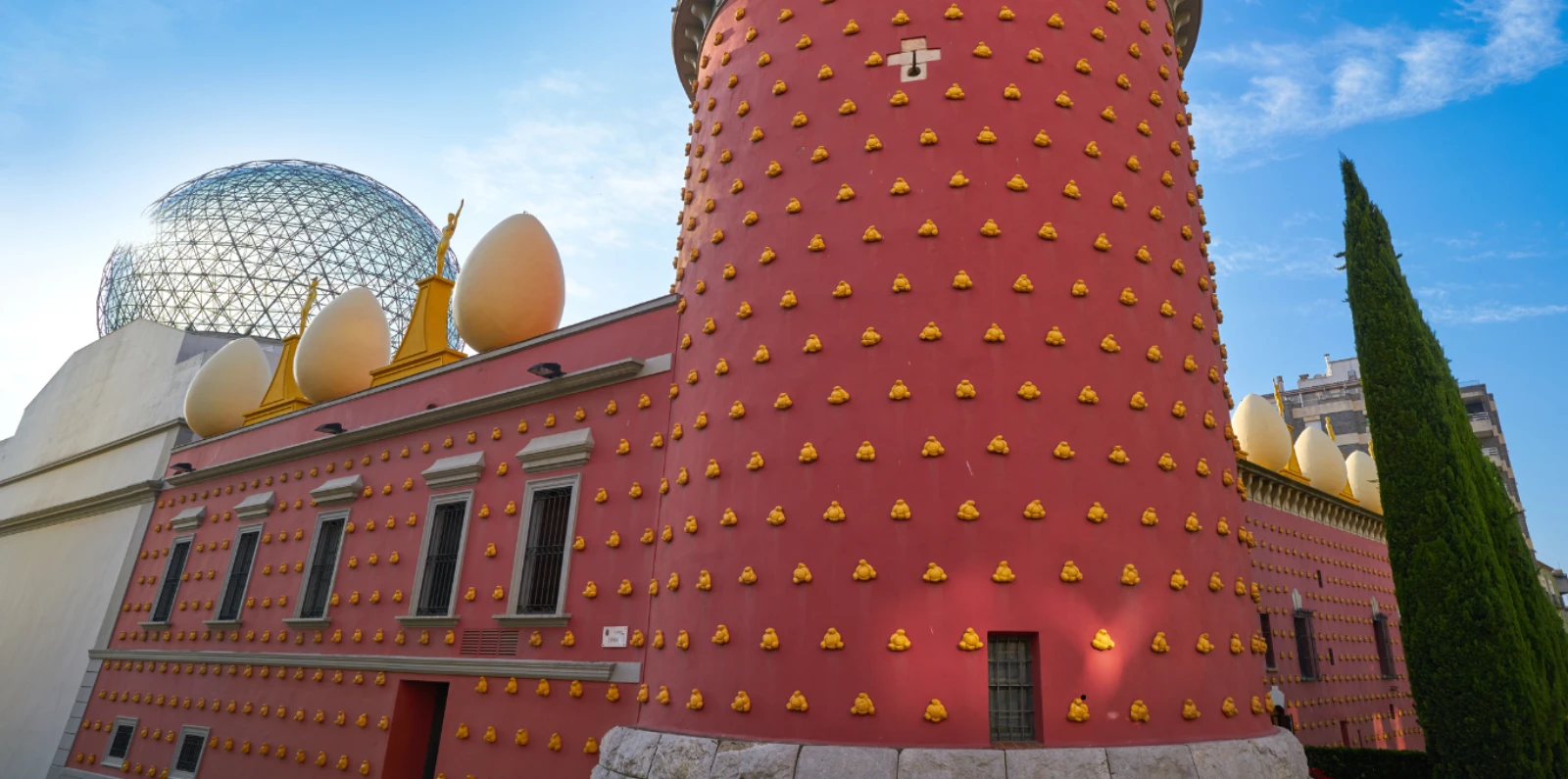

Drop a coin into the slot beside the black Cadillac in the courtyard and it starts raining inside the car. That single gesture explains the Dalí Theatre-Museum better than any wall text: the artist rebuilt Figueres’s burnt-out municipal theatre into one continuous artwork and then had himself buried under its stage. Direct trains from Barcelona-Sants reach Figueres-Vilafant in 53-58 minutes, timed entry costs 18.50 € online, and the whole town fits between a morning and an evening train.
Getting there without losing an hour
The high-speed line does not stop in the town centre, and that detail decides your morning. Fast trains arrive at Figueres-Vilafant, roughly a 25-minute walk from the museum door; slower regional services pull into Figueres station, under 10 minutes from everything. Renfe’s official data lists more than 15 direct departures a day from Sants, with advance fares from about 8-11 € each way.
| Option | Journey time | Arrival station | Walk to museum | Best for |
|---|---|---|---|---|
| High-speed (AVE, Avlo) | 53-58 min | Figueres-Vilafant | ~25 min | full day trips |
| Regional via Girona | ~2 h | Figueres | under 10 min | unhurried travel |
| Car via the AP-7 | ~1 h 30 min | n/a | n/a | adding Cadaqués |
For a day trip the high-speed train wins, walk included; you gain over an hour each way. The regional makes sense if you want to break the ride in Girona, itself a strong day out, or if you treat rail time as part of the pleasure, as with most train day trips from Barcelona. Drivers should only bother if they plan to push on to Cadaqués and Portlligat afterwards.
Tickets, time slots and the Monday closure
Buy the timed slot online before you buy the train ticket. According to official figures from the Gala-Salvador Dalí Foundation, general admission costs 18.50 € on the web against 20.50 € at the door, reduced entry is 15 €, children up to 8 go free, and a guided ticket runs 26.50 €. The building closes on Mondays from October through June, apart from a handful of listed holiday openings, and normal hours run 10:30 to 18:00 with last entry 45 minutes before closing.
Two rules catch people out at the door. Nothing larger than 35 × 35 × 25 centimetres gets in, backpacks included, so travel light or use the cloakroom in the lobby. And anyone under 16 must enter with an adult. Flash and tripods are banned throughout.
Inside the largest surrealist object on Earth
More than 1,500 works fill the old theatre, rooms 1 to 18, plus temporary galleries and two rooms of jewellery, all on one ticket. The set pieces earn their fame: the Rainy Taxi in the courtyard, the Mae West room whose sofa and fireplace snap into a face from a raised platform, and the glass geodesic dome over the former stage, which Dalí compared to a fly’s eye. Under that dome hangs the canvas of Gala facing the sea that resolves into Abraham Lincoln from 20 metres back; watch other visitors walk the distance like a ritual.
Then comes the part reproductions never show, and the reason this place outranks most of the best museums in Barcelona for sheer strangeness: the small stuff. A turtle with a coin balanced on its shell. Peepholes opening onto a mirrored flamingo in a green room. A soft self-portrait with fried bacon, and a portrait of Picasso worth comparing with what hangs in the Picasso Museum back in Barcelona. In rooms 23 and 24, the jewels Dalí designed between 1941 and 1970 include a gold heart with rubies that mechanically beats. Give the visit 2-3 hours; an unmarked marble slab beneath the stage, the artist’s crypt, is easy to miss if you rush.
Figueres beyond the museum
Half a day covers the rest comfortably, and your museum ticket keeps paying. The Birth House at Carrer Monturiol 6 charges 12 €, cut to 9 € on presentation of the Theatre-Museum ticket; visits run in groups of 8 every 10 minutes and the last session starts at 18:00. The Toy Museum of Catalonia shows 7,000 pieces from a collection of over 26,000, among them the teddy bear shared by Dalí and Lorca, and also discounts against a same-day museum ticket. Uphill, the Sant Ferran fortress spreads across 32 hectares behind a 3,120-metre perimeter, the largest bastioned fort in Europe; basic entry costs under 4 €, and a 15 € booked tour crosses its 9-million-litre underground cistern by boat. Between them, the Rambla and the free Gothic church of Sant Pere, where Dalí was baptised, fill the gaps.
Is the trip worth it
Yes, and specifically as a day trip rather than an overnight. The full day lands around 55-60 € per person before food: return train from roughly 18-22 € booked ahead, museum at 18.50 €, Birth House at 9 €, fortress under 4 €. For a first Barcelona visit of four days or fewer, the city’s own essential sights should win; from five days up, Figueres is the strongest art excursion on the map. The honest downsides are real, though. Coach groups flood the rooms between 11:00 and 14:00, the dome area bottlenecks, and August queues form even with timed tickets, which is one more reason to weigh the best time of year to visit before locking dates.
The timing trick that beats the queues
The time slot you book changes the whole visit. Coach groups from the Costa Brava flood the rooms between 11:00 and 14:00, and the dome bottlenecks worst; experts recommend the first slot of the morning or the last of the afternoon, when the Rainy Taxi courtyard sits nearly empty. July and August run on high-season pricing, 22 € online and 24 € at the door, with extended hours from 9:00 to 20:00 and evening Dalí by Night sessions that light the rooms differently. Pairing the trip with the city, the Foundation also sells a combined ticket with La Pedrera in Barcelona.
Book the museum slot first, the train second, and let the rest of Figueres arrange itself around those two hours.
Most museums display an artist’s work; this one buries the artist inside it, and that difference survives the train ride home.