
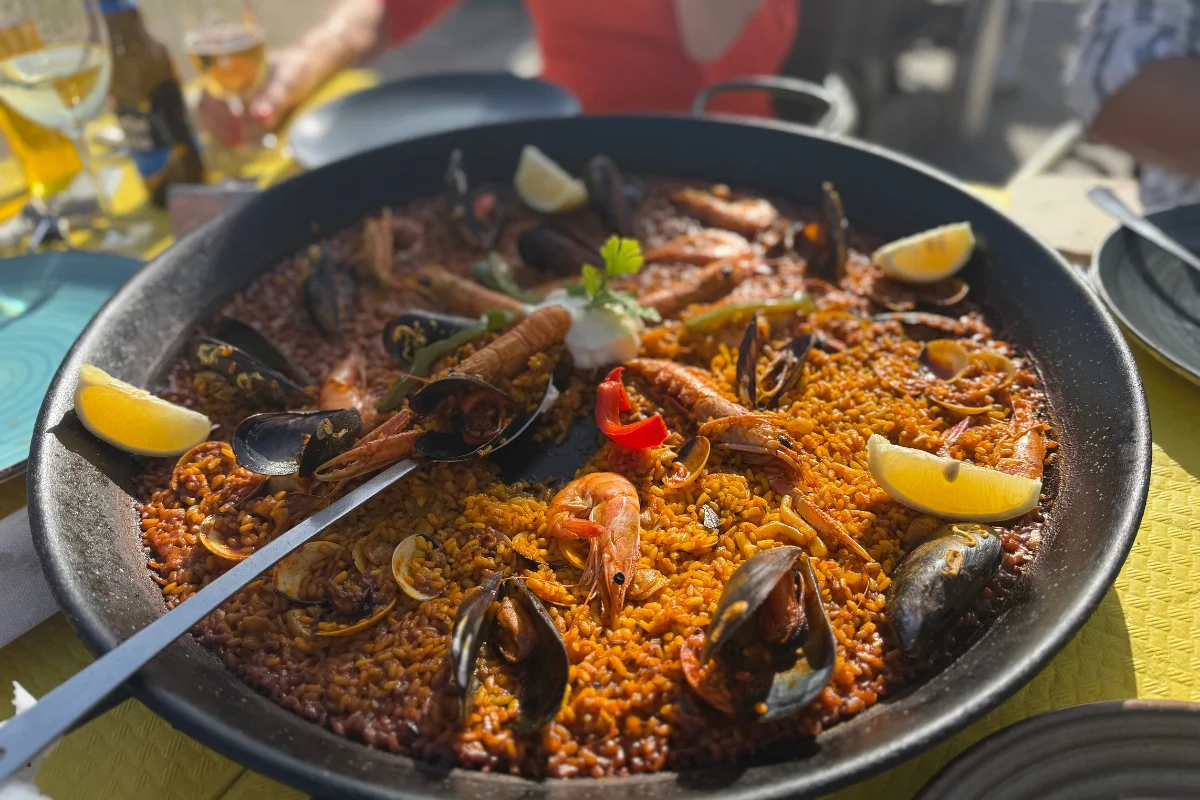

The tourist paella of Barcelona — overcooked, pre-made, reheated in a non-iron pan, served in under 10 minutes — is so widespread that it has given the city’s rice scene an undeserved reputation for mediocrity. The actual scene is more interesting. Barcelona handles three technically different rice styles well, and each requires different technique, different grain, and a different restaurant to find at its best.
The three styles: seco (dry, with socarrat crust), meloso (creamy, no added fat, driven by grain starch), and caldoso (brothy, high liquid ratio, entirely different plate). Ordering the wrong style at the wrong restaurant — or failing to recognize what you’re getting — is where most visits go wrong.
The Three Styles — What Actually Differs
Seco (dry rice with socarrat): thin layer of rice in a wide iron pan, maximum fire contact, crust of toasted grain on the bottom. The socarrat — the caramelized base layer — is the technical benchmark. Done correctly: a consistent, non-burnt crust across the entire pan base. Done incorrectly: burnt edges and raw center. A 20–25 minute cook time from when the stock enters the pan is the minimum for proper execution.
Meloso (creamy rice): the grain releases starch during cooking, creating a naturally creamy consistency without added fat. The result is neither dry nor soupy. The correct grain — Molí de Pals or Marisma de Illa de Buda — is essential because standard Bomba rice doesn’t have sufficient amylose content to produce the texture. Requires precise liquid dosing and continuous attention.
Caldoso (brothy rice): 5 parts stock to 1 part rice. The grain absorbs liquid without breaking. The stock must be deep enough to carry the dish — it’s the most technically demanding style because there’s nowhere to hide a weak fumet. The rice should hold its form in the broth, not disintegrate.
Where to eat the best paella and rice in Barcelona? Casa Amàlia (Eixample, 4.7 with 10,000+ reviews) leads on creamy meloso with Molí de Pals grain. CruiX (Eixample, Michelin Bib Gourmand) is the reference for dry rice with socarrat. Cadaqués Restaurant (Porches de Xifré) makes the best caldoso over orange-wood flame. For black rice, Restaurante Elche has been the city’s reference since 1959. Can Ros (Barceloneta) has the best value for honest local rice.
Quick Decision — By Style and Budget
- Best creamy rice (meloso) → Casa Amàlia (Eixample, near Mercat de la Concepció) — 4.7, Molí de Pals grain, wagyu and kokotxas available, €25–40
- Best socarrat, author technique → CruiX (Eixample Esquerre) — Michelin Bib Gourmand, thin rice layer in large pan, €20–45
- Best caldoso over wood flame → Cadaqués Restaurant (Porches de Xifré) — orange-wood fire, Menorca lobster with Marisma de Illa de Buda rice, 4.5 with 1,500+ reviews, €28–48
- Most historic rice restaurant → 7 Portes (since 1836) — Arroz Parellada, 70,000 portions annually, oven-finished, open 365 days, €24–38
- Best black rice pedigree → Restaurante Elche (Poble Sec, since 1959) — first restaurant in Barcelona to build an entire menu around rice
- Best value for local rice → Can Ros (Barceloneta) — weekday lunch with rice under €20, local clientele majority, black rice with cockles
- Most creative rice outside the tourist circuit → Els Pescadors (Plaça de Prim, Poblenou) — black pudding and mushroom rice, green rice with salt cod kokotxas, artisanal stock, far from the maritime tourist strip
Casa Amàlia and CruiX — The Eixample Standards
Casa Amàlia (Eixample, near Mercat de la Concepció) has 4.7 on Google with over 10,000 reviews — a rating that’s statistically unusual at that review volume for a rice-specialist restaurant. The technical reason: they use Molí de Pals grain, an artisan Catalan variety with amylose content that produces optimal starch release without losing firmness. The result is a meloso that gets its creaminess from the grain, not from added butter or cream.
Most-ordered: mountain rice (rabbit, mushroom, and butifarra del perol), A5+ wagyu rice, kokotxas rice. For the best paella in Barcelona with technical rigor, Casa Amàlia is the non-negotiable reference for the meloso category.
CruiX (Eixample Esquerre) holds the Michelin Bib Gourmand — the recognition for exceptional quality-to-price ratio. Chef Miquel Pardo applies a specific technique: thin rice layer in a large-diameter pan to maximize fire contact and produce socarrat in every serving. Combinations like aged beef with picaña or white prawn with duck are what justify the review scores. Weekday lunch menu is highly competitive for the technical level. 9.7 on TheFork.
7 Portes and Elche — The Historical Institutions
7 Portes (Passeig d’Isabel II, 14) has been open since 1836 — Barcelona’s oldest continuously operating restaurant still serving the same dishes. It sells approximately 70,000 portions of Arroz Parellada annually. The dish was created in the early 20th century for a bourgeois regular who wanted to eat rice without peeling shellfish or separating fish bones — peeled prawns, pork loin, sausages, and chicken, all in dry rice with an oven finish. The oven step guarantees consistency across 270 daily paellas. Picasso, Hemingway, García Lorca, and Robert De Niro have eaten here. Open 365 days a year.
Restaurante Elche (Poble Sec) has been operating since 1959 and was the first restaurant in Barcelona to build an entire menu dedicated to rice. Its black rice — darkened with cuttlefish and artichoke — is the historical reference point for that style in the city. For Barcelona’s best food market restaurants and gastronomic itineraries, these two are the only rice restaurants with verifiable multi-decade consistency.
The grain specification test for a serious rice kitchen
7 Portes and the tourist paella trap are the easy part. What identifies a serious rice kitchen is the grain specification test.
Serious rice restaurants in Barcelona specify the grain variety on the menu: Molí de Pals, Bomba, Marisma de Illa de Buda, Calasparra. Each has distinct properties — Bomba expands up to three times its volume without breaking; Molí de Pals releases more starch for creamy textures; Marisma absorbs stock flavors with more intensity than Bomba.
If a restaurant doesn’t specify the grain, it almost certainly doesn’t choose it deliberately — it uses whatever the distributor sends. That’s the single most reliable signal separating rice-specialist restaurants from rice-as-menu-item restaurants, and it’s rarely mentioned in any guide.
The second signal: preparation time. Proper rice needs 20–25 minutes from when stock enters the pan. If a waiter says it’ll be ready in 10 minutes, the rice was pre-cooked or regenerated. There are no shortcuts in the cooking process.
Barceloneta — Where to Go and What to Avoid
Barceloneta has the densest concentration of rice restaurants in Barcelona and also the densest concentration of establishments operating on tourist proximity rather than product quality. The most reliable signal: restaurants with predominantly local clientele don’t have menus in eight languages with saturated-color paella photographs on placards outside the door.
Can Ros is the local alternative to the tourist strip. Wood, benches, black rice with cockles at honest price, weekday lunch with rice under €20. Local residents fill it on weekends — sufficient data.
Maná 75 operates differently: it has the longest paella line in Barceloneta and can prepare up to 19 simultaneous rice dishes at temperatures visible to clients. The name comes from 75 degrees Celsius, their stated ideal cooking temperature. Black rice and carabinero prawn rice are the most ordered. 4.4 with over 7,900 reviews.
Can Solé (founded 1903) maintains an extensive rice and fideuà menu with direct auction product. Marine stocks are made from fish bones and rockfish using slow-extraction techniques — the collagen thickens the stock naturally. Writer Manuel Vázquez Montalbán cited it as one of the best caldoso options in the Mediterranean.
| Restaurant | Neighborhood | Rating | Price | Best for |
|---|---|---|---|---|
| Casa Amàlia | Eixample | 4.7 (10k+) | €25–40 | Creamy rice, Molí de Pals grain |
| CruiX | Eixample | 4.6 (2.6k+) | €20–45 | Socarrat, Michelin Bib Gourmand |
| Cadaqués | Porches de Xifré | 4.5 (1.5k+) | €28–48 | Caldoso over wood flame |
| Maná 75 | Barceloneta | 4.4 (7.9k+) | €22–35 | Black rice, 19 types simultaneous |
| Can Ros | Barceloneta | 4.4 (3.4k+) | €15–22 | Honest price, local clientele |
| 7 Portes | Passeig Isabel II | n/a | €24–38 | Historic, Arroz Parellada since 1836 |
| Elche | Poble Sec | 4.0 (2.6k+) | €20–35 | Black rice, first rice-specialist in city |
| Els Pescadors | Poblenou | 4.0 (1.9k+) | €30–45 | Artisanal stock, daily rice |
Mistakes to Avoid
- Ordering rice without asking the preparation time: if the answer is under 15 minutes, the rice is pre-cooked. Walk out. There is no version of properly made rice that takes under 15 minutes.
- Accepting rice served in a deep bowl: the pan should arrive at the table as the cooking vessel. Rice transferred from pan to bowl means the socarrat doesn’t exist — and likely the rice was cooked in a different container.
- Choosing a restaurant based on seafront location: proximity to Barceloneta beach has zero correlation with product quality. Some of the best rice in the city is cooked blocks away from the sea.
- Ordering caldoso at a seco specialist: the techniques are incompatible. A restaurant that excels at socarrat crust is not set up for the 5:1 liquid ratio of caldoso. Ask what style the house specializes in before ordering.
Which rice style is technically hardest?
Caldoso is the most demanding because it requires a deep fumet and exact liquid dosing — 5 parts stock to 1 part rice, with the grain absorbing without breaking. The margin for error is minimal. Black rice is the most forgiving because the squid ink masks small cooking imperfections. Meloso sits between: it requires the right grain (Molí de Pals or Marisma) and starch control that comes from the grain itself, not from added fats.
The gap between tourist rice and serious rice in Barcelona is not a price gap. Can Ros charges under €20 and outperforms most restaurants charging double on the seafront. The difference is the grain, the stock, and the time. If a restaurant controls those three variables, the style — dry, creamy, or brothy — becomes a matter of personal preference rather than quality.
For the maritime neighborhood context: the Barceloneta Barcelona guide covers the waterfront beyond restaurants. For a full gastronomic day integrating rice into a neighborhood route, the best restaurants Barcelona guide maps the wider dining scene. And for the specific seafront restaurant options, seafront restaurants Barcelona covers terrace options along the maritime front.