
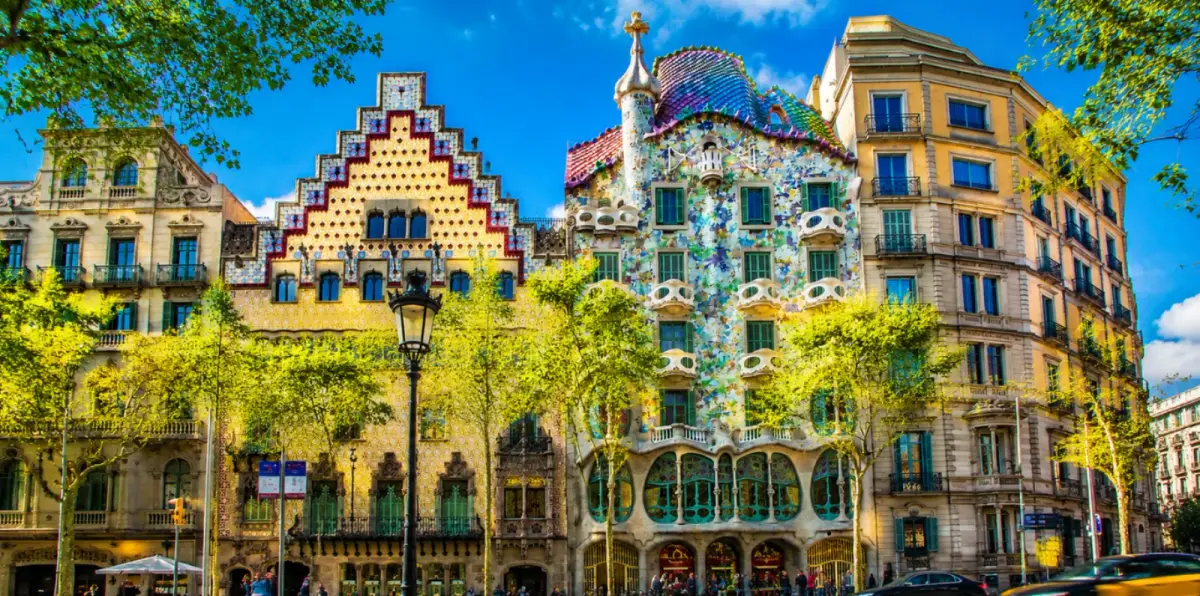

Three modernista houses stand within forty metres of each other on Passeig de Gràcia, all charging admission, all worth an hour. Most visitors buy the Casa Batlló ticket by reflex and walk past the other two. At Casa Amatller the choice is more complicated than it looks, because three different products share the address.
Which Casa Amatller ticket should you buy? The guided tour, at 23 € general and 16 € for ages 18 to 25, is the only one that walks you through the 1900 apartment with a person explaining it. The audio-guided version costs less and runs every 30 minutes. The Centre d’Art Amatller is a separate digital experience and does not include the historic rooms.
Quick decision by what you want
- First time on the block, one house only → guided tour at Amatller, 23 € — the only interior on the street that kept its original furniture
- Already booked Casa Batlló → audio-guided Amatller — the two show different things, architecture against domestic life
- Travelling with a child under 8 → guided tour — under-8s enter free, and the tour ends with a box of Amatller chocolate
- Aged 18 to 25 → guided tour at 16 € — the youth rate undercuts the audio guide, which has no equivalent discount
- Short on time before a dinner reservation → audio-guided, departures every 30 minutes from 10:00 to 19:00, done in 45 minutes
- School or study group → educational visit at 9 € per student, or 12 € with workshop, booked by email
- Want projections and VR rather than rooms → Centre d’Art Amatller, sold separately and not the historic house
What you get for 23 euros
Sixty minutes on the main floor, in a small group, with a guide, in Catalan, Spanish or English. The main floor was the family apartment; the rest of the building was rented out, exactly as at Casa Batlló next door.
The ticket includes a box of Amatller chocolate leaves. General admission is 23 €, the reduced rate 19 €, the 18 to 25 band 16 €, and children under 8 go free. According to official rates published by the foundation that runs the house, those figures apply year-round.
What the price actually buys is access to furniture. The dining room, bedrooms, study and music room keep the pieces Josep Puig i Cadafalch designed for those exact rooms, along with the lamps, the stained glass and the mosaic floors laid to imitate carpets.
The interior nobody else on the block still has
This is the argument for choosing Amatller, and it rests on an accident of ownership rather than luck.
Antoni Amatller died in 1910 and left testamentary instructions about the family estate. His daughter Teresa had no children. Advised by the art historian Josep Gudiol i Ricart, who had seen New York’s Frick Collection with its museum and its research library under one roof, she founded the Institut Amatller d’Art Hispànic in 1941 and installed it in the house.
The building was therefore never sold, never stripped and never converted to offices, because from 1941 an institution lived there whose stated purpose included preserving it. A full restoration between 2009 and 2015 returned the main floor to its 1900 condition, and it opened to visitors that year.
Compare that with the neighbours. The Casa Batlló is toured without its original furnishings, its power coming from Gaudí’s structural imagination instead. Casa Lleó Morera lost facade sculpture during a commercial refit in the 1940s. Both are extraordinary buildings. Neither shows you a room as its owners left it.
Three tickets, side by side
Official data published by the foundation sets out the options. The differences are larger than the price gap suggests.
| Ticket | Price | Duration | Languages | What it covers |
|---|---|---|---|---|
| Guided tour | 23 € / 19 € reduced / 16 € age 18-25 / free under 8 | About 60 min | Catalan, Spanish, English | Main floor with guide, chocolate box included |
| Audio-guided | Lower than guided, departures every 30 min | About 45 min | 7 languages including French, German, Chinese | Main floor at your own pace, staff open access points |
| Centre d’Art Amatller | Sold separately | Varies | n/a | Digital projections and VR, no access to the historic rooms |
The seven-language audio guide is the practical choice for anyone whose Spanish, Catalan or English is shaky, since the guided tour runs in only three. The trade-off is that a guide answers questions and an audio track does not.
The chocolate industrialist who photographed Egypt
Understanding who commissioned the house changes what you notice inside it. Antoni Amatller inherited a chocolate dynasty active since the eighteenth century and industrialised it, opening a factory in 1879 capable of 11,000 kilos a day and commissioning advertising posters from artists including Alphonse Mucha.
He was also a travelling collector and an award-winning amateur photographer, recognised by institutions in New York and Belgium after journeys through Morocco, Egypt and Turkey. Puig i Cadafalch built him a photographic studio high in the building, set away from the neighbours because developing required chemicals.
His collection ran to over 750 pieces of archaeological glass from across the Mediterranean and Europe, alongside a Romanesque altarpiece, a Hispano-Flemish panel attributed to Bartolomé Bermejo, a painting by Ramon Casas and a Lalique jewel he gave his daughter.
One detail dates the house better than any plaque. Some lamps carry a dual gas and electric system, because around 1900 the electricity supply still failed and a household at this level could not risk the dark. Anyone drawn to that kind of preserved detail will find more in the lesser-known museums of Barcelona.
Mistakes people make buying tickets
Four errors account for most of the disappointment, and all four are avoidable.
- Confusing the Casa Museu with the Centre d’Art. The digital experience is a separate purchase and does not enter the historic rooms. Ask explicitly for the Casa Museu.
- Assuming Amatller and Ametller Origen are related. They are different companies. Ametller Origen runs over a hundred food stores across Catalonia and has nothing to do with the house.
- Turning up without booking on a summer afternoon. Guided groups are small and fixed-time, so they clear out early in peak months.
- Visiting Batlló first. Amatller was finished in 1900, the Lleó Morera refit began in 1902, and Gaudí only took on Batlló in 1904. Seeing them in that order shows what Gaudí was answering.
That last point matters more than it sounds. The Block of Discord is usually presented as a simultaneous contest between three architects. It was not. Amatller came first and had no rival to outdo, and the name itself was applied later, borrowed from the Greek myth of the disputed apple.
What is new for 2026
Two practical notes and one correction.
The house opens daily from 10:00 to 20:00, closing only on 25 and 26 December and 6 January. Audio-guided departures run from 10:00 to 19:00 rather than to closing, so a 19:30 arrival buys you nothing.
The stepped gable is routinely described online as a nod to a chocolate bar. No architectural source attributes that intention to the architect. Puig i Cadafalch was a medieval art historian who later presided over the Mancomunitat de Catalunya, and the form he used is a Flemish stepped gable from the guild houses of the Low Countries. The symbol he did place deliberately sits at street level, a Saint George and the dragon relief carved by Eusebi Arnau.
For anyone assembling a modernisme day, the house sits ten minutes from La Pedrera and works well with Modernisme beyond Gaudí or a wider walk through the Eixample. It is also the least crowded of the three houses on the block, which shows up in the things to see in Barcelona rankings far below its quality.
Frequently asked questions about Casa Amatller
Do you need to book Casa Amatller in advance?
For the guided tour, yes. Groups are small and slots run at fixed times, so they sell out in high season. The audio-guided option departs every 30 minutes between 10:00 and 19:00 and absorbs walk-ins better, though arriving without a ticket still risks a wait.
How long does the Casa Amatller visit take?
About an hour on the guided tour, closer to 45 minutes with the audio guide since you set the pace. Both cover the main floor, which was the family apartment, plus part of the ground floor. The upper storeys have other uses and are not open.
Is Casa Amatller the same as the Amatller chocolate shops around the city?
The house and the chocolate brand share a family origin, and there is a chocolate room on the ground floor serving drinking chocolate to a historic recipe. Ametller Origen, the chain with over a hundred Catalan stores, is a separate company with no connection to either.
If you can only open one door on this block, open the one where the furniture never left.