

Casa Batlló’s contemporaries called it “the house of bones”. Casa Milà was likened to a zeppelin parking garage. The stretch of Passeig de Gràcia where three of Europe’s most photographed buildings compete still carries the name Block of Discord, precisely because of the public ridicule it once provoked. The Modernisme that Barcelona now sells as civic pride was born surrounded by mockery, and that part of the story rarely makes the tour.
It is worth knowing, because it changes how you read the city. Behind each celebrated facade sits a clash of egos, an improbable patron, or a technique born from rubbish. What follows are the stories that hold the movement up, checked against official sources and, where a shaky figure keeps circulating, corrected with the real number. If this is your first visit, it pairs well with a first-time visitor’s guide to Barcelona.
The nicknames started as insults
Today “modernisme” sounds prestigious, but the population of the era reacted against almost everything it stood for. Humour magazines mocked the new architecture: Casa Batlló was nicknamed casa dels ossos, the house of bones, for its bone-shaped balconies, and Casa Milà was compared to a futuristic zeppelin garage and an Easter cake. The name Block of Discord, on Passeig de Gràcia, comes from exactly that aesthetic rivalry, which the public read as excess.
The shift in taste had material consequences. From 1906, Noucentisme gained ground with its call for a soberer, more classical style, and Modernisme went into decline. With no heritage protection laws, many works were lost or disfigured within decades. It took years before figures such as Salvador Dalí and international historians reclaimed what Barcelona had nearly thrown away.
Nicknames and recognition at a glance
A quick reference for the buildings most visitors photograph without knowing the backstory.
| Building | Architect | Original nickname | Status today |
|---|---|---|---|
| Casa Batlló | Antoni Gaudí | House of bones | UNESCO World Heritage |
| Casa Milà (La Pedrera) | Antoni Gaudí | The quarry / zeppelin garage | UNESCO World Heritage |
| Palau de la Música | Domènech i Montaner | Targeted for demolition | UNESCO World Heritage |
| Hospital de Sant Pau | Domènech i Montaner | n/a | UNESCO World Heritage |
| Casa Amatller | Puig i Cadafalch | Part of the Block of Discord | Heritage-listed |
The teacher-student rivalry that reached the newspapers
The juiciest story in the movement pitted a professor against his own student. Lluís Domènech i Montaner taught Josep Puig i Cadafalch at the School of Architecture, and between 1901 and 1906 he organised trips with his students to document Catalan Romanesque architecture. According to records held at Sant Pau, some of those notes ended up in a book by Puig, and Domènech denounced him publicly in an article in El Poble Català in 1909.
The detail that makes the anecdote delicious is the earlier turn: in 1902, Puig himself had written a piece acknowledging Domènech’s enormous influence over an entire school of architects. Master and student went from declared admiration to public conflict in seven years, with a political undercurrent that soured the relationship further. Puig’s work sits pared with Gaudí’s on the Modernisme route through Barcelona, where his Casa Amatller shares a wall with Casa Batlló.
A 28-year-old wrote the founding text
The text that put Catalonia on the European architectural map was written by a man in his twenties. In 1878, aged 28, Domènech published the article “In search of a national architecture” in the magazine La Renaixença, now considered the founding treatise of Modernisme architecture. The concept he defended was eclecticism, today one of the traits that best define the movement.
That same polymath built an overflowing public life. He taught at the School of Architecture for 45 years, the last 20 as director, training most of the Modernisme architects, including Gaudí, Puig i Cadafalch and Josep Maria Jujol. He was also a politician, historian, editor and typeface designer. His masterpiece, the Sant Pau modernist complex, is the largest Modernisme site in Europe.
They smashed artworks with hammers
The anti-Modernisme backlash went beyond press jokes. The Noucentistes opposed it so fiercely that some works were physically destroyed: the Eusebi Arnau sculptures decorating the ground floor of Casa Lleó Morera, a Domènech building, were removed in a 1943 renovation and smashed with hammers. In the 1920s, some architects went as far as calling for the demolition of the Palau de la Música Catalana, now a World Heritage Site.
That the building you now cannot visit without booking weeks ahead was once nearly torn down says a great deal about how fast judgement on art can flip. The Palau survived, was restored, and is now recognised by UNESCO as the only Modernisme concert hall in the world with that status. Its stained glass and full backstory are covered in the Palau de la Música visit guide.
From 800 Modernisme shops, fewer than 50 remain
Modernisme did not stay in grand mansions; it took over retail, and that is where most has been lost. In 1962, architect David Mackay counted around 800 Modernisme shopfronts in Barcelona, from pharmacies and bakeries to bars and haberdashers. With time and the wrecking ball, that number has fallen to fewer than fifty, according to the official Modernisme Route. That is a drop of more than 90 percent in sixty years.
Among the casualties was the Café Torino, at number 18 Passeig de Gràcia, decorated in 1902 by Gaudí and Puig i Cadafalch with an iron canopy by Pere Falqués. It lasted eight years. To spot the survivors there is a field clue: since 1993, the city council has fixed a cast-iron plaque, “Guapos per sempre”, to the pavement outside shops with more than 50 years of continuous trade that keep their original decoration.
Trencadís came from a tantrum and from rubbish
Barcelona’s most recognisable mosaic has an origin somewhere between legend and recycling. A popular anecdote places the birth of trencadís during a visit by Gaudí to the workshop of ceramist Lluís Bru: impatient at the slow pace, he supposedly broke a tile and declared that the pieces “have to be thrown on by the handful or we will never finish”. Truth aside, the technique solved a real problem: covering the curved surfaces Gaudí was obsessed with, impossible to clad with whole tiles.
Its pioneering side is environmental. According to official data from the basilica, trencadís let builders reuse discarded fragments from ceramic factories, broken plates and glass, turning waste into cladding more than 100 years before recycling was a common concern. Much of the material came from the Pujol i Bausis factory in Esplugues de Llobregat. Its first documented use in Gaudí’s work is on the door knocker of the Finca Güell, and Jujol gave it much of its visual personality. You can see it at full strength at Park Güell and on the rippling facade of Casa Batlló.
The Sagrada Família towers shine with Murano glass
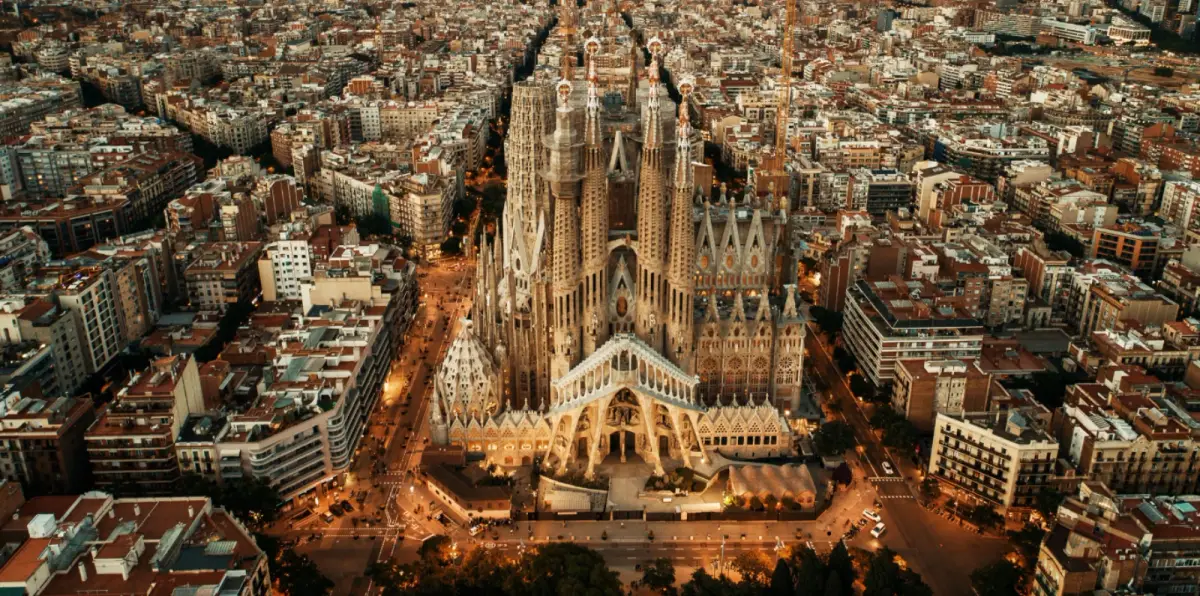
Almost nobody notices from below, and yet the central tower of Jesus reaches 172.5 metres: the tower pinnacles are finished in Venetian glass. According to official data from the basilica, the bell towers are crowned with polychrome glazed mosaic from the island of Murano, in Venice, chosen both for its vivid colour range and its resistance to weather. That is why these tips are also called Venetian glass.
Here is the field detail that settles the argument: the mosaics on the Nativity facade towers, the only facade Gaudí completed in his lifetime, have not suffered the same fixing problems as those on the Passion facade, built in the 1970s. The difference between what the master made and what came later is measured, literally, in how the mosaic holds to the stone. The rest of the temple’s secrets are in the Sagrada Família inside guide.
Europe’s largest Modernisme complex was a hospital
The most extensive Modernisme site on the continent is neither a house nor a theatre, but a hospital. The Sant Pau complex, by Domènech i Montaner, was built in the early 20th century as a garden city for the sick, with underground tunnels connecting the pavilions, therapeutic gardens, sculptures and stained glass. Domènech deliberately broke the grid of the Eixample to orient the site diagonally.
The ambition was not only aesthetic. He built in large windows, cross-ventilation and natural light decades before those principles became medical standard, working from the idea that a beautiful setting helped patients heal. Sant Pau and the Palau de la Música share a curious record: both were declared World Heritage on the very same day, and Sant Pau is the only case in the world of a hospital that earned the distinction while still in active service. It belongs near the top of any list of the best things to see in Barcelona.
The anonymous widow who saved the Sagrada Família
The most recent and least-known fact about the temple has nothing to do with Gaudí and everything to do with who funded it at its critical moment. For more than a century, historians knew only that a woman named Isabel had made an anonymous donation of between half a million and a million pesetas, channelled through an executor. Research by writer Julià Bretos, published in the book La dama sin rostro, has finally given her a name: Isabel Bolet Vidiella, widow of an ironmaster industrialist from the Sants district.
Her bequest, paid in instalments between 1891 and 1898, arrived when the project was in debt and barely above its foundations. With that money, Gaudí could abandon the idea of a modest church and think on a monumental scale; the size that defines the basilica today begins there. Isabel imposed anonymity in her will, and not even Gaudí ever knew who stood behind “Doña Isabel”. When she died, only the crypt was standing. It is a reminder that behind one of Barcelona’s most visited landmarks stood a patron the historical record took a hundred years to recognise.
The forgotten architect of 300 buildings
While Gaudí and Domènech soak up the spotlight, the most prolific architect of Modernisme Barcelona is barely mentioned. Enric Sagnier signed more than 300 buildings in the city and rarely appears outside academic circles. His is, among many others, the Tibidabo church that so many visitors mistake for a fairy-tale castle.
Sagnier’s case illustrates a widespread misunderstanding. More than a hundred architects are estimated to have produced Modernisme work, with around 2,000 buildings across Catalonia, so reducing the movement to a single name leaves out 99 percent of the story. Domènech, Puig i Cadafalch, Jujol and Sagnier are not footnotes; they are the bulk of Modernisme.
The architect of the Palau de la Música tested those details an hour up the coast: the skirting in his Canet de Mar workshop matches the Palau’s own columns, and entry costs €5, as the Canet de Mar guide explains.
Frequently asked questions about Catalan Modernisme
Why is Casa Milà called La Pedrera?
La Pedrera means the quarry in Catalan. It started as a mocking nickname from the satirical press, which compared the rough stone facade to an unfinished quarry, and even to a zeppelin parking garage. The insult eventually turned affectionate, and the building is now a UNESCO World Heritage Site.
Who was Domènech i Montaner and why does he matter?
Lluís Domènech i Montaner laid the theoretical foundations of Modernisme in 1878 and taught at Barcelona’s School of Architecture for 45 years, 20 of them as director. His students included Gaudí, Puig i Cadafalch and Jujol. He designed the Palau de la Música and the Sant Pau hospital.
What is trencadís and where did it come from?
Trencadís is a mosaic made from irregular fragments of ceramic and glass, much of it factory waste. Its first documented use in Gaudí’s work is on the door knocker of the Finca Güell, around 1884. It covers the curved surfaces that whole tiles cannot fit.
How many Modernisme shops are left in Barcelona?
Fewer than fifty. In 1962, architect David Mackay counted around 800 Modernisme shopfronts in the city. A lack of legal protection and successive renovations cut that number sharply. Among the lost was the Café Torino, decorated by Gaudí and Puig i Cadafalch in 1902.
Did only Gaudí build Modernisme architecture in Barcelona?
No. More than a hundred architects produced Modernisme work across Catalonia, roughly 2,000 buildings in total. Domènech i Montaner, Puig i Cadafalch, Jujol and Enric Sagnier, who signed over 300 buildings in Barcelona alone, are essential names beyond Gaudí.
Barcelona now laughs at the nicknames that were once contempt, and that is the truest measure of how wrong it got the movement at first.