
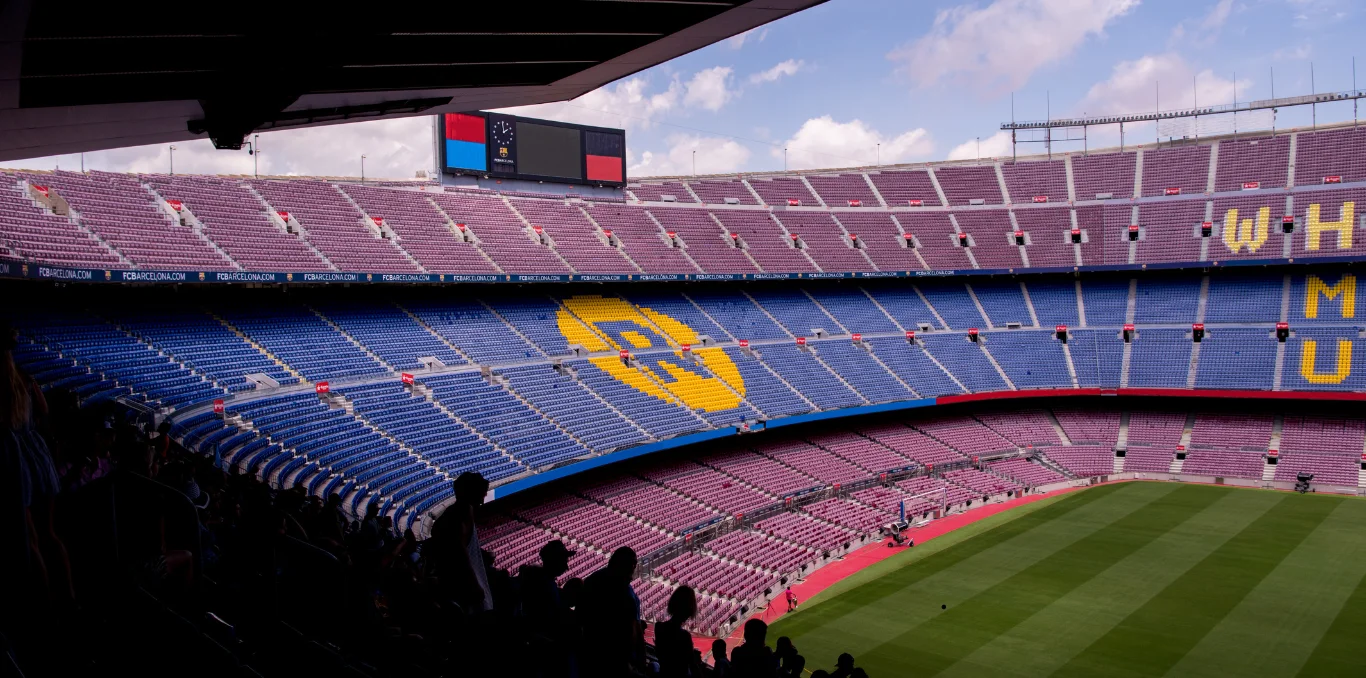

FC Barcelona is one of the very few football giants left on earth that belongs to its fans rather than to a billionaire or a state. That single fact shapes everything else about the club, from a Swiss founder who answered to no owner to a stadium built on the pull of one player. Between the 1899 founding and Lionel Messi’s 672 goals, the club holds a set of verified stories that mix football, politics and engineering, many unknown even to its own supporters.
A club owned by its members, not a tycoon
FC Barcelona is owned by its members, the socis, who number more than 140,000, which makes it one of only a handful of professional clubs in Spain that is not a public limited company. No single investor or owner controls it; members elect the president and vote on the big decisions in referendums. This civic ownership is the literal meaning behind the motto more than a club.
Who owns FC Barcelona? FC Barcelona is owned by its members, the socis, who number over 140,000. It is one of the few professional clubs in Spain that is not a public limited company, so no single owner controls it. Members elect the president and vote on major decisions, the model behind the motto more than a club.
That model is a genuine rarity in modern football, where most elite clubs are owned by funds, magnates or nation-states. The motto itself is not marketing: it traces back to the dictatorship years, when the club became one of the few spaces where a repressed Catalan identity could be expressed, turning the team into a cultural reference as much as a sporting one. To understand the language behind that identity, the guide to what language is spoken in Barcelona explains the context.
Visiting the stadium and the museum
For visitors, the headline news is that the Camp Nou has reopened. After playing temporarily at the Estadi Olímpic in Montjuïc during the works, the club returned to its home ground for official matches on 22 November 2025, even though the stadium is still under partial construction. The first match back ended 4-0 against Athletic Club, with the opening goal from Robert Lewandowski in the fourth minute.
The club museum, one of the most visited in Catalonia with over a million visitors a year, has reopened with immersive experiences using new technology. The full renovation, including the third tier and the roof, is not due to finish until late 2027, so a visit now means seeing a stadium mid-transformation. To fit the stadium into a wider day in the city, the things to see and do in Barcelona guide maps the rest of the essentials, and the public transport guide covers the metro lines to Les Corts.
The nickname comes from a row of backsides
Barcelona fans are called culés for a literal and unglamorous reason. At the old Carrer Indústria ground, where the club played between 1909 and 1922, the stands were so small that many supporters sat on top of the wall surrounding the pitch. From the street, all passers-by could see was a long row of backsides, culs in Catalan.
The image of those rows of culs poking over the wall became so well known that the nickname stuck as an affectionate badge of identity, and supporters still use it with pride more than a century later. The origin of the blue and claret colours, by contrast, has no single confirmed version: theories range from Gamper’s FC Basel to the rugby kit of the English school where the founding Witty brothers studied. The club crest, meanwhile, comes from a 1910 design contest won by a member, Santiago Femenia, which means the emblem is over a century old with only minor tweaks.
A Swiss founder who answered a magazine advert
The club was founded on 29 November 1899 by Joan Gamper, a young Swiss man who had arrived in Barcelona the year before and placed an advert in the magazine Los Deportes looking for players. He gathered a group of eleven men of several nationalities at the Gimnàs Solé, and the club was officially registered on 5 January 1903.
Gamper, born in Winterthur, had already founded FC Zürich and played for FC Basel before reaching Catalonia, bringing a cosmopolitan outlook to the project. As a player he scored more than 100 goals in just four years, but his deeper mark came across five spells as president, several of them to save the club from dissolution. There is a telling detail in the founding: Gamper could not become the first president because he was under the legal age at the time.
The Camp Nou was built because of one player
The Camp Nou exists for a specific reason. The previous stadium, Les Corts, became too small for the excitement generated by the Hungarian Ladislao Kubala in the 1950s. The board understood that the star’s pull demanded a far larger venue, and so the new stadium project began, running between 1954 and 1957.
The foundation stone was laid on 28 March 1954 before 60,000 fans, and the inauguration came on 24 September 1957, coinciding with the La Mercè festival. The initial budget was 67 million pesetas, but unexpected problems with the subsoil pushed the final cost to 288 million. The project went to architect Francesc Mitjans, a cousin of president Miró-Sans. The roof canopy over part of the stand, an engineering feat of the 1950s, projects 40 metres out, held by the tension of the tribune ramps. To plan a visit around the festival the stadium opened with, the La Mercè festival guide covers the dates.
The official name took decades to become real
The stadium was popularly called Camp Nou from day one, but that was not its official name for over forty years. It was originally meant to carry the founder’s name, Joan Gamper, but opposition from the authorities of the time led the board to choose a neutral name, Stadium of Club de Fútbol Barcelona.
Fans immediately christened it Camp Nou, meaning new field, to distinguish it from the old Les Corts ground, but the members did not vote to make the name official until the 2000-01 season. Since July 2022, the venue has been called Spotify Camp Nou under a naming-rights sponsorship deal worth 250 million euros. The number that confuses most people is the capacity, which has shifted constantly across the stadium’s life.
The capacity, the stadium’s most misread figure
The Camp Nou’s capacity changes by era, which is why it is so often misquoted. Before the current renovation, it held 99,354 spectators, keeping it the largest stadium in Europe and the third largest in the world. That figure, however, sits well below its historic peak.
For the 1982 World Cup it was expanded to around 120,000 with a third tier, and that was its ceiling. The official attendance record was set in April 1986, with 120,000 people at a European Cup match. The reduction came in the 1990s, when UEFA forced the removal of standing room and required all-seater stadiums, dropping the capacity below 100,000. The table sums up the evolution.
| Moment | Capacity | Reason |
|---|---|---|
| 1957 opening | ~90,000-106,000 | Original capacity |
| 1982 World Cup | ~120,000 | Third tier added |
| 1986 attendance record | 120,000 | European Cup |
| From 1998 | 99,354 | All-seater, UEFA rule |
| After Espai Barça | ~105,000 | Renovation with roof |
Messi, a statistical anomaly in the club’s numbers
Lionel Messi is FC Barcelona’s all-time top scorer with 672 official goals in 778 matches across 17 seasons, a figure that surpassed the 643 Pelé scored with Santos. He joined the academy at 13, and the club paid for a growth hormone treatment, a detail now part of the player’s mythology.
His most extraordinary year was 2012, when he scored 91 official goals for club and country combined, beating the world record the German Gerd Müller had held since 1972. That same season, at 24, he became the club’s all-time top scorer by overtaking César Rodríguez. Messi won eight Ballon d’Or awards and was the only player to take the Ballon d’Or, FIFA World Player, Pichichi and Golden Boot in a single season. According to the club’s own records, he also holds the marks for most appearances, most titles and most wins in its history.
A chapel, a pope and concerts inside the ground
The Camp Nou has been far more than a football pitch, and holds details few fans know. Inside the ground there is a small chapel, opened in 1957 beside the dressing-room tunnel, with a replica of the Virgin of Montserrat, where some players paused to pray before important matches.
The stadium has also hosted major non-footballing events. On 7 November 1982, Pope John Paul II celebrated mass before around 120,000 worshippers. Beyond that, it has staged concerts by Michael Jackson, U2, Bruce Springsteen and Madonna, cementing its place as one of the city’s great cultural venues. For travellers who want the stadium as one stop among many, the first-time visitor guide places it alongside the rest of the city’s landmarks.
The Premier League and the Champions League run on different Spanish broadcasters, so the bar showing your match is not always the best-rated one: the where to watch football guide matches bar to competition.
Frequently asked questions about FC Barcelona and the Camp Nou
Who owns FC Barcelona?
FC Barcelona is owned by its members, known as socis, who number over 140,000. It is one of only a handful of professional clubs in Spain that is not a public limited company, meaning no single owner or investor controls it. Members elect the president and vote on major decisions, a model summed up by the motto more than a club.
Who founded FC Barcelona and when?
FC Barcelona was founded on 29 November 1899 by Joan Gamper, a Swiss man who placed an advert in the magazine Los Deportes looking for players. He gathered a group of men of several nationalities at the Gimnàs Solé. Gamper could not be the first president because he was under the legal age at the time of founding.
Why are Barcelona fans called culés?
The nickname culés comes from the old Carrer Indústria ground, where the club played between 1909 and 1922. The stands were so small that many fans sat on top of the perimeter wall, so from the street all passers-by saw was a row of backsides, culs in Catalan. The image stuck as a badge of identity.
What is the capacity of the Camp Nou?
The Camp Nou held 99,354 spectators before the current renovation, keeping it the largest stadium in Europe. Its historic peak was around 120,000 with the third tier built for the 1982 World Cup. The Espai Barça project will take it to about 105,000 seats with a full roof, the largest in Europe.
How many goals did Messi score for FC Barcelona?
Lionel Messi scored 672 official goals for FC Barcelona in 778 matches across 17 seasons, making him the club’s all-time top scorer, ahead of César Rodríguez. In the 2012 calendar year he scored 91 goals for club and country combined, a world record that beat Gerd Müller’s mark from 1972.
Can you visit the Camp Nou in 2026?
Yes. The Camp Nou reopened to official matches on 22 November 2025 after temporary play at the Estadi Olímpic in Montjuïc, though it is still under partial construction. The full renovation, including the third tier and roof, is not due to finish until late 2027. The club museum, one of Catalonia’s most visited, has reopened with immersive experiences.
A Swiss man founded it, a Hungarian forced its stadium and an Argentine broke all its records: the most Catalan club in the world was built with foreign accents.