
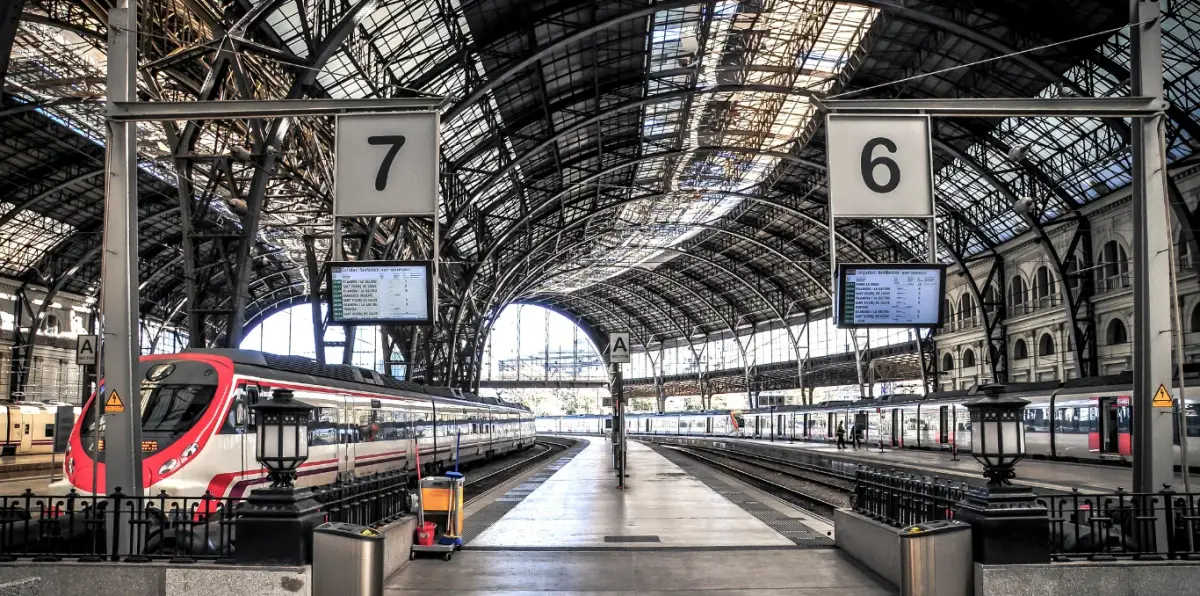

Most people ride the Barcelona metro without realising they pass abandoned platforms every day. Beneath the working network sit close to a dozen ghost stations, among them Gaudí, a station completed in 1968 that never carried a single passenger, and Correus, sealed since 1972 with period advertising still hanging on its walls. The system opened on 30 December 1924, sheltered thousands during the Civil War, and now runs three driverless lines, which makes it one of the most layered pieces of underground heritage in Europe.
The ghost stations still beneath your feet
Barcelona preserves the remains of around a dozen ghost stations across the metro, FGC and Rodalies networks, and at least three of them are genuine time capsules. According to the archives of the Fundació TMB, some never opened because they sat too close to neighbouring stops, while others were closed when their lines were extended. From a moving train, if you watch carefully, you can still catch their darkened platforms for a second or two.
What hidden secrets does the Barcelona metro hold? The Barcelona metro, opened in 1924, holds around a dozen ghost stations such as Gaudí, Correus and Banc, tunnels used as air-raid shelters during the Civil War, a 256-metre interchange at Passeig de Gràcia, and line L1 built with wider tracks because of its railway origins. Lines L9, L10 and L11 run with no driver.
Gaudí, the finished station that never opened
Gaudí station holds the rare distinction of being fully completed without ever receiving a passenger. Built in 1968 beneath the avenue of the same name, between Sagrada Família and Sant Pau/Dos de Maig on line L5, it was meant to belong to the original L2 under the name Sagrada Família. A change of route left it just 200 metres from the Sagrada Família stop, when the average distance between stations is around 600 metres, so it was never inaugurated. Its concourse now houses the Espai Gaudí and the offices of the TMB retired workers’ association, and its intact platforms are visible as L5 trains pass. It sits beside the basilica covered in the Sagrada Família inside guide.
Correus, frozen since March 1972
Correus is the most storied of all. Located between Jaume I and Barceloneta on line L4, it operated from 1934 to 1972, when it closed as the line was extended toward Barceloneta. It lost its street access, today only hinted at behind a ventilation grille, and inside it still keeps tiles, old advertising and even period election posters. For the centenary, TMB opened it for the first time in more than half a century, with late-night visits that required walking along the track from Jaume I because the station no longer has an entrance of its own.
Banc, the station behind the bank legend
Banc station feeds one of the network’s most persistent urban legends. Built around 1911 beneath Plaça d’Antoni Maura on Via Laietana, with trains running past from 1926, it never opened to passengers because it sat too close to Urquinaona and Jaume I. The legend claimed a tunnel connected it to the vault of the Bank of Spain to move the metro’s takings at night. The reality is duller, it simply became obsolete before it could open and now serves as technical space. This area is reached from the Gothic Quarter, one of the city’s historic cores.
A network born in 1924 from two rival companies
The Barcelona network grew out of competition between two companies rather than a single plan. The first stretch, opened on 30 December 1924, linked Lesseps and Catalunya and belonged to the Gran Metropolitano de Barcelona, today part of the green L3. In parallel, the Transversal metro, the current red L1, opened a first stretch of barely four kilometres. The two firms built separate lines for decades before merging into the network used today.
The mark of that rivalry still shapes the system. Line L1 was laid as the Transversal railway with an old Iberian track gauge, around 1,672 mm, different and wider than the rest of the network. The reasoning was strategic, to connect the city’s main train stations and let Renfe trains run on its tracks if needed. That is why, even now, the tunnels and trains on the red line are visibly wider. To understand how these lines combine in practice, the Barcelona public transport guide breaks down the day-to-day network.
The metro as a Civil War air-raid shelter
During the Spanish Civil War, between 1936 and 1939, the metro became the largest and safest air-raid shelter in Barcelona. Several stations and tunnels protected thousands of people from the bombing, and in some cases benches, lighting and basic services were installed for those spending alarm nights underground. The L1 tunnels, unusually wide because of their railway origin, even allowed trains to be parked inside so people could sleep in the carriages.
That sheltering role left a mark still woven into the city’s story. Central stations such as Plaça Universitat and Passeig de Gràcia are among those that gave refuge, and the episode ties the metro to the memory of a bombed Barcelona, a chapter that also surfaces in the city’s hidden places guide. The metro did not only move people, it kept them alive underground.
The structural quirks a million daily riders walk past
Beyond the ghost stations, the metro hides structural quirks that escape more than a million daily riders. The most talked-about is the Passeig de Gràcia interchange, a corridor of around 256 metres connecting lines L3 and L4 and the longest walk in the entire network. Its length is not a design error but a detour forced by an underground car park that blocked any more direct passage.
There are more details that break the routine. On line L2, between the Monumental and Paral·lel stretches, trains run on the left, the opposite of the rest of the network, something almost no rider notices. Three stations sit almost at street level, Mercat Nou and Santa Eulàlia on L1 and Can Boixeres on L5, which is very rare for a metro. The only entrance that keeps its original 1920s design, with its spiral staircase, is Urquinaona. And since 1982 station names have been written officially in Catalan, a change that cemented the identity of the signage. These corners fit the spirit of the secret spots in Barcelona guide.
Legends, Rocafort and the metrosurf myth
The Barcelona metro accumulates as many legends as verifiable facts, and the two are worth separating. Rocafort station, on line L1, carries a reputation as a “cursed station” after a wave of suicides in the 1930s, and staff claim to have seen figures walking the platform on security cameras after the last train. There is no evidence of any paranormal phenomenon, but the story is part of the city’s popular folklore.
Another recurring legend is the phantom train, a white, driverless convoy said to roam the abandoned stations at night. The myth feeds on real practices such as the 1980s metrosurf, when some young people climbed onto the carriage roofs at Plaça Catalunya, a recklessness that caused several deaths. Against these stories, the gravest documented incident is entirely real, the crash on 30 October 1975 at Virrei Amat, with two dead and more than 200 injured when two trains collided after a brake-system failure.
Records of the Barcelona metro
The Barcelona underground holds several records that help convey its scale, with close to 190 stations and more than 150 kilometres of track. According to TMB, the network logged over 400 million validations in 2018, with more than a million daily users, and L1 is the busiest line against the small L11, the least used. The table gathers the most cited figures.
| Record | Figure | Detail |
|---|---|---|
| First stretch | 30 December 1924 | Lesseps to Catalunya, today L3 |
| Longest interchange | 256 m | Passeig de Gràcia, between L3 and L4 |
| Station never opened | 1968 | Gaudí, finished and never used |
| Most storied ghost station | 1934-1972 | Correus, on line L4 |
| Worst accident | 30 October 1975 | Virrei Amat, 2 deaths |
| Busiest line | L1 | The most used in the network |
| Least used line | L11 | 2.3 km and five stations |
| Annual validations | 400 million-plus | 2018 figure |
Pioneering engineering, from the giant tunnel to driverless lines
The Barcelona network has been a European pioneer in engineering, to the point of giving an international name to a construction method. Automation is now its most advanced frontier, with three lines running without a driver. According to TMB, the L9 and L10 form the longest automated metro line in Europe, connecting Barcelona with Badalona, Santa Coloma de Gramenet, L’Hospitalet and El Prat de Llobregat, removing historic mobility barriers on the periphery.
Three technical advances sum up that leap to the cutting edge.
- The Barcelona Method — a single large-diameter tunnel, bored with a tunnel boring machine, carrying trains on two stacked levels, which minimises disruption on narrow streets
- Platform screen doors — barriers synchronised with the arriving train on the automated lines, an essential requirement for driverless running and for preventing falls onto the track
- Control from La Sagrera — the Metro Control Centre supervises the network 24 hours a day and injects extra trains in real time when demand rises
That same ambition runs deep. The 200 series, nicknamed the Pajaritos, was built in 1944 with technology inspired by the Berlin metro and was the first with a modern design in Spain. Today that legacy sits alongside the driverless technology that defines the newest lines.
Is it worth visiting the ghost stations
Yes, with conditions. The visits to Gaudí and Correus are an uncommon chance to step into heritage that is normally closed, and for anyone drawn to urban history or transport architecture they are hard to match. According to TMB, places are free but very limited and sell out in minutes, so they take planning and a little luck in the ballot.
It is not worth it if you expect a spectacular, comfortable visit. Correus is walked at night along the track, with no street access, and Gaudí is seen with L5 trains passing alongside, so it is not a conventional museum but a platform frozen in time. If your trip is short and does not match the opening calendar, glimpsing Gaudí from the train window is enough, or leave the metro as one more chapter within the best things to see in Barcelona guide.
The Barcelona metro in 2026
In 2026 the metro is still shaped by the afterglow of its centenary, marked across 2024 and 2025 as the network turned a hundred years since that first stretch in 1924. During the celebration, TMB opened eight normally closed spaces for the first time, among them the ghost stations of Gaudí and Correus, with more than 5,000 free places handed out through the official centenary website. The sheer demand crashed the servers on the first day of registration, which confirms the interest in the underground’s hidden heritage.
Looking just ahead, the major project remains the extension of L9 to the airport, a key connection detailed in the airport to city centre transport guide, alongside the technological conversion of L2 to join the automated model. The network, which began with barely 2.7 kilometres, enters its second century combining the preservation of its memory with the shift to driverless lines.
The city runs two different celebrations on the night of 31 October — the imported Halloween with its scream parks, and the older local one — and the Halloween and horror guide separates them.
Frequently asked questions about the Barcelona metro
How many ghost stations does the Barcelona metro have?
Barcelona keeps the remains of around a dozen ghost stations across the metro, FGC and Rodalies networks. The best known are Gaudí on line L5, Correus and Banc on line L4, and Ferran on line L3. Some never opened at all, like Gaudí and Banc, while others closed when their lines were extended, like Correus in 1972.
Can you visit the Gaudí ghost station in Barcelona?
Yes, but only on occasional guided visits. For the metro centenary, operator TMB opened Gaudí station on 4, 5, 25 and 26 October 2025, with free, limited places booked through obrimelmetro.cat. The station, completed in 1968 and never inaugurated, can also be glimpsed from L5 trains between Sagrada Família and Sant Pau/Dos de Maig.
When did the Barcelona metro open?
The Barcelona metro opened on 30 December 1924, with the Gran Metropolitano stretch between Lesseps and Catalunya, today part of the green L3. The project was approved in 1912 but stalled for lack of funding, and construction only began in 1921. It is one of the oldest metros in Europe, after London, Budapest, Paris and Madrid.
Why is line 1 of the Barcelona metro different?
Line L1 was built as the Transversal railway with an old Iberian track gauge, around 1,672 mm, wider than the rest of the network. The goal was to link the city’s mainline train stations and let Renfe trains run on its tracks if needed. As a result, the tunnels and trains on the red line are noticeably wider than on every other line.
Was the Barcelona metro used as an air-raid shelter?
Yes. During the Spanish Civil War, between 1936 and 1939, the Barcelona metro became the city’s largest air-raid shelter, protecting thousands of people from bombing. Some stations were fitted with benches, lighting and basic services, and the wide L1 tunnels even allowed trains to be parked inside so people could sleep in the carriages.
Which Barcelona metro lines have no driver?
Lines L9, L10 and L11 run fully automatically, with no driver and synchronised platform doors. The L9 and L10 together form the longest automated metro line in Europe, connecting Barcelona with Badalona, Santa Coloma, L’Hospitalet and El Prat. This automation accelerated after the network was modernised in the years following the 1992 Olympic Games.
Under every routine ride lies a century of bricked-up tunnels, platforms that never opened, and legends the city still tells in the dark.