
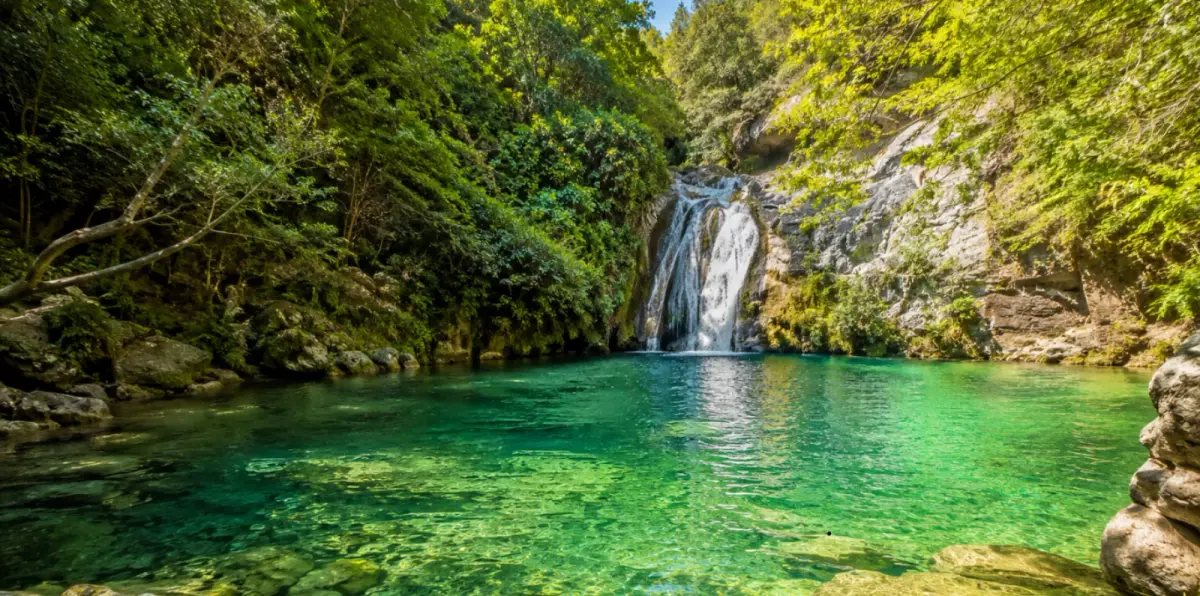

Picture the end of a forest path where the trees open onto a pool of cold, clear water, a waterfall spilling into it from the rocks above. That is a gorg, and on a July afternoon it beats any crowded beach. The catch is that half the people who drive out to one arrive to a sign they did not expect, because in a growing share of these pools swimming is now banned or tightly regulated, and turning up unprepared can mean a wasted trip or a fine.
Can you swim in the gorgs near Barcelona? It depends on the gorg, and that is the key. In many, swimming is allowed, but in a growing number it is banned or regulated with an eco-tax and booking to protect the environment. Before going, it is worth knowing where you can actually swim, how long the drive is and whether you need to pay for access. Most are 45 to 90 minutes from Barcelona.
Why swimming rules matter more than the drive
Start with what really decides the plan, because the single most useful thing about a gorg is not how it looks but whether you can get in the water, and a beautiful pool where you cannot swim is a long drive for a look. According to official data, a map compiles 50 gorgs across Catalonia with their swimming and access restrictions, and the trend is towards more regulation each season, not less.
According to experts in natural spaces, the picture breaks into three cases worth telling apart. Free-swimming gorgs, fewer every year. Regulated ones, where you can swim but paying an eco-tax and sometimes booking: the Gorg del Pare (around 1 hour, easy) allows swimming freely, while the 7 gorgs of Campdevànol (around 1.5 hours) allow it with a €6 eco-tax in high season. And banned or restricted ones, where you can only look or wade in parts: La Foradada (around 1.5 hours) bans swimming and charges a €2.50 eco-tax, the Montseny’s Gorg Negre and the Riu Tenes gorgs restrict it in parts, and the Riera de Merlès, which many lists sell as free swimming, has it banned along a 6-kilometre stretch. The growing fame of these spots on social media is exactly why restrictions keep tightening: too many visitors damage a fragile ecosystem. This kind of water escape complements the nature closest to the city in the Collserola natural park guide, and pairs well with the best time to visit Barcelona guide for choosing the right season.
The closest and most photogenic gorgs
Starting with the ones nearest the city, the Gorg del Pare is probably the best known, hidden in Mediterranean forest in the Sant Llorenç del Munt park, with a small waterfall and a clear pool just over 1 hour away. The Riu Tenes gorgs, near Sant Miquel del Fai, string together several pools and falls with views of the Cingles de Bertí, though swimming is restricted in some stretches. And the Gorg de les Donzelles, in the Moianès, stands out for its fairy-tale look and the legends of the dones d’aigua, the water nymphs that folklore says lived in these pools.
Rising in drama, the Montseny’s Gorg Negre, on the Gualba stream, is a very vertical waterfall surrounded by volcanic rock and lush vegetation, closer to jungle than to Mediterranean mountain. La Foradada, in Cantonigròs, offers a large pool beneath a natural rock arch with a waterfall over 15 metres, though swimming is banned and there is a €2.50 eco-tax to access. All of them are natural stops you can combine with one of the prettiest villages near Barcelona.
Multi-gorg routes for a full day
If you prefer a long hike over a single pool, some circuits link several. The Ruta dels 7 Gorgs of Campdevànol, near Ripoll, is the most famous: a circular route of about 10 kilometres connecting seven pools and waterfalls through forest, an hour and a half away by car. Swimming is allowed, but jumping from the rocks is banned, and in summer and at weekends access is regulated with a €6 eco-tax per person and limited capacity. The Riera de Merlès, between Osona and the Berguedà, is a river stretch with dozens of pools where you can spend the whole day, respecting the banned stretch.
Further out, for anyone willing to drive a little more, the Garrotxa region holds some of the most photogenic gorgs, like the Molí dels Murris in Les Planes d’Hostoles or the Sant Aniol gorgs, though swimming has been banned for years in several to preserve them. The turquoise pools of the Llobregat beneath the Pont de Pedret, a 13th-century Romanesque bridge near Berga, also stand out, mixing historic scenery with river swimming. Many of these corners lie near destinations like Girona, easy to combine in the same trip.
Tips for a trouble-free visit
Before setting off, 5 things make the difference. Go early, especially on summer weekends, because car parks fill up fast and many gorgs have a capacity limit. Check whether access needs booking or an eco-tax, since a growing number of gorgs cap visitors. Always respect the signs on swimming, because it is not allowed in every pool and fines do exist.
As for kit, shoes with good grip or trekking sandals are essential, because the rocks by the water are slippery. Bring water and some food, since many gorgs have no fountains or services, and take your rubbish back. And out of respect for the environment, never use sunscreen or soap in the water, which pollute the pool. With these precautions, a gorg is one of the best-value plans of the summer, fitting easily within the Barcelona travel budget guide for how little it costs.
Only 13 inland bathing areas in all of Catalonia have official water-quality control against 256 on the coast, and swimming near dams and canals is banned outright — the ground rules of the lakes and reservoirs guide.
Frequently asked questions about the gorgs near Barcelona
Can you swim in the gorgs near Barcelona?
It depends on the gorg. In many, swimming is allowed, but in a growing number it is banned or regulated to protect the environment. At the 7 gorgs of Campdevànol swimming is allowed with a €6 eco-tax per person in high season, while at the Gorg de l’Olla (known as Gorg de la Sort) or in stretches of the Riera de Merlès it is banned. It is worth checking local signs before getting in the water.
Which are the closest gorgs to Barcelona?
The Gorg del Pare, in the Sant Llorenç del Munt park, is just over an hour away by car and one of the best known. The Riu Tenes gorgs, near Sant Miquel del Fai, and the Montseny’s Gorg Negre are a similar distance. Most gorgs in the province are 45 to 90 minutes from the city, which makes them ideal for a day trip.
Do I need to book to visit the Campdevànol gorgs?
In high season, yes. The 7 gorgs of the Torrent de la Cabana, near Ripoll, have regulated access in summer and at weekends, with a €6 eco-tax per person paid at the entry point and a limited capacity that may require booking online in advance. Parking in high season costs around €10 a day. Off-season, access is usually free and open.
What should I bring to visit a gorg?
Shoes with good grip or trekking sandals are the most important thing, because the rocks by the water are usually wet and slippery. Bring water, some food, swimwear and a towel if you plan to swim, and a bag for rubbish. Do not use sunscreen or soap in the water, as they pollute the pool, and it is essential to respect the signs on swimming and access.
Near Barcelona, the best gorg is not the prettiest in the photo, but the one where they actually let you swim.