
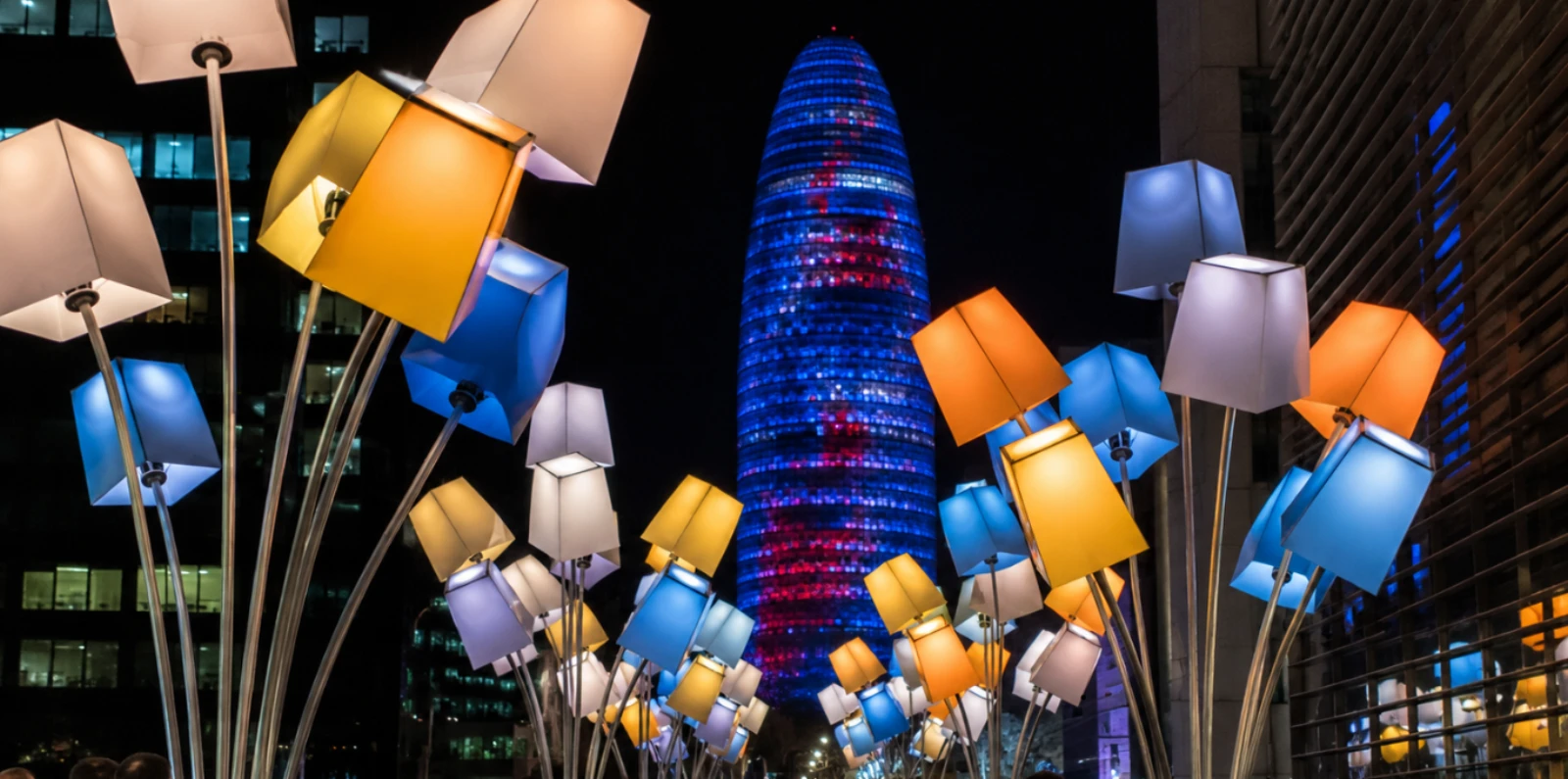

Llum BCN began in 2012 as a pair of lit courtyards in the Gothic Quarter, folded into the programme of a saint’s day festival. Fourteen years on it fills a triangle of Poblenou streets with around thirty large-scale installations across three February nights, draws roughly 300,000 people and charges nothing. The decision that made that scale possible came in 2018, and it meant walking away from the most photogenic quarter in Barcelona on purpose.
Two courtyards in the Gothic Quarter, and then a factory district
The early editions were modest and geographically hemmed in. Installations sat in Sant Felip Neri square and the Rubió i Lluch gardens, then expanded into buildings like the Casa de l’Ardiaca and the city history museum. The programme grew, the audience grew faster, and the medieval street grid stopped coping.
What is Llum BCN and when does it happen? A free light-art festival held over three nights each February in Barcelona’s Poblenou district, run by the city’s culture institute. Around thirty main installations combine professional artists with student work from local design schools. The 2027 edition runs 5 to 7 February. Hours are 19:00 to midnight, and Sunday to 23:00.
The seventh edition, in 2018, moved the whole thing to Poblenou. It was the most ambitious programme to date and roughly doubled both the number of installations and the budget against the previous year. The stated reason was crowd management: Ciutat Vella had become a queue.
The move also severed the festival from Santa Eulàlia, the winter patron saint celebration it had grown out of. They are separate events now, and in some years they do not even share a weekend.
Why leaving the old city was the right call
Narrow medieval alleys are hostile to large-format light art. Projection needs throw distance, and a facade six metres from the opposite wall gives you none. Poblenou supplies the opposite condition.
The district was Barcelona’s industrial engine in the nineteenth century, dense enough with textile mills and chimneys to earn the nickname Catalan Manchester. What survives is a stock of blank factory walls, high chimneys, vacant plots and wide orthogonal streets. Layered on top sits the 22@ technology district, all glass office blocks and contemporary facades.
That collision is the festival’s actual subject. A projection mapped onto a brick chimney from 1890 and a laser cutting across a glass tower built in 2010 are not the same gesture, and the programme uses both deliberately. The Poblenou neighbourhood guide covers what that landscape looks like by daylight, and the creative district walking route traces the industrial remains still standing.
There is a civic argument too. Pulling tens of thousands of people east on three winter nights spreads visitor pressure away from a saturated centre, in a month when the city needs the footfall.
The international curator who changes every year
This is the structural detail that explains why Llum BCN feels different edition to edition, and almost nothing written about the festival mentions it.
Alongside the artistic director, each year brings in a guest international curator drawn from another European light festival. The 2025 edition was curated by Martin Pošta, co-founder of Prague’s Signal Festival. The 2026 edition brought in Birgit Lill-Schnabl, who runs Klanglicht in Graz, Austria.
The effect is deliberate cross-pollination. A curator arriving from Prague brings a different roster and a different sense of what a light installation should do than one arriving from an Austrian sound-and-light festival. Where a fixed curatorial team would settle into house style within a few years, this rotation keeps resetting the aesthetic.
For a returning visitor that matters. The venues repeat, the map barely moves, but the programme is genuinely a different proposition each February rather than the same festival with new titles.
Eighteen university schools build about half the programme
Around 18 university-level design, art and architecture schools contributed to the most recent edition, against 12 professional artists. By headcount, the student programme is the larger half of the festival.
Barcelona has the institutional density to sustain this: Elisava, BAU, IAAC, ESDI and the architecture faculty among others, plus specialist lighting design programmes. Their students design, build and install real pieces in public space, with real budgets, real deadlines and real audiences of tens of thousands.
The work reads differently from the professional commissions. Student installations tend to be smaller, more conceptual, more willing to fail interestingly. They occupy courtyards, plots and side streets rather than monumental facades. Anyone who finds the headline pieces too polished usually prefers this half.
The festival also runs a professional strand of talks and encounters during the weekend, which turns the event into a recruiting and networking floor for the lighting design sector. That combination of public spectacle and industry gathering is unusual at this scale.
Fifteen editions in numbers
The trajectory is easier to read as a table than as prose. Official data from Barcelona City Council and its culture institute underpins each row.
| Edition | Dates | Professional artists | University schools | Curatorial note |
|---|---|---|---|---|
| 12th | 3-5 February 2023 | 13 | 15 | Around 30 installations, energy and climate themes |
| 14th | 7-9 February 2025 | 15 | 17 | Guest curator Martin Pošta, Signal Festival, Prague |
| 15th | 6-8 February 2026 | 12 | 18 | Guest curator Birgit Lill-Schnabl, Klanglicht, Graz |
| 16th | 5-7 February 2027 | n/a | n/a | First edition under new artistic direction |
Attendance tells the same story. The ninth edition counted around 190,000 visitors. By 2024 the figure had reached 240,000, and the following year approached 300,000. Roughly a sixty per cent increase in five years, on a footprint that has barely expanded.
Is Llum BCN worth building a February trip around
Verdict: yes if you are already choosing between February weekends, no as a standalone reason to fly. Three nights of free outdoor art is a strong anchor for a city break, but it is three nights, and the works are ephemeral by design.
The case for it is the combination. February is low season, hotel rates sit below the spring rebound, and the queues at the major monuments are at their annual minimum. Adding a festival that costs nothing to a month that is already the cheapest window makes the arithmetic work. The best time to visit Barcelona guide sets out that seasonal picture in full.
The case against is honest enough. Poblenou in February at 22:00 is cold, flat and exposed, and the walking distances between installations are real. If large-scale digital art leaves you cold, five hours of it will not convert you, and the same money buys a lot of museum in daylight.
One practical point that decides the experience. Only three of the roughly thirty main installations sit indoors, which is a deliberate choice to keep queues down. Ninety per cent of the festival is walked, not queued, and the pieces that do form lines are identifiable in advance.
Dates for 2027 and a change at the top
The sixteenth edition is confirmed for 5, 6 and 7 February 2027, around the Disseny Hub and Poblenou, according to official information published by Barcelona City Council.
It arrives with new leadership. Architects Xevi Bayona and Núria Prieto hold the artistic direction for the 2026 to 2029 cycle, awarded by the culture institute through a public competition judged on artistic, professional and sustainability criteria.
One correction is needed here, because several accounts get it wrong. The 2026 edition was directed by Maria Güell, who had led the festival since 2019 and was stepping down. The competition to replace her accepted applications until 17 February 2026, nine days after that festival closed. Bayona and Prieto’s first edition is therefore 2027, not the one before it.
For anyone assembling a February itinerary, the festival slots alongside the rest of the Barcelona festivals calendar, and the Disseny Hub that anchors it is worth a daytime visit independently of the light programme. Newcomers to the city will find the wider orientation in the first-time visitor guide.
Frequently asked questions about Llum BCN
How much does Llum BCN cost to attend?
Nothing. Every installation is free and no booking exists. The festival is funded by Barcelona City Council through its culture institute, with technology sponsors supplying projection equipment for specific pieces. The only limit is capacity in the handful of indoor venues, which can mean a queue.
Where exactly does Llum BCN take place?
In a triangle of Poblenou streets bounded by Avinguda Meridiana, Plaça de les Glòries and the Parc del Centre del Poblenou, with the Disseny Hub as the hub. Tram line T4 runs through it. Metro access is Glòries on L1, or Llacuna and Bogatell on L4.
How does Llum BCN compare to other European light festivals?
It is smaller than Lyon’s Fête des Lumières but more experimental in structure. Roughly half the programme comes from university design schools rather than established studios, and the international curator changes every edition, so the character shifts year to year rather than settling into a formula.
Can you see Llum BCN in one evening?
One of the three routes, comfortably, in three to four hours. All three in a single night means walking around six kilometres and arriving at the final works near closing. Two nights covers the main programme plus the parallel Off Llum circuit without rushing.
Is Llum BCN suitable for children?
Yes, and many installations are interactive by design. The constraint is timing rather than content, since the festival runs from 19:00 to midnight on Friday and Saturday. The Sunday session ends at 23:00 and is the least crowded of the three.
A festival that traded the cathedral for a factory district, and found its subject in the swap. The backdrop was never decoration.