
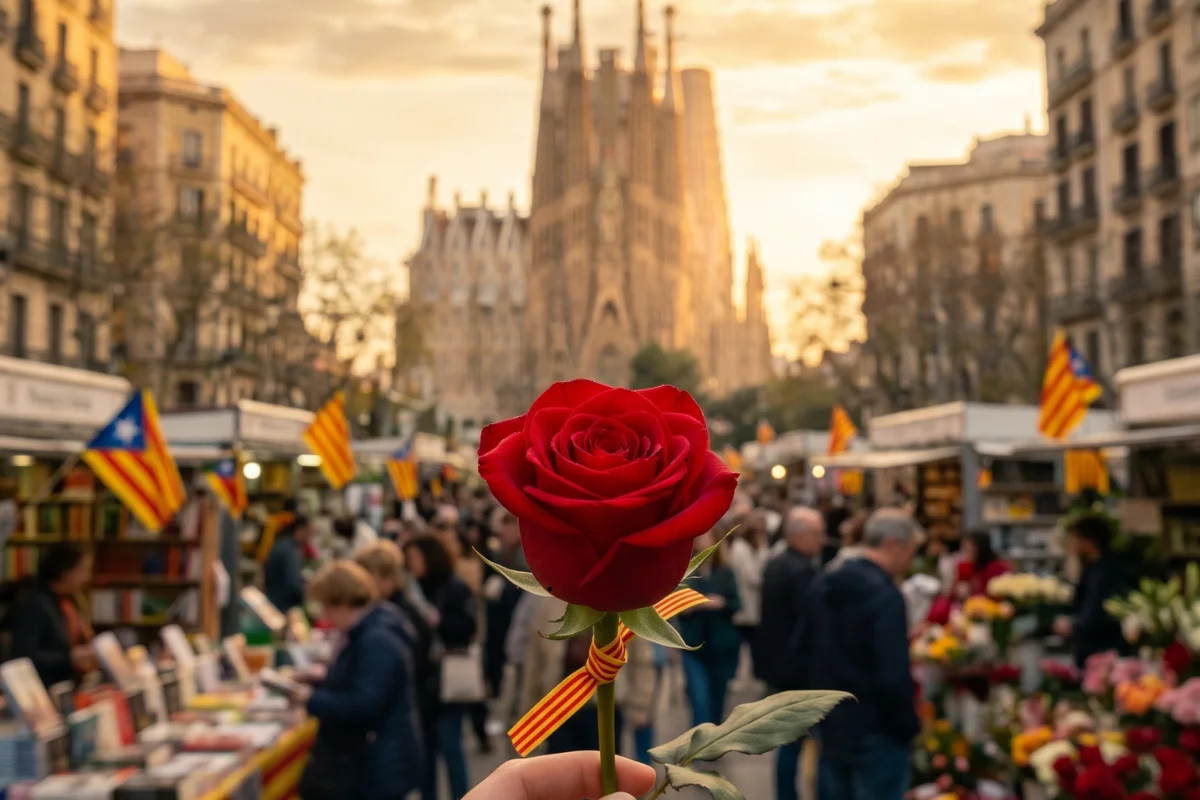

April 23 is not a public holiday in Catalonia. It’s a working Tuesday in 2026 — and yet Barcelona shuts down the Eixample to traffic, lines up millions of books and roses along its main boulevards, and generates more book sales in a single afternoon than most cities see in a month. Sant Jordi is the day the city turns itself into an open-air library and flower market simultaneously, with author signings, free access to buildings that are normally closed, and crowds that peak hard between 5pm and 8pm when offices empty out.
If you’re in Barcelona on April 23, knowing what’s where and when matters more than it sounds — the difference between a memorable afternoon and two hours of shoulder-to-shoulder gridlock is mostly a question of timing and neighbourhood choice.
The numbers give the scale: around 2 million books and 7 million roses sold citywide, representing roughly 20% of Catalonia’s entire annual book revenue in one day. The Barcelona festivals calendar has nothing else that concentrates this much economic and cultural activity in a single afternoon.
What Sant Jordi Actually Is
The rose tradition dates to 15th-century Barcelona. The legend places Sant Jordi (Saint George) in the Tarragona town of Montblanc, where a dragon demanded human sacrifices. When the king’s daughter was chosen, Sant Jordi killed the dragon — and from its blood, a red rose bush grew. Sant Jordi cut the finest rose and gave it to the princess. That’s the origin of the gift.
The book tradition came later and from a completely different direction. In 1930, writer Vicente Clavel fixed April 23 as Book Day in Spain because it coincides with the death of both Cervantes and Shakespeare. Barcelona — which already had a deep street-fair culture around Sant Jordi — absorbed the book tradition into its existing rose celebration. UNESCO made it World Book Day in 1995, citing the Catalan tradition specifically as the model.
The result is a festival that combines a medieval chivalric legend, a literary commemoration, and a street-fair infrastructure that Barcelona has been running for decades. No other city has this combination.
Quick Decision — How to Approach the Day
- Want the full experience without the worst crowds → arrive in the centre before 11am or after 8pm — the 5pm–8pm window when offices close is when streets become genuinely difficult to move through
- Looking for a specific author signing → check the official programme a week in advance — popular authors at Passeig de Gràcia, Fnac and El Corte Inglés generate 2–4 hour queues; arrive 30–45 minutes before the published time
- Want to visit buildings that are normally closed → Palau de la Generalitat (1pm–8pm, advance online booking required) fills up days ahead; Ajuntament de Barcelona (10am–8pm) is free entry without booking
- Travelling with children → outer districts have family programming without the centre’s pressure; Passeig de Sant Joan specialises in comics and children’s literature; go before noon
- Want quieter stalls with the same selection → Gràcia, Poblenou, Sants and Poble Sec all have full stall programmes with a fraction of the Eixample’s foot traffic
- Arriving by public transport → metro only within the Superilla perimeter; L1, L3 and L4 cover all Eixample and old town access points; avoid Passeig de Gràcia station between 5pm and 8pm
The 2026 Superilla Literària — What Changed and Where
In 2026 the main change is the full pedestrianisation of the Passeig de Gràcia — Rambla de Catalunya axis plus the block between Balmes and Pau Claris, from Diagonal down to Gran Via. Three kilometres of continuous car-free space with 400+ stalls running without interruption.
Carrer d’Aragó and Carrer de València stay open as through-traffic arteries to prevent total gridlock. Bicing stations inside the perimeter go offline from 10pm the night before.
Passeig de Sant Joan runs a separate programme focused on comics and children’s and young adult literature — less saturated than the main axis and worth knowing if you’re navigating with kids or just want less density.
The old town — Portal de l’Àngel and Plaça de la Catedral — absorbs stalls displaced by the ongoing La Rambla renovation works. High concentration but more manageable than the Superilla. This zone sits closest to the historic buildings opening their doors.
What Sant Jordi does to the city’s institutional buildings
Sant Jordi looks like a street fair from outside. The more interesting part is what it does to the city’s institutional architecture for one day.
The Palau de la Generalitat — Catalonia’s seat of government, 15th-century Gothic construction, normally inaccessible — opens its courtyards and ceremonial rooms to anyone who books ahead. The Ajuntament’s Saló de Cent, where the Consell de Cent governed Barcelona from the 14th century, is open all day. The Recinte Modernista de Sant Pau runs a swing jazz session inside the UNESCO World Heritage Domènech i Montaner complex from 9:30am.
These are not tourist attractions that happen to open during Sant Jordi. They’re working government and heritage buildings that make a point of becoming public space on this specific day. That’s a different category of access from what you’d get on a standard visit.
The Palau de la Música — the only UNESCO World Heritage concert hall in the world — is in the same neighbourhood and worth combining if you’re already in the Gothic Quarter end of the route.
Buildings Open on April 23
| Building | Hours | Access | What’s Inside |
|---|---|---|---|
| Palau de la Generalitat | 1pm–8pm | Advance online booking | Pati dels Tarongers, Sala Daurada, Sant Jordi chapel |
| Ajuntament de Barcelona | 10am–8pm | Free, no booking | Saló de Cent (14th century), Mayor’s office |
| Recinte Modernista Sant Pau | 9:30am–6:30pm | Online booking by time slot | Modernista pavilions, swing jazz session |
| Palau Güell | 10am–8pm | Invitation via official website | Gaudí’s first major Barcelona commission |
| Biblioteca de Catalunya | 10am–7:30pm | Guided visits, advance booking | Archives, Pompeu Fabra reading room |
| Ateneu Barcelonès | 11am–8pm | Free entry | Romantic garden, poetry readings 12pm–1:30pm |
| Pavelló Mies van der Rohe | 10am–8pm | Free entry | Reading space, silence — rare during Sant Jordi |
The Ateneu’s garden is one of the most overlooked spaces in central Barcelona on any day. On Sant Jordi it functions as a quiet counterpoint to the street-level chaos — worth knowing about if the crowds become too much. It is the one day the garden needs no reservation; the other 364 are covered in the Ateneu Barcelonès visiting guide, tour times and the 3 € ticket included.
Casa Batlló and the Dragon Architecture
Casa Batlló is the building where Gaudí embedded the Sant Jordi legend into the architecture itself. The roof represents the dragon’s back in ceramic scales; the tower with its four-armed cross is Sant Jordi’s sword driven into the beast; the balconies shaped like masks evoke the skulls of the dragon’s victims.
On April 23 the facade is covered with over a thousand red roses — the most photographed image of the day on the city’s main boulevard. Entry queues are at their longest of the year; if you plan to go inside, book weeks ahead.
The Palau de la Generalitat has the oldest relief sculpture in the city depicting Sant Jordi on horseback killing the dragon — 15th century, main facade. The door handles in the interior courtyard are cast as dragon heads. The legend isn’t decorative in these buildings: it’s structural to the identity of the institutions that commissioned them.
For the full Gaudí context, the Gaudí route in Barcelona connects Casa Batlló with Park Güell, Sagrada Família and Casa Vicens in chronological order.
The Pa de Sant Jordi — Barcelona’s One-Day Bread
The Pa de Sant Jordi (Sant Jordi bread) was invented in 1989 by baker Eduard Crespo of Fleca Balmes, commissioned by the Barcelona Bakers’ Guild. The brief was to create something visually representing the Catalan flag that could be eaten on the day.
The structure is a rustic loaf with three interlaced doughs: one with sobrassada sausage (for the red stripes), one with emmental or parmesan cheese (for the yellow), and an outer layer with crushed walnuts. Cut in cross-section, the Senyera’s colours appear.
It went from a novelty in the late 1980s to a citywide obligation in the space of about ten years. Every artisan bakery in Barcelona has it available from the morning of April 23 — most sell out before noon. It pairs with charcuterie and aged cheese, which puts it directly in the tradition of Catalan food built around pork and preserved products.
Best Strategy by Time Available
If you have 2–3 hours in the morning (before noon): Start at the Recinte Modernista Sant Pau for the jazz session and stalls in the less crowded early window. Walk down to the Sagrada Família area — Taller del Patinete on Provença has good Sant Jordi programming nearby. Pick up Pa de Sant Jordi at a Gràcia bakery on the way back.
If you have a full afternoon (from 3pm): Book the Palau de la Generalitat weeks in advance for the 1pm slot. Combine with Ajuntament (no booking needed). Walk up the Rambla de Catalunya while stalls are still well-stocked. Be at Passeig de Gràcia for the 5pm–7pm light on Casa Batlló’s rose-covered facade.
If you’re visiting with children: Skip the Superilla centre entirely. Go to Passeig de Sant Joan for the comics and children’s literature zone, then to Gràcia’s Gran de Gràcia axis — quieter, with independent booksellers who know their stock. The Barcelona with kids guide has neighbourhood logistics for family navigation.
Mistakes to Avoid
- Going to Passeig de Gràcia metro between 5pm and 8pm — it becomes one of the most congested stations in the city; use Diagonal or Provença instead and walk the last stretch
- Arriving at the Generalitat without a booking — the building doesn’t accept walk-ins on Sant Jordi; slots fill days in advance and there’s no queue system at the door
- Expecting to browse stalls freely after 6pm in the Superilla — by late afternoon the density makes browsing impractical; the stalls are still there but moving between them takes significant time
- Bringing a bike or electric scooter into the pedestrian zone — €500 fine for riding in the Superilla perimeter; the Barcelona safety guide covers enforcement patterns in the city centre
- Underestimating the pickpocket situation — April 23 is the single highest-activity day for pickpockets in Barcelona; bag on the front, phone in an inner pocket, especially in the Gothic Quarter’s narrow streets
Who Sant Jordi Is For
The architecture visitor → prioritise Palau de la Generalitat and Ajuntament — buildings accessible no other day, free of charge, with context the Gothic Quarter guide can fill in before you go.
The book buyer → go to Gràcia or Poblenou instead of the Eixample — independent booksellers with curated stock, no crowds, same prices; the best bookshops in Barcelona has the permanent options for after the day.
The photographer → Casa Batlló between 5pm and 7pm with the rose installation catching the late light; Palau de la Música courtyard in the morning before crowds; Ateneu garden for the quiet contrast shot.
The first-time visitor to Barcelona → Sant Jordi on its own is worth planning a trip around; combine it with a 2-day itinerary using the Barcelona 2-day guide which accounts for the April 23 disruption to normal transport patterns.
The local or long-stay visitor → skip the Eixample entirely and go to whichever neighbourhood you know least — each district runs its own programme and the outer barrios are where the least-touristic version of the day still exists.
Sant Jordi works because it doesn’t require any infrastructure beyond a table and a permit. The city doesn’t need to organise entertainment — the books and roses create their own economy, and the people who sell them are the same ones who sell them the other 364 days of the year. What April 23 does is make the transaction public, repeated across every neighbourhood simultaneously, in a city that has been doing this long enough that it doesn’t need to explain itself.