
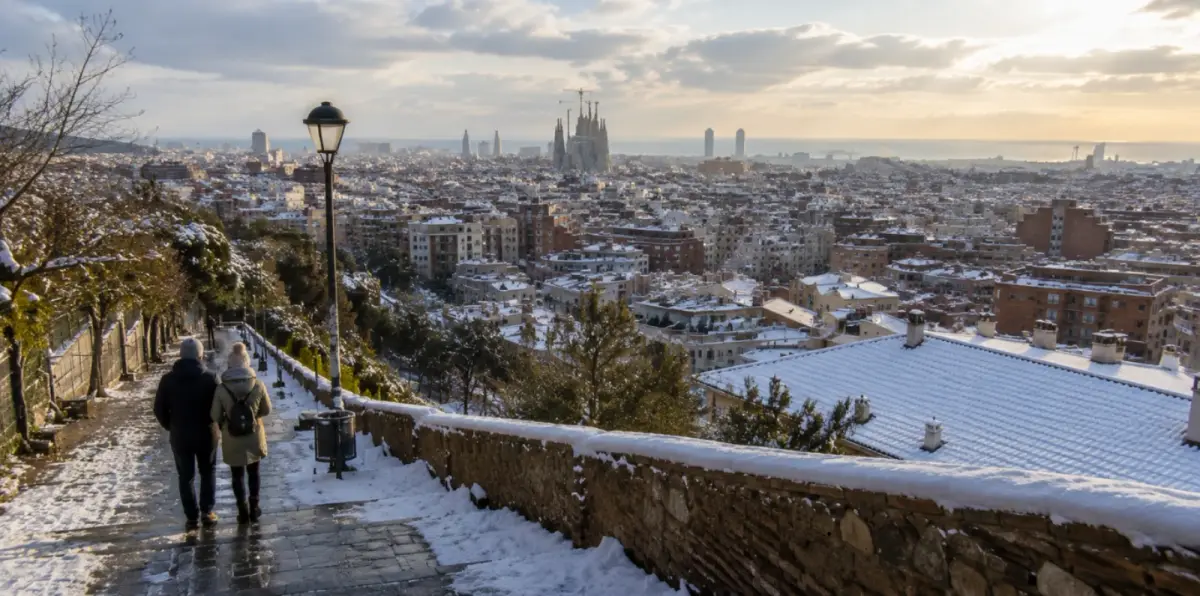

Sunset lands before 17:30 in December, and the shortest day of the year gives Barcelona just over nine hours of daylight. Official climate normals put actual sunshine at around five hours a day across the three winter months, with highs of 13-14 °C at sea level. Those numbers decide everything about how a trip here should be shaped, and almost no itinerary accounts for them.
Five hours of sun is the number that runs the day
Barcelona records 455 hours of sunshine between December and February at the airport station, which averages out at just over five hours daily. Temperature is not the scarce resource in a Catalan winter. Light is.
That changes the arithmetic of a city break. In July you can start at eight and still be outside at nine in the evening. In January the usable window runs roughly 11:00 to 17:00, and everything after that belongs indoors or under streetlights.
Two things follow. Museums and interiors should be scheduled for late afternoon, not mid-morning when the sun is doing its best work. And a three-day trip in winter delivers about two thirds of the outdoor hours of the same trip in June, which is worth knowing before you book four days and plan five.
The winter rhythm, start late and finish indoors
Mornings are the weak part of a Barcelona winter day, and locals treat them accordingly. Temperatures at 09:00 sit near the overnight minimum of 4.7 °C in January, and the low sun barely reaches into the narrow streets of the old city.
By 11:00 the picture has changed completely. Stone walls have absorbed a couple of hours of sun, terraces on the north side of the Eixample grid catch full light, and the difference between shade and sun on the same street can reach six or seven degrees.
The practical rule: book breakfast indoors, put the walking between late morning and mid-afternoon, and treat sunset as the signal to move under a roof. The Gothic Quarter walking route works better at noon in January than at any hour in August, when the same alleys trap heat.
One winter day in Barcelona, hour by hour
A sequence built around the light rather than the map. Roughly six hours, no rushing, no repeated ground.
- 10:00, breakfast indoors in Sant Antoni or Gràcia. Pastry and coffee for 4-6 € while the streets warm up.
- 11:15, Eixample on foot. The modernista block along Passeig de Gràcia takes the sun head-on until early afternoon.
- 13:00, set lunch. The menú del día runs 12-18 € Monday to Friday and is the single best value in the city.
- 14:30, seafront walk from Barceloneta. The flattest, brightest hour of the day, with the water at 13-14 °C and nobody on the sand.
- 16:00, one large interior. A basilica or a museum, timed for when the light outside starts to fail.
- 17:30, dark, and that is fine. Vermouth, an early dinner, or the lit facades of the old city.
The order matters more than the specific stops. Front-load the outdoors, back-load the roof. Reverse it and you spend the best light queuing indoors and the darkness walking. Anyone wanting the full inventory of options can work from the things to see in Barcelona list and slot alternatives into the same time slots.
Why the high viewpoints let people down
Fog is the winter risk nobody warns about, and it lives on the hill rather than in the city. The Fabra observatory in the Collserola range averages 12 foggy days across December, January and February. The airport station, at sea level, records 1.8.
That gap has a direct cost. Climbing for a panorama in winter carries roughly a 13 per cent chance of arriving to find the view swallowed while the streets below sit in clear sun. Collserola fog forms overnight and in the early hours, and usually clears by late morning.
So the Bunkers del Carmel and Tibidabo belong to the afternoon in winter, never to sunrise. Clear-air days with the Pyrenees visible on the horizon tend to follow a cold front, when northerly wind has scrubbed the haze out of the sky.
Dressing for 14 degrees that feels like 9
Layers beat thickness here, and the reason is humidity rather than cold. Frost falls on about four days across the entire winter, so a heavy coat spends most of the trip being carried rather than worn.
The gap between forecast and sensation opens on the waterfront. Fourteen degrees in a sheltered Eixample street is shirt-sleeve weather in the sun. The same fourteen degrees on the Barceloneta promenade, with sea wind and 70 per cent relative humidity, feels closer to nine.
A light waterproof outperforms an umbrella on this coast. Streets in the old city run narrow enough that umbrellas collide, and the wind that accompanies winter rain turns them inside out. Experts recommend one packable shell, one mid layer, and a scarf that lives in the bag until the seafront.
Footwear matters more than people expect. Old-city paving is stone worn smooth by centuries, and it turns genuinely slippery in the drizzle, particularly on the slopes around the cathedral.
Sea, snow and the three-hour train north
The Mediterranean-and-mountains pitch is real but the timing gets misquoted constantly. The train to La Molina in the Pyrenees takes about three hours, not the ninety minutes that circulates online.
Rodalies line R3 covers the 150 kilometres from Barcelona, running on single track north of Montcada, which caps both speed and frequency. A shuttle bus links the station to the slopes in around 10 minutes. By car the same trip drops to roughly two hours.
The combined Skitren ticket costs 53 € for adults and 41.50 € for children, covering the return train, the shuttle and a full day lift pass. Bought separately, the lift pass alone approaches that figure, so the transport is effectively free. According to official Renfe information, the Vall de Núria equivalent runs 47.70 € and includes the rack railway.
One warning from anyone who has done it. Return frequencies are thin, and missing a train can mean a three-hour wait in the cold. With nine hours of daylight, a departure before 07:00 stops being advice and becomes the only workable schedule. Milder alternatives sit in the hiking routes near Barcelona.
What shifts on the winter calendar in 2026
Three dated items worth holding on to.
The Renfe and Rodalies Skitren offer holds its pricing until 5 April 2026, which covers the full snow season. After that, transport and lift pass return to separate purchases.
The climate figures used throughout come from the 1981-2010 normal period published by Spain’s meteorological agency for both Barcelona stations. Recent winters have been running above those averages, so treat the numbers as a floor rather than a ceiling.
The rhythm of the season itself does not shift year to year, but the sweet spot is narrow and most visitors miss it. Christmas and the 5 January Three Kings parade keep the city busy and prices high. From 7 January, when the winter sales open and the crowds evaporate, until Santa Eulàlia in mid-February, Barcelona offers its best combination of low season pricing and empty streets. That window aligns closely with what the best time to visit Barcelona guide identifies, and it pairs well with the indoor options in the rainy day guide for the twelve days when precipitation does arrive.
Frequently asked questions about Barcelona in winter
Is Barcelona worth visiting in winter?
Yes for architecture, museums, food and walking. No for beach time. The city keeps around five hours of sun a day and highs of 13-14 °C at sea level, which is warm enough to stay outdoors between late morning and sunset without the summer heat or the summer queues.
Do I need a heavy coat for Barcelona in winter?
No. A mid-weight jacket over layers handles it, plus a scarf for the seafront. Frost falls on roughly four days across the whole winter. What catches people out is wind carrying sea humidity, which makes 14 °C feel closer to 9 °C on exposed promenades.
How early does it get dark in Barcelona in winter?
Sunset arrives before 17:30 around the solstice, and the shortest day runs just over nine hours of daylight. Barcelona sits at the eastern edge of its time zone, so evenings feel earlier than the latitude suggests. Plan outdoor stops for the 11:00 to 17:00 window.
The cold is not the constraint here. The clock is, and a trip planned around sunset gets more done than one planned around temperature.