
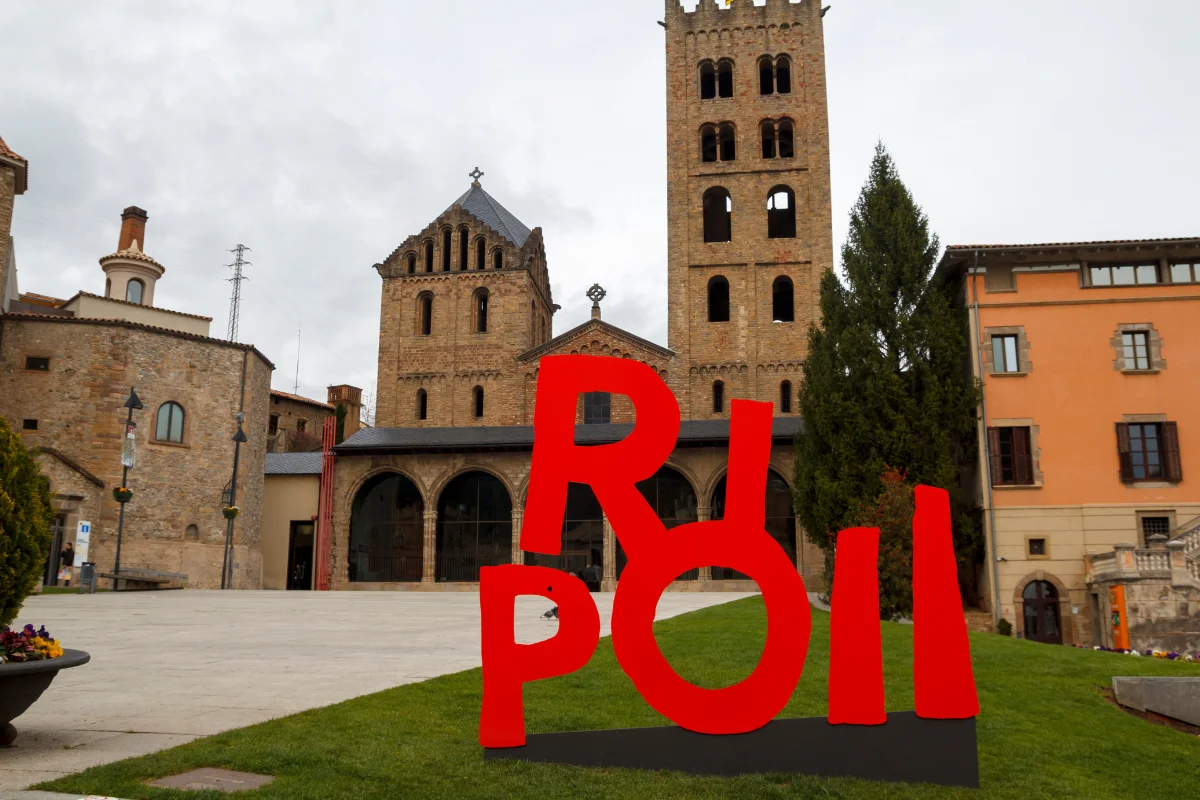

Ripoll is 1 hour 30 minutes from Barcelona on the R3 Rodalies train. It has a 9th-century monastery with the most elaborate Romanesque portal in Catalonia — seven horizontal bands of carved stone covering the complete theology of 12th-century Christian thought, a monthly agricultural calendar, scenes from the Book of Daniel and an enthroned Christ Pantocrator — and almost no tourists.
The contrast with the Sagrada Família queue or a summer weekend at Montserrat is pronounced. The monastery is fully accessible, the cloister is intact, and the explanatory material is serious enough to reward a visit without a guide.
Ripoll was also, in the 17th century, the principal centre of firearms manufacturing on the Iberian Peninsula. That industrial history is in the same building as the monastery: the Ethnographic Museum, opened in 1929 and considered the first of its type in Catalonia, occupies the square immediately outside.
The monastery portal: why it matters and how to read it
The Romanesque portal of Santa Maria de Ripoll was completed in the 12th century and is conceived as a Roman triumphal arch, not as a standard church entrance. The seven horizontal bands read from top to bottom, covering the complete theology of the period:
- Top band: Christ Pantocrator enthroned, surrounded by the Tetramorph (four evangelists in symbolic form) and the 24 Elders of the Apocalypse
- Middle bands: cycles of Saints Peter and Paul, scenes from Daniel (lions’ den), Jonah, Cain and Abel
- Lower bands: the agricultural calendar — a carved monthly record of medieval peasant life, including the pig slaughter, grape harvest and sowing
The detail that changes the visit: the stone is sandstone, and a combination of the “stone disease” (biological crust formation) and the 1835 fire has erased the original inscriptions and biblical text that guided the iconographic reading. Ask for the interpretation centre before you approach the portal. Without the explanatory context, the sculptural density is visible but not readable. With it, each band becomes a specific narrative.
Monastery hours: Monday–Saturday 10am–1:30pm and 3:30pm–6pm. The cloister and basilica are visited together.
Quick decision: how to structure your time in Ripoll
- One day from Barcelona by train → Monastery + Ethnographic Museum + old town walk — the R3 from Sants or Passeig de Gràcia takes 1h 30min; two hours at the monastery and one at the museum fills the day without rushing; pairs naturally with the day trips from Barcelona by train guide
- Combine Romanesque with walking → Ripoll + Sant Joan de les Abadesses by car — the monastery at Sant Joan is 10 minutes away by car, Romanesque-Gothic with the 1251 Descent from the Cross sculptural group, then the Iron and Coal greenway back
- Industrial history rather than religious architecture → Farga Palau + Ethnographic Museum — the water-powered iron forge explains how Pyrenean river engineering drove the peninsula’s main firearms manufacturing centre; the museum holds the 17th-century Ripoll gun collection
- Families and children → Scriptorium interpretation centre — workshops recreating medieval manuscript copying with goose quill on parchment, pedagogically adapted for different ages
- Senderismo after the cultural visit → Four signed viewpoint routes (Sant Bartomeu, Sant Roc, Santa Maria de Catllar, Sant Antoni de Morers) — elevation gains from 219 to 414 metres, marked as Local Trails with white and green markers; the easiest takes 1h 35min
- Two days → Ripoll + rack railway to the Vall de Núria — the rack railway running since 1931 covers 12.5 km rising 1,000 metres in 40 minutes using solar energy; the Núria sanctuary at the top has a mountain lake, hiking trails and a ski resort in winter
Inside the monastery: cloister, basilica and what the excavations found
The basilica has five naves and seven apses — the central apse deeper than the rest. It was consecrated in 1032 under Abbot Oliba. After earthquake damage in 1428 and the 1835 fire, it was rebuilt between 1886 and 1893 by architect Elies Rogent in Neoromanesque style.
The cloister has two levels with distinct historical periods. The lower gallery is pure 12th-century Romanesque — the only part that survived without major transformation. The capitals carry a fantastical bestiary: griffins, centaurs and double-tailed mermaids, designed for the monks who used the cloister, not for public view. The upper level (14th–16th century) is Gothic, with scenes from the Passion and the Golden Legend, including Sant Jordi.
The comital tombs: the transept and central nave contain tombs of the counts of Barcelona, including Guifré el Pelós himself. An archaeological excavation conducted between 1968 and 1976 — undertaken while searching for a Romanesque crypt beneath the high altar that turned out not to exist — discovered a necropolis of 65 tombs with remains up to 1,400 years old. No tourist guide mentions this with any specificity.
The scriptorium: between the 10th and 12th centuries, Ripoll’s scriptorium was the most important manuscript production centre in the Catalan counties. The Bibles of Ripoll — two illuminated volumes considered among the finest calligraphic works of Romanesque Europe — are now in the Vatican Museums. For visitors interested in comparable religious heritage in Barcelona, the Pedralbes Monastery offers a Gothic cloister of first-order importance accessible by metro.
The Ethnographic Museum: the industrial surprise
The Museu Etnogràfic de Ripoll, opened in 1929 as the first of its type in Catalonia, stands in the Plaça de l’Abat Oliba immediately adjacent to the monastery.
The part of the museum that gets skipped: its firearms collection. Ripoll was the principal producer of portable firearms on the Iberian Peninsula during the 17th century — a first-order European industrial position built on Pyrenean iron and the technique of the farga catalana (Catalan forge). The museum holds rifles, knives, swords and tools made with that steel, with the forging process documented.
The rural and pastoral collection — shepherds’ tools, agricultural instruments, 19th and early 20th century Pyrenean photographs — is one of the most complete in the region.
The Farga Palau and the Iron and Coal greenway
In the Almoina neighbourhood: Farga Palau, a 17th-century Catalan forge that operated for approximately 500 years using the Freser river’s current to power forging hammers. The system is pre-industrial water engineering: the water drives a wheel that powers a several-hundred-kilogram hammer striking iron at red heat.
The neighbourhood has interpretation panels explaining how iron metallurgy defined Ripoll’s economy and demographics for centuries — the city grew around fire, not faith.
The Via Verde del Ferro i Carbó (Iron and Coal greenway): the former mining railway converted into a walking and cycling route. 18 km connecting Ripoll with Ogassa and Sant Joan de les Abadesses at 1% gradient on the flat section and 3% ascending to Ogassa. An efficient combination of cultural visit in Ripoll with active travel to the next destination. Regular walkers who use the hiking near Barcelona network include it in Ripollès itineraries.
The scriptorium, and the Bibles that ended up in the Vatican
The Bibles of Ripoll are two 11th-century illuminated manuscripts — the Biblia de Ripoll and the Biblia de Rodes — produced in the scriptorium during the period when the monastery was the primary intellectual centre of the Catalan counties. Both are now in the Vatican Apostolic Library.
What makes this absence significant: the two most important objects produced at the monastery are in Rome, not in Ripoll. The interpretation centre addresses this directly, explaining the transfer history and showing high-resolution reproductions. But the fact that the scriptorium’s greatest output left the building eight centuries ago is part of the story of how Ripoll became a place that history moved through rather than stopped at.
Getting there and when to go
By train: R3 Rodalies from Estació de Sants or Passeig de Gràcia. Approximately 1 hour 30 minutes. No car needed for a Ripoll-only visit — the monastery, museum and old town are all within 10 minutes’ walk of the station.
By car: around 100 km from Barcelona via C-17 (Vic motorway). Approximately 1 hour 15 minutes without traffic. Necessary if combining Ripoll with Sant Joan de les Abadesses or the Vall de Núria rack railway.
Best season: spring and autumn — comfortable temperatures for the old town and marked routes, fewer visitors than summer. In August, Ripoll holds the Mercadal del Conde Guifré, a medieval recreation in the city centre. In October (around the 15th), the Fira de Santa Teresa is essentially the Catalan Sheep Fair.
What to eat: Ternera del Ripollès (local veal), mountain charcuterie (butifarra, bull) and moixaines — crunchy biscuits with nuts that are specific to Ripoll. Restaurant Reccapolis has a Michelin mention.
Comparison: Ripoll vs other Romanesque day trips from Barcelona
| Destination | Distance | Transit | Main draw | Crowd level |
|---|---|---|---|---|
| Ripoll | 100 km | R3 train, 1h30 | Portal, cloister, tombs | Very low |
| Montserrat | 55 km | R5 + rack railway | Natural park, monastery | Very high |
| Vic | 65 km | R3 train, 1h20 | Romanesque-Gothic cathedral, market | Low |
| Sant Joan de les Abadesses | 110 km | Car (10 min from Ripoll) | 1251 Descent from the Cross | Very low |
| Besalú | 130 km | Car or bus | 11th-century bridge, Mikvé | Low-medium |
For combining Ripoll with a second destination, Vic is 40 minutes by car with a Romanesque-Gothic cathedral at the same quality level. For train-based day trip planning, the excursions from Barcelona by train guide maps the full R3 line and what’s accessible without a car. And for visitors interested in Catalan medieval heritage across the region, the Besalú guide covers the other major Romanesque ensemble within a similar travel radius.