
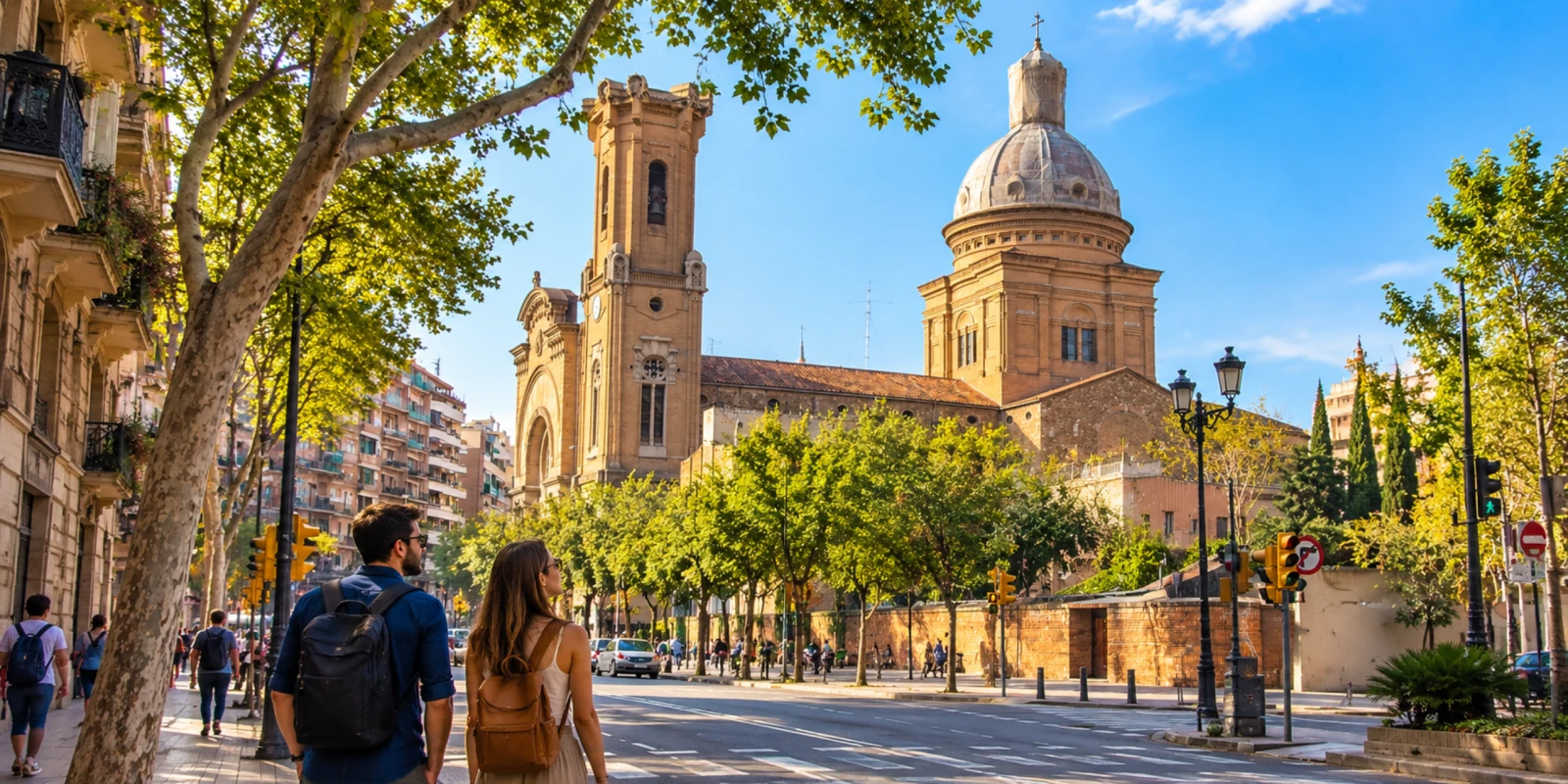

Sant Andreu de Palomar is the largest neighbourhood in Barcelona, with 59,330 residents, ahead of la Vila de Gràcia at 51,477 and El Raval at 50,863. It also appears in none of the city’s cultural rankings, while those two smaller neighbourhoods appear in all of them. What it has instead is an intact village centre you reach without changing trains: the L1 exit opens straight onto Plaça d’Orfila, where the church was finished in 1881 with a dome instead of spires. And the commercial census gives away how to plan a visit, because 137 bars make it a bar neighbourhood and restaurants do not reach the top five.
Why go to Sant Andreu de Palomar? It is Barcelona’s most populated neighbourhood, 59,330 residents, and the one least written about. Metro L1 opens onto Plaça d’Orfila and its 1881 church, and Carrer Gran de Sant Andreu runs up to the market in Plaça del Mercadal.
Getting there and what to walk
| Place | What it is |
|---|---|
| Plaça d’Orfila | The central square, where the metro exits |
| Sant Andreu church | Finished 1881, dome rather than spires |
| Carrer Gran de Sant Andreu | The commercial and historic spine |
| Plaça del Mercadal | Enclosed square holding the market hall |
| Fabra i Coats | Former thread factory, now an arts centre |
| Rambla de Fabra i Puig | Long promenade down towards Meridiana |
The practical detail that makes this an easy half day is the exit: metro L1 at Sant Andreu opens directly onto Plaça d’Orfila, so you arrive in the centre rather than on an edge. The Església de Sant Andreu de Palomar stands beside it, completed in 1881 on the site of a 10th-century Romanesque church, and it reads differently from the Gothic churches downtown because it carries a dome instead of spires.
From the square, Carrer Gran de Sant Andreu is the spine, running up to Plaça del Mercadal, an enclosed square with the neighbourhood market inside it. The other anchor is Fabra i Coats, a former thread factory turned into a creation factory with artist studios, exhibitions and concerts; the city’s whole network of them is in the creation factories guide.
For walking without crossing traffic, the two promenades are the Rambla de Fabra i Puig and the Rambla de l’Onze de Setembre.
Bars, not restaurants
| Activity | Active premises |
|---|---|
| Bars and internet cafes | 137 premises |
| Hairdressers | 108 premises |
| Health and care | 104 premises |
| Business services and offices | 103 premises |
| Construction trades | 100 premises |
This is the most useful thing to know before you go. Restaurants do not appear in the top five activities, which does not happen in El Raval, el Poble-sec, Sant Antoni or el Poblenou, where they lead or come second. Come for a drink and a long afternoon, not for a tasting menu.
The district trend runs the same way: Sant Andreu has gone from 439 restaurants to 222 and from 154 bars to 363 between two revisions of the commercial census, the second-largest growth in bars of any Barcelona district. Of the 2,055 premises registered in the neighbourhood, 1,852 are active and 203 are vacant, a 9.9 percent vacancy rate against the city’s 9.0.
Dinner is rarely served before 21.00 in this city, and in a bar neighbourhood that means the evening starts with a drink around 19.00 rather than with a table booking. Tipping is not expected either; rounding up the bill is the normal gesture.
Who lives here
| Neighbourhood | Average household income |
|---|---|
| El Poblenou | 64,824 euros |
| La Vila de Gràcia | 60,418 euros |
| Sant Antoni | 59,947 euros |
| Sant Andreu de Palomar | 55,881 euros |
| El Poble-sec | 45,978 euros |
| El Raval | 38,545 euros |
At 55,881 euros gross per household it sits just above the median for Barcelona neighbourhoods, mid-table among the profiled ones. The number to pay attention to is the internal spread, from 42,990 to 77,565 euros across its 39 census sections, a factor of 1.8 inside one neighbourhood, so an average tells you less here than elsewhere.
Those 39 sections are the most of any neighbourhood in the city, which follows from being the most populated. How the ten districts compare is in the districts guide.
The trees, and why the streets look different
5,017 street trees put it second in the whole city, behind la Dreta de l’Eixample’s 6,137 and ahead of Les Corts’s 4,949. The interesting part is the mix rather than the count, because no single species passes 16 percent: bitter orange leads with 786, the melia follows with 726, and the plane tree is only third with 685.
Citywide the plane tree is 27.6 percent of the canopy, and in el Poblenou it alone reaches 48.8 percent. Walking here in August therefore feels different, with shade spread across species rather than delivered by one avenue of planes.
There are also 54 drinking fountains, the fourth highest of any neighbourhood, behind el Poble-sec with 77, la Dreta de l’Eixample with 59 and el Besòs i el Maresme with 58. Tap water in Barcelona is safe to drink, and the fountain map is in the drinking water guide.
The festival on 30 November
The local festival falls on 30 November, for Sant Andreu, and it is one of 59 neighbourhood festivals with its own entry on the city’s popular culture site. None of those 59 except the Gràcia and Sants ones make it into the citywide festival calendar.
The festive procession comes down from Plaça del Mercadal along Carrer del Mercat and Carrer Gran de Sant Andreu, through Plaça del Comerç and Carrer de l’Ajuntament, and finishes at Plaça d’Orfila. That is the same route the neighbourhood shops on for the rest of the year, so if you only have one walk, this is it.
Two things that only make sense if you live here
Waste works differently here than in most of Barcelona. Sant Andreu de Palomar is one of the two neighbourhoods with door-to-door collection, along with Sarrià, so the bag goes outside your door on a calendar day rather than into a street container, and it also has pneumatic chutes. Both regimes are set out in the rubbish rules.
It also has one of the city’s seven zone recycling centres, which means rubble and furniture can be dropped off without leaving the district, something neither Ciutat Vella nor the Eixample can do. That map is in the green points guide.
A half day, in order
- Exit the L1 at Sant Andreu and you are on Plaça d’Orfila, facing the 1881 church.
- Walk up Carrer Gran to Plaça del Mercadal and the market.
- Look in at Fabra i Coats for whatever is on.
- End in a bar, because that is what this neighbourhood is for.
If it rains, the indoor options by district are in the rainy-day guide.
The biggest neighbourhood in Barcelona is also the least written about.
Frequently asked questions about Sant Andreu de Palomar
What is the largest neighbourhood in Barcelona?
Sant Andreu de Palomar, with 59,330 residents, first of the city’s 73 neighbourhoods. It is bigger than la Vila de Gràcia at 51,477 and El Raval at 50,863, both of which appear in every cultural ranking while it appears in none.
How do I get to Sant Andreu de Palomar?
Metro line L1 to Sant Andreu, whose exit opens directly onto Plaça d’Orfila, the square everyone meets in. From there the spine is Carrer Gran de Sant Andreu, which runs up to Plaça del Mercadal and the market hall.
Is it worth visiting Sant Andreu de Palomar?
If you want a working neighbourhood rather than a sight, yes. The church on Plaça d’Orfila was finished in 1881 and has a dome instead of spires, the Fabra i Coats factory is now an arts centre with exhibitions and concerts, and the market sits in an enclosed square.
Where should I eat in Sant Andreu de Palomar?
Plan around bars rather than restaurants. Bars and internet cafes are the neighbourhood’s first commercial activity with 137 active premises, and restaurants do not make the top five at all, which is unusual for a Barcelona neighbourhood of this size.
What is the average income in Sant Andreu de Palomar?
55,881 euros gross per household, just above the median for Barcelona neighbourhoods. The internal spread runs from 42,990 to 77,565 euros across its 39 census sections, a factor of 1.8 inside the same neighbourhood.
When is the local festival?
30 November, for Sant Andreu. The festive procession comes down from Plaça del Mercadal along Carrer del Mercat and Carrer Gran de Sant Andreu, through Plaça del Comerç, and ends at Plaça d’Orfila, which is the same route the neighbourhood shops on all year.
Population, commercial census, street tree register and income by census section from Barcelona’s municipal data; festival date from the popular culture site.