

On 20 February 2026, a crane lowered the final arm of a cross onto a tower above the Barcelona skyline, and a 144-year construction site quietly reached its full height of 172.5m. Most visitors who crane their necks at that tower never learn that it was built half a metre short on purpose, that the church became the tallest in the world only months earlier, or that almost every carving below it hides a number or a meaning. Antoni Gaudí built the temple to be read in layers, and the standard audio guide barely opens the first one.
What makes the Sagrada Família different from any other basilica? It became the world’s tallest church on 30 October 2025, passing Ulm Minster’s 161.53m. It has been under construction since 1882, funded only by donations, and nearly every element hides a religious meaning or a geometric experiment. Gaudí worked on it for over 40 years and is buried inside the crypt.
Quick guide by what draws you in
- Math and puzzle lovers → the magic square on the Passion facade — 4x4 grid, 310 combinations summing to 33
- Architecture and engineering → the branching stone columns inside — hyperboloid vaults, almost no straight lines
- Photographers → the stained glass at the right hour — blues until noon, reds and oranges after 16:00
- History readers → the 1936 fire and lost plans — the project was rebuilt from plaster models and photos
- First-time visitors short on time → the Nativity facade — the only major part Gaudí saw nearly finished
- Anyone tracking the 2026 milestone → the Jesus tower, completed outside on 20 February 2026 at 172.5m
The basilica just reached its final height after 144 years
On 20 February 2026 the top arm of the cross on the Jesus tower was set in place, and with that single piece the Sagrada Família reached its maximum height of 172.5m, 144 years after the first stone. This completed the exterior of the central tower, though not the building itself. The cross stands 17m tall and 13.5m wide, clad in white glass and glazed ceramic, and was manufactured in Germany before being assembled almost entirely above the nave.
The world-record claim has a precise date behind it. According to official temple data, the basilica passed Germany’s Ulm Minster on 30 October 2025, reaching 162.91m with the first piece of the cross, ahead of the 161.53m the German church had held for more than a century. The margin then was just 1.38m. Today, at 172.5m, it is comfortable. Experts recommend timing any rooftop or skyline photo of Barcelona around this new profile, since older guides still show the temple under scaffolding.
The magic square that adds up to 33, not 34
On the Passion facade, next to the scene of Judas’s kiss, sits a 4x4 grid that is the single most photographed detail of the whole temple. Any standard magic square of that size adds up to 34 across rows, columns and diagonals. This one adds up to 33, the traditional age of Christ at his death, and it gets there by cheating with style: it repeats the numbers 10 and 14 and drops 12 and 16 entirely.
Gaudí did not design it. It was added by sculptor Josep Maria Subirachs, who took charge of finishing the Passion facade from 1987. He started from the magic square Dürer engraved in his Melencolia of 1515, which summed to 34, and reworked it down to 33. The detail almost no one knows: there are 310 distinct four-cell combinations inside the grid that total 33, not just the obvious rows and columns. Symbol scholars also point to a hidden signature, where the repeated numbers read against the Latin alphabet spell out the letters INRI.
A height calculated not to beat the mountain
The Jesus tower stops half a metre short of Montjuïc on purpose. The hill sits at around 173m and the tower reaches 172.5m, and that gap is neither accidental nor a technical limit. Gaudí was explicit that no human work should rise higher than nature, which he understood as divine creation. It is one of those decisions you only appreciate once someone points it out.
The hierarchy of towers works like a vertical org chart of heaven. When the full set is complete there will be 18: twelve for the apostles, four for the evangelists, one for the Virgin Mary and the central one for Jesus. The four evangelist towers, finished in 2023, surround the central one and connect to it by bridges. The Mary tower, completed in 2021, is crowned by a twelve-pointed star that acts as a beacon over the Eixample at night. The apostle towers will each reach 135m. To see how this skyline sits within the wider city, it helps to map it against the best things to see in Barcelona.
The fruit changes with the season each facade represents
The baskets of fruit crowning several pinnacles are among the most photographed details that almost no one understands. They are not modernist decoration: they represent the fruits of the Holy Spirit and the passing seasons, and they change by facade. On the Nativity facade, facing east and tied to the start of life, you find spring and summer fruit such as cherries, loquats and peaches, spread across the 18 pinnacles of the design. On the Passion facade, linked to the end of the cycle, there are autumn and winter apples, figs and almonds.
There is a moral logic to how high they sit. According to temple scholars, the lower fruit tends to appear still green, standing for good works in progress, while the higher fruit is shown ripe, a symbol of works spiritually complete. Many were made in ceramic trencadís following models Gaudí left behind, now kept by the basilica’s foundation.
Inside it is a forest, not a Gothic nave
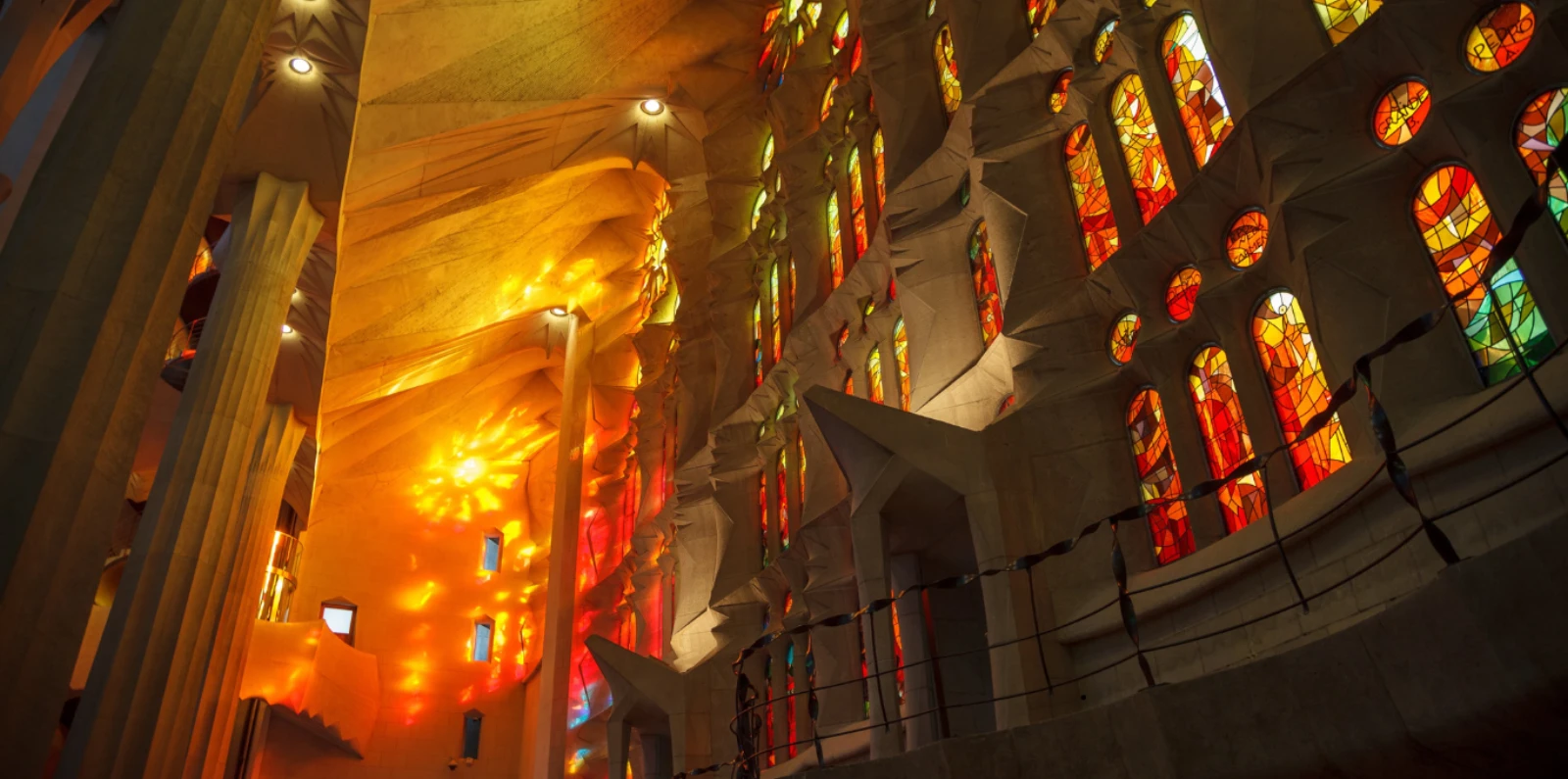
Gaudí did not want the interior to feel like a cathedral. He wanted a stone forest. The columns branch as they rise, like trunks opening into a canopy, and they hold up hyperboloid vaults that filter light the way leaves do. The line that sums up his method says it plainly: the straight line belongs to man, the curve belongs to nature. That is why the temple has almost no conventional straight lines inside.
The stained glass by Joan Vila-Grau turns that structure into a light show that shifts by the hour. Between 10:00 and noon, light enters from the east side and the cool blues and greens of the Nativity facade dominate. After 16:00, the west windows flood the interior with reds and oranges, like a permanent sunset. If you plan to photograph the inside, the hour decides the entire result, which is worth factoring into when to visit Barcelona and what time slot to book. The same branching geometry shows up across Gaudí’s work and the wider modernisme movement beyond Gaudí.
Gaudí did not start the temple and nearly lost his blueprints
Gaudí’s name is now inseparable from the temple, but he did not lay the first stone. The project began in 1882 under Francisco de Paula del Villar, hired by bookseller and philanthropist Josep Maria Bocabella with a conventional neo-Gothic design. Del Villar resigned in 1883 after disputes with the building board, and a 31-year-old Gaudí took over and pushed it in a radically different direction. He gave it more than 40 years, until he died in 1926 after being struck by a tram; he was carrying no identification and dressed shabbily, was mistaken for a beggar, and went without prompt help.
The episode that explains many of today’s unknowns is the destruction of 1936. During the Spanish Civil War, a group stormed the temple workshop and burned much of the original plans and models. Gaudí, knowing he would never see it finished, had left scale plaster models of the key sections to serve as a guide. Everything since has been reconstructed by interpreting those fragments and old photographs, which is why digital modelling and laser scanning now drive the work forward. Anyone wanting the full architectural picture will find it in the Sagrada Família inside guide.
The 2026 picture, the Gaudí centenary and what is left
2026 marks the centenary of Gaudí’s death, and Barcelona holds the title of World Capital of Architecture, which concentrates events and attention on the temple. The central moment came on 10 June 2026, the exact centenary of the architect’s death, with the blessing of the Jesus tower led by Pope Leo XIV, the first papal visit to Barcelona in fifteen years.
It is worth knowing the basilica is not finished, whatever the headlines suggest. Interior work on the Jesus tower runs through 2027 and 2028, and attention now shifts to the Glory facade, the future main entrance, which has stirred friction with neighbours over a proposed monumental staircase. To grasp the scale of visitor traffic, the temple drew 4,833,658 people in 2025, a record worth keeping in mind when you plan the visit and work out the cost of a trip to Barcelona.
Details almost no one notices in passing
Several award-worthy touches sit in plain sight for anyone who knows where to look. At the base of the Nativity facade there is a land tortoise and a sea turtle as symbols of permanence, set against chameleons that stand for change. On the Passion facade, Subirachs hid a self-portrait of Gaudí as an evangelist, modelled the Roman soldiers’ helmets on the chimneys of La Pedrera, and left one soldier with six toes. The huge bronze doors carry fragments of the Gospels in several languages, and the carved fauna on the apse, snails and lizards, faces downward on purpose, representing forces that flee toward the ground before the purity of the spire above.
One legend deserves a careful frame. Some theories link Gaudí to freemasonry through the coincidence of the number 33 with its highest degree, but that reading is no part of the temple’s official explanation, which insists on the Christian meaning of every symbol. Gaudí settled it himself with a line that captures the spirit of the whole basilica: everyone finds their own thing in the temple, farmers see roosters and hens, scientists see the signs of the zodiac, theologians see the sacred genealogy. For a broader sense of where it ranks among the city’s landmarks, it sits near the top of any list of things to see in Barcelona.
Frequently asked questions about the Sagrada Família
Why does the Sagrada Família magic square add up to 33 instead of 34?
A standard 4x4 magic square sums to 34. The one on the Passion facade sums to 33, Christ’s age at death. Sculptor Subirachs achieved it by repeating the numbers 10 and 14 and dropping 12 and 16. There are 310 different combinations inside it that total 33.
Is the Sagrada Família finished in 2026?
No. On 20 February 2026 the exterior of the Jesus tower was completed, reaching the final height of 172.5m. But interior work on that tower continues through 2027-2028, and the Glory facade, the main entrance, is still unbuilt. The full basilica is years from done.
Why is the Sagrada Família a basilica and not a cathedral?
A cathedral is the seat of a bishop, and Barcelona already has one, the Gothic Cathedral. The Sagrada Família was consecrated as a minor basilica by Pope Benedict XVI in 2010, an honorary title the Vatican grants to churches of special significance, with no bishop’s seat attached.
How tall is the Sagrada Família and why that exact height?
The Jesus tower reaches 172.5m, set deliberately half a metre below Montjuïc hill at 173m. Gaudí held that no human work should rise above nature, which he saw as God’s creation. It became the world’s tallest church on 30 October 2025, passing Ulm Minster.
Why does the inside change colour through the day?
The stained glass by Joan Vila-Grau is arranged by orientation. The Nativity facade windows, facing east, wash the interior in blues and greens in the morning. The Passion windows, facing west, flood it with reds and oranges in the afternoon. The space never looks the same twice.
Where is Gaudí buried?
Antoni Gaudí is buried inside the basilica, in the crypt, in the chapel of Our Lady of Mount Carmel. He died in 1926 after being hit by a tram, having spent over 40 years on the project. His tomb can be visited and draws thousands of admirers each year.
Gaudí designed a temple no single generation would ever see whole, and that impossibility is exactly what keeps it alive.