
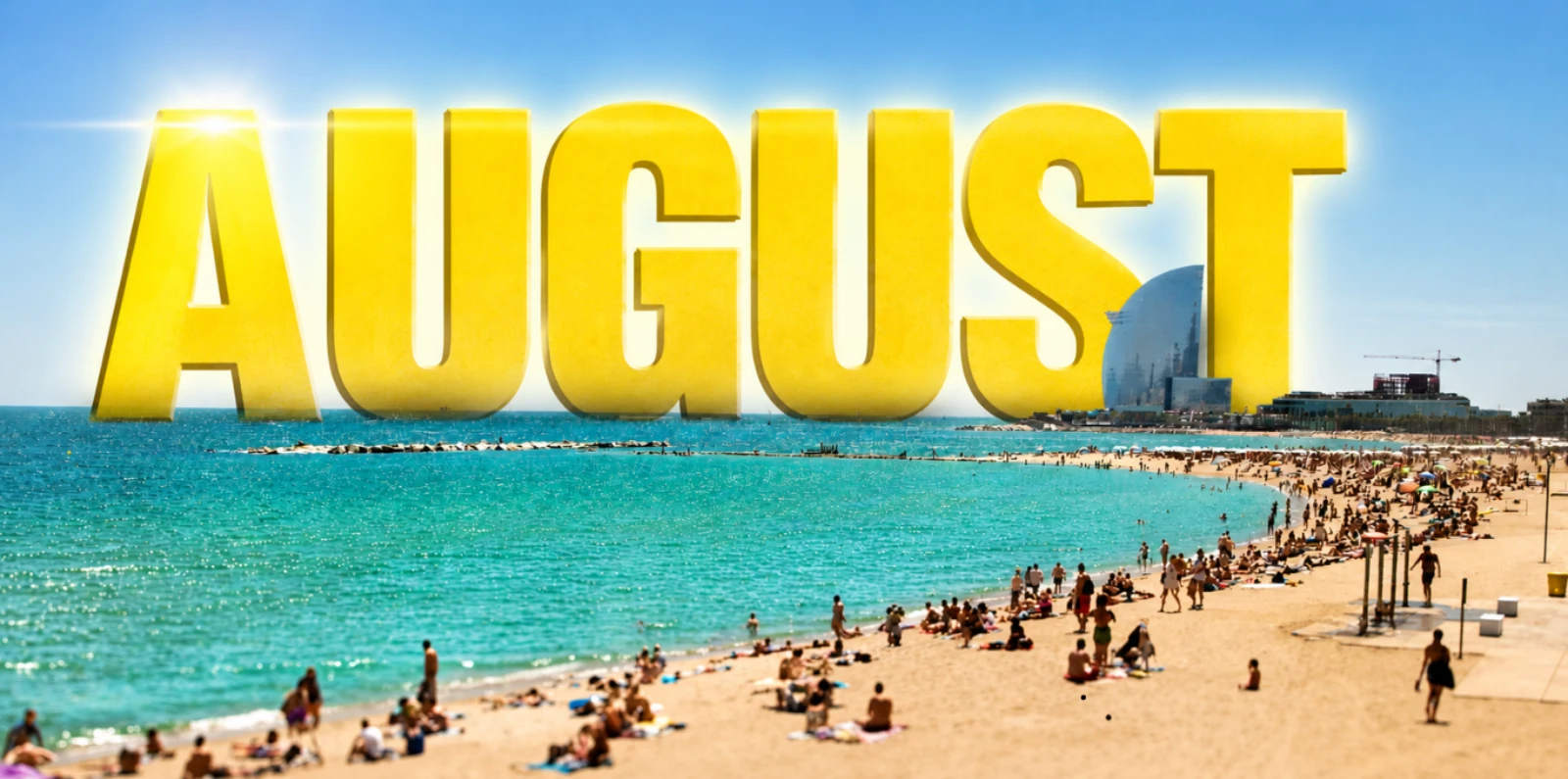

By the middle of August, half the shops on a Gràcia side street are shuttered for the holidays while, a few blocks away, the queue for the Sagrada Família runs forty deep in the sun. That contrast is the whole month in a single frame. Barcelona does not close in August, but it splits down the middle: the residents leave and the tourists arrive, so the city runs at two speeds at once. Reading which speed you are standing in is what separates a smooth trip from an afternoon spent staring at closed shutters.
Barcelona’s major sights and museums all stay open in August, but many independent neighbourhood businesses close for the holidays. The Gràcia and Sants street festivals are the month’s standout plan, and in the heat the smart move is to book the icons for early morning and keep midday for indoor spaces.
What’s open and what quietly shuts
The safe rule is that anything built for tourists stays open in August, and much of what serves locals does not. Here is the split at a glance, which is the fastest way to plan a day without wasted trips.
| What | In August | What to do |
|---|---|---|
| Sagrada Família, Park Güell, Casa Batlló | Open, but sell out days ahead | Book online, take the first slot |
| Big museums and markets | Open as normal | Ideal for the 12 to 4pm heat |
| Independent local restaurants | Often closed 2-3 weeks | Check their Instagram before crossing town |
| Neighbourhood shops and services | Many shut for holidays | Assume closed unless confirmed |
| Metro and buses | Running, some summer works | Check for line closures on your route |
| Beaches | Open and packed at midday | Go early, or head north by train |
According to travel guides and the city’s own tourism data, this pattern holds every year, so the one thing you cannot assume is that a small, local-facing place will be trading. The big-ticket sights are the reliable part of the month.
Why the city feels half-empty
August is when Barcelona changes population. A large share of residents heads for the coast or the mountains, and at the same time the city hits its tourist peak of the year, with average highs around 28 degrees. That produces the two-speed effect: the tourist Eixample and the old town are heaving, while residential districts further out can feel oddly still, with lowered shutters and half-empty terraces.
For a visitor this matters in a practical way. In the tourist core you will barely notice it is August, because everything is open. Step into the neighbourhood fabric, though, and the odds of finding your target bar closed climb sharply. The counterintuitive lesson is that the liveliest parts of the city in August are not the central sights but the two neighbourhoods where locals come back for one specific reason, which are the big street festivals.
Booking is the one thing you cannot wing
In August, advance booking stops being advice and becomes the price of entry. The Sagrada Família, Park Güell and Casa Batlló routinely sell out several days ahead, and turning up at the door to buy a ticket simply wastes a day of your trip. Book online before you leave home, choose a specific time slot, and make it the first of the morning, before 10am: you get thinner crowds, softer light on the façades and cooler air all at once.
If you plan to see several icons, a combined city pass that bundles the Sagrada Família and Park Güell with transport can save both money and queuing, but only if you would have visited those sites anyway. A culture-focused museum pass makes more sense if your midday plan is indoor art rather than monuments. Whichever route you take, reserve the timed entries the moment your dates are fixed, because August slots vanish faster than any other month. For a fuller rundown of avoiding the wait, see how to plan around the city beaches and monuments before you arrive.
Two street festivals worth building your dates around
If August has a reward, it is the pair of neighbourhood festivals, and both are free. The Festa Major de Gràcia, from 15 to 21 August, is the famous one: residents turn entire streets into elaborate themed installations that compete for a prize, and the neighbourhood fills with free concerts, fire runs, human towers and giants late into the night. The tradition dates back to 1817. To get the most from it, read the guide to the Festa Major de Gràcia before you go.
As soon as Gràcia winds down, the Festa Major de Sants takes over, from 23 to 31 August, around the feast of Sant Bartomeu. It runs the same playbook with 11 decorated streets, human towers and a closing fireworks display, but with a more local feel and roughly half the tourists. It is the better choice if you want the decorated-street magic without the crush, and it pairs naturally with a walk around the Sants neighbourhood. Both sit within the neighbourhood festivals calendar if your trip falls in the handover between them.
Heat, beaches and pickpockets
August heat is beaten with a clock, not with willpower. Average highs sit near 28 degrees, but the humidity of around 70 per cent is what wears you down, and in a heatwave the day passes 34 while the night holds above 26. The midday stretch from 12 to 4pm is the harshest, so give it to air-conditioned interiors: museums, Casa Batlló, or the city’s climate-refuge network, which according to official figures tops 500 summer spaces, all guaranteeing water and a 26-degree indoor temperature. Mornings and late afternoons are the windows that actually work; there are more cooling ideas in the guide to beating the summer heat.
For the water, skip La Barceloneta at midday, when it is packed and murky, and head north to Ocata on the R1 line in about 35 minutes, or pick from the best beaches and coves in Catalonia. Two more practical notes: the summer is when the metro schedules track works on some lines, so check your route for closures, and stay alert to pickpockets in the festival crowds, where dense, distracted groups are exactly the conditions thieves look for. If you are still weighing whether August suits you at all, compare it against the best time to visit before committing.
A sample August day, hour by hour
Assembling the pieces above into one route gives a day that works with the heat instead of against it. Here is a sample weekday in August, built around the hours that actually function.
- 9am — Start at Park Güell on the first booked slot, before the terraces fill and the sun turns the paths harsh.
- 11am — Wander the shaded lanes of the Gothic Quarter and the Boqueria while it is still bearable, coffee stop included.
- 1pm — Duck into a museum or Casa Batlló for the 12-to-4 peak, trading 34-degree pavement for 26-degree galleries.
- 5pm — Take the train north to Ocata for a swim once the worst heat lifts, skipping the midday Barceloneta crush.
- 8pm — Finish on a decorated street in Gràcia (15-21) or Sants (23-31) for free concerts and late-night buzz.
Frequently asked questions
Is August a good time to visit Barcelona
It works if you plan around it. Every major sight and museum is open, and the Gràcia and Sants street festivals mid to late month are the year’s best free events. The trade-offs are heat, big crowds at the icons, and many local shops closed for the holidays.
What closes in Barcelona in August
Mostly independent neighbourhood shops and the restaurants locals rely on, which shut for two or three weeks, often around the 15 August holiday. The major attractions, big markets and transport keep running normally.
How hot does Barcelona get in August
Average highs sit near 28 degrees with humid nights around 22 to 24. During heatwaves the day passes 34 and the night stays above 26, so it pays to keep off the street between roughly midday and 4pm.
Do I need to book tickets in advance in August
Yes. The Sagrada Família, Park Güell and Casa Batlló sell out several days ahead in August. Book online before you travel and pick the first morning slot, when queues and heat are both lowest.
Which August festivals are worth seeing
The Festa Major de Gràcia, 15 to 21 August, famous for its competitively decorated streets, and the Festa Major de Sants, 23 to 31 August, which repeats the decorated-street tradition with a more local crowd and fewer tourists.
August does not switch Barcelona off; it divides it. Book the icons early, escape the midday heat indoors, and save evenings for the festivals.