
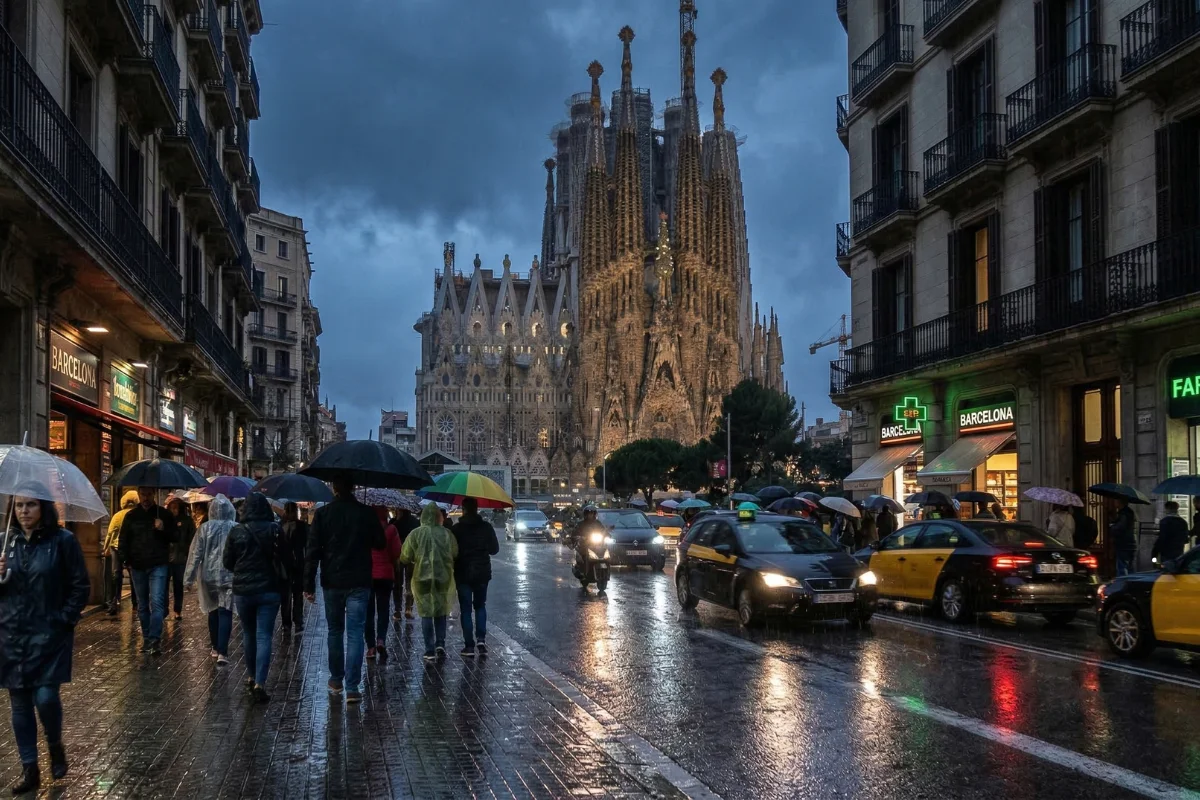

Rain in Barcelona reduces visitor volume at popular sites by 30–50%. That’s the starting point for thinking about a rainy day in the city — not as a problem to solve but as a competitive advantage to use. The Sagrada Família interior on an overcast day produces a quality of stained-glass light that architects specifically reference in the building’s documentation. The MUHBA’s Roman city underground is completely covered and has no sunlight dependency at all. The CosmoCaixa’s Amazon forest is explicitly designed to have rain falling on its glass dome while you’re dry inside.
The correct framing: which Barcelona experiences are better in the rain, which are neutral, and which require a different plan.
What should you do in Barcelona when it rains? The Sagrada Família interior (stained glass improves in overcast light), the MUHBA underground Roman city (4,000m² covered, Gothic Quarter), CosmoCaixa (Amazon ecosystem + planetarium, free for under 16), Palau de la Música Catalana (guided tour or concert, UNESCO interior), Museu Picasso (five Gothic palaces, Born), MACBA + CCCB together (Raval, full morning). All completely covered, all genuinely high quality.
Quick Decision: What Type of Rainy Day Are You Having
- Long morning, serious cultural visit → MNAC (Romanesque art, world’s best collection) or Museu Picasso (5 Gothic palaces, 4,000+ works)
- With children → CosmoCaixa (free under 16, Amazon forest, planetarium)
- Architectural interest → Palau de la Música Catalana guided tour or concert
- Roman and medieval history → MUHBA underground site, Gothic Quarter
- Contemporary art → MACBA + CCCB back-to-back, El Raval
- No ticket budget → Gran Teatre del Liceu lobby, central library reading rooms, covered market circuit
- Combination of everything → Mercat de Santa Caterina → Museu Picasso → Born evening for dinner
The Monuments That Are Better in the Rain
Sagrada Família: The Light Architecture Argument
Gaudí designed the interior light system to work with Mediterranean overcast as a specific condition. The stained glass on the east side (Nativity facade) uses cooler blues, greens and ambers. The west side (Passion facade) uses warmer reds, oranges and yellows. On bright sunny days, the effect is dramatic but harsh. On overcast days, the same glass produces a diffused, multi-directional light that fills the space without creating the sharp contrast zones that direct sunlight generates.
This isn’t a consolation. It’s a genuinely different version of the same interior — and in architectural terms, the overcast version reveals the spatial proportions more completely because your eye doesn’t compensate for glare.
Booking on a rainy day: book anyway. The reduced queue is a bonus, not the reason to go. The Sagrada Família inside guide explains the light system and structural symbolism in detail.
Palau de la Música Catalana: The Inverted Skylight Argument
The main concert hall has an inverted stained-glass dome at the ceiling — the most technically complex glass element in any building in Barcelona. On overcast days, the dome produces a lower-contrast, more evenly distributed light that illuminates the sculptural program (the 18 Muses along the back wall, the floral columns, the Art Nouveau ornamental density) without the directional glare of bright sun through glass.
The building is visitable via guided tour (daily in multiple languages, book at palaumusica.cat) or by attending a concert. The concert version is superior for anyone with genuine interest in the building — seeing the dome change quality as an afternoon performance progresses is an architectural experience that no guided tour replicates. The best live music bars guide covers Barcelona’s full performance landscape if a concert extends the evening.
Museums Worth the Full Morning
Museu Picasso: Five Gothic Palaces, One Collection
The Museu Picasso occupies five connected Gothic palaces on the Carrer de Montcada in El Born. The physical space is as important as the collection — the 15th-century pati (courtyard) entrance, the stone stairways and the room proportions were designed for a different function and the collection inhabits them without trying to compete.
Over 4,000 works organized chronologically. The Las Meninas series — 58 canvases where Picasso reinterprets Velázquez’s painting — is the most intellectually concentrated section of the museum. The early works from Barcelona (1895–1900) show the city’s influence before Picasso moved to Paris, and are the most locally specific part of a collection that spans his entire career.
Free: first Sunday of every month, all day. Thursdays from 18:00–20:00. No need to book for the free sessions, but queues form.
MNAC: The Romanesque Art Collection
The MNAC on Montjuïc has the most important Romanesque art collection in the world — a claim that is not local pride but international art-historical consensus. The collection consists of mural paintings removed from Pyrenean churches in the early 20th century when the buildings were deteriorating and the art was at risk of being sold to foreign collectors. The removal methodology is controversial; the result is extraordinary.
The paintings occupy rooms designed to replicate the church apse dimensions from which they came. Seeing 11th-century religious painting at original scale, in its original spatial context, is an experience available only here. The modern Catalan art collection (Casas, Rusiñol, Nonell — the same generation visible at Cau Ferrat in Sitges) provides the chronological bridge to the 20th century.
Free: Saturdays from 15:00, first Sundays of every month (online reservation required even for free access). Entry: €15 standard.
MACBA + CCCB: The Raval Double
The MACBA (Museu d’Art Contemporani de Barcelona) and the CCCB (Centre de Cultura Contemporània de Barcelona) are back-to-back in the El Raval neighborhood. Doing both in sequence covers a full morning without logistical overhead.
MACBA holds the permanent collection of Catalan and international contemporary art from the 1940s to the present. CCCB programs large-format temporary exhibitions, concerts and screenings — the program changes significantly each season. The Richard Meier building of the MACBA is architecturally notable; the rain on the white geometric exterior is actually a photographic improvement over the flat-light clarity that direct sun provides.
CosmoCaixa: The Rainy Day MVP for Families
CosmoCaixa in Sarrià-Sant Gervasi has one specific exhibit that makes it the best rainy day option for visitors with children: the Flooded Forest. This is 1,000 square meters of actual Amazon ecosystem — living caimans, boas, piranhas, tropical birds — under a glass dome. The rain falling on the dome roof while you’re dry inside looking at a functional tropical ecosystem is an experience so compositionally perfect for a rainy day that it seems designed for it. It was not designed for it — it’s been operating since 2004 — but it works.
Free for visitors under 16. Adults: €8. The Planetarium has additional cost from €5 (€2.50 for CaixaBank customers). FGC line L7 to Av. Tibidabo, then 10 minutes on foot or bus 60.
The Underground Option: MUHBA and the Roman City
The Museu d’Història de Barcelona has access to the 1st-century Roman city of Barcino through elevated walkways four meters below the Plaça del Rei in the Gothic Quarter. The space covers approximately 4,000 square meters and includes visible streets, shop interiors, a garum factory, a wine production facility and sections of the Roman city wall.
Completely underground. Completely covered. No weather dependency whatsoever. The contrast between the medieval Gothic exterior of the Plaça del Rei and the Roman city immediately below it is the most temporally disorienting experience in Barcelona — you’re walking between the 1st and the 15th century in a single elevator ride.
Entry included in the MUHBA general ticket. Check specific opening hours on the museum website.
Free indoor stops with no ticket at all
The Mercat de Santa Caterina in El Born has archaeological remains from a medieval convent visible through glass panels in the market floor — free, no ticket, visible during market hours. The undulating mosaic roof by Enric Miralles and Benedetta Tagliabue (2005) is one of the most significant contemporary architectural elements in the city. In the rain, the mosaic catches the light differently than in sun; the ceramic quality changes. Most visitors to the Born go to the Born CCM (which is excellent) and miss this completely.
The second overlooked option: the Filmoteca de Catalunya in El Raval. Classic cinema programming, international contemporary film, retrospectives. The building is contemporary architecture within the historic neighborhood. Tickets from €4. For an afternoon that combines culture with comfort in a properly designed screening room, the Filmoteca is the highest-quality indoor experience per euro in the city on a rainy afternoon.
Is It Worth Adapting the Itinerary?
Yes — unconditionally. The reduction in visitor volume at the Sagrada Família, the Museu Picasso and the MNAC on rainy days makes those experiences substantially better, not worse. The sites specifically improve in overcast conditions (the stained-glass buildings, the Flooded Forest). The sites that require outdoor experience (the Búnkers, Park Güell) can shift to another day.
When rain genuinely disrupts: if the primary objective was an outdoor market (like Palo Alto in Poblenou or the El Encants flea market), a beach day, or the Montjuïc views. These require sun and are not substitutable with equivalent indoor options. The best markets in Barcelona guide notes which markets operate rain or shine.
Mistakes to Avoid
- Canceling the Sagrada Família because it’s raining — the interior light is better in overcast conditions. This is a reason to go, not to postpone.
- Not booking CosmoCaixa for children — it fills on rainy days. The Planetarium specifically has limited capacity per session.
- Skipping the MUHBA for “another rainy day” — the underground Roman site is one of the best uncrowded experiences in Barcelona at any weather, and most visitors to the Gothic Quarter don’t know it exists.
- Treating the Palau de la Música Catalana as a “nice to have” — it’s one of the most architecturally significant interiors in Europe. A rainy day with lower visitor volume is the ideal time for the guided tour.
- Going to Las Ramblas for shelter — there’s nothing covering Las Ramblas. Use it as a transit corridor; the covered arcades of nearby streets (Carrer de Sant Pau, Carrer de l’Hospital) are more interesting and less crowded.
Final Insight
Barcelona has 300+ days of sun a year. The city’s reputation and tourism infrastructure were built around those days. The rain days — approximately 60 per year, mostly October through December — show a different version of the same places: quieter, with better light quality for the interior architectural experiences, and with admission lines that don’t require strategic planning. The visitors who understand this don’t dread the rain forecast. They look at it and rebook their outdoor plans for another day, knowing the covered version of the city is the higher-quality one.
For the complete picture of Barcelona’s museums — which ones merit a full morning and which are better as 90-minute stops — the best museums in Barcelona guide covers the full landscape with honest time estimates. And the hidden museums guide identifies the less-visited institutions that a rainy day finally makes accessible without crowds.