
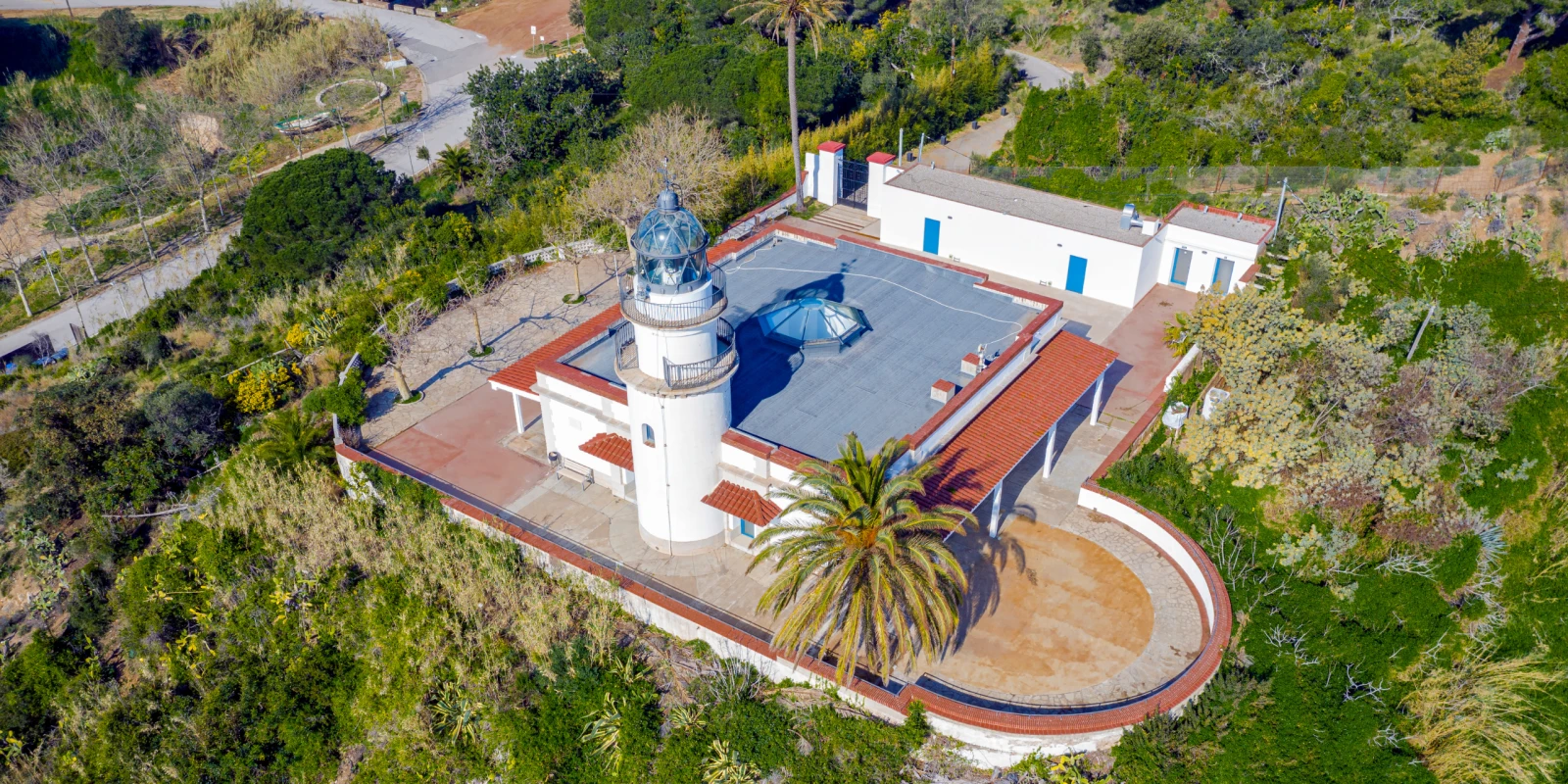

Calella is a package-holiday town on the Maresme coast, with the hotel blocks and the long promenade to prove it. It is also the place where you can go down into a 1937 air-raid shelter, climb a lighthouse that once ran on olive oil, and see two towers that flashed messages to the French border before the electric telegraph existed. The combined ticket for all three costs €3.50.
That gap between what the town looks like and what it holds is the reason to get off the train here. The catch is the timetable, and it is a real one.
What is Calella? A resort town on the Maresme coast, an hour north of Barcelona and the last stop on the frequent stretch of the R1 line. Its heritage sites are a lighthouse from 1859, two optical telegraph towers from 1848 and 1857, a Civil War air-raid shelter and a municipal museum.
The timetable is the thing to check first
Everything here opens in the afternoon, which is exactly when most visitors are still on the sand. On weekdays there is no way to see any of it in the morning.
| Site | Opening hours | Price |
|---|---|---|
| Museum, 15 April to 14 October | Tuesday to Saturday 18:00-21:00, Sunday and holidays 11:00-14:00 | €2.00, €1.00 reduced |
| Museum, 15 October to 14 April | Tuesday to Saturday 17:00-20:00, Sunday and holidays 11:00-14:00 | €2.00, €1.00 reduced |
| Lighthouse centre, April to June and October | Saturday, Sunday and holidays 10:00-14:00 | €2.00, €1.00 reduced |
| Lighthouse centre, July to September | Tuesday to Sunday and holidays 17:00-21:00 | €2.00, €1.00 reduced |
| Lighthouse centre, November to March | Closed | n/a |
| Combined shelter, museum and lighthouse | Within each site’s hours | €3.50 |
Two consequences worth planning around:
- The lighthouse shuts entirely from 1 November to 31 March, so a winter trip loses the single most photographed thing in town.
- In July and August it only opens 17:00 to 21:00, the hours most people spend on the sand.
At €3.50 for three sites, this is among the cheapest culture on the coast — worth setting against the city rates in the Barcelona travel budget guide.
Entry is free for under-16s, unemployed visitors without benefits, teachers, Calella residents and everyone on the first Sunday of the month. The museum is at Escoles Pies 36-40; the phone number is 93 769 51 02.
A lighthouse that burned olive oil
The Far de Calella stands on the rocky Capaspre headland, a site documented as far back as 5 November 961 in a donation to the monastery at Sant Pol de Mar. A gun tower watched for corsairs here through the Middle Ages, and it was demolished in 1857 to make room for the lighthouse.
Spain’s 1847 Plan General para el Alumbrado Marítimo called for 126 lighthouses along the coast, and a royal order of 27 June 1856 placed one of them on these rocks, about 35 metres above sea level. Construction finished on 14 November 1859 and the light went into service on 15 December.
The details are what make the visit:
- The optical apparatus was built in Paris and threw light about 18 miles.
- It first burned olive oil, later paraffin, later still petroleum.
- The works cost 127,000 reals.
- It was the fifth lighthouse in Catalonia to enter service.
- Electricity arrived in 1916, and a stronger apparatus in 1927 pushed the range to 33 miles.
Alongside it stand Les Torretes, two optical telegraph towers, the first from 1848 and the taller second from 1857. They relayed visual signals up the coast to the French border, each tower sighting the next, so a message crossed Catalonia in hours rather than the days a rider needed. The technology lasted only decades, which is why so few survive.
Down into the shelter at Parc Dalmau
The Refugi Antiaeri del Parc Dalmau went into service in 1937, months after the town council resolved on 2 November 1936 to dig shelters against air raids. Jeroni Martorell drew up the project.
Calella built three: one on the Roser hillside, one at Parc Dalmau, and one at la Granja. Together they held around 3,600 people — roughly half the town’s population at the time. Residents were assigned a shelter by the street they lived on, and each had three entrances so nobody bottlenecked when the sirens went.
The council restored it with the Memorial Democràtic and opened it to visitors on 11 April 2010. It belongs to Catalonia’s network of democratic memory sites. Inside you walk the main gallery and watch Testimonis de la Guerra, in which Calella residents describe the war and the years after it.
For visitors whose interest in Spain runs to this period, it is one of the more accessible Civil War sites near Barcelona, and it pairs with the wartime layers described in the Barcelona history walking material.
The museum, and the pharmacy inside it
The Museu-Arxiu Municipal de Calella Josep M. Codina i Bagué was founded in 1959 by a group of young locals, but it did not open to the public until 1979.
It occupies a manor house built by Bernat March between 1636 and 1669, the later date carved into a window lintel. The set piece is a full reconstruction of the old Barri pharmacy, previously Tió, with its original fittings and furniture intact. There is also a traditional kitchen, rooms on local trades and customs, and a courtyard opened in 1989 holding ceramic panels by Joan Baptista Guivernau.
The permanent display is captioned in Catalan, Spanish, English and French, which is not something every small museum on this coast manages.
Don’t book the wrong Calella
This deserves its own warning because the mistake costs money. There are two places called Calella in Catalonia and they are more than an hour apart.
Calella is on the Maresme coast, has its own commuter rail stop and is a full resort town with a large hotel stock. Calella de Palafrugell is a small whitewashed cove village on the Costa Brava, far to the north, with no train station.
If the photos that brought you here show white arcades above a tiny cove, you want the other one, covered in the Calella de Palafrugell guide. If you want hotels, services and a direct train to Barcelona, this is the right place.
Getting there and what to combine it with
Calella sits on the Rodalies R1 along the Maresme, and it marks the end of the line’s frequent stretch: trains run every 15 minutes at peak and every 30 off-peak as far as here, and the service thins out beyond it. That makes Calella the furthest point on this coast where you can still improvise the journey home.
Fares are zonal — a single from €2.90 in one zone to €8.80 in five, and the 10-journey T-casual from €13.00 to €51.20. Details are in the Barcelona public transport guide.
A coastal path runs from Calella to Sant Pol de Mar along the clifftops, and since both have their own station the walk works one-way. The three neighbouring towns each have a different draw: rocky coves and a 6th-century crypt in the Sant Pol de Mar guide, the architect’s workshop in the Canet de Mar guide, and a weekday fish auction in the Arenys de Mar guide.
To build the route without a car, see Catalonia without a car and the best villages near Barcelona.
Two stops north the frequent stretch ends and a different coast begins: the Sa Palomera rock marks the start of the Costa Brava, covered in the Blanes guide.
Frequently asked questions about Calella
Is Calella the same place as Calella de Palafrugell?
No, and booking the wrong one is a common and expensive mistake. Calella sits on the Maresme coast about 50 km from Barcelona with its own R1 train stop. Calella de Palafrugell is a small Costa Brava cove village much further north, with no railway station at all.
How much does it cost to visit Calella’s museums?
Standard entry is €2 and reduced €1 per site. A combined ticket covering the air-raid shelter, the museum and the lighthouse costs €3.50. Under-16s, unemployed visitors without benefits and teachers go free, as does everyone on the first Sunday of the month.
Can you visit Calella lighthouse all year?
No. The interpretation centre closes completely from 1 November to 31 March. From April to June and in October it opens Saturdays, Sundays and holidays 10:00-14:00, and from July to September Tuesday to Sunday 17:00-21:00.
How far is Calella from Barcelona by train?
Calella is roughly 50 km up the Maresme coast and marks the end of the R1 line’s frequent stretch, with trains every 15 minutes at peak and every 30 off-peak. Beyond this stop the service thins out, so it is the furthest point where you can still improvise the trip back.
Is Calella worth visiting outside the summer?
Partly. The museum and the air-raid shelter stay open all year, and the museum shifts to 17:00-20:00 in winter. The lighthouse interpretation centre does not: it shuts from 1 November to 31 March, so the headland is a view rather than a visit.
What is the air-raid shelter at Parc Dalmau?
A Civil War shelter that entered service in 1937, designed by Jeroni Martorell. Calella built three of them, holding around 3,600 people between them — roughly half the town’s population at the time. It opened to visitors on 11 April 2010 after restoration.
Come for the beach if you like, but the €3.50 ticket is the better deal.