

On the entrance wall of a workshop in Canet de Mar there is a run of tiled skirting. The same design later went onto some of the columns of the Palau de la Música Catalana in Barcelona. Upstairs, the ceramic buttons are the ones that ended up in the mermaid dining room of the Fonda Espanya, and the plaster over every doorway is Eusebi Arnau’s trial work for Casa Lleó Morera.
This village on the Maresme coast is where Lluís Domènech i Montaner tried things out before building them in the city. Entry costs €5. The Palau de la Música, the finished article, runs €20 to €24.
What is Canet de Mar? A village on the Maresme coast, an hour north of Barcelona on the R1 line, where the architect of the Palau de la Música kept his house and workshop. The house-museum charges €5, the hilltop castle he remodelled appeared in Game of Thrones, and two flat beaches run 1,500 and 600 metres.
The workshop where the city’s landmarks were tested
The museum is two joined buildings, and that is what makes it unusual. One is the Casa Domènech, the family home. The other is the Masia Rocosa, a 16th-century farmhouse the architect turned into his studio.
He bought the house in 1886 for 42 pesetas and pulled down the party wall between the two properties, so workshop and home opened into each other. The major remodelling came in 1904, after he gave up his seat as a member of parliament in Madrid before the term was out, following the internal crisis in the Lliga Regionalista.
What he left in that farmhouse is a catalogue of prototypes:
- The skirting in the entrance room matches what later decorated columns in the Palau de la Música.
- The kitchen washstand carries the same ceramic as the entrance hall of Casa Thomas.
- The second floor uses the blue and white ceramic buttons designed for the mermaid dining room at the Fonda Espanya.
- Every door lintel holds Eusebi Arnau’s plaster trials for the Casa Lleó Morera entrance hall.
- The facade carries a ceramic panel over three metres high by Lluís Bru.
He was deliberate about what he kept, too: the original Baroque features stayed visible, including the 17th-century stone lintels and the window seats built into the wall.
The reason any of this is here is domestic. His mother came from a Canet family and his wife, Maria Roura, was born in the village. For the finished buildings in the city, see the Catalan modernisme guide.
Santa Florentina, Horn Hill in Game of Thrones
The Castell de Santa Florentina stands in woodland on Pedracastell hill, outside the village. It went up in the 11th century on Roman remains and became a fortified farmhouse in the Middle Ages, defence against the pirate raids that shaped this whole coastline.
In the early 20th century Domènech i Montaner reworked it as a summer palace, adding stained glass, marble, wrought iron and sculpture onto a medieval structure. That collision of two languages in one wall is the point of the building.
For television audiences it is Horn Hill, seat of House Tarly, in season six, episode six, Blood of My Blood. Filming used the castle courtyard, the King’s Room standing in as the dining hall, and a bedroom.
It remains private property, still hosts weddings and a classical music festival, and opens for visits by prior booking rather than as a walk-in attraction. Arrange it through the castle’s own site before setting off, since sessions start on the hour and the gate opens as each one begins.
Getting there
Canet sits on the Rodalies R1, the Maresme line between Molins de Rei and Maçanet-Massanes. Frequency varies along it: as far as Mataró trains run every 6 minutes at peak and every 10 off-peak, and Canet falls in the next band, at every 15 to 30 minutes.
Fares are zonal — a single from €2.90 in one zone to €8.80 in five, and the 10-journey T-casual from €13.00 to €51.20. The station machine sets the exact figure once you enter the destination; pass details are in the Barcelona public transport guide.
Three villages on this line chain together well in a weekend without a car. North is Sant Pol de Mar, with rocky coves and a 6th-century crypt. South is Arenys de Mar, with a weekday fish auction and the poet’s cemetery. The rest of the options are in the best villages near Barcelona and Catalonia without a car.
What it costs, and the closure nobody expects
| Ticket | Price |
|---|---|
| Adult | €5.00 |
| Pensioners, unemployed, students, library card | €2.00 |
| Barcelona Pass Modernista holders | €1.50 |
| Accompanied under-12s | Free |
| Guided visit, groups over 10 | €7.00 per adult |
Free days include the first Sunday of the month, International Museum Day, Museum Night and 27 December, Domènech i Montaner Day.
Opening hours are Tuesday to Friday 10:00-14:00, Saturday 10:00-14:00 and 16:00-19:00, and Sunday 10:00-14:00. Mondays closed.
Then the catch: the museum closes on the last weekend of every month. It is the normal calendar, not a one-off. Alternative activities run behind closed doors on those dates — a costumed visit, or a stained-glass route — but they need booking ahead by email.
Put the Monday closure and that last weekend together and there are stretches of several consecutive days when the main sight in the village is shut. Check the calendar before booking a train.
The museum is also the village tourist office, at the corner of the Gavarra and Buscarons streams, so one stop covers tickets and information. The museum number is 93 795 46 15 and the tourist office 93 794 08 98.
Pedracastell and the free self-guided routes
The village sits between the Mediterranean and the Montnegre i el Corredor Natural Park, on granite ground worn into gentle slopes. The highest point is Pedracastell at about 300 metres, and from the top you see the Montnegre, the Montseny and much of the Maresme and Barcelona coastline. It is the same hill the castle stands on.
Farming here ended recently enough to still be visible. Vines, carob and fruit trees worked these slopes until the mid-20th century, and the last crop was strawberries, still grown on the sunniest inclines.
Three routes cost nothing and need no booking:
- The indiano heritage route, through the houses built by villagers who made their fortunes in the Americas and came home.
- The municipal cemetery pantheons, where the funerary architecture is modernista too.
- The Eduard Ferrés i Puig route, covering the other architect who shaped Canet and who tends to be overshadowed by his famous neighbour.
Leaflets and audio guides are at the tourist office, open Tuesday to Sunday 10:00-14:00 and Saturday afternoons 16:00-19:00.
Two flat beaches, one shared with the next village
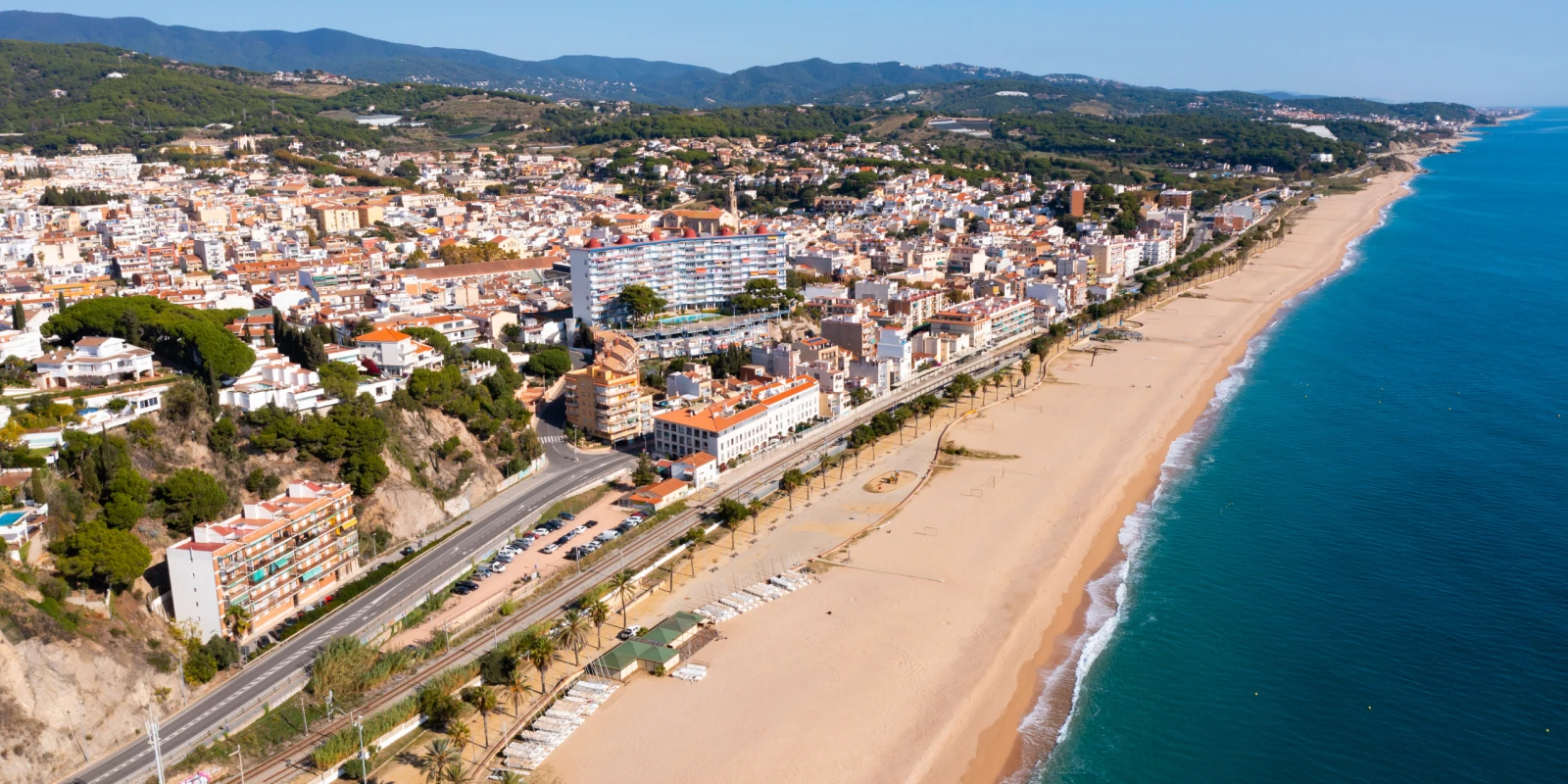
Canet has two stretches of sand, both flat and reachable on foot or by bike from the station in under 10 minutes, without the level changes that make other parts of this coast awkward.
The Platja de Canet runs 1,500 metres. The Platja del Cavaió runs 600 metres, its sand formed from the breakdown of the granite rock underlying the district. A pet-friendly zone is set up on the Cavaió during peak bathing season, which makes it one of the few local beaches where a dog is welcome in summer — the wider picture is in the Barcelona dog beaches guide.
One thing that confuses map readers: the Cavaió straddles a municipal boundary and appears in the beach list of the neighbouring town too, with a different length. Both figures are right; each council is describing its own stretch. The full comparison is in beaches near Barcelona by train.
Facilities are unusually complete for a village this size: boardwalk access, adapted toilets and showers, a health post, a defibrillator, picnic areas and a protected dune zone. A beach day here costs nothing beyond the fare, which is worth weighing against the city rates in the Barcelona travel budget guide.
Frequently asked questions about Canet de Mar
Why is the Domènech i Montaner house-museum in a small coastal village?
Family reasons rather than architectural ones. His mother came from a Canet family and his wife, Maria Roura, was born in the village. He bought the house in 1886 for 42 pesetas, knocked through to the neighbouring farmhouse, and used that farmhouse as his workshop.
Where was Horn Hill filmed in Game of Thrones?
At Castell de Santa Florentina in Canet de Mar, an hour north of Barcelona. It stands in as Horn Hill, seat of House Tarly, in season six, episode six, Blood of My Blood. The scenes were shot in the castle courtyard, in the King’s Room standing in as the dining hall, and in a bedroom.
How much does the Canet de Mar house-museum cost?
€5 for adults and €2 reduced for pensioners, unemployed visitors, students and library card holders. Barcelona Pass Modernista holders pay €1.50 and accompanied under-12s go free, as does everyone on the first Sunday of the month.
Is Canet de Mar worth a day trip from Barcelona?
If modernista architecture interests you, yes: €5 buys the workshop where the Palau de la Música details were tested, against €20 to €24 for the finished building in the city. Add the castle and two beaches and it fills a day without a car.
How long does the Canet de Mar house-museum take to visit?
The two joined buildings, the family home and the 16th-century workshop, take about an hour at a normal pace. Guided visits for groups over 10 run longer and cost €7 per adult, and both need booking by email beforehand.
What days is the Canet de Mar museum closed?
Mondays, and the whole of the last weekend of every month, which is the part that catches people out. Otherwise it opens Tuesday to Friday 10:00-14:00, Saturday 10:00-14:00 and 16:00-19:00, and Sunday 10:00-14:00.
The prototypes are in Canet; the famous buildings are the copies.