

The most reliable thing to watch in Arenys de Mar happens at four in the afternoon, and only on a weekday. That is when the boats come back and the catch goes under the hammer at the market hall on the quay, in a working auction rather than a demonstration for visitors.
Nothing else in town keeps those hours. The lace museum shuts at 13:30 and never reopens after lunch. The guided explanation of the baroque altarpiece happens once a week. The cultural centre only opens at weekends. In Arenys the question is not what to see, it is which day to come.
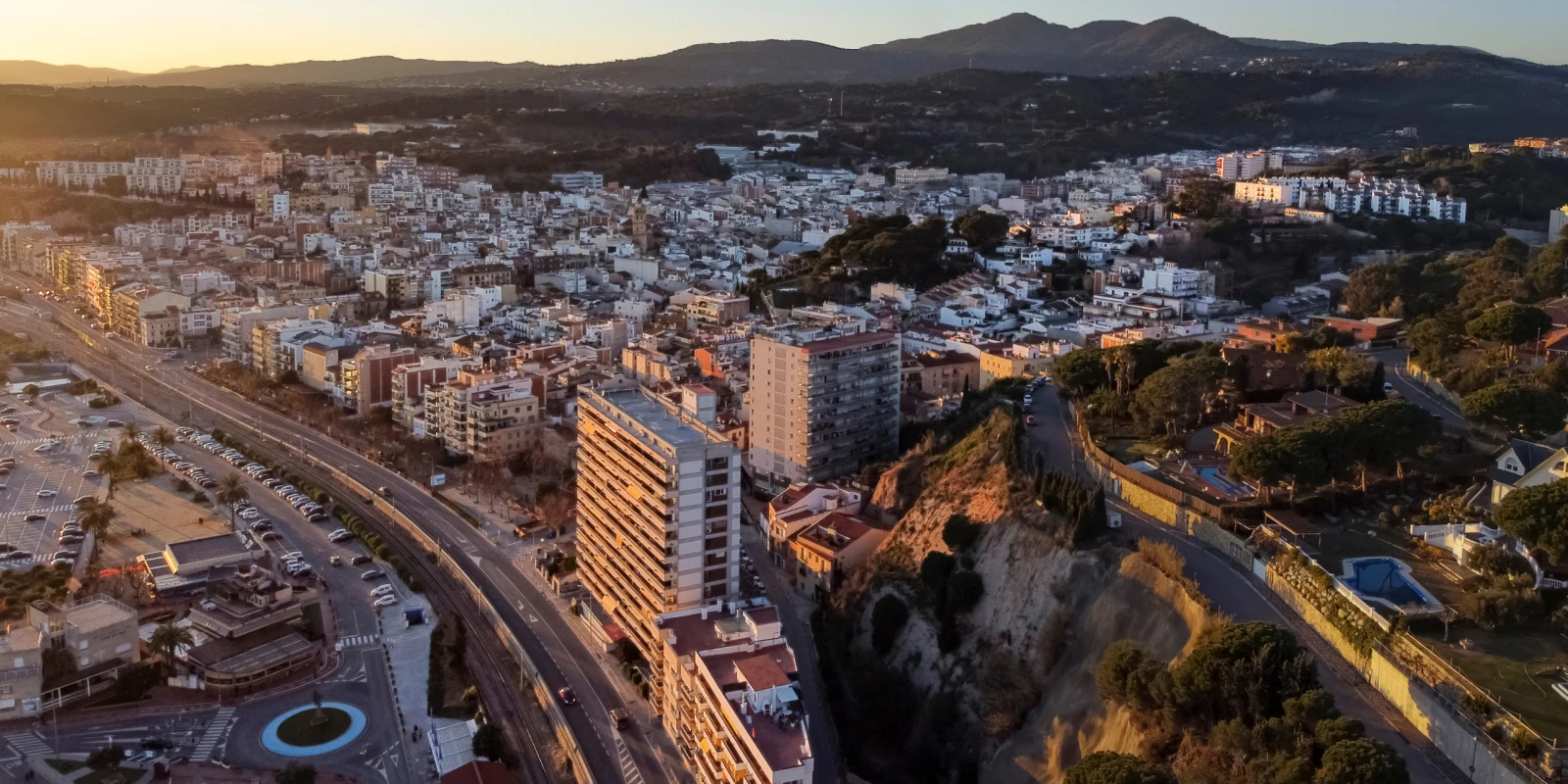
What is Arenys de Mar? A working fishing town on the Maresme coast, an hour north of Barcelona on the R1 line, with one of the most important harbours on the Catalan coast, a lace collection ranked among Europe’s finest, and the hilltop cemetery the poet Salvador Espriu turned into a literary myth under the name Sinera.
The fish auction runs at four, and only on weekdays
The Port d’Arenys is one of the largest on the Catalan coast, and the fishing industry around it drives much of the local economy. When the boats come in, the crates of fresh fish are unloaded on the quay in full view.
The auction runs every afternoon from 16:00, Monday to Friday. There is none at the weekend, which is the single fact that decides whether a Saturday trip makes sense. Groups wanting access to the market hall itself must give notice to the Confraria de Pescadors Sant Elm on 93 792 04 90 or at cpsantelmo@gmail.com. There is also a self-guided interpretive trail signposted around the fishing dock.
What comes off these boats has its own festival. The Calamarenys, the town’s squid gastronomy season, has now run for thirty years, held between mid-October and mid-November to match the fishing season. The species it celebrates is calamar de potera, squid caught one at a time on a hand jig rather than trawled, which is why the town treats it as a product with a name rather than a commodity.
Around 19 restaurants take part with roughly forty recipes, and a parallel tapa route puts a squid tapa on the counter at a fixed price in 18 bars and restaurants. The showcase itself is held in the old port warehouse. For the year-round comparison against the city, the Barcelona seafood restaurants guide covers where that catch ends up.
What opens when
No single day in Arenys covers everything, which makes this table worth checking before booking a train.
| Site | Opening hours | Price |
|---|---|---|
| Fish auction at the port | Monday to Friday from 16:00 | Quayside free, market hall by arrangement |
| Museu Marès de la Punta and Mollfulleda | Tuesday to Friday 10:00-13:30, Saturday 10:00-13:00, Sunday and holidays 11:00-13:00. Closed all August | €3.50 full, €2.00 reduced, free first Sunday of the month |
| Església de Santa Maria | Tuesday to Saturday 9:00-13:00 and 16:00-20:00, Sunday 9:00-14:00 | Free |
| Guided visit to the altarpiece | Saturday at 11:00 | €2.00 per person |
| Centre Cultural Calisay | Friday 18:00-20:30, Saturday and Sunday 11:00-13:00 and 18:00-20:30 | Free |
| Riera street market | Saturday morning | Free |
| Sinera cemetery | Daily 8:00-17:30 in winter, 8:00-19:00 in summer | Free |
Two conclusions follow:
- Saturday morning catches the street market, both museums, the church and the altarpiece talk at 11:00 — but no auction, because there is none at weekends.
- A weekday afternoon catches the auction at 16:00, but arrives two and a half hours after the museums have shut for the day.
The trap is August, when the museum closes for the entire month, which is exactly when the Maresme fills up. The town also closes it on two local holidays, 9 July and 16 August.
A lace collection that is here because of a condition in a donation
The Museu Marès de la Punta opened on 13 March 1983, when the Generalitat handed over the lace collection of Frederic Marès i Deulovol. Marès had deposited it on one condition: that it be displayed in Arenys de Mar, under his name. That clause is the reason a collection of European standing sits in a coastal town of this size rather than in Barcelona.
The display runs from the late 16th century, when lace emerges in Venice, through to the present, arranged by origin and technique — collars, handkerchiefs, fans, mantillas, shawls. There are French blondes, work from Le Puy, Belgian gauze and duchesse. Bobbin lace, which came to dominate over needle lace, appears first in the old territory of Flanders.
The local anchor is Casa Castells d’Arenys de Mar (1862-1962), which drove the modernista renewal of lace. Marià Castells made the altar cloths, alb and rochet for the Chapel of Sant Jordi in the Palau de la Generalitat (1927-1930), shown alongside the original designs.
One ticket, two museums. The same €3.50 admits you to the Museu Mollfulleda de Mineralogia a few doors down, founded in 1988 on the collection of Joaquim Mollfulleda i Borrell. Its second room follows the Strunz classification and holds a bismuth from Villanueva de Córdoba with a skeletal crystal 3 centimetres across the edge. With children, that is usually the better of the two.
Sinera, and why a cemetery is the town’s most visited monument
Sinera is Arenys spelled backwards. That reversal is the whole device: the poet Salvador Espriu used it to name the town in his work, and the cemetery became the fixed point of that invented world. He is buried there, and the grave is strikingly plain.
The municipal cemetery was built between 1865 and 1867, is designated a National Cultural Interest site, and stands on the Turó de la Pietat above the town. It is a Mediterranean seafarers’ cemetery, and the funerary sculpture is by names that appear in Barcelona’s own museums: Venanci Vallmitjana, Josep Llimona and Frederic Marès. Llimona’s sculpture for the Mundet family hypogeum, from 1901, counts among the key works of Catalan modernista funerary art.
It opens daily, 8:00 to 17:30 in winter and 8:00 to 19:00 in summer, and entry is free. Along with the port, it is the one thing here that never depends on anyone’s calendar — in August, when the museum is shut, the cemetery is open.
It is also the end point of the Ruta dels Indians, a self-guided walk that starts at the top of the Riera and descends to the sea, tracing the houses built by townspeople who went to the Americas in the 18th and 19th centuries and came back wealthy. The leaflet is at the tourist office, Riera del Bisbe Pol, 8.
The altarpiece, explained only on Saturdays
Santa Maria d’Arenys was built between 1584 and 1628 and later extended with three side chapels. The main body is late Gothic, with a baroque facade, a bell tower topped by a small turret, and a comunidor.
The reason to go in is the baroque altarpiece to the Virgin Mary, dated 1706-11, by the Vic sculptor Pau Costa — ranked by the comarcal tourist authority among the most important and best preserved in Catalonia. Its base is older in style, Renaissance, in marble and Tortosa jasper, by the Arenys sculptor Antoni Joan Riera.
The church can be visited freely during opening hours, but the explanation has exactly one slot: the Amics del Retaule run a guided visit every Saturday at 11:00 for €2.00, meeting at the Carrer de l’Església doorway. For the wider architectural context, the Catalan modernisme guide picks up the thread that runs through the town’s market building.
Four beaches, split by the harbour
Arenys has four stretches of sand and the fishing harbour divides them, so the side matters. El Cavaió is the longest in the municipality, La Picòrdia the closest to the centre, La Musclera sits between them, and a further stretch runs beside the port.
These are Maresme beaches: long, straight and sandy, without the rocky coves that make the next town north different. That contrast is set out in the Sant Pol de Mar guide, and the full comparison of what is reachable on this line is in the beaches near Barcelona by train.
Getting there
Arenys sits on the Rodalies R1, the Maresme line between Molins de Rei and Maçanet-Massanes. Frequency is not uniform along it: as far as Mataró trains run every 6 minutes at peak and every 10 off-peak, and Arenys falls in the next band, at every 15 to 30 minutes.
Fares are zonal. A single runs from €2.90 in one zone to €8.80 in five, and the 10-journey T-casual from €13.00 to €51.20; the station machine works out the exact figure once the destination is set. Pass details are in the Barcelona public transport guide.
By car it is the N-II, or the C-32 taking exit 109 from Barcelona and exit 111 from Girona. From the A-7, leave at Sant Celoni and follow the B-511 through Vallgorguina.
To chain Arenys with another stop on the same line without a car, the combinations are in Catalonia without a car. Where it ranks against the alternatives is covered in the best villages near Barcelona, and if the date can move, the best time to visit Barcelona applies with one local caveat: August is the worst month here, because the museum is shut.
One stop up the line, the same architect who signed this town’s market building kept his house and workshop, and the Game of Thrones castle sits in the woods above: the Canet de Mar guide covers both.
Frequently asked questions about Arenys de Mar
Can visitors watch the fish auction at Arenys de Mar?
The auction runs every afternoon from 16:00, Monday to Friday, and there is none at weekends. Groups wanting inside the market hall must contact the Confraria de Pescadors Sant Elm in advance on 93 792 04 90 or at cpsantelmo@gmail.com. The quayside itself is open to anyone.
Why is a major European lace collection in a small Catalan town?
Because the collector set a condition. Frederic Marès i Deulovol deposited his lace collection with the Generalitat on the terms that it be shown in Arenys de Mar and carry his name. The museum opened on 13 March 1983 and has grown by donation since.
What is the Sinera cemetery and why is it famous?
Sinera is Arenys spelled backwards, the name the poet Salvador Espriu gave the town in his work. He is buried in the municipal cemetery on the Turó de la Pietat, a National Cultural Interest site built between 1865 and 1867. Entry is free, every day.
Come on a weekday for the fish, on a Saturday for everything else, and never in August.