
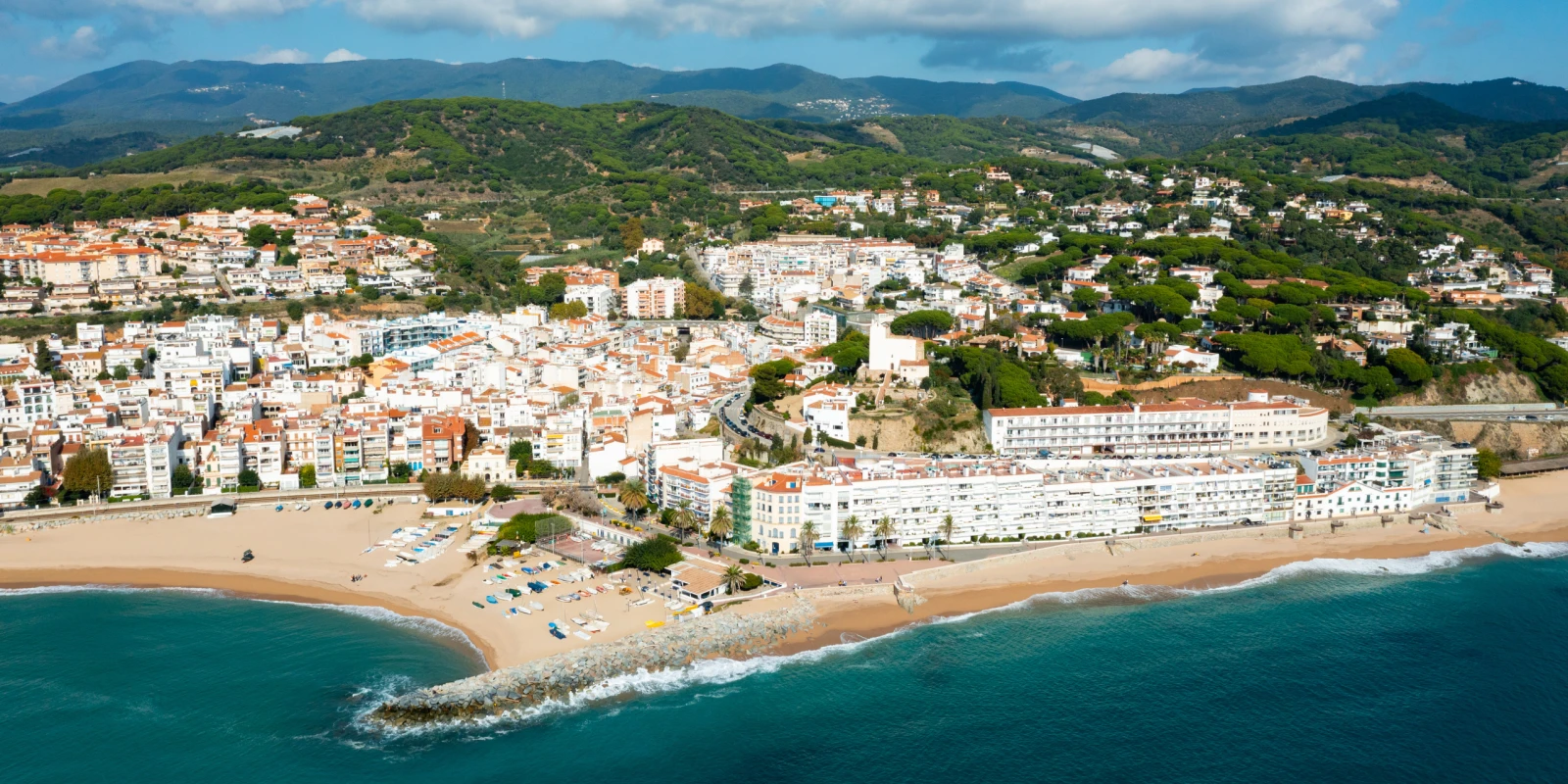

Most beach day trips out of Barcelona include a stretch that nobody enjoys: the twenty minutes between the station and the water, dragging a bag past an industrial estate. Sant Pol de Mar removes it. The R1 platform sits beside the sand, and the first thing visible on stepping off the train is the sea.
That single fact decides who this village suits. For a trip with no logistics, no car and no plan, the reward starts at the platform. For anyone arriving to tick off monuments, most of them are shut.
What is Sant Pol de Mar? A village of 5,793 people on the Maresme coast, 49 kilometres north of Barcelona, built as white fishermen’s houses above a series of small rocky coves, with its own stop on the R1 commuter line and a hilltop hermitage that traces back to a monastery documented in the year 955.
Why the timetable matters more than the distance
The Rodalies R1 runs from Molins de Rei to Maçanet-Massanes along the whole Maresme coast, 95.1 kilometres and 31 stations. One of those stations is Sant Pol. The journey is straightforward, but the service is not uniform along the line, and that catches people out on the way home.
Rodalies publishes four separate frequency bands on this route:
| Section of the line | Peak frequency | Off-peak |
|---|---|---|
| As far as Mataró | Every 6 minutes | Every 10 minutes |
| As far as Calella | Every 15 minutes | Every 30 minutes |
| As far as Blanes | Every 30 minutes | Every 30 minutes |
| As far as Maçanet-Massanes | Every 60 minutes | Every 60 minutes |
This stop falls inside the Calella band, so a missed train costs 15 or 30 minutes rather than an hour. That is the practical difference between this village and the towns further up the coast, where improvising the return journey stops being an option.
Tickets are integrated and priced by zone: a single runs from €2.90 in one zone to €8.80 in five, and the 10-journey T-casual from €13.00 to €51.20 across the same range. Sant Pol sits well outside the metropolitan zone, so the fare falls at the upper end of that scale; the station machine calculates it once the destination is set. Full details of passes and validation are in the Barcelona public transport guide.
Three beaches, all of them reached on foot from the platform
The main beach begins at the platform and is shared with the Club Nàutic. Walking north from the centre reaches Platja del Morer, a quieter stretch, and continuing in the direction of Calella for around twenty minutes on foot reaches Platja de la Roca Grossa, the one most photographs are taken at.
The coast here does not look like the rest of the Maresme. The council attributes that to the terrain: instead of one long continuous beach, the village has several small rocky coves with coarse sand, closer in character to the Costa Brava than to the flat sands south of Mataró.
Three municipal rules are worth knowing before going down:
- Smoking is banned on every beach in the municipality, with no exempt stretch. It is stricter than the position on Barcelona’s own beaches.
- Dogs are banned from 1 May to 30 September, which is the entire bathing season. Outside those dates they are allowed, the same seasonal logic covered in the Barcelona dog beaches guide.
- Fishing is prohibited between 6:00 and 21:00.
A lifeguard service operates in season, with assisted bathing by amphibious chair, and beach status and capacity are published in real time. Buses run too: Sagalés operates the Barcelona Bus service along the Maresme coast, including a night route between Barcelona and Pineda de Mar.
Those rock shelves are also why a mask is worth packing. The water around Roca Grossa, 20 minutes north of the platform, sits over rock rather than over the sediment that clouds the flat sands south of Mataró, and the coves are separated by stone instead of breakwaters. Bring your own gear: none of the three beaches has a rental hut. The comparison against the clearest water on this coast is in the snorkelling and swimming guide.
The hermitage of Sant Pau is locked, and what is inside is worth the phone call
The Ermita de Sant Pau crowns the hill east of the village. It is what survives of the monastery of Sant Pol del Maresme, documented from the year 955, and the building itself is Romanesque, from the 11th century. From the top, the view runs the length of the Maresme coast to Barcelona and, in clear conditions, as far as Montjuïc.
The view is free and the hill is public. The interior is neither. The town hall asks visitors to arrange a day and time with the tourism department on 93 760 04 51, and is explicit that this is an opening of the doors, not a guided tour. Without that call, the only way in is the mass on the last Wednesday of each month at 10:00.
What is behind the door explains the effort. In the basement, serving as a crypt, there is a Roman-Visigothic chamber from the 6th century: rectangular, with a central arch and four lateral arcosolia set in pairs. The voussoirs of that arch are reused Roman roof tiles. The municipal record describes it as possibly the only structure of that age surviving intact in the whole comarca, and one of very few in Catalonia.
The outside tells part of the story without entering. The oldest section, unrendered, shows irregular ashlar and reused Roman ceramic material in the wall, and the apse carries a Lombard band that was raised when the hermitage was converted into a fortified tower against piracy.
The same defensive logic shaped the church down in the village. The Església de Sant Jaume dates from 1590 and is late Gothic. It went up over an earlier chapel already under the same dedication, attached to a 16th-century watchtower that became the bell tower and still serves as one.
That tower is the detail that distinguishes it: circular in plan, walls more than 2 metres thick and 10 metres high. It was not built for bells. It was built to watch the sea, the same piracy threat that fortified the hermitage on the hill.
Inside there is a silver monstrance, a 17th-century carving of the Mare de Déu del Roser, and a sculptural group of La Pietat attributed to the Sevillian Juan Martínez Montañés, from the 16th and 17th centuries. Access is during mass only; the rest of the time it is a building seen from outside. It stands at Abat Deàs, 47.
What is open, what is not
Three of the five heritage sites the council lists in Sant Pol cannot be entered freely, which is worth checking before boarding the train.
| Site | Access | Condition |
|---|---|---|
| Ermita de Sant Pau | Interior by arrangement | Book with the tourism department, 93 760 04 51. Mass last Wednesday of the month at 10:00 |
| Església de Sant Jaume | Exterior free | Entry during mass times only |
| Modernista facades | Exterior only | Every building is privately owned |
| Roman ruins of El Morer | Closed | The council states the site is not prepared for visits |
| Passeig de la Punta | Free | Open at all times |
| Coves and beaches | Free | No dogs from 1 May to 30 September |
None of this is signposted at the station. The town hall number is 93 760 04 51 and the parish number 93 760 07 60, and a call a few days ahead is the difference between seeing the crypt and seeing a door.
Passeig de la Punta and the clifftop walk to Calella
The Passeig de la Punta was built between the cliffs and the sea as a project of Doctor Furest, designed to give walkers a route with a view over the whole coastline. No vantage point in the village beats it, and it never closes.
The promenade doubles as the village stage. The gegants gathering and the spring and summer fairs happen here, and on every Sunday in July and August at 20:00 there is a sardana dance. For a summer weekend visit, that is the hour to note.
From the village a coastal path runs to Calella along the clifftops. Both villages have their own station on the same R1 line, which turns the walk into a one-way trip with no backtracking: arrive at one, walk, catch the train home from the other. No car is involved at any stage, which puts it in the same category as the routes gathered in Catalonia without a car.
Modernista facades you can only see from the street
There is a notable modernista set here, most of it by the architect Ignasi Mas Morell. The standout is the school building on Carrer Santa Clara, opened in 1910, alongside Casa del Dr. Roura, Can Planiol and Can Tió, all in the streets of the old centre.
The point to be clear about: all of them are privately owned. What you get is the facade, with its wrought ironwork, Catalan tile and mosaic. There is no interior visit and no ticket.
That architecture arrived for a reason. From the early 20th century this stretch of coast filled with summer houses for Barcelona families, and those houses are the built record of it. Separation from Sant Cebrià came in 1599, and the railway arrived in 1859, bringing the industry that paid for much of what stands today. The wider context is in Catalan modernisme beyond Gaudí.
The other closed site is Roman. Between Platja del Morer and Roca Grossa, outside the built-up area, lie the remains of a wine production centre from the 1st century that stayed in use until the 5th, with four terraces held by retaining walls, a metalworking kiln and part of a grain mill. The council warns that the site is not prepared for visits, so the trip out is not worth making. Its traces are visible on the hill instead, in the Roman stone reused in the hermitage wall.
Planning the day
The half-day version runs in this order, and none of it needs booking:
- Off the train, onto the sand. The main beach starts at the platform and is shared with the Club Nàutic.
- Up to the Ermita de Sant Pau, about ten minutes from the square, for the view down the coast to Barcelona and Montjuïc.
- Through the old centre, past the 1910 school building on Carrer Santa Clara and the other Ignasi Mas Morell facades.
- Finish on the Passeig de la Punta, and on a July or August Sunday stay for the 20:00 sardana.
Total walking comes to under three kilometres. With a full day instead, the better use is the coastal path to Calella, or a morning in the coves with a mask followed by lunch. The municipality covers 7.53 square kilometres and everything is reachable on foot from the platform.
Crowds peak in July and August, when the coves fill and the train runs full. Choosing the month matters more here than in the city, and the reasoning is in the best time to visit Barcelona. For where this sits among the alternatives, see the best villages near Barcelona and the beaches reachable by train.
Two stops south, the fish auction runs at 16:00 on weekdays and the lace museum shuts at 13:30, a clash of hours worked through in the Arenys de Mar guide.
At the far end of that coastal path, a lighthouse that once burned olive oil and two towers that signalled to the French border are covered in the Calella guide.
Frequently asked questions about Sant Pol de Mar
How do you get from Barcelona to Sant Pol de Mar?
Take the R1 Rodalies line towards Calella, Blanes or Maçanet-Massanes. The village sits 49 kilometres from Barcelona and the platform is beside the beach, so there is no walk from station to sand. Trains run every 15 minutes at peak and every 30 the rest of the day.
Can you go inside the hermitage of Sant Pau?
Only by arrangement. The town hall asks visitors to book a day and time with the tourism department on 93 760 04 51, and describes it as an opening of the doors rather than a guided tour. The alternative is the mass held on the last Wednesday of each month at 10:00.
Are the beaches at Sant Pol de Mar sandy or rocky?
Both, and that is the point. The council describes the coast as several small rocky coves with coarse sand, shaped by the terrain rather than the long continuous beach found elsewhere on the Maresme. The rocks make it one of the better snorkelling stops on this stretch.
Can you swim with a dog at Sant Pol de Mar?
Not between 1 May and 30 September. Municipal rules ban dogs from every beach in the village during those five months, which covers the whole bathing season. Outside those dates dogs are allowed.
How long is the coastal walk from Sant Pol de Mar to Calella?
It runs along the clifftops between the two villages, and both have their own station on the same R1 line. That is what makes it work without a car: arrive at one, walk the coast, and catch the train home from the other.
Sant Pol is the rare beach town where the journey ends at the platform, not after it.