
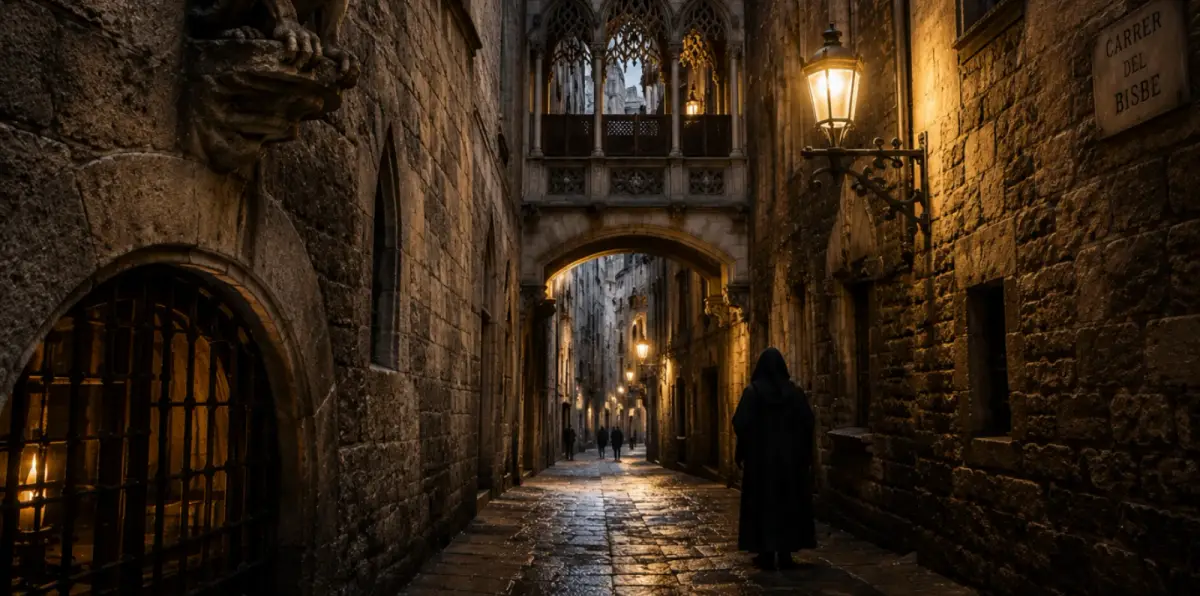

The most photographed bridge in the Gothic Quarter, the one that looks straight out of the Middle Ages, was built in 1928. That single fact unlocks the biggest secret in the neighbourhood: much of what you walk through as medieval Barcelona is a 20th-century reconstruction. It doesn’t cheapen the legends, it sharpens them, because many were born alongside the stage set. What follows are the stories the night tours tell, with the documented facts pulled apart from the folklore in each one, starting with the twist most visitors never hear.
Why “Gothic Quarter” is a 20th-century invention
The name itself gives it away. “Barri Gòtic” is a label from the 1900s; before that, the area around the cathedral was simply the cathedral district, and a Barcelonan in 1900 couldn’t have pointed you to a “Gothic Quarter” because none existed by that name. It began when the Via Laietana was cut through the old centre between 1908 and 1913, flattening dozens of streets. Out of that wound came a plan: salvage old windows, doorways and friezes, move them near the cathedral, and assemble a medieval-looking whole that blended tourism with Catalan identity.
Joan Rubió i Bellver, a disciple of Gaudí and the man behind the Bishop’s Bridge, said it plainly: the Gothic Quarter didn’t exist, so one had to be built. A great deal of what gets photographed as medieval, the cathedral’s main facade included, dates from between the late 1800s and 1970. Hold onto that, because it reframes everything else: when a legend sounds ancient, it’s worth asking whether the stage it plays out on is as old as the tale. Most of this scenery goes unnoticed on a standard Gothic Quarter walking route.
The skull on the Bishop’s Bridge
Look up as you pass under the arch and you’ll see a stone skull run through with a dagger, and nobody knows for certain why it’s there.
✓ What we know. Rubió i Bellver built the bridge in 1928, part of the run-up to the 1929 International Exposition, and when he unveiled this “fake Gothic bridge” locals mocked it, one satirical magazine suggesting it would make a fine balcony for Romeo and Juliet. The reading most historians favour is that the skull is the architect’s coded signature: denied the chance to carry out his full plan to remodel the quarter, he drove it in as a protest, a sign that his project had been murdered.
✦ What the legend says. The best-known version warns that the day someone pulls out the dagger, Barcelona’s buildings will collapse on their foundations. A gentler one promises that passing beneath it while looking at the skull and making a wish grants the wish. A third links to the next stop: to undo the bad luck of meeting its gaze, you go and stroke a nearby tortoise. You can’t cross the bridge on foot, only admire it from Carrer del Bisbe below.
The medieval look is partly a twentieth-century invention
This is the layer that changes how the quarter reads. The polished medieval look was, in large part, a deliberate act of city-branding: sectors of the Catalan bourgeoisie wanted symbols for a distinct identity, and they found them in the Middle Ages, the era of the region’s commercial and political peak. Architects like Puig i Cadafalch dreamed of turning these lanes into something out of Nuremberg or Bruges. So the skyline you frame is partly genuine stone and partly deliberate stagecraft from 1880 to 1970, which is why the quarter can feel almost too perfectly medieval. Knowing that changes how you read every “ancient” doorway, and it pairs well with the sharper history behind Barcelona’s modernisme beyond Gaudí.
The bomb scars of Sant Felip Neri
The most haunting square in the quarter holds the most important correction on this list.
✓ What we know. The holes covering the church facade are not from a medieval battle, nor from a firing squad. According to official records from Barcelona city council’s memorial, on the morning of 30 January 1938 the Italian air force allied with Franco bombed the city centre from 9:00 to 11:20; the church was sheltering children, and the bombs brought it down: 42 people died, most of them minors. The planes came back mid-morning to bomb the already-ruined square, once people had rushed out to help the wounded.
✦ What the legend says. For years, Franco-era propaganda pushed the story that the marks were from a firing squad, covering its own role in the killing. And over the real tragedy a legend of children’s whispers and laughter on quiet nights has been layered, a staple of the after-dark tours. But what actually unsettles needs no ghosts: it’s shrapnel, still there in plain sight. The square is a fixed stop on any tour of Barcelona’s hidden churches.
The 13 geese at the cathedral
Exactly 13 white geese live in the cathedral cloister, and the number is no accident. Per the Archbishopric of Barcelona, they honour Saint Eulàlia, co-patron of the city: she was 13 when she was martyred and endured 13 torments, one for each year of her life, for refusing to renounce her faith in Roman times. Before her death she herded geese in what is now Sarrià, hence the bird, and their white colour stands for purity. Because geese honk at strangers, they doubled as a natural alarm, and legend says they raised the alert during an attempted theft while the cathedral was being built.
Popular tradition adds that the number must never drop: the day the cloister loses its 13 geese, the cathedral will fall. In practice the cathedral staff make sure the count stays intact, century after century. It’s one of those legends that survives precisely because someone tends it daily.
What still has no answer
Not everything resolves, and that’s part of the pull. Symbols carved into facades across the quarter are mostly medieval masons’ and guild marks, a system for tracking who cut each block, but some still lack a clear reading. The Call, the old Jewish quarter, has carried tales of hidden passages, tunnels and a great buried hoard since the pogrom of 1391, none of which excavations have found. And the Plaça del Rei, the heart of medieval power and once the seat of the Inquisition, feeds stories of presences that belong to the tours’ fixed repertoire, with nothing but atmosphere to back them. To keep pulling the thread, Barcelona’s secret spots and its eerie metro ghost stations are worth another afternoon.
Walking them in one loop
Chaining the stops in order turns the legends into a walk that makes sense rather than a pile of trivia. The sequence that works best starts at the cathedral and its 13 geese, drops to the Casa de l’Ardiaca for the tortoise, passes under the Bishop’s Bridge along Carrer del Bisbe, and ends in Plaça de Sant Felip Neri. It’s only a few minutes on foot between each point, all inside the old town, and along the way you cross the Roman columns of the Temple of Augustus on Carrer Paradís, the only standing remains of the original Barcino. It sits well as the close of a day in the old city, in the spirit of the wider Gothic Quarter guide or a run through Barcelona’s essential sights on a first day in the city.
When to go and what costs a ticket
Most of these 6 points are free and outdoors, so you can walk them at any hour with no ticket, though the cathedral charges for cloister access and keeps its own hours. Guided legend tours of the quarter run year-round, experts recommend after dark, when the lanes empty and the neo-Gothic set piece looks its part, and they’re worth booking ahead in high season. If you’d rather go alone, the order above covers the essentials in a long hour, each stop good for a photo and a short story.
Guided versions of the same material range from history-and-legend walks to explicit paranormal terror, true crime and tip-based free tours, compared in the mystery and legend tours guide.
What’s true here, and what isn’t
Is Barcelona’s Gothic Quarter actually medieval?
Only in part. It keeps genuine Roman remains, like the Temple of Augustus columns, and real medieval buildings, but much of its image was rebuilt or created outright between 1908 and 1970 to give it a unified medieval look. The name Barri Gòtic is itself a 20th-century invention; it was previously known as the cathedral district.
What really happened at Plaça de Sant Felip Neri?
On 30 January 1938, the Italian air force allied with Franco bombed the square, where the church was sheltering children. Forty-two people died, most of them minors. The holes in the facade are shrapnel from those bombs, not marks from a firing squad, as Franco-era propaganda claimed for years.
Why is there a skull with a dagger on the Bishop’s Bridge?
There’s no official explanation. Joan Rubió i Bellver designed the bridge in 1928, and the reading historians most often cite is that he placed the skull as a coded protest after his plan to remodel the quarter was rejected. Folklore says whoever removes the dagger will bring down Barcelona’s buildings, or that making a wish while looking at it comes true.
In this quarter the strangest story isn’t a legend: it’s how a city built its own medieval past.