
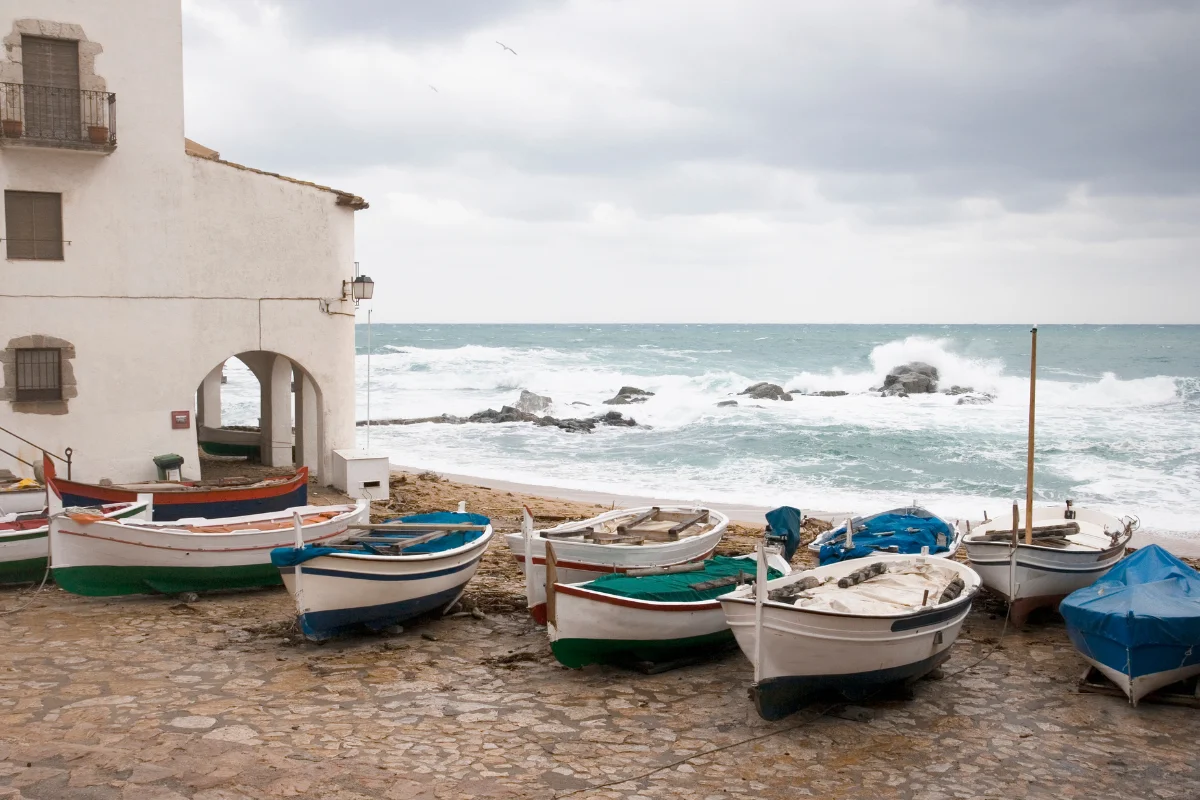

The Costa Brava runs 214 kilometres of coastline between Blanes and the French border. Not all of it is worth equal effort. There are coves with Caribbean-quality water accessible only after a 20-minute hike, and there are summer-saturated urban beaches that don’t justify the drive. There are medieval villages with centuries of coherent identity and 1970s urbanisations with no argument of their own.
This guide divides the coast from south to north, distinguishes what’s genuinely worth the detour, and specifies how much time each destination actually needs.
Is the Costa Brava worth visiting from Barcelona? Yes, with the right choices. Tossa de Mar is 1h15 by car — 13th-century walled medieval city plus beach in one plan. Begur and its coves (Aiguablava, Sa Tuna) are 1h45 away and concentrate the best water quality and scenery on the central stretch. Cadaqués is 2h30 and requires an overnight stay or a very early start. In July and August, arriving at the most popular coves before 9am is the difference between enjoying them and not.
Quick decision: Costa Brava by profile and time available
- One day without a car → Tossa de Mar — direct bus from Estació del Nord (Sarfa/Moventis, 1h30), 13th-century walls and Platja Gran at the same stop
- Best water colour in Catalonia → Cala Aiguablava (Begur) — white-sand bottom, Caribbean-blue water; parking can reach €36 in August — arrive before 9am
- Medieval village without tourist crowds → Peratallada — moat cut directly into rock (10th century), porticoed streets, 10 km from the sea; pairs well with Pals
- The most iconic photograph on the coast → Cadaqués — white houses, Santa Maria church, landscape Dalí painted for decades; better as a 2-day destination
- Large untouched beach → Platja de Castell (Palamós) — 375 metres of sand, no development, 4.7/5 with 1,000+ ratings, no direct road access
- Coastal hiking with sea views → Camí de Ronda between Palamós and Calella de Palafrugell (10.6 km, 3.5h) — passes Cala S’Alguer and the Pineda d’en Gori forest
- May, June or September visit → any option without timing constraints — water temperature 18–24°C, low crowds, lower accommodation prices
South: Blanes to Tossa
Blanes is the official start of the Costa Brava, marked by the Sa Palomera rock. The Jardín Botánico Marimurtra, founded in 1920 by Carl Faust with 4,000+ species on terraced cliffs above the sea, is one of the most significant Mediterranean botanical gardens in Europe — and appears in almost no travel itinerary.
Lloret de Mar has a mass-tourism reputation that is partly deserved, but the Santa Clotilde Gardens (novecento aesthetic, sea views) and the Camí de Ronda toward Tossa or Blanes give access to coves like Sa Caleta and Cala Trons with clean water and no construction. The problem isn’t Lloret — it’s that most visitors never leave the centre.
Tossa de Mar is the most balanced destination on the southern stretch and the most practical for a car-free day trip. Its Vila Vella — 13th-century walls and seven towers, declared a Historical-Artistic Monument in 1931 — is the only preserved medieval walled city on the Catalan coastline. Walk up to the lighthouse for the best views of the coast. The local dish is cim-i-tomba: a stew of ray or monkfish with vegetables and an alioli base, with dedicated festival days in September.
The GI-682 road between Tossa and Sant Feliu de Guíxols is one of the most spectacular drives on the Mediterranean — hairpin curves on cliff edges, viewpoints, access to coves impossible by bus. If you have a car, don’t take the motorway bypass.
Central: the Baix Empordà and its concentration of coves
This is where the Costa Brava justifies its reputation. Between Sant Feliu de Guíxols and Begur, the most photogenic coves, best-preserved inland medieval villages and greatest variety of options in the fewest kilometres are concentrated.
Palamós and the Gambas de Palamós
Palamós is the region’s marine gastronomy hub. The Gambas de Palamós have a quality designation based on a specific submarine ecosystem: daily catch from the port, intense red-pink colour, mineral flavour from feeding on deep algae beds. Recommended simply grilled with sea salt. There’s no equivalent quality available in any Barcelona restaurant.
2 km north: Cala S’Alguer, a set of 16th-century fishing huts with coloured doors declared a National Cultural Heritage Site in 2004. Pedestrian access only from Platja del Castell or La Fosca — no road, no development, time stopped. The kind of place the Costa Brava wants to preserve and has already lost elsewhere.
Platja de Castell (Palamós) — 375 metres of unspoiled sand surrounded by forest and farmland, is the last large virgin beach on the Costa Brava. 4.7/5 with 1,050+ reviews. No direct road access, which keeps it relatively uncrowded even in August.
Calella de Palafrugell, Llafranc and Tamariu
All three belong to the municipality of Palafrugell and represent the best example of traditional Catalan seaside culture — without trying to be anything else.
Calella de Palafrugell retains its fishermen’s white houses facing the sea and the Voltes arcade vaults that served as maritime storage and now house local seafood restaurants. The reference annual event is the Habaneras Singing on Port Bo beach each first Saturday of July — traditional sailors’ music accompanied by cremat (rum flamed with lemon and sugar). It functions as the cultural anchor of the entire central stretch.
Llafranc is more open, with an elegant seafront promenade. The Far de Sant Sebastià — a complex including an Iberian settlement, a 17th-century hermitage and one of the most powerful lighthouses on the peninsula — is 20 minutes’ walk from the village and offers one of the best perspectives on the central coast.
Tamariu is more sheltered and wooded. Ideal for kayaking to Cova d’en Gispert, the longest sea cave on the Costa Brava at 150 metres depth. Quiet, uncomplicated.
Begur: the municipality with the most varied coastline
Begur sits on a hill crowned by the ruins of its 11th-century medieval castle. Views from the top span 360 degrees between the Pyrenees and the Medes Islands. But the real argument is the coastline: eight coves within 10 kilometres, each with different geology.
Cala Aiguablava: the most photographed on the stretch. The water colour — electric blue that reads as Caribbean — is explained by the purity of the white-sand bottom and light incidence. Parking can reach €36 per full day in August (a deliberate deterrent to limit capacity). Arriving before 9am is the only practical solution. Excellent for snorkelling.
Sa Tuna: the most picturesque of Begur’s coves. Fishermen’s houses literally at the water’s edge, boats on the sand, an atmosphere from decades ago. The Camí de Ronda arriving at Sa Tuna from Sa Riera follows red-rock cliff edges with reference-quality views.
Illa Roja: the most dramatic visually. Seen from above before the descent on the Camí de Ronda, with a red rock formation in the middle of the water. Naturist beach with general access.
Aiguafreda: the quietest and least frequented. The Camí de Ronda section between Aiguablava and Aiguafreda, skirting the Cap de Begur, is among the best coastal paths in Catalonia.
For accommodation in the central stretch, Begur is the most strategically positioned base: access to all coves in under 15 minutes by car and high-quality restaurants in the village itself.
The inland medieval triangle: Pals, Peratallada and Monells
Less than 10 kilometres from the sea, three medieval villages that can be covered in a half-day and raise any coastal trip above pure beach:
Pals sits above the Empordà rice plain. The historic nucleus — El Pedró — is Catalan Gothic civil architecture, carefully restored. The Torre de les Hores (circular tower) dominates the view over the Empordà rice fields that give the area its culinary identity: arròs de Pals, the local variety grown in those paddies, is the base of the best mar i muntanya dishes in the zone. From the Josep Pla viewpoint, the Medes Islands are visible on the horizon.
Peratallada is smaller and more concentrated. The name comes from pedra tallada — cut stone — because the moat surrounding the walls is literally excavated into the natural rock of the 10th century. The Plaça de les Voltes and the network of ochre-stone porticoed streets have a visual coherence that no coastal village can match. It’s the favourite among Barcelona residents for weekend escapes that don’t involve a beach.
Monells is the third of the inland triangle, less known than Pals and Peratallada. Its medieval porticoed square was a market under the Aragonese kings. The 14th–15th century urban structure survives intact.
Cala S’Alguer is protected heritage, and what that changes
Cala S’Alguer looks like a row of picturesque fishing huts, and that is how it is usually described. The part that matters is that it was declared a National Cultural Heritage Site (BCIN) in 2004 — a formal protection status that prevents any construction, modification or commercial exploitation of the huts or their immediate environment.
That legal protection is what makes it different from every other “picturesque fishing cove” on the coast. Most of those coves in similar condition elsewhere were converted into beach bars and summer rentals decades ago. Cala S’Alguer cannot be. The pedestrian-only access isn’t a quirk of geography — it’s part of a deliberate management policy to maintain what the heritage designation is protecting. Knowing this changes how you look at the place when you get there.
North: Cadaqués and the Alt Empordà
Cadaqués is separated from the rest of the coast by the Cap de Creus massif — you cross the Perafita switchbacks to reach it. That difficulty of access has preserved what other parts of the Costa Brava have lost: rastell paving (flat river stones), white houses with no concessions to mass tourism, the Santa Maria church with its Baroque altarpiece, and an atmosphere that Picasso, Miró, Marcel Duchamp and Dalí chose before anyone talked about “authentic destinations.”
The Dalí House-Museum at Portlligat is his only permanent studio — a labyrinth of converted fishing huts with the Christ of the Rubble patio and the workshop where most of his major work was created. Advance booking required; extremely limited capacity.
Cap de Creus is Catalonia’s first marine-terrestrial park and the easternmost point of the Iberian Peninsula. The geology — schists and pegmatites eroded by the Tramuntana wind over millions of years — produces formations that Dalí identified as the “Camel” and the “Eagle” and transferred to his paintings. The Camí de Ronda from Cadaqués to the Cap de Creus lighthouse (10 km, 3h) is the wildest coastal path on the entire coast.
Roses has the Ciutadella — a military fortress containing superimposed Greek, Roman and medieval remains — and access to the Bay of Roses, recognised by UNESCO as one of the best-preserved bays in the western Mediterranean.
The Medes Islands: the best marine reserve in the western Mediterranean
Off L’Estartit, the protected archipelago of seven islets has the highest biomass in the western Mediterranean — large groupers, barracuda, red coral, seahorses. The fishing ban has generated a recovery unparalleled on the Catalan coast.
Diving centres in L’Estartit and L’Escala operate with strict capacity limits to minimise impact. For non-divers, glass-bottom boats and guided snorkelling tours access the richest zones without requiring full immersion.
Comparison table: Costa Brava destinations from Barcelona
| Destination | Distance | Drive | Car-free | Best for |
|---|---|---|---|---|
| Tossa de Mar | 80 km | 1h15 | Yes (Sarfa bus) | Full day — medieval town + beach |
| Calella de Palafrugell | 120 km | 1h45 | Yes (Moventis) | Fishing village, small coves |
| Begur / Aiguablava | 125 km | 1h50 | Difficult | Best water on the central coast |
| Pals | 130 km | 2h | No | Medieval + rice fields, no direct beach |
| Peratallada | 135 km | 2h | No | Most intact medieval inland village |
| Palamós / Platja de Castell | 115 km | 1h40 | Yes (Sarfa) | Virgin beach + market-fresh prawns |
| Cadaqués | 180 km | 2h30 | Yes (Sarfa, 2h45) | The most iconic — plan 2 days |
| Figueres / Dalí Triangle | 140 km | 1h30 | Yes (AVE) | Art and culture, no beach |
Which is the most beautiful cove on the Costa Brava?
Aiguablava (Begur) has the most turquoise water on the central stretch and the most photogenic setting. Platja de Castell (Palamós) has the best conservation state for a large beach. Sa Tuna (Begur) is the most picturesque for the fishermen’s houses at water level. In the north, the Cap de Creus coves (Cala Culip, Cala Jugadora) are the wildest and least visited.
Which Costa Brava village is most worth visiting?
Depends on the profile. For combining village and beach in one day: Tossa de Mar. For unique atmosphere and aesthetic: Cadaqués. For the most complete inland medieval experience: Peratallada. For top-quality marine gastronomy: Palamós. With Begur as base, coves, village, Pals and Calella de Palafrugell are all reachable on the same day.
How to reach the Costa Brava without a car from Barcelona?
Sarfa/Moventis operates buses from Estació del Nord to Tossa (1h30), Palamós (1h40), Calella de Palafrugell (2h), Begur (2h10) and Cadaqués (2h45). The AVE Barcelona–Girona (38 min) connects with regional buses toward the central and northern stretch. For access to smaller coves and the Camí de Ronda, a car remains the only practical option.
The coastline has a precise starting point: the Sa Palomera rock at Blanes, which splits the bay and separates the long Maresme sands from the coves to the north, as the Blanes guide explains.
Mistakes to avoid
- Going to Aiguablava after 9:30am in August — the car park starts filling at 9:30am and reaches capacity by 10am on peak days; this is not an exaggeration
- Taking the motorway between Tossa and Sant Feliu — the coastal GI-682 road is one of the most dramatic drives in the Mediterranean and cannot be replaced by anything a motorway offers
- Planning Cadaqués as a day trip from Barcelona — 2h30 each way plus the Perafita switchbacks (which genuinely cause motion sickness for some) means arriving at midday and leaving at 4pm; the village is worth two days
- Underestimating Camí de Ronda footwear requirements — the Cap de Begur and Cap de Creus sections require proper hiking shoes, not trainers; the coastal path between those sections is genuinely technical terrain
- Arriving in Peratallada without a table reservation on weekends — the village has very few restaurants, all small, and weekend lunch fills weeks ahead in peak season
The Costa Brava doesn’t need promoting. Aiguablava’s water is that colour because of what’s on the bottom. The Tossa walls have been standing since the 13th century. The Camí de Ronda has existed since customs guards needed to watch for smugglers arriving at night. It’s all still there — without needing anyone to call it authentic.
For individual destination guides with hours, access and specific recommendations, the Cadaqués guide, Tossa de Mar guide, Begur guide, Peratallada guide and Calella de Palafrugell guide cover each destination in depth. For Girona as a half-day addition to a Costa Brava trip, the guide covers the city logistics from any of the central stretch villages.