
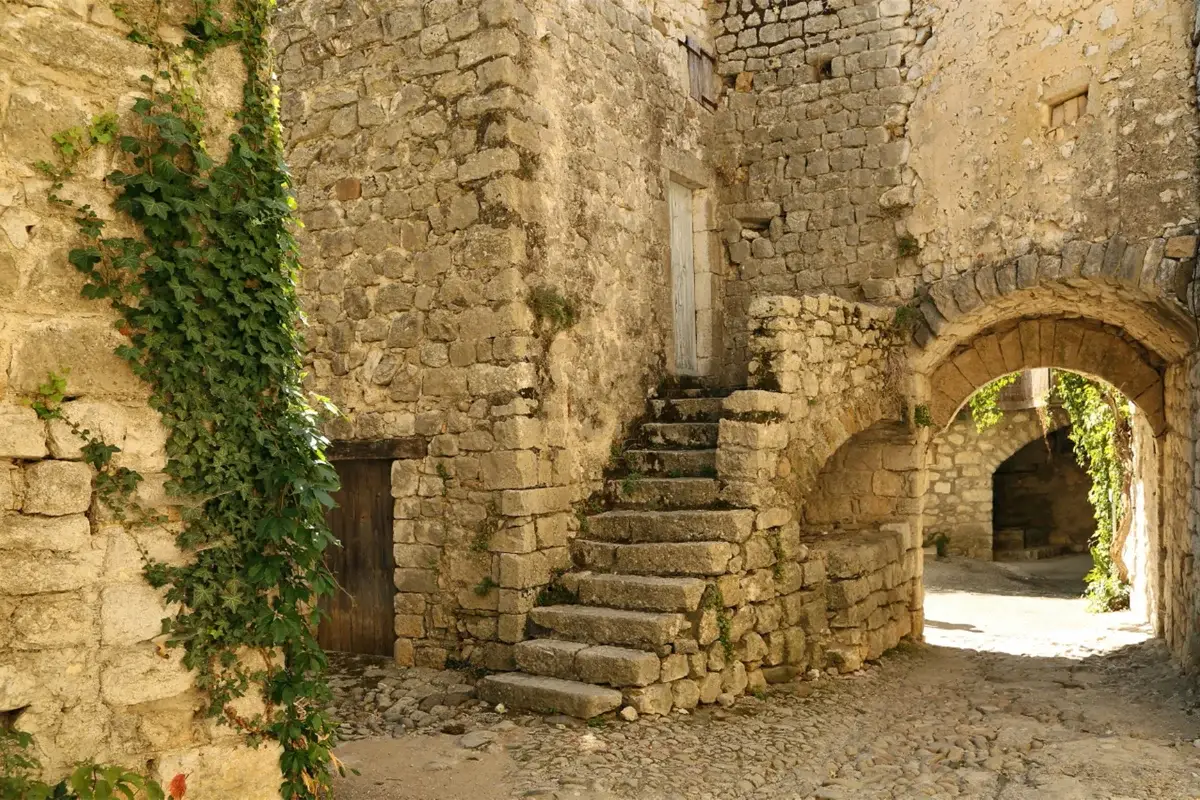

The first documented mention of Pals dates from 889, when the Castellarum Montis Áspero — the fortress on the Mont Aspre, a 55-metre elevation above the Empordà plain — was recorded. The name comes from the Latin palus (marsh), because the surrounding landscape was a wetland system that determined where and how the village was built over the following centuries. That geographical context explains three things at once: why it’s built on a hilltop, why the rice fields are part of the landscape today, and why the medieval nucleus is still accessed entirely on foot.
Pals won the National Fine Arts Prize in 1973 and the Catalan Tourism Medal of Honour in 1986. It is classified as a National Cultural Heritage Site. It sits in the Baix Empordà, approximately 40 km from Girona and 140 km from Barcelona — a natural add-on for anyone already planning a Costa Brava day trip.
What is there to see in Pals? The essential circuit covers the Torre de les Hores (11th–12th century, only surviving castle remnant), the Sant Pere church (Romanesque, Gothic and Baroque in one building), the Josep Pla viewpoint with views over the rice fields and the Medes Islands, and the Carrer Major with Visigothic tombs cut directly into the rock. A complete visit to the old town takes 90 minutes to 2 hours.
The Torre de les Hores: why it survived when the castle didn’t
The Torre de les Hores is the most recognisable element of Pals and the only surviving remnant of the original castle. It stands 15 metres high, has a circular plan and dates from between the 11th and 12th centuries. The castle itself was destroyed during the Catalan Civil War of the 15th century. The tower survived because it had already been converted into a public clock — its civic utility saved it from demolition.
Two bells were installed in the 15th century: one for quarter hours, one for full hours. That bell system is still functional and defines the acoustic landscape of the village. From the top, you can see the rice fields, the Montgrí massif and, on clear Tramuntana days, the Canigó peak in the French Pyrenees.
The royal decree that recycled a castle into a church
In 1478, King Juan II gave explicit authorisation for the stones of the ruined castle to be reused for two specific purposes: reinforcing the defensive walls and rebuilding the Sant Pere church. It’s one of the earliest documented examples of royal-decreed architectural recycling in Catalonia. The result is a church that literally incorporates the memory of the castle that preceded it in its own walls.
The Sant Pere church is documented from the late 10th century. The current structure has a Romanesque base, a Gothic nave from the 15th century built with the castle stones, and a Baroque portico from the 18th century. The bell tower is also 18th century. Three centuries of superimposed architecture in one building — all visible on the facade if you know where to look.
Quick decision: what to prioritise in Pals
- 2 hours only → Torre de les Hores + Carrer Major + Josep Pla viewpoint — the essential triangle of the historic nucleus
- Historical detail not on any sign → the Visigothic tombs on the Carrer Major, carved into the rock before the year 1000
- Best sunset in the area → Josep Pla viewpoint with views over the rice fields — the golden light on the Empordà plain between 6pm and 8pm
- With children → the El Xiulet de Pals tourist train through the rice fields with a stop at the 15th-century Molino de Arroz — departs from the old town
- Local gastronomy → restaurants Vicus and Es Portal (both Michelin-recognised) have Pals rice on the menu; El Pedró and Antic Casino are more accessible price points
- Late July → the Nit de les Espelmes (Night of the Candles): electric lighting is switched off and the entire historic nucleus is lit by thousands of candles, with music and dance — the only event of this type in the comarca
- Adding a beach → Platja Gran de Pals is 5 km by car — 3.5 km of sand, one of the least urbanised beaches on the Costa Brava
The defensive walls and what the towers reveal about medieval strategy
The current walls date from the 12th to 14th centuries, built on earlier foundations. The circuit is almost entirely preserved and allows a reading of the defensive system that other nearby villages have largely lost.
The four rectangular towers have an architectural feature that goes unnoticed: they are open on the interior side. The design was deliberate — if an attacker captured a tower from the outside, they couldn’t shelter inside it to attack the village from within. They remained exposed to the local defenders. This tactical medieval solution is directly verifiable at the Torre d’en Ramonet (northwest flank) and the Torre del Hospital (east sector) — the latter named for a now-vanished pilgrims’ care facility that stood outside the walls.
The Archaeological Promenade follows the northern face of the walls with views over the Empordà plain. The path includes sections where the natural bedrock forms part of the wall foundations — no separate construction was needed because the promontory itself was the base. For context on how Catalan defensive architecture evolved, the Barcelona Modernisme route guide traces the architectural lineage from medieval to 20th century across the region.
The Carrer Major and the Visigothic tombs: what’s under your feet
The Carrer Major is the ascending axis of the old town — the historical route that connected the plain to the defensive hilltop nucleus. It’s the most photographed street in Pals, with stone arches, Gothic windows and facades in the specific texture of Empordà sandstone.
What most visitors walk past: embedded in the pavement and in the lateral rock of the Carrer Major are anthropomorphic tombs carved directly into the stone, dated before the year 1000. They predate the Gothic height of the village and demonstrate a human occupation continuity that precedes the 9th-century Carolingian castle. They’re not prominently signposted. They’re visible if you look down and to the sides as you walk.
These tombs, alongside the Torre de les Hores, place occupation of the promontory at least in the 5th–8th centuries — the Visigothic period. The 889 Carolingian castle was not the beginning of the settlement. It was a military formalisation of something that already existed.
The rice fields: banned cultivation, a 15th-century mill and what the grain actually tastes like
The Pals landscape has two faces: the stone village on the hill and the agricultural rice plain that extends almost to the dunes. That dual identity is what makes Pals distinct from other medieval villages in the comarca.
Rice cultivation here has a more turbulent history than it appears. Between 1838 and 1900, it was prohibited in the area due to malaria. The stagnant water of the paddies was an ideal vector for the disease. Only with improvements in hydraulic engineering and public health advances at the end of the 19th century could cultivation resume safely. The transition from unhealthy marsh to productive wetland is one of the major agricultural engineering projects of the region.
The Molí d’Arròs (rice mill) has been in operation since 1452 and remains functional — it’s part of the rice fields tourist route. Pals rice has a specific texture that comes from its latitude: as the northernmost significant rice cultivation zone in the Iberian Peninsula, the maturation cycle is longer than in the Ebro Delta. The grain develops greater firmness and resistance to overcooking — which is why it appears on menus at high-level restaurants across Catalonia. For the broader regional food context, the best restaurants in Barcelona regularly source Pals rice for their rice-based dishes.
From late May through September, the fields turn intense green, shifting tones until the October harvest. The Plantada (traditional June planting) and Siega (October harvest) are public events with demonstration of manual techniques. The Pals i la Cuina de l’Arròs gastronomic campaign, running each spring since 1993, involves thirteen municipal restaurants with specific menus based on the local rice.
Radio Liberty broadcast from behind Platja Gran until 2001
From 1959 to 2001, in the pine forest behind Platja Gran de Pals, Radio Liberty operated. It was a shortwave radio station funded by the United States government with the objective of broadcasting uncensored news and Cold War propaganda toward the Soviet Union and Eastern Bloc countries. The facilities — designed by architect Agustí Borrell Senat in a specific Rationalist style — are still standing. There is an active proposal to convert them into a Cold War interpretation centre. The complex is visible from certain sections of the pine forest, though not currently open to the public.
That superposition — 21st-century protected dunes over 20th-century Cold War infrastructure over rice fields cultivated since the 15th century — is the most complex and least-known image of Pals.
Platja Gran de Pals itself: 3.5 km of beach, one of the best-preserved coastal dune systems in Catalonia, and seabed with posidonia meadows. The sand is coarser in the south sector and finer toward the north (Platja del Grau). No seafront promenade. Substantially lower urbanisation than most Costa Brava beaches.
The Josep Pla viewpoint and the ongoing landscape debate
The Mirador Josep Pla sits at the highest point of the walled perimeter. It’s named for the writer — born in Palafrugell a few kilometres away — who brought visitors here specifically to show them what he considered the best view in the Empordà: the agricultural plain, the Montgrí massif, the Medes Islands, and on Tramuntana days, the Canigó in the Pyrenees.
What no signage mentions: there is an active debate among heritage managers and environmentalists about the growth of pine trees on the hillside slopes. Those pines are progressively obstructing the views that Pla described. The tension between forest conservation and preservation of the historic landscape has no simple resolution and is one of the most specific management conflicts currently facing the municipality.
The sunset view from this viewpoint — rice fields turning gold, Medes Islands on the horizon — is one of the most reproduced images of the Costa Brava interior. The optimal photography window is the hour before sunset to the setting of the sun itself.
Comparison: Pals vs nearby medieval villages
| Village | Distance from Pals | Distinctive feature | Time needed |
|---|---|---|---|
| Peratallada | 10 km | Moat cut into rock, 10th century; best-preserved medieval street plan | 2–3 hours |
| Begur | 15 km | Castle ruins + eight coves in 10 km | Half day + beach |
| Calella de Palafrugell | 20 km | Fishermen’s houses, July Habaneras festival | 2–3 hours |
| Monells | 18 km | Medieval porticoed square, least visited of the three | 1 hour |
| L’Escala / Empúries | 20 km | Greek + Roman city on same site, anchovy production | Full day |
Practical information
Ca la Pruna — a fortified 15th–16th century house at the base of the historic nucleus, now housing the Tourist Office, exhibition spaces on local history, rice, submarine archaeology and rural Empordà life — is the logical starting point. Information available in multiple languages; adapted itineraries exist for visitors with reduced mobility (note that the cobblestone surface of the old town is not accessible throughout).
- Old town: completely pedestrianised; wear rigid-sole footwear for the cobblestones
- Parking: free at Carrer Abeurador or Av. Pompeu Fabra, a few minutes’ walk from the walled perimeter
- Torre de les Hores: exterior always visible; interior only with arranged guided visits
- Best season: May–June (rice fields in growth, no saturation) or September–October (harvest, autumn light)
- August: the most crowded month, especially during the Nit de les Espelmes which operates with capacity access control
- Michelin-recognised restaurants: require reservations several days ahead in peak season
Mistakes to avoid
- Going only for the old town without the viewpoint — the Josep Pla viewpoint is the element that puts the entire landscape in context; the village without the view is half the visit
- Missing the Visigothic tombs on the Carrer Major — they’re genuinely undermarked; consciously look at the lateral rock surfaces as you walk, not just at the facades
- Planning Pals as a midday stop in August — the old town becomes significantly crowded by 11am in peak weeks; arriving before 10am or after 5pm changes the experience entirely
- Not checking the Nit de les Espelmes date if visiting in July — it’s the village’s most atmospheric event and the specific week fills accommodation across the comarca; either plan around it or avoid it depending on your crowd preference
Twenty minutes down the coast, Les Voltes at Port Bo were built in the 19th century as fishermen’s workshops rather than restaurants, and the Habaneras festival began there in 1966 — the thread of the Calella de Palafrugell guide.
Who is this for?
Medieval architecture focus → the triple-layered Sant Pere church (Romanesque/Gothic/Baroque) and the intact defensive wall circuit with open-backed towers are the two architectural arguments that specialists rank above most comparable villages in the comarca
Gastronomy focus → Pals rice at Vicus or Es Portal represents the best example of place-specific ingredient cooking in the Costa Brava interior; the meal-with-provenance experience is complete here in a way it isn’t in most beach towns
Photography → the sunset from the Josep Pla viewpoint is technically specific: the hour, the direction and the rice field foreground make this a different image from any other Costa Brava hilltop; plan around the light
First-time Costa Brava visitor combining beach and inland → Pals old town (2 hours) + Platja Gran (afternoon) + dinner in the village covers the essential Baix Empordà experience in one day without a complicated itinerary
Pals is the only medieval village in the Baix Empordà where you can walk the same street layout that 9th-century inhabitants used, step over the Visigothic tombs beneath the cobblestones of the Carrer Major, eat rice cultivated in the fields visible from the viewpoint, and drive to a beach where Cold War radio transmitters still stand in the pines. It’s not a stage set — it’s a layered accumulation of history that hasn’t needed to simplify itself to attract visitors.
For the broader Costa Brava from Barcelona context and how Pals fits into a wider coastal itinerary. For the nearest medieval village at 10 km, the Peratallada guide covers the moat and street plan that make it the most architecturally concentrated village in the comarca. And for the Girona day trip as a half-day addition to a Pals visit, the city is 40 minutes by car.