

Montjuïc rises 173 meters above sea level and takes less than 40 minutes to climb on foot from Carrer Blai in Poble Sec — or 4 minutes on the funicular from Paral·lel metro. The route starts with pintxos in the neighborhood, climbs through gardens with direct sea views, passes the Mirador de l’Alcalde and the Castle, and ends with drinks at La Caseta del Migdia as the sun drops over the airport. For the complete Montjuïc guide including all the museums, the full article covers the hill in detail. Metro L2/L3, Paral·lel stop.
Poble Sec Start — Carrer Blai and Quimet & Quimet
Carrer Blai is the pintxos street of Poble Sec — pedestrianized, with bars open from early, genuine neighborhood energy. For the full picture of what to do in Poble Sec beyond the Blai, the neighborhood has more layers: the Anti-Aircraft Shelter 307, the Teatre Grec, and the Paral·lel strip with Barcelona’s cabaret history.
Quimet & Quimet (Carrer del Poeta Cabanyes, 25) is the most-cited family bodega in the neighborhood — fifth generation, famous for its creative montaditos with quality conservas. Opens for lunch only (12:00–16:00); if arriving later, any Blai bar has continuous service. Weekend caveat: Quimet & Quimet closes Saturday and Sunday afternoons — any Blai bar substitutes with better hours.
If the route starts early, coffee first at the neighborhood and save the vermouth for the return descent.
Time: 20–30 minutes.
Quick Decision — Route Options
- 2 hours without the climb → Funicular from Paral·lel + Mirador de l’Alcalde + Jardins de Costa i Llobera — the three best viewpoints without the walking ascent
- Best panorama in Barcelona → Mirador de l’Alcalde (free, 180° views) or the MNAC terraces (€2, perspective toward the city and Sagrada Família)
- For sunset → Mirador del Migdia and La Caseta del Migdia — the only point where the sun sets without obstacles on the horizon, with terrace tables
- With children → Jardins de Joan Brossa with “musical cushions” in the pavement and play areas, then the Castle exterior walls
- Full route as described → Parc del Mirador del Poble Sec + Jardins de Costa i Llobera + Mirador de l’Alcalde + Castle + descent through Jardins de Laribal
- Combining with MNAC → MNAC terraces (€2 separate entry) have the best perspective of the monumental axis from Plaça d’Espanya to the Magic Fountain
First Climb — Parc del Mirador del Poble Sec
From Carrer Blai, the most direct ascent is via Passeig de Montjuïc, turning toward the hill on any of the streets that rise on a slope. The Parc del Mirador del Poble Sec (Passeig de Montjuïc, 59) has two viewpoints: one facing the city, one facing the harbor. The 18-meter waterfall descending to the lower pond is the park’s most distinctive element — designed between 1995 and 1997 with jacarandas, holm oaks, and Peruvian pepper trees that provide shade on the climb.
From here you can already see Passeig de Colón and the Tres Chimeneas smokestacks of the Paral·lel in the valley below.
Funicular alternative: Metro L2/L3 to Paral·lel, Montjuïc funicular integrated in the T-Casual card (4 minutes), then walk 10–15 minutes to the first viewpoint.
Time: 20–25 minutes walking from Blai.
Jardins de Mossèn Costa i Llobera — Cactus and Sea Views
On the southern slope of the hill: the Jardins de Mossèn Costa i Llobera — a collection of cacti and succulents considered one of the most important in Europe. The south-facing orientation and the hillside microclimate allow species that don’t grow anywhere else in the city. Views from the gardens are directly to the sea, with no buildings between.
Free entry. Opens at 10:00, closes between 19:00 and 21:00 depending on the season.
This is the point on the route where time stops without noticing — few people, much quiet, a Mediterranean perspective completely different from the beaches.
Time: 20 minutes.
Mirador de l’Alcalde — The 180-Degree Free Viewpoint
Mirador de l’Alcalde is the 180-degree panorama over city, harbor, and Mediterranean that appears in every serious Montjuïc photograph. Stepped terraces with mosaic pavement designed by Carles Buïgas, free, open 24 hours. From here: Port Vell, El Born, the Gothic Quarter, and the coastline north to the Maresme on clear days.
10 minutes further: Mirador de Miramar, with a different perspective — closer to the commercial port and cruise terminal. Adjacent to the Jardins de Miramar and the harbor cable car station that crosses above the water to Barceloneta. For anyone planning to continue down to the seafront, the cable car connects Miramar to the beach neighborhood — the most visual connection between the hill and the waterfront.
Time: 15–20 minutes combined.
Why an astronomer was measuring Montjuïc in 1792
Beyond the Castle and the main viewpoints, the fact worth carrying is why Pierre-André Méchain was at Montjuïc Castle in 1792.
French astronomer Pierre-André Méchain used the castle as a measurement point for the meridian arc survey that established the basis for defining the meter as a unit of measurement. The meter was defined as one ten-millionth of the distance from the North Pole to the equator along the Paris meridian — Méchain’s job was to measure the arc between Barcelona and Dunkirk to calculate that distance. The castle’s height and unobstructed sightlines made it the ideal southern anchor point. A statue at the castle site commemorates the measurement.
The meter is, in a real sense, partly defined from this hilltop. That fact doesn’t appear on any tourist information at the site.
Montjuïc Castle — 173 Meters, and a Measurement That Built the Metric System
Montjuïc Castle at 173 meters is the highest point on the route. The current fortress was designed by military engineer Juan Martín Cermeño — the same engineer who laid out Barceloneta’s street grid — in a star-shaped plan in the 18th century.
The exterior walls are free to walk. Interior entry costs €12 (reduced €8), or €16 with the guided tour, with free access Sundays from 15:00. For the complete historical context of the castle’s use as a prison and instrument of political repression before becoming a cultural space, the Montjuïc Castle guide covers the full transformation.
From the walls: the industrial port to the east, the airport to the southwest, and Tibidabo to the north. Clear-day visibility reaches the Maresme coastline.
Time: 30–45 minutes.
La Caseta del Migdia — Sunset End Point
The Mirador del Migdia, at the western end of the hill, has the best Montjuïc sunset view: the sun disappears behind the Collserola range, leaving the city lit in the “blue hour” while the airport and Zona Franca form a silhouette on the horizon.
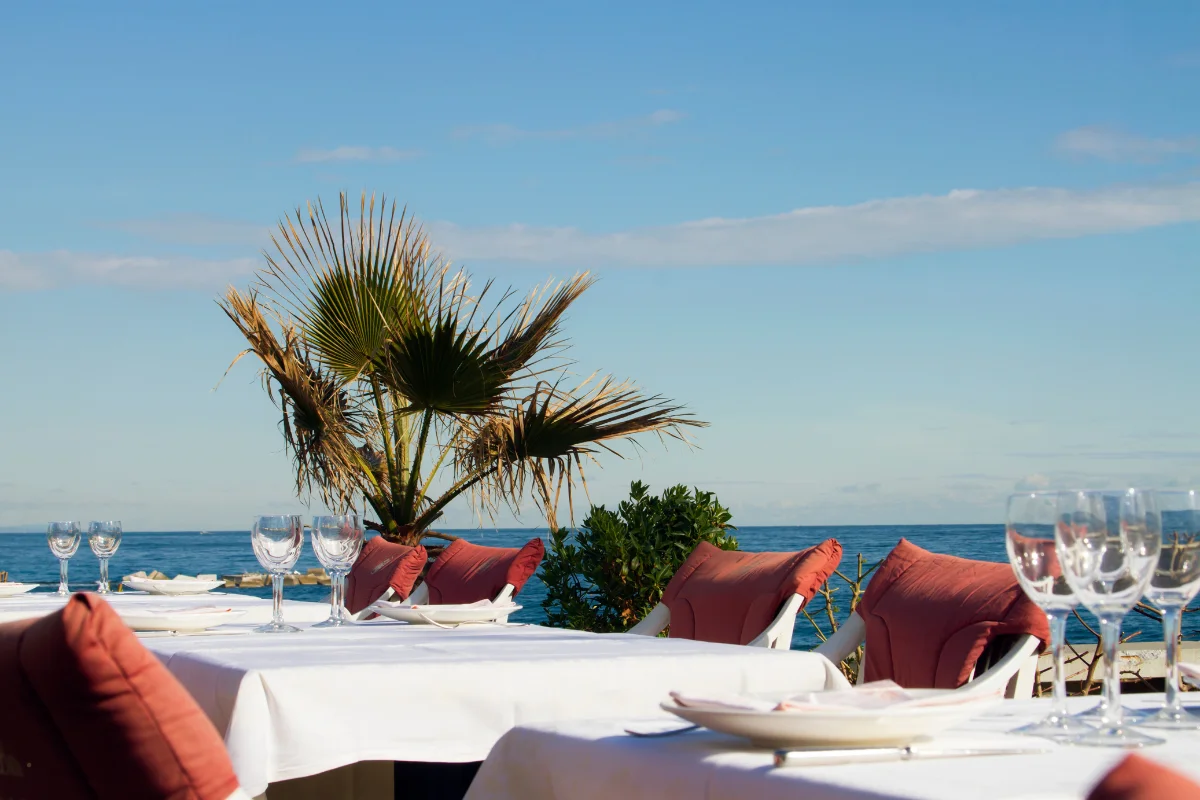
La Caseta del Migdia is an informal bar with outdoor tables directly at this viewpoint. No pretensions, bocadillos and drinks at reasonable prices. At 19:00 with the sun dropping, it does exactly what it needs to do: somewhere to sit, something cold in hand, and a view that requires no editing.
Return transport: bus 150 to Paral·lel or Plaça d’Espanya (T-Casual valid), or walk down through the Jardins de Joan Brossa and Mossèn Cinto Verdaguer to the funicular.
Practical Notes
- Duration: 3–4 hours at an easy pace. With Castle interior and terrace stops, plan 4–5 hours
- Difficulty: easy-moderate. Slopes and stairs but nothing technical — comfortable sneakers, not hiking boots
- Water: bring at least 750ml — between Mirador de l’Alcalde and La Caseta del Migdia there isn’t always a purchase point
- Return transport: bus 150 (T-Casual) connects the Castle with Plaça d’Espanya and Paral·lel; Montjuïc cable car costs ~€12 one way with stops at Parc, Mirador, and Castle
- Sunset timing: Mirador del Migdia — arrive 30–40 minutes before the official sunset time
- Castle free entry: Sundays from 15:00 and first Sunday of each month all day — higher attendance in those windows
The route starts at sea level with pintxos on Carrer Blai and ends at 173 meters with sunset over the Mediterranean. Between those two points: cactus gardens, a castle that helped define the meter, and one of the best free viewpoints in Europe. Three and a half hours of walking that explain why Montjuïc is the most contradictory space in Barcelona: military and green, historic and contemporary, popular and monumental at the same time.
For the wider Montjuïc context: the Montjuïc complete guide covers the Fundació Joan Miró, MNAC, and the full hill itinerary. The Mies van der Rohe Pavilion is on the descent toward Plaça d’Espanya — one of the world’s most influential buildings en route from the Castle. And for connecting down to the beach, the Barceloneta guide picks up where the cable car ends.