
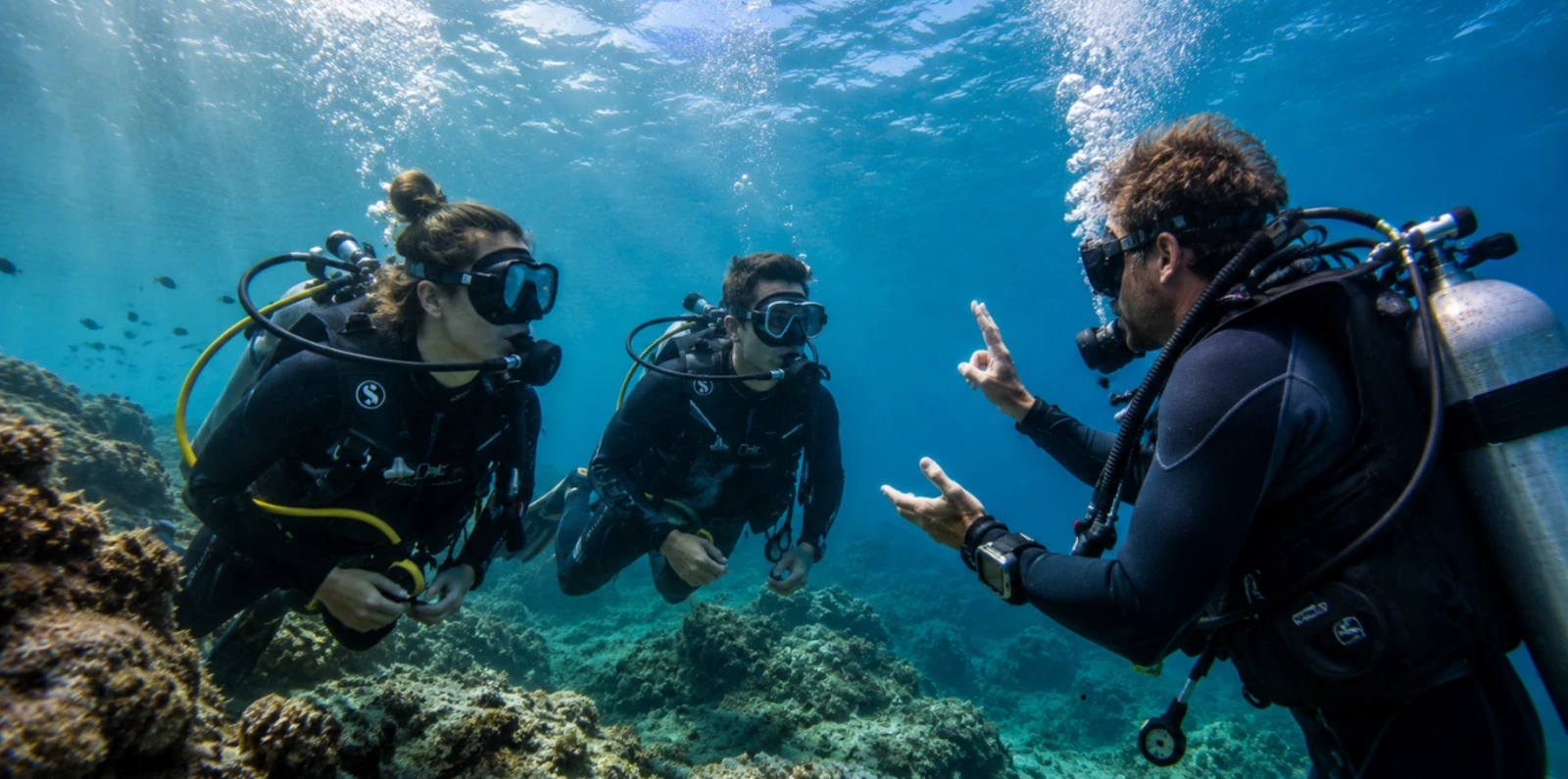

Between the Port Olímpic and the Fòrum, the seabed drops to roughly 10 metres and then flattens into sand for kilometres. That single fact explains most of what people get right and wrong about diving here. There is no wall, no coral garden and no drop-off within swimming distance of the city beaches, which is why honest reviews of city dives talk about octopus and nudibranchs rather than groupers. It also explains why every serious dive day on this coast eventually involves a car heading north.
The seabed off Barcelona is sand, and that decides what you see
The Catalan coast changes character about 70 kilometres north of the city. South of that line the bottom is soft sediment shaped by river outflow; north of it the Palaeozoic rock of the Costa Brava produces the walls, tunnels and pinnacles that put the region on dive maps. Barcelona sits firmly on the sand side.
Is there any real diving in Barcelona itself? Yes, but at a modest scale. City dives run 6 to 12 metres over sand and breakwater rock, with octopus, cuttlefish, nudibranchs, damselfish and occasional torpedo rays. Try dives cost 40-85 €. The dramatic Mediterranean scenery starts around L’Estartit and Palamós, 90 minutes away.
Soft-bottom diving has one underrated advantage for a beginner: nothing to crash into. Buoyancy mistakes that would damage a gorgonia field or bruise a diver against rock simply stir up a cloud of sand. Instructors in the Port Olímpic use exactly this to run first dives in conditions they can control, and centres there add seabed clean-ups and marine biodiversity workshops to the same sites.
The cost is visibility. Fine sediment plus a working port means the water clouds quickly after wind or rain, and a proportion of city dives happen in three or four metres of usable sight. Anyone booking a first dive here should treat clear water as a bonus, not a promise, and read the beach guide for Barcelona with that in mind, because the same sediment that softens the swimming beaches is what hangs in the water column below them.
Spanish law sets the floor and the training agency sets the ceiling
Two separate rulebooks apply to every dive in Spain, and they do not agree. Understanding which one wins saves families a wasted booking.
Royal Decree 550/2020 governs diving safety nationally. Article 7 sets a minimum age of 8 for recreational diving, with depth bands by age: 6 metres at ages 8 to 9, 12 metres at 10 to 11, 21 metres at 12 to 15 and 40 metres from 16 to 18. Under-18s may breathe air only, never nitrox. The same decree caps recreational scuba at 40 metres overall, requires a signed health declaration for any introductory experience, and makes a surface marker buoy compulsory whenever there is no support boat or buoyed zone. No support vessel is needed within 200 metres of a beach.
PADI standards are stricter at the young end. No one under 10 is accepted for a Discover Scuba Diving session in open water; ages 8 and 9 get pool-only programmes with a 2-metre ceiling. Certified Junior Open Water divers aged 10 and 11 are limited to 12 metres and must dive with a parent, guardian or professional.
The practical rule: the more restrictive of the two applies. Spanish law would permit a nine-year-old at 6 metres, but no PADI centre in Barcelona will take that child into the sea. If one offers to, that is a reason to book elsewhere.
One correction worth carrying into any booking conversation. Several reservation portals state that Open Water certifies you to 30 metres. It does not. The standard is 18 metres; 30 metres belongs to the Advanced level. Official data from the agencies is unambiguous on this, and a shop that repeats the error is worth a second look.
Four steps from first breath to a certification card
The progression is short and each step has a defined depth and a defined cost.
- Discover Scuba Diving, 40-85 € — one supervised open-water dive, 20 to 30 minutes underwater, ceiling of 12 metres, no qualification issued and minimum age 10
- Open Water Diver, 360-399 € — online theory, five confined-water dives and four open-water dives, certifying to 18 metres worldwide, typically over a long weekend
- Advanced Open Water, around 400 € — five adventure dives with deep and navigation compulsory, extending the limit to 30 metres and adding night, wreck or nitrox options
- Rescue and beyond — the point where most divers on this coast start joining boat trips to the Costa Brava rather than booking courses
Group pricing shifts the middle step: several Barcelona centres drop 10 to 20 € per person once two or more people book the Open Water together. Where the price does not move is the sea portion, and that is the detail to interrogate. A course sold as “in Barcelona” may still do its four open-water dives in Palamós or Lloret de Mar, which adds a car, a full day and fuel to a figure you thought was final. Anyone budgeting a trip around this should cross-check against what a day in Barcelona actually costs.
The dive sites that justify driving north
Three sites explain why Catalan divers accept the drive, and all three sit between 90 minutes and two hours from the city.
Els Ullastres, off Llafranc. Three submerged pinnacles covered in red gorgonians, running from 8 to 40 metres. The depth range is the point: a newly certified diver and a veteran can share the same dive at different levels, which almost no other site here allows.
The Boreas wreck, Palamós. A vessel sunk deliberately for diving in the 1980s, seized from smugglers before that. The deck sits around 18 metres and the seabed near 30, so the upper structure is reachable on an Open Water card while the rest waits for Advanced.
The Medes Islands, off L’Estartit. Protected since 1990 and now the reference dive of the Spanish Mediterranean, with groupers that ignore divers, vertical gorgonian walls, and the Cova del Dofí and La Vaca tunnels. Thirteen dive centres operate from L’Estartit alone. Two conditions apply: a reserve fee of 5.20 € per dive on top of the centre’s price, and a hard prohibition on try dives and entry-level training inside the reserve. Beginners cannot start here, whatever a booking site implies.
The whole area pairs naturally with a Costa Brava trip from Barcelona, and basing yourself in L’Escala puts you within 20 minutes of the L’Estartit boats.
Fitting a dive into a three-day city break
This is the constraint that catches most visitors, and it has nothing to do with diving skill. It is about the flight home.
Consensus guidance from diving medicine bodies sets a minimum 12-hour surface interval after a single no-decompression dive and 18 hours after multiple dives or multiple days. Dives requiring decompression stops push that past 24 hours. Some dive computers demand longer. Experts recommend treating those numbers as floors rather than targets.
For a Barcelona trip the arithmetic is blunt. A try dive finishing at 13:00 rules out any flight before 01:00 the following morning. A two-day Open Water course that ends Sunday afternoon rules out a Sunday evening departure entirely and makes an early Monday flight marginal. The fix is simple and never appears at the booking stage: dive on day one or day two, never on the last day.
Two practical consequences follow. First, book the dive before you book anything inflexible, because dive days get cancelled for sea state and you want spare days to reschedule into. Second, use the freed-up final day for something at sea level, such as the Barceloneta to Port Olímpic walking route, which passes the dive centres themselves. If this is your first trip to the city, the general first-time visitor guide explains how the coastal district connects to everything else.
Is diving in Barcelona worth it
Verdict: yes for learning, no for sightseeing. The city is one of the few European capitals where you can walk from a metro stop to a PADI five-star centre, complete a full certification without renting a car, and be back in the centre for dinner. For a beginner, the convenience is worth more than the scenery, and the reduced visibility genuinely does not matter while you are learning to clear a mask.
It is not worth it if you are an experienced diver with two spare days and a rental car. In that case the honest answer is to skip the city entirely and book directly in L’Estartit or Palamós, where the same money buys a considerably better dive.
It is also not worth it in the wrong month. Water sits at 13-14 °C from January to March, and while centres run year-round with 7 mm suits, a first dive in cold water with poor visibility converts more people away from the sport than towards it. April to June and September to October give the best balance of temperature and clarity, which lines up closely with the best time to visit Barcelona generally.
What changes on the Catalan coast in 2026
Two shifts affect how you book this year.
The Medes reserve no longer works on a daily headcount. Since 2015 the quota is annual and calculated per mooring buoy, scaled to how fragile each zone is. In practice, high-season weekend slots disappear weeks ahead rather than days, so a July or August dive in the reserve needs booking well before you arrive.
Barcelona’s own dive scene consolidated around the Port Olímpic after the marina’s redevelopment, and at least one long-standing centre changed both its name and its unit within the port. Listings and aggregator pages have not all caught up, so confirming the current address by phone before turning up with a wetsuit under your arm is time well spent.
Visibility figures also deserve recalibrating. The frequently repeated “30 metres” for this coast is the exceptional ceiling on the Costa Brava, not the norm. Normal conditions there give 10 to 20 metres, and the city coast gives considerably less. Divers who arrive expecting the higher number leave disappointed for no good reason, while those who plan around other water sports in Barcelona as a backup rarely lose a day.
Frequently asked questions about diving in Barcelona
Can you scuba dive in Barcelona without a certification?
Yes. A Discover Scuba Diving session takes uncertified beginners into open water with an instructor within arm’s reach, to a ceiling of 12 metres. It grants no qualification and has to be repeated or upgraded if you want to dive independently later.
How deep does a first dive in Barcelona actually go?
Most city try dives stay between 7 and 10 metres because the seabed off the Port Olímpic flattens out around that depth. The agency ceiling is 12 metres for the open water portion and 6 metres for the initial shallow skills section.
What is the sea temperature for diving in Barcelona?
It ranges from 13-14 °C in January and February to 24-26 °C in August. A 3 mm wetsuit covers summer; winter needs a 7 mm semi-dry with hood and gloves, or a drysuit. Rental suits are included in almost every course and try dive price.
How long should you wait to fly after diving?
The consensus guidance is a minimum 12-hour surface interval after a single no-decompression dive and 18 hours after several dives or several days of diving. That rule alone decides whether a dive fits into a short trip to Barcelona.
Are the Medes Islands suitable for a first dive?
No. The marine reserve does not authorise try dives or entry-level training, so beginners cannot start there regardless of what booking portals suggest. Certified divers pay a reserve fee of 5.20 € per dive on top of the dive centre price.
The water off the Barceloneta is not the reason to dive here. The instructors, the price and the proximity are.