
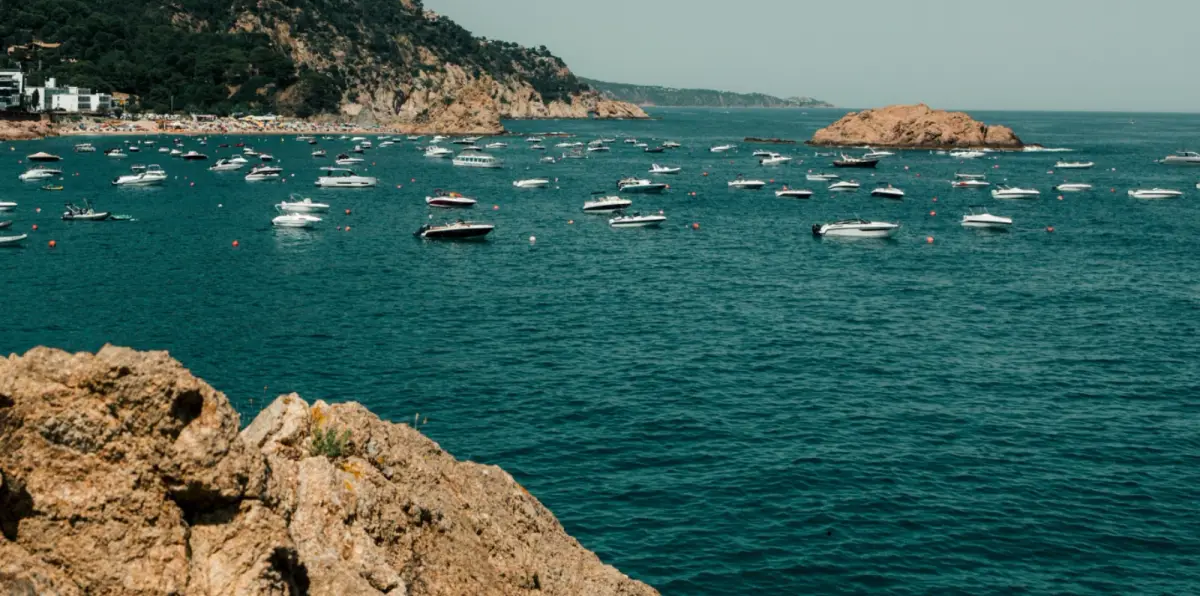

The three coves that fill Catalonia’s postcards, Aiguablava, Sa Tuna and Cala Fonda, share an inconvenient detail: no train stops within walking distance of any of them. That single fact reshapes how you should plan a beach day here. The prettiest water sits on a rugged coast that never got a coastal railway, while the beaches you can reach in half an hour by train are wider, flatter and far less photogenic. So the useful question is not which beach is most beautiful, but which one you can actually get to with the time and transport you have.
The best coves in Catalonia cluster on the Costa Brava north of Barcelona, but they need a car; the Maresme, Garraf and Sitges have solid beaches on the Rodalies train line, and the Costa Daurada and Ebro Delta hold the wild, empty sand of the south.
The best beaches at a glance
Catalonia’s 580 kilometres of coast split into four stretches, and this table is the fastest way to see which specific beaches fit your trip, by access, snorkelling, family suitability and travel time from Barcelona.
| Beach | Train | Car | Snorkel | Families | Time from Barcelona |
|---|---|---|---|---|---|
| Ocata (El Masnou) | Yes | Yes | No | Yes | 35 min |
| Garraf | Yes | Yes | Fair | Fair | 30 min |
| Sitges (Sant Sebastià) | Yes | Yes | No | Yes | 40 min |
| Castelldefels | Yes | Yes | No | Yes | 30 min |
| Aiguablava (Begur) | No | Yes | High | Yes | ~1 h 45 |
| Sa Tuna (Begur) | No | Yes (not in Aug) | High | No | ~1 h 45 |
| Platja de Castell (Palamós) | No | Yes | Fair | Yes | ~1 h 30 |
| Cala Pola (Tossa) | No | Yes | High | Fair | ~1 h 20 |
| Cala Fonda (Tarragona) | No | Yes + walk | Fair | No | ~1 h 20 |
| Platja del Torn (L’Hospitalet) | No | Yes | No | No | ~1 h 45 |
| Ebro Delta (Riumar) | No | Yes | No | Fair | ~2 h |
According to travel guides such as National Geographic, eleven of the twenty-one standout beaches on this coast sit on the Costa Brava, which is exactly where the train does not go. The pattern in the table is the same one that shapes the whole trip: everything that scores high for snorkelling needs a car, and everything the train reaches is town sand with no rocky bottom.
Beaches you can reach by train
Rodalies, the regional rail network, reaches a handful of good beaches from central Barcelona in under 40 minutes, and it is the sensible choice if you would rather not drive. Two lines matter. The R1 runs north along the Maresme coast; the R2 Sud heads south toward the Garraf and the Costa Daurada. You can check times on the Rodalies app and buy a single ticket at any station machine.
The best northern stop is Ocata, in El Masnou, about 35 minutes out, where the platform sits almost on the sand and the beach is long, flat and fully serviced. Closer in, Montgat (28 minutes) and Badalona (23 minutes) work for a fast dip, and Vilassar de Mar (42 minutes) adds a harbour with restaurants. Heading south, the R2 Sud drops you at Garraf in roughly 30 minutes, a small, tucked-away beach with few services and the wildest feel the train can offer. Five minutes further is Sitges, around 40 minutes from Barcelona, with tidy town beaches and an old quarter worth the afternoon, covered in detail in this guide to Sitges as a day trip. In summer these lines add weekend departures every few minutes at peak swimming hours. If you would rather stay put, the city beaches in Barcelona itself are a metro ride away, though they trade scenery for convenience.
The Costa Brava coves worth renting a car for
This is where Catalonia earns its reputation, and where the logistics get real. The Costa Brava holds most of the celebrated coves, but its steep, folded coastline never had a coastal train, so you arrive by car on the C-31 and local roads, or by intercity bus from Barcelona Nord to Palafrugell and the nearby towns. Budget at least an hour and a half, and expect car parks to fill before eleven in July and August.
Begur makes the best base. Its three famous coves, Sa Riera, Sa Tuna and Aiguablava, are linked in summer by the Bus Platges Begur, which runs from the village for 1 euro with up to seven services a day. One rule catches people out: in July and August, cars belonging to non-residents are banned from Sa Tuna and Aiguafreda, so you leave the car in the village car park at 1 euro an hour and take that bus. Sa Tuna is small, about 80 metres, floored with dark pebbles rather than sand, and the water is clear enough to read the seabed from the surface. Aiguablava, whose name means “blue water” in Catalan, is barely 100 metres long but keeps its own car park and a ten-minute walk down, and its colour is what made it famous. Nearby, toward Pals, Illa Roja sits below a tall reddish rock and keeps a naturist tradition. To pair the beaches with the old town and its clifftop viewpoints, set aside time for the town of Begur.
In Palamós, Platja de Castell is one of the last large undeveloped beaches on the coast: roughly 300 metres of crescent sand that locals fought to save from building, backed by pine woods with the ruins of an Iberian settlement at one end. Summer parking runs about 5 euros a day, and fines for wild camping reach 500 euros. Further south, at Tossa de Mar, Cala Pola hides some 4 kilometres from town among Mediterranean forest, with calm water for swimming and paddleboarding. The far north, the Cap de Creus, is the wildest edge of Catalonia, the easternmost point of the peninsula, its coves shaped by the tramuntana wind. The most remote of them, Cala Taballera, takes about ninety minutes on foot along the GR-11 trail before it appears, nearly deserted. If a full self-drive tour feels like too much, an organised Costa Brava day trip handles the transport for you.
Where the water is clearest for snorkelling
The Costa Brava’s rocky coves give Catalonia its best snorkelling, and a few stand out for water clarity and marine life. The rule that matters most is timing: go before 11 in the morning, because once boats and swimmers arrive, they stir up sediment and visibility drops.
Sa Tuna, in Begur, has a clean rocky bottom visible from the surface and calm, sheltered water, which makes it a reliable spot even for beginners. Aigua Xelida, near Tamariu, is a small, protected cove often named among the best on the coast for its clear water and rocky seabed. Around Roses and the Cap de Creus, Cala Montjoi and the coves near Cadaqués reward stronger swimmers with deep blue water and rock walls dropping straight down. Two practical notes: bring your own gear, since none of these coves rent it, and wear something on your feet, because the entries are rock rather than sand. Experts recommend the first hours after opening for the clearest water and the calmest surface, before the afternoon breeze picks up.
The wild south, Costa Daurada and the Ebro Delta
South of Barcelona the coast changes character: less cliff, more fine golden sand and shallow water that warms early. The standout here is Cala Fonda, known as Waikiki, about 6 kilometres north of Tarragona. You can only reach it on foot, after a 15 to 20 minute walk through the Marquesa woods from Platja Llarga or the Torre de la Mora campsite. It is roughly 200 metres of sand between pale limestone cliffs that glow gold at dawn, with no bar, shower or bin, so you carry in water, food and shade. It keeps a naturist tradition and a local ritual of coating the skin in cliff mud. Nearby, at L’Hospitalet de l’Infant, Platja del Torn is a naturist beach nearly 2 kilometres long, quiet and pine-backed, while at Tamarit the tiny Cala Jovera opens below a medieval castle across barely 90 metres of sand.
Two hours further south lies the Ebro Delta, a different world of dunes, rice paddies and near-empty beaches, the second most important species habitat in Spain after Doñana. The Trabucador is a sand bar several kilometres long separating the Alfacs bay from open sea, flat and wind-swept. The Fangar beach occupies a whole dune peninsula crowned by a lone lighthouse, and neighbouring La Marquesa offers kilometres of virgin sand with that lighthouse on the horizon, made for sunsets. Riumar, gently sloping and better served, is the practical family option and a kitesurfing spot. According to official tourism data, Spain counts more than 400 beaches with a naturist tradition, and much of Catalonia’s share lies along this southern coast. Come here for silence and horizon, not for comfort.
When to go and what to know
June and September are the sweet spot. The sea hits around 24 degrees in August but stays warm in September, with the difference that in peak season the popular coves’ car parks fill before eleven and the R2 Sud runs packed. In July and August, arrive early or after five in the afternoon.
For the Costa Brava coves and the Cap de Creus, wear closed shoes, since the coastal paths are stone and dirt, and many of these coves are linked on foot by the Camí de Ronda, the old cliffside route that is often the smartest way in when the car park is full. Carry water everywhere wild: Cala Fonda, Castell and the Cap de Creus coves have no fountain. In the north the tramuntana can rise suddenly, so mornings are usually the calmest hours on the water. If you want quieter, clothing-optional spots specifically, this guide to quieter and clothing-optional coves near Barcelona goes deeper, and before locking in dates it is worth checking the best time to visit for weather and crowd patterns across the year.
Frequently asked questions
Do you need a car to visit the best beaches in Catalonia
For the famous Costa Brava coves, yes. Begur, Palamós, Tossa and Cadaqués have no train station, so you reach them by car or by intercity bus from Barcelona. The train does reach decent beaches in the Maresme, Garraf and Sitges.
Which Catalan beach is best for snorkelling
Sa Tuna and Aigua Xelida, both small Costa Brava coves with clear water over clean rocky bottoms. Visibility is best before late morning, before boat traffic and swimmers stir up the sediment.
Is nude bathing legal on the beaches near Barcelona
Yes. Nudity is permitted on many Catalan beaches, and several keep a naturist tradition, including Illa Roja near Begur, Cala Fonda in Tarragona and Platja del Torn. Nobody is required to undress, and mixed use is common.
Which beach in Catalonia is best for families
Castelldefels for services and space, or Platja de Castell in Palamós for wide shallow sand in a protected setting. Both offer calm, gently sloping water and room to spread out, unlike the tiny rocky coves.
When is the best time to go to Catalonia’s beaches
June and September. The sea reaches around 24 degrees in August but stays warm into September, with far fewer people and car parks that do not fill by mid-morning as they do in peak summer.
Rent a car for the Costa Brava coves; take the train for the Maresme and Sitges; drive south only for empty sand.