
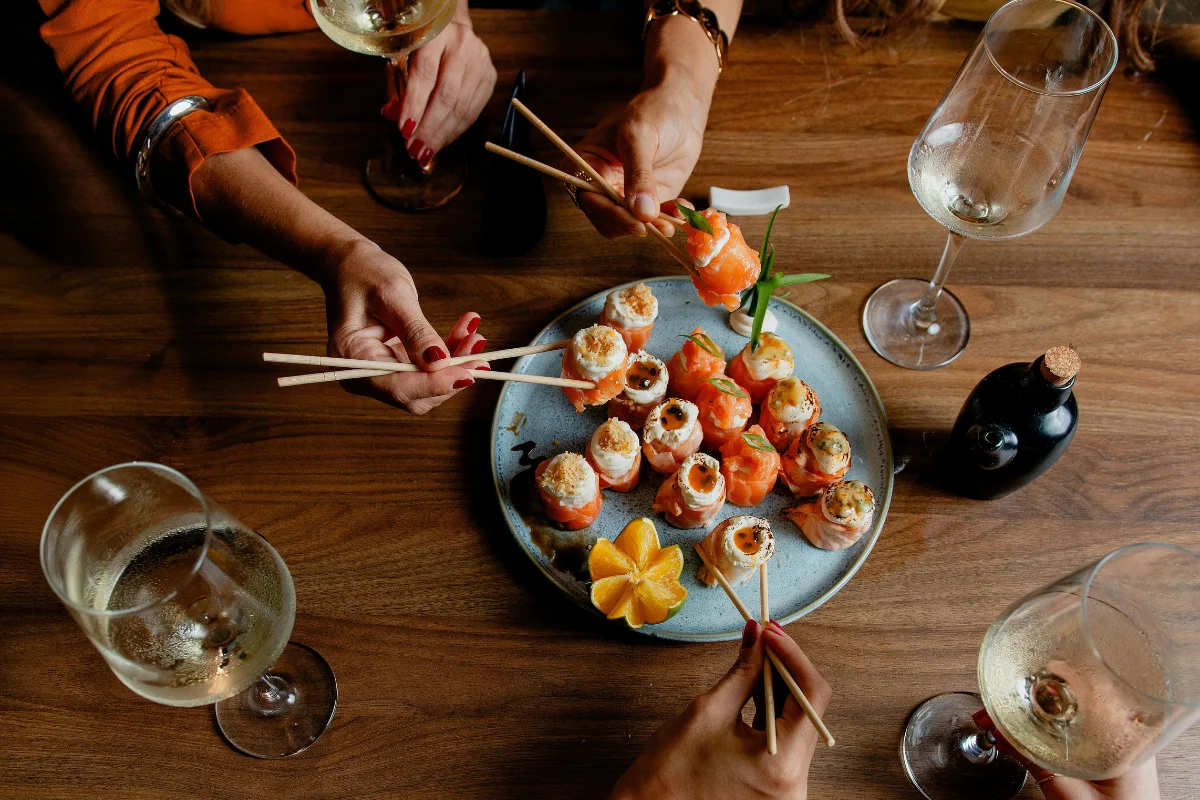

Most travel guides approach sushi in Barcelona the same way: a ranked list, a price range, a star rating. What they skip is the question that actually determines whether you’ll enjoy the meal — are you booking an omakase or a menu restaurant? They are completely different experiences, and confusing them leads to expensive disappointment.
In an omakase, the chef decides the entire menu based on what arrived at the market that morning. The format exists because it allows the kitchen to work exclusively with peak-freshness fish without the risk of holding anything in stock. In a carte restaurant, the menu is fixed, the fish is managed for consistency. Neither is better by definition. But they require different preparation, different budgets, and different expectations.
This guide organizes Barcelona’s best sushi restaurants by format — so you know exactly what you’re booking.
Quick Answer: Best Sushi in Barcelona by Format Michelin / haute technique: Koy Shunka (€89–132 tasting menu, book weeks ahead). Omakase — smallest bars: Sensato (6 seats, no takeout policy), Fukamura (7 seats, edomae nigiri), Kintsugi (left-handed chef who forges his own knives). Best entry point to high-technique sushi: Sato i Tanaka (lunch from €15, double counter). Best value with serious credentials: IKOYA Izakaya (4.7 stars, 4,000+ reviews, same chef as Koy Shunka). Cheapest serious sushi: Grado Sushi inside a 1959 bodega in Sant Antoni (€12.50 lunch menu). Most hidden: Ají in Vila Olímpica (9.4/10, opens strictly at 21:00).
Quick Decision — Which Sushi Restaurant in Barcelona Is Right for You?
| If you want… | Go to | Budget per person |
|---|---|---|
| The best technical sushi in the city | Koy Shunka | €89–132 |
| Michelin-level kitchen at half the price | Shunka | €65 |
| Purist omakase, minimal seats | Sensato or Fukamura | €80–120 |
| High technique without breaking the bank | Sato i Tanaka (lunch) | From €15 |
| Serious sushi on a tight budget | Grado Sushi (Sant Antoni) | €12.50–20 |
| The best eel in the city | Hitsumabushi (Sarrià) | €28–40 |
| Chef-driven sushi + sake in a relaxed setting | IKOYA Izakaya | €35–60 |
| Nikkei fusion (Japanese-Peruvian) | Ají or Nikkei 103 | €40–70 |
| Japanese-Brazilian visual experience | Ikibana | €30–55 |
| Quality sushi delivery at home | Jara or Kibuka | €25–40 |
| Budget sushi with real quality | Monster Sushi or Sudoki | €20–30 |
Koy Shunka, The Michelin Benchmark
There is one detail about Koy Shunka that no other restaurant in the city can replicate: the nigiri is placed directly from the chef’s hand into the diner’s mouth. No plate. No counter transfer. The reason is thermal — the fish and rice reach the precise temperature equilibrium at the moment of forming, and any intermediate surface disrupts that balance within seconds.
Chef Hideki Matsuhisa holds the Michelin star that makes Koy Shunka Barcelona’s formal reference point for Japanese cuisine, but the hand-to-mouth delivery is the technical signature that defines the experience on a practical level. It is also the clearest indicator of what separates this from every other sushi restaurant in the city.
Pricing: Tasting menu €89–132. À la carte €60–90. Closed Mondays and Sundays. Reserve weeks in advance — months during peak season.
Address: Carrer de Copons 7, Gothic Quarter.
Matsuhisa also leads IKOYA Izakaya, directly across from the Mercat de Santa Caterina in El Born — same product philosophy, izakaya format, lower price point.
Shunka — The Michelin Kitchen’s More Affordable Sibling
Two streets from Koy Shunka, in the same Gothic Quarter, sits Shunka — the original restaurant that came before the Michelin-starred version. The kitchen technique descends from the same school, but the tasting menu runs around €65 for roughly nine courses plus dessert, against the €89–132 of its starred sibling. For diners who want the Matsuhisa lineage without the peak-season booking war, Shunka is the answer. The open kitchen and the carrer dels Sagristans location, steps from the cathedral, make it an easy pairing with a morning in the Gothic Quarter walking route.
Address: Carrer dels Sagristans 5, Gothic Quarter. Reserve ahead — it fills faster than its lower profile suggests.
The Omakase Bars — Six Seats, Seven Seats, and a Left-Handed Knife
Sensato — Six Seats, No Takeout, No Exceptions
Sensato at Carrer de Septimània 36 is the most philosophically rigorous omakase bar in Barcelona. Masters Ryuta and Aya Sato have six seats and a twelve-course menu. The no-takeout policy is not a logistics decision — it is a stated position: sushi begins degrading within minutes of being formed. Temperature shifts in the rice, texture changes in the fish, the structural balance between the two elements breaks down. Serving it for takeout, Sensato argues, would mean compromising the product they spent the morning sourcing.
The waiting list is long. Reservations require significant advance planning.
Address: Carrer de Septimània 36, Eixample / Sant Gervasi.
Fukamura — Seven Seats, the Densest CV in the City
Daisuke Fukamura has the most compressed résumé of any independent sushiman in Barcelona: Koy Shunka, Espai Kru, and Shibui — before opening his own counter. Seven seats. Fourteen-course menu built around edomae nigiri, the Tokyo tradition that treats rice as the central element rather than the fish. If you understand what edomae means, this is the bar you’ve been looking for.
Kintsugi — The Chef Who Forges His Own Knives
Kintsugi has a profile that does not exist anywhere else in the city: chef Héctor Ribeiro, Mozambican-born, holds the Kuro-obi certification — the highest qualification in Japanese sushi — and forges his own knives because he is left-handed and standard sushi knives are engineered for right-handed cuts. The bevel geometry and cutting angle are different for the left hand. Off-the-shelf tools produce an inferior result, so he makes his own.
Beyond the knives: Kintsugi sources Minori rice from the Ebro Delta and applies ikegime — the Japanese fish-sacrifice technique that controls rigor mortis and optimizes meat texture — to locally sourced fish. It is the only restaurant in Barcelona that applies this technique to local product systematically.
For more on the Ebro Delta as a food-sourcing region, the Ebro Delta day trip guide covers why its rice and seafood occupy a specific category in Catalan cuisine.
Sato i Tanaka, The Entry Point That Doesn’t Compromise
Sato i Tanaka (Grupo Nomo, Carrer del Bruc 49, Eixample) is the restaurant that makes high-technique sushi accessible without reducing the experience. Lunch menu from €15. Tasting menus up to €55. The double counter means multiple diners can watch the preparation simultaneously — the sushiman’s movements are part of the experience.
The honest caveat: demand far exceeds capacity. Reserve days in advance even for lunch.
Address: Carrer del Bruc 49, Eixample. Reservations required.
If you’re planning a full day around this neighbourhood, the best Barcelona walking streets guide covers the Eixample grid in detail — Bruc and its surrounding blocks are worth time on foot.
Hidden Gems With a Credential
The most interesting sushi in Barcelona is not always behind a tasting-menu price. Two addresses prove it — both with a chef CV that explains why the fish is better than the setting suggests.
Grado Sushi — A Nobu-Trained Kitchen Inside a 1959 Vermouth Bodega
Bar Bodega Chiqui on Carrer de Vilamarí 29 in Sant Antoni opened in 1959 and still serves vermouth on tap, tinned anchovies, and pa amb tomàquet. The neon sign reading SUSHI above the door is the only clue to what happened in 2020: chef Douglas Alves, Brazilian-born and trained at Tunateca Balfegó, Mishima and Nobu — and who learned rice directly from Hideki Matsuhisa of Shunka — installed a full sushi kitchen inside the family bodega during the pandemic.
The numbers tell the story of the technique: each nigiri carries 12 grams of fish over 11 grams of Minori rice from the Ebro Delta, with the grains fanned to cover the surface rather than compressed into a ball. The standout is a nigiri of foie gras and eel, the eel bought live and dispatched in-house. The lunch menu is €12.50, with an average à la carte spend of €15–20 — the lowest price-to-quality ratio of any serious sushi in this guide.
Address: Carrer de Vilamarí 29, Sant Antoni. For more of the neighbourhood, see the Sant Antoni guide.
Hitsumabushi — The Eel Specialist From Tsukiji
In Sarrià-Sant Gervasi, on Avinguda Príncep d’Astúries 3, Hitsumabushi is built around a single ingredient most Barcelona sushi restaurants barely touch: eel. Chef Nobuyuki Kawai worked in a sushi restaurant inside Tokyo’s legendary Tsukiji fish market before opening here, and the kitchen sources its eel fresh from the Ebro Delta — the same region that supplies Kintsugi’s rice.
The signature dish, the unagi hitsumabushi, runs about €23.50, with an average spend of €28–30 per person. Beyond the eel, the miso-flambéed squid, the toro, and the sea-urchin nigiri are what regulars return for. The room is small, plain, and unglamorous — the entire investment is in the product, not the decor. Reservations are strongly advised; the place can refuse walk-ins on a busy night.
Address: Avinguda Príncep d’Astúries 3, Sarrià-Sant Gervasi.
IKOYA Izakaya, Matsuhisa’s Accessible Side
IKOYA Izakaya faces the Mercat de Santa Caterina in El Born. The format is izakaya — sushi sits alongside robata-grilled dishes, small-producer sakes, and a wider menu than any of the omakase bars. The market proximity is functional: morning product goes into the midday service.
The 4.7-star rating across more than 4,000 reviews makes it the highest-ratio quality-to-accessibility option in the Matsuhisa circuit. Same sourcing philosophy as Koy Shunka, format that doesn’t require a month of advance planning.
Address: Opposite Mercat de Santa Caterina, El Born.
El Born is also the neighbourhood with the highest density of architecture and gastronomy within walking distance of each other — the Casa Batlló visit guide and IKOYA are both reachable from the same afternoon route.
Ají, The One Hidden Behind a Staircase
Ají scores 9.4/10 on TheFork — one of the highest ratings of any Japanese restaurant in the city. It is located behind a staircase near the Casino de Barcelona in Vila Olímpica, which explains why it remains largely unknown outside the local food circuit.
The specialty is nikkei (Japanese-Peruvian fusion): tuna tataki with smoked ponzu, ceviche nikkei with red tuna, a €68 tasting menu. Lunch menu at €21.
Operational note: opens strictly at 21:00. No early service regardless of circumstances.
Address: Vila Olímpica, near Casino de Barcelona.
Fusion Formats — Nikkei, Nipo-Brazilian, and the Izakaya-Mediterranean Hybrid
Ikibana (Paral·lel, also in Sarrià) runs the most visually elaborate Japanese-Brazilian fusion in the city — uramaki with tropical fruit, Mediterranean product with Japanese technique, a space designed as part of the experience.
Nikkei 103 under chef Christian Bulnes is the nikkei reference in Barcelona: anticuchero-miso octopus, Peruvian citrus balance (ají, lime, purple corn) combined with Japanese technique. The kitchen treats the two food cultures as equal sources rather than one dominating the other.
Alapar is the most technically interesting hybrid: founded by alumni of Tickets and Disfrutar, it applies Japanese technique to Catalan Mediterranean product. An izakaya where the philosophy is Japanese but every ingredient is local. Catalan wine list as the backbone. This one is worth researching before visiting — the weekend workshops Barcelona guide has context on the Catalan food culture that makes Alapar’s sourcing choices make sense.
Which ones open on Monday and which never shut in the afternoon
Above the question of quality sits one that no list answers: when these places are actually open. Barcelona’s establishment census records 274 named Japanese and sushi places inside the city, and 127 of them publish readable hours.
Monday and Sunday are the thin days, with 95 serving dinner against 121 from Wednesday to Friday. Counted by whole days, 22 do not open at all on Monday and 21 do not open at all on Sunday, while between Wednesday and Friday none closes. Tuesday sits at 115 and Saturday at 119.
Twenty of those 127 serve without closing between lunch and dinner, and they are the only places where you can eat at half past five with the full menu. La Suerte, at Carrer de la Mare de Déu de Port 347, opens at 10:30 and runs 12.5 hours straight; Kyoza on Carrer dels Tallers and Yoüme both run 11:30 to 23:30; La Uramakeria at Ronda de Sant Pere 52 goes 11:45 to 23:15; and Sushi Bar DING at Carrer d’Arizala 9 does 12:00 to 23:30.
One caveat on the cliché that the city shuts in the afternoon: of the 1,037 Barcelona restaurants with published hours, 495 are listed as open at five on a Wednesday, close to half. Many have the kitchen closed even with the door open, and the census does not distinguish between the two. The twenty here declare a single uninterrupted block, which is what makes them reliable.
The latest is Ikibana at Avinguda del Paral·lel 148, serving to 2am and to 3am at weekends. The clustering is heavy: 37 in l’Antiga Esquerra de l’Eixample, 35 in la Dreta and 27 in la Vila de Gràcia, 99 between the three, while 29 of the city’s 73 neighbourhoods have none at all.
Sushi by Neighbourhood — Where to Eat in Each District
Most searches for sushi in Barcelona are tied to a neighbourhood — where you’re staying or where you’re spending the day. This is the short map by district, each with at least one option worth the detour.
- Gràcia — Kibuka and Kitsune. Kibuka is a long-standing Gràcia classic on Carrer del Montseny with a famous Hot Philadelphia roll; its Fast Kibuka format is built for takeaway. Kitsune on the same street is a cosy, high-value booking that fills fast.
- Poblenou — Isami. On Rambla del Poblenou 88, Isami is the neighbourhood favourite; the donburi is the order regulars recommend over the rolls.
- Eixample — Sun Taka and Futami. Sun Taka on Bruc 156 has a strong lunch deal and a counter where you watch the chef work. Futami on Enric Granados is the comfortable, no-drama lunch option.
- Sarrià-Sant Gervasi — Yushu. A tiny side-street room using top-grade product, with a toro-and-foie-gras nigiri and a shiitake with butter, garlic and soy that regulars single out.
- Eixample Esquerra — Robata. Cosy nooks, beautiful plating, and the strongest gluten-free options of any sit-down sushi room in the centre.
For a wider sense of how these districts differ before you choose a base, the best neighbourhoods to stay in Barcelona guide assesses El Born, Eixample, Gràcia and Vila Olímpica with the trade-offs of each.
Sushi Delivery in Barcelona — Quality That Survives the Trip
Delivery sushi usually means a drop in quality — but a few Barcelona kitchens treat it as seriously as the dine-in service. The rule is simple: order from a restaurant that built its reputation at the counter, not from a delivery-only brand.
- Jara Sushi (Sarrià, Carrer de Padua 84) built much of its name on delivery with restaurant-grade presentation, and on selected dates runs a private 10-seat omakase.
- Kibuka (multiple locations) is the dependable Gràcia option, with the Fast Kibuka format designed for takeaway.
- Monster Sushi (various locations) is the most delivery-focused of the quality options and is notably gluten-conscious.
If you’re pricing out a trip and wondering where sushi fits, the Barcelona travel budget guide breaks down food costs by profile — from a €12.50 lunch menu to a €130 tasting — with realistic numbers.
What Most Sushi Guides in Barcelona Get Wrong
They rank by price, not by format. A €25 lunch at Sato i Tanaka and a €120 omakase at Sensato are not comparable. Treating them as points on the same scale tells you nothing useful.
They ignore the rice. The fish gets all the attention in most reviews. The rice is actually the harder technical challenge — temperature, seasoning, grain separation, and forming pressure are the variables that separate a skilled sushiman from a competent one. A cold nigiri means the rice was made too early. A compressed nigiri means the forming pressure was wrong. These are the things to check.
They don’t tell you about the booking reality. Barcelona’s best sushi bars — Sensato, Fukamura, Kintsugi, Sato i Tanaka — are consistently overbooked. Showing up without a reservation at any of them is not a viable strategy.
Three Things to Check Before Ordering
Rice temperature: should be at body temperature (36–38°C), not cold. Cold rice means it was prepared too far in advance. Quality rice has grains that separate slightly on the palate without being sticky.
Wasabi: industrial green paste in a tube is horseradish with food dye. Authentic wasabi — grated fresh on sharkskin — is a duller green and produces heat that rises to the nasal passage without lingering in the mouth. Every high-end restaurant in this guide uses authentic or certified high-quality wasabi.
Nigiri size: should be a single bite. A two-bite nigiri means the rice-to-fish ratio is wrong. Oversized nigiri is usually compensating for product quality with volume.
Frequently asked questions about sushi in Barcelona
How much does Koy Shunka cost in Barcelona?
Tasting menu runs €89–132 per person. À la carte dishes range €60–90. Closed Mondays and Sundays. Reserve weeks ahead — months in advance during peak season. Its sister restaurant Shunka offers a comparable kitchen with a tasting menu around €65.
What is omakase and why is it more expensive?
Omakase means “I leave it to you” — the chef builds the day’s menu around the best product that arrived that morning, working with peak-freshness fish without holding stock. The higher price reflects daily top-quality sourcing and the personalized small-counter experience of six to seven seats.
What is the best budget sushi in Barcelona with real quality?
Grado Sushi inside Bar Bodega Chiqui in Sant Antoni serves a lunch menu at €12.50 from a chef trained at Tunateca and Nobu. Sato i Tanaka has a lunch menu from €15 with genuine counter technique. Sudoki in Eixample offers buffet format at €20–30 with 4.7 stars and over 3,000 reviews.
Which Barcelona sushi restaurants have the fewest seats?
Sensato has 6 seats with a 12-course omakase. Fukamura has 7 seats and edomae nigiri from an ex-Koy Shunka chef. Jara Sushi runs a private omakase with only 10 seats on selected dates. All require advance reservations and are the highest-exclusivity formats in the city.
Where is the best eel sushi in Barcelona?
Hitsumabushi in Sarrià-Sant Gervasi specializes in eel from the Ebro Delta, prepared by chef Nobuyuki Kawai, who trained at Tokyo’s Tsukiji market. The signature hitsumabushi eel dish costs around €23.50, with an average spend of €28–30 per person.
What is the most unusual sushi restaurant in Barcelona?
Kintsugi has a Mozambican chef with Kuro-obi certification who forges his own left-handed knives, uses Ebro Delta rice and applies ikegime to local fish. Grado Sushi hides a Nobu-trained sushi kitchen inside a 1959 vermouth bodega in Sant Antoni. Ají in Vila Olímpica sits behind a staircase and opens strictly at 21:00.
Where can I order quality sushi delivery in Barcelona?
Jara Sushi in Sarrià is known for delivery with restaurant-grade presentation. Kibuka has multiple locations and a Fast Kibuka takeaway format. Monster Sushi is strong on delivery and gluten-conscious preparation. These are the reliable options when you want counter-level quality at home.
Is there gluten-free or vegan sushi in Barcelona?
Aruku is the reference for fully gluten-free sushi — tamari only, certified flours, cross-contamination protocols. Robata in Eixample Esquerra has strong gluten-free options. Veganashi offers plant-based sushi with brown rice. Most high-end restaurants in this guide accommodate dietary requirements if contacted in advance.
Plan the Rest of the Evening
After a long sushi dinner, the best live music bars in Barcelona guide covers what’s worth doing after 22:00 — particularly in El Born and the Eixample, the two neighbourhoods where most of the restaurants above are concentrated.
If you’re building a full day around the Gothic Quarter or El Born (where Koy Shunka and IKOYA are both located), the Barcelona complete travel guide has the framework for combining architecture, markets, and dinner in the same route without backtracking.
The best sushi in Barcelona is not the most expensive plate — it is the one where the chef’s CV explains the fish before you taste it.