
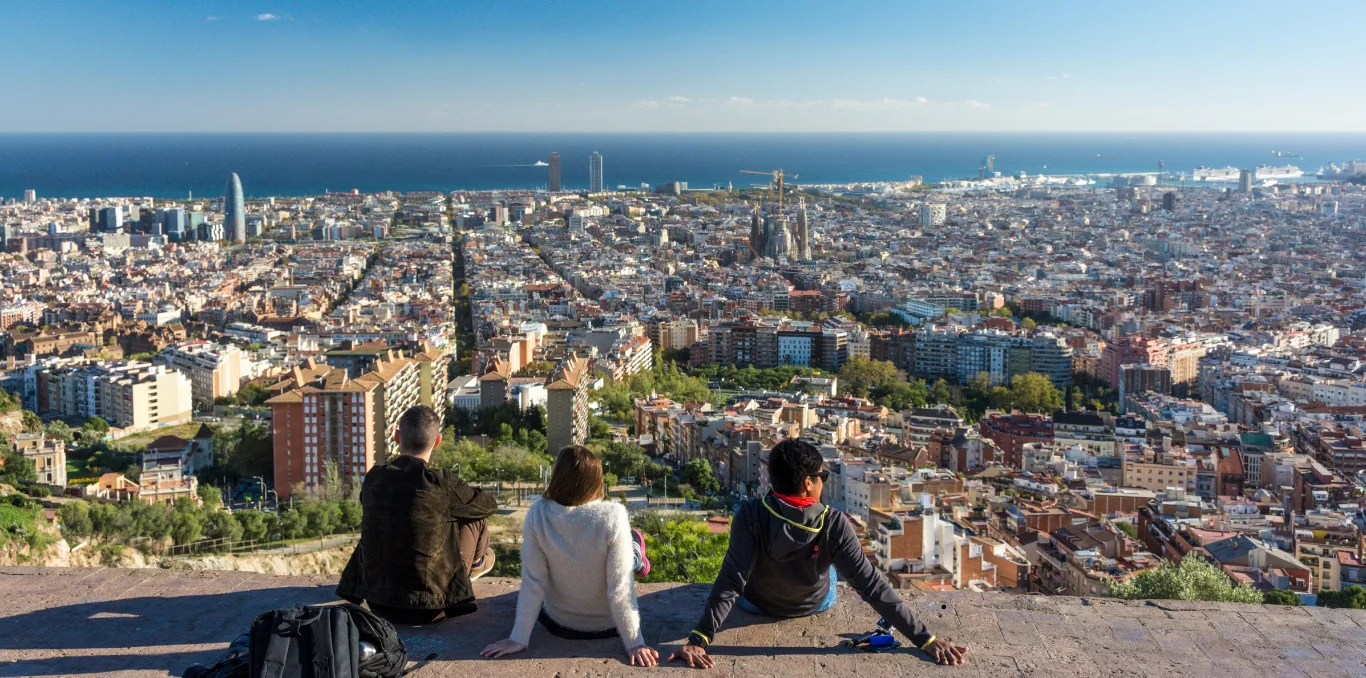

The single best free view in Barcelona is not from a rooftop bar or a cable car — it is from a set of concrete gun platforms on a hill in the Carmel district. The Bunkers del Carmel sit on top of the Turó de la Rovira at 262 metres, and they deliver a 360-degree panorama that takes in the Sagrada Família, the sea and the Collserola hills in a single sweep. The catch most visitors learn too late: the site now closes before sunset for much of the year, and it was never actually a bunker.
What you can see from the top
The view is why this place went from local secret to global landmark. From the platforms you get a 360-degree panorama that many rate as the best in the city, and unlike side viewpoints such as Montjuïc, the Turó offers a near-perpendicular angle over the Eixample grid — you can read Cerdà’s urban plan at a glance.
Four landmarks stand out clearly:
- Sagrada Família: Gaudí’s basilica dominating the Eixample in the foreground.
- Torre Glòries: the unmistakable marker of the 22@ tech district.
- The Mediterranean and the port: the seafront with the Vela hotel and Torre Mapfre.
- Montjuïc and Collserola: the two hills that frame the city to the south and north.
For anyone collecting panoramas, it pairs naturally with the city’s other secret viewpoints and a planned photography route.
Why they aren’t really bunkers
The detail that never gets cleared up is that the name is wrong. A bunker is an enclosed protective space, and what was built on the Turó de la Rovira was an open-air anti-aircraft battery. The concrete structures you walk across today are gun emplacements, not shelters.
What are the Bunkers del Carmel and why do they stand out? They are the remains of a Republican anti-aircraft battery from the Civil War, on top of the Turó de la Rovira at 262 metres. Access is free, open 9:00 to 19:30 in summer. They offer the best 360-degree view in Barcelona, taking in the Sagrada Família, the sea and Collserola in one panorama.
Barcelona holds the grim distinction of being one of the first major cities in history to be bombed massively and systematically against its civilian population, by the Italian and German air forces allied with Franco. That is why the hilltop was militarised, as the Barcelona City Council documents in its district archive.
The anti-aircraft battery on the Turó de la Rovira
The Republic’s anti-aircraft defence command chose the Turó de la Rovira for its 360-degree sightline over the plain and its proximity to the sea, the direction the attacks came from. The battery became operational on 3 March 1938, two weeks before the bombings that besieged the city for three days.
The site held four Vickers 105 mm guns, with a range of 7 to 13 kilometres covering the city in every direction. The structure included seven gun platforms, passages used as a magazine, a command post and quarters for troops and officers. Between 25 and 26 January 1939, facing the fall of Barcelona, the Republican army disabled the guns itself so the enemy could not reuse them.
The shantytown that lasted until 1990
After the war the military structures were abandoned, and around 1948 families began building shacks using the concrete walls. This became the neighbourhood of Els Canons (The Cannons), part of the Carmel shantytown phenomenon, which grew to around 110 huts and some 600 residents.
Despite harsh conditions, the community built its own fabric and eventually secured electricity, water and basic services. It was one of the last settlements of its kind to disappear in Barcelona, demolished around 1990, on the eve of the 1992 Olympic Games. Patches of household floor tiles still survive on the ground, marking where those homes stood — a layer the attentive visitor can read alongside the gun platforms.
Current hours and the sunset paradox
The site’s runaway popularity brought a real problem of noise and night-time drinking that disrupted the neighbourhood. As a result, since 2 May 2023 the grounds close at night behind a perimeter fence, with the Guardia Urbana clearing the area in the late afternoon. Hours are 9:00 to 19:30 in summer and 9:00 to 17:30 in winter, and access remains free.
Hence the paradox that catches many visitors out: the classic time to come up was sunset, but under the current schedule the gates close before the sun goes down for much of the year, especially in spring and summer. Sunrise has become the better alternative — soft light, almost nobody around — an option it shares with the city’s other sunrise viewpoints. Inside the grounds, the MUHBA museum spaces open Saturdays and Sundays from 10:00 to 15:00.
How to get up to the Turó de la Rovira
There is no direct metro access, and that is the main hurdle. The nearest stops are El Carmel (L5), Alfons X (L4) and Guinardó-Hospital de Sant Pau (L4), all a 15-20 minute uphill walk. By bus, lines 22, 24, V17 and 119 get fairly close to the final pedestrian stretch up Carrer de Marià Labèrnia.
That last section is steep, so comfortable shoes and water are worth it, especially in summer, since there is no shade or fountain at the top. It sits just 20-25 minutes on foot from Park Güell, so many visits combine the two in one outing around Horta-Guinardó. It is also one of the strongest entries in any free Barcelona plan.
Access updates at the Turó de la Rovira
In late May, Barcelona City Council approved a new access-regulation system for the Turó de la Rovira batteries, aimed at reducing tourist saturation and improving life for residents. The agreement tightens enforcement of the closing hours, seeks to block out-of-hours access and increases Guardia Urbana presence, while asking that the site stop being promoted as a night-time leisure spot.
The measure confirms the direction set in 2023, so it is safe to assume visits will be increasingly regulated and to plan the climb within daytime hours. The space was turned into a heritage site in two phases — the surroundings in 2011 and the interior structures around 2015 — and is now one of the MUHBA spaces dedicated to the memory of the war and post-war years.
Is the climb to the Bunkers del Carmel worth it?
For anyone after the best free view in the city and a place with real historical weight, the climb pays off easily, especially early in the day or midweek when it is quieter. The combination of a 360-degree view, original concrete platforms and the traces of the shantytown exists at no other viewpoint.
It is the wrong call if you specifically want sunset in spring or summer, since the 19:30 closure usually thwarts it, or if you have reduced mobility, given the steep final stretch and no direct transport. Don’t come expecting services either — there are no bars or fountains at the top. To place it among the city’s other plans, it helps to weigh it against the best things to see in Barcelona and to check the safety guide by area if you go up at dusk in the months when that is still possible.
FAQ
What are the opening hours of the Bunkers del Carmel?
The site is open 9:00 to 19:30 in summer and 9:00 to 17:30 in winter. Since May 2023 it closes at night, with a perimeter fence and Guardia Urbana patrols. Access is free. The MUHBA museum spaces open Saturdays and Sundays from 10:00 to 15:00.
Are the Bunkers del Carmel actually bunkers?
No. Despite the popular name, they are the remains of a Republican anti-aircraft battery built on the Turó de la Rovira during the Civil War, not an underground shelter. It had four Vickers 105 mm guns and became operational on 3 March 1938 to defend Barcelona from bombing.
How do you get to the Bunkers del Carmel?
The nearest metro stops are El Carmel (L5), Alfons X (L4) and Guinardó (L4), all a 15-20 minute uphill walk. Buses 22, 24, V17 and 119 get closer to the final stretch. The last part is steep, so comfortable shoes are worth it.
Can you watch the sunset from the Bunkers del Carmel?
It depends on the season. In winter yes, since the site closes at 17:30 and the sun sets earlier. In spring and summer the 19:30 closure usually falls before sunset, which prevents watching it from the main platforms. Sunrise is the quieter alternative.
How much does it cost to enter the Bunkers del Carmel?
Nothing. Access to the Turó de la Rovira viewpoint is free and needs no booking. Only the MUHBA museum spaces have restricted hours. Many consider it the best free viewpoint in Barcelona, with a 360-degree panorama over the city.
What can you see from the Bunkers del Carmel?
A 360-degree panorama with the Sagrada Família, the Torre Glòries, the Mediterranean, Montjuïc, Park Güell, the port and the Collserola hills. The hill’s central position and its near-perpendicular view over the Eixample grid set it apart from side viewpoints like Montjuïc or Tibidabo.
Few places in Barcelona compress a whole century — from the guns to the shacks to the selfie — into the same hundred metres of concrete.