
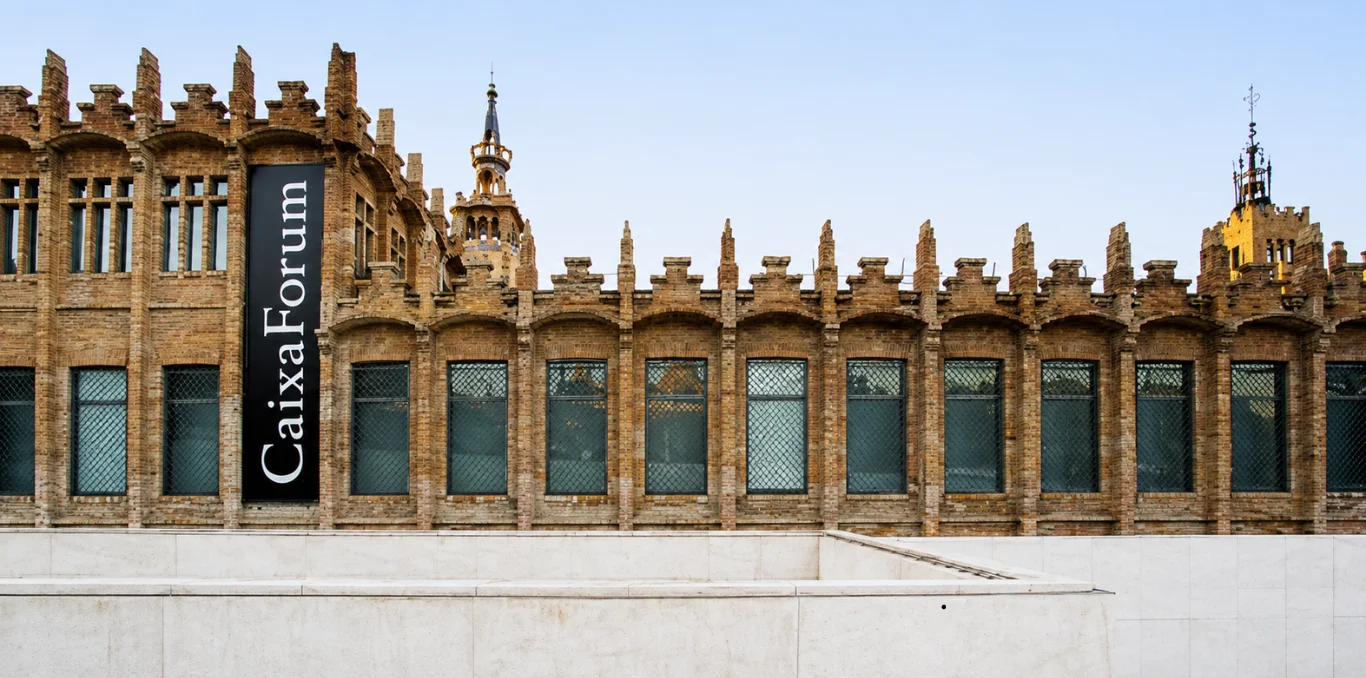

A cotton baron terrified of fire built a factory obsessed with not burning down, used it for barely eight years, and watched it spend the next half-century as a police stable. That building is now CaixaForum Barcelona, one of the city’s busiest cultural centres and the only one where the shell competes with the art inside. It occupies the former Casaramona textile factory, a masterpiece of industrial Modernism that Josep Puig i Cadafalch built between 1909 and 1911 at the foot of Montjuïc, and admission to all its exhibitions is €6.
A Factory Built to Outlast Fire
The building’s history is one of the strangest in Barcelona’s heritage. Casimir Casaramona, a cotton industrialist making blankets and towels, commissioned Puig i Cadafalch to design a factory around a single fixation — avoiding fire — because his previous one had burned down. According to architectural historians, the result was both a pioneering building and one of the shortest-lived of its era.
Puig i Cadafalch — who ranks beside Gaudí and Domènech i Montaner as one of the three masters of Catalan Modernism — designed single-storey halls linked by internal streets that doubled as firebreaks, the same logic Domènech used at the Hospital de Sant Pau. The two towers were not decorative but water tanks, and the factory was among the first to use sprinklers and to run on electricity rather than coal, which is why it has none of the chimneys typical of the period. It won the city’s award for best industrial building in 1913. Yet the La Canadiense general strike and the textile crisis shut it down around 1919, barely eight years after it opened.
What is CaixaForum Barcelona and how much does it cost? CaixaForum is the cultural centre of the la Caixa Foundation, housed in the former Casaramona textile factory by Puig i Cadafalch (1909-1911). It has no permanent collection, instead hosting temporary shows borrowed from museums like the Prado, the British Museum and the Pompidou. General admission is €6 and covers every exhibition open at once, and it is free for under-16s and CaixaBank clients.
From Police Stables to Cultural Centre
What followed was half a century of decline. The building served as a warehouse during the 1929 International Exposition and, from 1940, became a cavalry barracks and stables for the police, with almost no upkeep. The la Caixa Foundation bought it in 1963, and in 1976 it was declared a Historic-Artistic Monument, which saved it from demolition.
The restoration that turned it into CaixaForum ran from 1999 to 2002 with a top-tier team. The most celebrated name is Japan’s Arata Isozaki, a 2019 Pritzker laureate and architect of the nearby Palau Sant Jordi, who designed the entrance plaza and the two steel-and-glass trees that greet visitors. The work excavated an underground lobby that gained around 5,000 m² without touching the protected facade, and to replace the brickwork the team fired 100,000 new bricks to match the originals. Isozaki’s sunken courtyard is clad in white Cabra limestone in homage to the Mies van der Rohe Pavilion directly opposite, and holds a small garden where water and its reflections set the tone for the entrance.
Three Masterpieces in the Free Lobby
Before the ticketed galleries begin, CaixaForum’s lobby holds three permanent works from the la Caixa Contemporary Art Collection, all visible without paying. There is Splat, a wall drawing Sol LeWitt made specifically for the centre in 2001; Ambiente Spaziale, a looping neon structure Lucio Fontana first created for the 1951 Milan Triennale; and Pain Room, Joseph Beuys’s installation of lead walls lit by a single bulb. Three major 20th-century names, free to anyone who walks in.
It means the building itself rewards a visit even without an exhibition. The internal-street layout Puig i Cadafalch designed as firebreaks now works as a circulation system for large visitor flows, a functional duality still doing its job more than a century later, and the brick, ceramic detailing and pinnacled towers repay a slow walk as much as any gallery inside.
The Dragon on the Tower
The tower facing Carrer de Mèxic holds the building’s most overlooked detail, a Modernist mosaic of a dragon set against green, blue and yellow. Lluís Bru i Salelles made it from glazed ceramic tesserae framed in brick and ironwork, above what was once the factory’s main entrance. The centre’s staff nickname him Casimiro, after Casimir Casaramona, and most visitors never see him, because reaching the mosaic means walking a few metres down Carrer de Mèxic rather than entering through Isozaki’s plaza.
A second dragon sits beside it, this one forged in iron and restored in 2015 by craftspeople struck by the quality of the original work. Since the two towers were water tanks for the fire-suppression system rather than decoration, the dragon effectively keeps watch from the top of a century-old reservoir.
The Major Shows on Now
The programme leans on the centre’s partnerships with the Pompidou, the Musée de l’Orangerie and the British Museum. These are the standout exhibitions currently on, with verified dates.
- Chez Matisse (27 March to 16 August 2026) — the season’s flagship, with the Centre Pompidou. It brings together 45 works by Matisse and 49 more by 20th- and 21st-century artists he influenced, across eight thematic sections. Admission €6.
- Desenfocado (21 May to 27 September 2026) — conceived by the Musée de l’Orangerie, it starts from Monet’s Water Lilies to explore blur as a deliberate aesthetic choice. It gathers 77 works by 58 artists, and the Barcelona run adds a Turner from the Tate. Admission €6.
- Pain Room, by Joseph Beuys — a permanent installation since 2002, a space of lead walls and a single light bulb meant for quiet reflection. Free to enter.
Alongside these, the centre runs a constant agenda of talks, original-version cinema, guided tours of the building and the immersive classical-music show Symphony — the kind of mix that turns a visit into an afternoon. The two flagship shows, Chez Matisse and Desenfocado, overlap between late May and mid-August, making that stretch the best window to catch both on a single ticket.
Is It Worth It
Yes — and unusually, it is worth it for the building alone. If you have any interest in architecture, the former Casaramona factory is one of the finest works of Catalan industrial Modernism, and a single €6 ticket also gets you whatever world-class exhibitions happen to be on, often borrowed from the Prado, the British Museum or the Pompidou.
It is less essential if you want a fixed, always-available collection: because everything here is temporary, the show you read about may have closed, so checking current dates matters. And if contemporary conceptual art leaves you cold, parts of the programme will too — though the building never does. For a permanent collection of Catalan art, the MNAC up the hill is the better choice.
Practical Details
All access information, checked against the centre’s official site.
| Detail | Information |
|---|---|
| General admission | €6 (covers all exhibitions) |
| Free | CaixaBank clients, under-16s, unemployed, people with disabilities |
| Hours | Daily including holidays, 10am to 8pm |
| Closed | 25 December, 1 and 6 January |
| Address | Av. de Francesc Ferrer i Guàrdia 6-8 |
| Metro | Espanya (L1, L3, FGC) |
| Permanent work | Beuys’s Pain Room, free |
Getting there is easy: the Espanya station (metro L1 and L3, plus FGC and Rodalies trains) is a few minutes’ walk, and many bus lines stop on the square. The centre is fully accessible, with wheelchairs available, induction loops and adapted toilets. For anyone moving around the city, the guide to getting around Barcelona helps pick the right ticket, and the daily budget breakdown by traveller type is worth a look if you are chaining several museums together.
Who Is This For
- Architecture lovers → the Casaramona factory — industrial Modernism by Puig i Cadafalch, 1913 city award
- One-ticket visitors → all temporary exhibitions — full access for €6
- CaixaBank clients → free entry — the centre charges its clients nothing
- Families → under-16s free — plus workshops and family activities
- Modern-art fans → Chez Matisse until 16 August — 45 works via the Pompidou
- Free and permanent → Beuys’s Pain Room — open-access installation since 2002
- Photographers → brick facade in late afternoon — side light brings out the towers and ceramic
Frequently Asked Questions
How much is CaixaForum Barcelona and when is it free?
General admission is €6 and covers every temporary exhibition open at the time. It is free for CaixaBank clients, under-16s, unemployed visitors and people with disabilities. The centre opens daily, including holidays, from 10am to 8pm.
Why is CaixaForum inside an old factory?
The building is the former Casaramona textile factory, built by Josep Puig i Cadafalch between 1909 and 1911. It closed in 1919, spent half a century as a police cavalry barracks, and was restored by the la Caixa Foundation, reopening as a cultural centre in 2002.
What exhibitions are on at CaixaForum in 2026?
The major shows are Chez Matisse, 27 March to 16 August in partnership with the Centre Pompidou, and Desenfocado, 21 May to 27 September with the Musée de l’Orangerie. Joseph Beuys’s installation Pain Room is permanent and free to enter.
Who designed the glass entrance at CaixaForum?
Japanese architect Arata Isozaki, a 2019 Pritzker laureate and designer of the nearby Palau Sant Jordi. He created the sunken courtyard and a steel-and-glass tree canopy, plus the descent into an underground lobby that added around 5,000 m² without touching the protected facade.
Is CaixaForum worth visiting for the building alone?
Yes. The former Casaramona factory is one of the finest works of Catalan industrial Modernism, by Puig i Cadafalch, who ranks alongside Gaudí and Domènech i Montaner. Many visitors come for an exhibition and leave more impressed by the building, which won the city’s best-industrial-building award in 1913.
How does CaixaForum differ from the MACBA and CCCB?
CaixaForum has no permanent collection and no single theme: it mixes classical, modern and contemporary art, photography and science in shows borrowed from museums like the Prado, the British Museum and the Pompidou. Its real distinction is the building itself, a Modernist factory unmatched in the city’s cultural cluster.
What is the dragon at CaixaForum?
It is a Modernist mosaic by Lluís Bru, made of glazed ceramic tesserae, showing a dragon against green, blue and yellow. It sits on the tower facing Carrer de Mèxic, above the factory’s old entrance. Staff nickname him Casimiro, after Casimir Casaramona, and a second iron dragon beside it was restored in 2015.
Casaramona built a factory so it would never burn; he used it for eight years, and a century on, the thing he most feared losing is the one part that survived intact.