
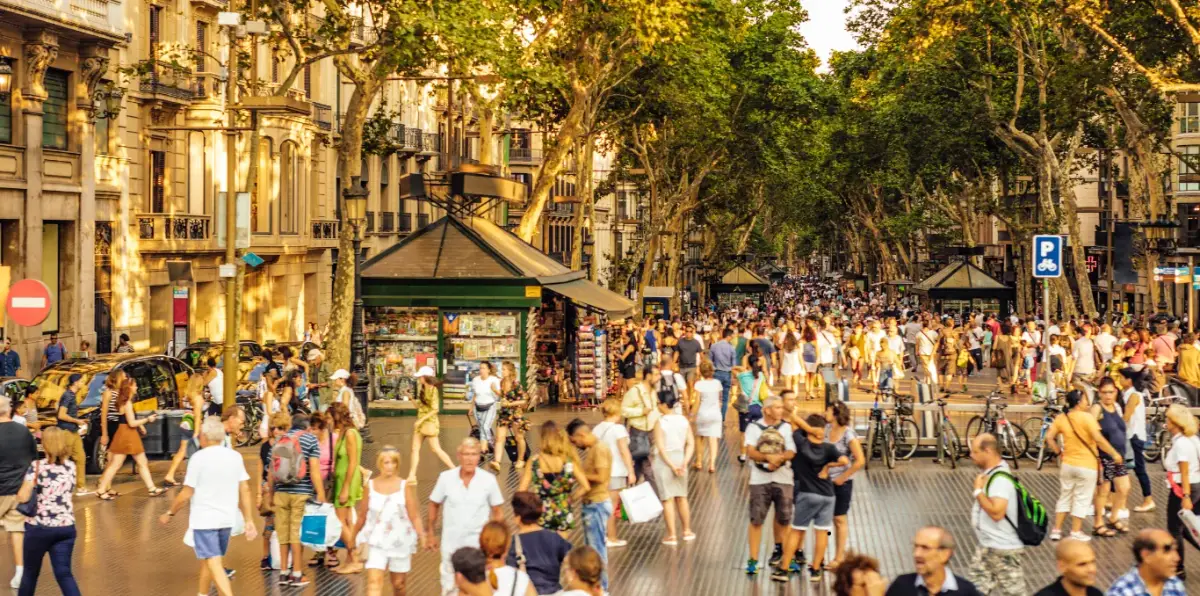

La Rambla has spent the last decade quietly turning into something most visitors never notice: a construction site with a thesis. The ongoing redesign isn’t cosmetic — it’s an attempt to reverse what mass tourism did to Barcelona’s most famous street. Understanding that tension is what separates a good visit from walking past everything that actually matters.
A Street Built on a Riverbed
La Rambla isn’t really a street. It sits on the bed of an old seasonal stream, the Riera d’en Malla, which once carried rainwater from the Collserola hills to the sea and acted as an open-air moat just outside the medieval walls. The name comes from the Arabic ramla, “sandy riverbed.” That origin as a border — water, edge, the line between the walled city and the slums beyond — explains almost everything the street later became.
What is La Rambla and why does it matter? La Rambla is Barcelona’s most famous pedestrian boulevard: 1.2 km from Plaça de Catalunya to the Columbus Monument by the old port, split into six named sections. It mixes a landmark market, an opera house, public art, and Gaudí’s earliest work — and it inverts normal city design by putting pedestrians in the center and cars on narrow side lanes. It’s both an essential sight and a tourist cliché.
Two ruptures, not a slow evolution, made the boulevard. First, the medieval walls came down between the late 1700s and mid-1800s. Then the 1835 desamortización — the state seizure of Church property — emptied the convents that lined the route. That sudden urban void became the plot of land where the great civic buildings rose: the Liceu opera house and the Boqueria market among them. Around 1850 the stream was finally covered and the shade-giving plane trees planted. A damp ditch had become the Catalan bourgeoisie’s favorite place to see and be seen.
Quick Decision: What Are You Here For?
- Want the architecture story → Palau Güell + the Plaça Reial lampposts — Gaudí’s earliest commissions
- Want the one detail everyone walks over → the Miró mosaic at Pla de l’Os, in front of the Liceu
- Want food, not a tourist trap → skip the boulevard terraces, step one street into El Raval or the Gothic Quarter
- Want fewer crowds → walk it 10:00–12:00, top to bottom
- Want the market → La Boqueria, but eat at the back stalls, not the front bars
- Want the cultural peak → April 23rd, Sant Jordi, when the street becomes a book-and-rose fair
The Six Sections, Top to Sea
People say “Las Ramblas” in the plural because the boulevard chains together distinct sections, each inheriting its own micro-history. Five are the classic stretches on land; the sixth, the Rambla de Mar, is the modern boardwalk over the water.
| Section | Name origin | Main landmark |
|---|---|---|
| Canaletes | 19th-century iron fountain | FC Barcelona fans’ gathering point |
| dels Estudis | Old Estudi General (university) | Betlem church, former bird market |
| de Sant Josep (de les Flors) | Former Sant Josep convent | La Boqueria market, flower stalls |
| dels Caputxins | Former Capuchin convent | Liceu opera house, Miró mosaic |
| de Santa Mònica | Parish and convent of the same name | Santa Mònica art centre, street performers |
| de Mar | 1992 port redevelopment | Wooden boardwalk to Port Vell |
Canaletes opens the walk: drink from its iron fountain and legend says you’ll always return to Barcelona. Dels Estudis recalls the medieval university Felipe V shut down, and for decades held a bird market now gone. Sant Josep is the sensory heart, with flower stalls and the entrance to La Boqueria market. Dels Caputxins is the cultural core, with the Liceu and the Miró mosaic underfoot. Santa Mònica closes the land stretch among living statues, and the Rambla de Mar carries the walk over the harbour.
La Rambla is built backwards, and that is the point
Beyond the list of sights, the structural fact is that La Rambla inverts how a normal avenue works. Pedestrians own the wide center under a continuous canopy of plane trees, while cars are squeezed onto two narrow side lanes that must yield at every crossing.
This isn’t an accident of traffic management — it’s why the urbanist Allan Jacobs cited La Rambla as one of the world’s great streets. Its proportions, the density of doorways and windows linking public and private, create what he called “fluidity”: a human scale that never feels claustrophobic despite the crowds. The street was designed so that, in effect, social life becomes visible. It functions at once as a road, a plaza, a stage, and a meeting point. The wave-patterned grey-and-white paving even echoes the nearby Mediterranean. That material coherence is exactly what the current redesign is trying to protect.
The Miró Mosaic: Art You’re Meant to Walk On
In front of the Liceu, at the Pla de l’Os, a circular mosaic about eight meters across sits in the pavement in white, black, blue, red, and yellow. It’s probably the most significant detail on the whole boulevard — and the most ignored, because people look at shop windows, not the ground.
The ceramist Joan Gardy Artigas built it to Miró’s design, and it was unveiled in 1976. The key isn’t aesthetic, it’s conceptual: it’s one piece of a trio Miró conceived to welcome arrivals to Barcelona by their route in. The airport mural is air; the Dona i ocell sculpture is earth; this mosaic, beside the historic port, is sea. By the artist’s explicit wish it has no protective layer — Miró wanted people to walk directly on the art. He placed it here because of the nearby house where he was born, and one tile carries his signature.
Gaudí’s Earliest Work and the Symbolism of Trade
The boulevard and its side streets hold some of Antoni Gaudí’s first works, all coded with the industrial, commercial spirit of the era. Just off Caputxins, a passage leads to the Plaça Reial, where Gaudí designed the lampposts in 1879 — his first municipal commission. They aren’t merely decorative: they carry Mercury’s winged helmet and the caduceus, symbols of commerce pointing straight at industrial Barcelona’s boom.
A side street in the lower stretch hides Palau Güell, another early Gaudí work and a lesson in vertical social stratification — stables in the basement reached by helical ramps, the noble floor for industrialist Eusebi Güell’s social life, and servants’ quarters under the famous roof of polychrome chimneys. Higher up, the Liceu opera house remains one of Europe’s great lyric theatres.
Is It Worth It?
Depends — on how you walk it. As a checklist of sights crammed into a slow shuffle through pickpocket territory, no. As a 90-minute morning walk that reads the street as a layered object — buried river, emptied convents, inverted street design, Miró underfoot — yes, easily.
When it is not worth it: if you plan to eat or drink on the boulevard itself, or visit in the late evening expecting atmosphere. The terraces overcharge for mediocre food, and the lower stretch toward the port turns seedy after dark. The Barcelona safety guide covers the pickpocket reality in detail.
Mistakes to Avoid
- Eating on the boulevard. Terraces facing La Rambla charge a steep premium for low quality. Step one street into El Raval or the Gothic Quarter and both price and food improve sharply.
- Eating at the front of the Boqueria. The visible front bars cost far more than the stalls at the back of the market.
- Walking it at peak afternoon. Density is worst midday to evening. Go 10:00–12:00.
- Carrying valuables loosely. This is one of the city’s top pickpocket spots, worked all hours with distraction techniques. Front pockets, zipped bags.
- Confusing it with Rambla de Catalunya. Different street entirely — see the FAQ below.
A Place of Memory
On 17 August 2017, La Rambla was the scene of one of the gravest attacks in recent Spanish history, when a vehicle drove into the crowd along the central walkway. Its path ended on the Miró mosaic, near the Liceu. Afterward, the mosaic that so many had walked over without noticing became a spontaneous shrine of flowers and candles, and a memorial now marks the spot with an anti-violence message in several languages. The street absorbed the trauma and turned it into a place of collective memory — one more layer of its role as the city’s emotional center.
A Boulevard Mid-Transformation
La Rambla is living through its biggest redesign in decades. A 2017 competition was won by the Km_ZERO team, with the project led by architects Lola Domènech and Olga Tarrasó. The first phase is nearly complete, with around a hundred trees still to be planted because of drought, and the full project is expected by 2027. In parallel, the historic bird-seller stalls have been dismantled entirely, closing a chapter of its history.
The stated goal is to balance historic identity with bringing the street back as a space for locals, against a mass tourism that hollowed out its neighborhood commerce. For context on the district beside it, the El Raval guide maps the neighborhood on its western edge, and the best streets walking guide sets La Rambla within wider routes through the old city.
FAQ
How many sections does La Rambla have?
Five classic sections on land — Canaletes, dels Estudis, de Sant Josep (de les Flors), dels Caputxins, and de Santa Mònica — plus the Rambla de Mar, the wooden boardwalk over the port added in 1992. Each takes its name from a fountain, an old institution, or a vanished convent.
Why is La Rambla built where a river used to be?
Because it literally sits on the bed of the Riera d’en Malla, a seasonal stream that carried rainwater from Collserola to the sea and served as a moat outside the walls. When the stream was covered around 1850 and the walls came down, the freed space became the boulevard. The name, from Arabic ramla, means “sandy riverbed.”
Where exactly is the Miró mosaic and why does it matter?
At the Pla de l’Os, mid-boulevard in the Caputxins section, in front of the Liceu opera house. It’s a roughly eight-meter circle set into the pavement, deliberately left unprotected by the artist. It’s one of a trio of Miró works (air, earth, sea) welcoming arrivals to the city. Look down near the Liceu to find it.
What did the 1835 desamortización have to do with La Rambla?
More than the promenade suggests. The 1835 seizure of Church property emptied the convents along the route. That sudden urban void became the building plots for the Liceu opera house and the Boqueria market. Without that emptying, the cultural La Rambla we know today wouldn’t exist.
Is La Rambla dangerous?
Not for violent crime, but it’s one of the city’s top spots for pickpockets, who work it at all hours using distraction techniques. The real risk is theft of wallets, phones, and bags. By day with basic vigilance it’s perfectly fine to visit; the stretch toward the port feels seedier at night.
Is La Rambla the same as Rambla de Catalunya?
No. The La Rambla covered here runs from Plaça de Catalunya down to the sea through the old city — popular and commercial. Rambla de Catalunya runs up from the same square toward the Diagonal; it’s an Eixample boulevard, more elegant and residential, with Modernista architecture and upmarket terraces. Two different streets sharing one starting point.
The most interesting thing about La Rambla isn’t on any landmark list — it’s that the street is arguing with itself in real time. A buried river, an emptied row of convents, a sidewalk that puts you above a Miró and below a canopy of plane trees, all of it now being rebuilt to undo what fame did to it. Walk it slowly enough to notice, and it stops being a cliché.