
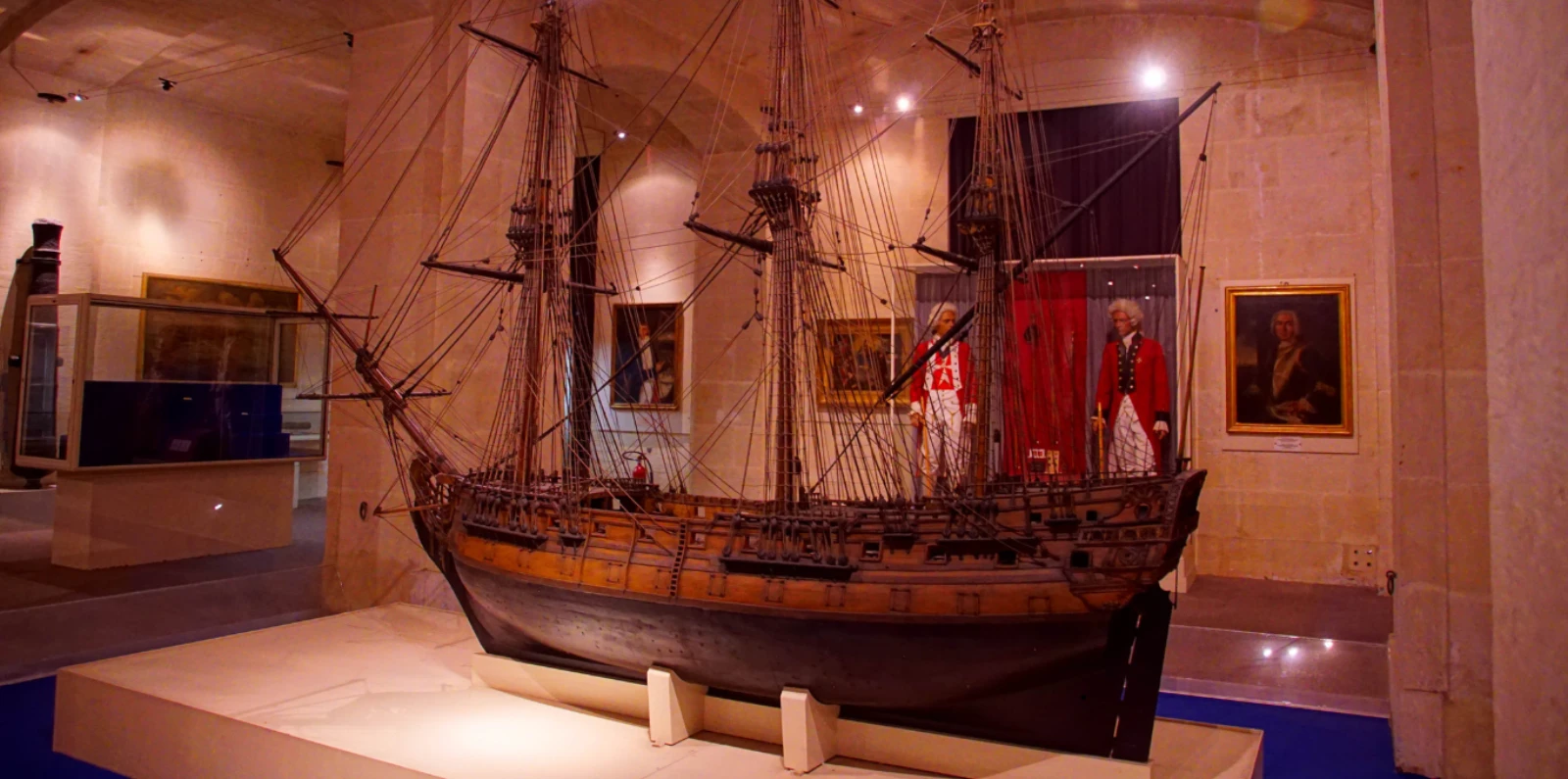

The first thing most visitors photograph is a galley painted red and gold, beached inside a hall of bare grey stone. The contrast is the point. The ship is a replica of the flagship from Lepanto, and the hall around it is the largest surviving civil Gothic building in the world — not a church, but a factory built in the late 13th century to turn out the war galleys of the Crown of Aragon. The Maritime Museum of Barcelona fills these naves, yet its single most valuable object is the building itself.
What the Royal Shipyards actually are
The Royal Shipyards, or Drassanes Reials, were the great naval arsenal of the Crown of Aragon. The Catalan word drassana comes from the Arabic dar as-sina’a, meaning house of manufacture, the term used across the Mediterranean for major shipyards. The first documented mention of shipyards in Barcelona dates to 1243 under James I, but the compound that gave rise to today’s building was driven from the late 13th century under Peter III the Great.
What are the Royal Shipyards of Barcelona? They are the former royal shipyards of the Crown of Aragon, built from the late 13th century to produce war galleys. They form the largest surviving civil Gothic building in the world and now house the Maritime Museum of Barcelona, with a collection of over 6,600 pieces. The complex has been protected as a Cultural Asset of National Interest since 1976.
The compound was raised on the beach, outside the city walls and at the foot of Montjuïc, ringed by towers and stretches of rampart. It opened directly onto the sea, and galleys passed in and out through the Mediterranean façade. For centuries it ran as an enormous boatyard employing thousands and driving the city’s economy. The museum sits today in the El Raval neighbourhood, at the foot of La Rambla and facing the old port.
What the 2010-2012 excavations found under the floor
Archaeologists confirmed this during the excavations carried out between 2010 and 2012. The structure you walk through today is, in large part, a 16th-century reconstruction built over the original medieval foundations. The reason was practical — early that century, construction of the port’s first jetty shifted the coastline and damaged part of the building, which collapsed. The Crown chose to raise a new one, reusing only part of the old.
This corrects the myth of an intact medieval shipyard. What is medieval are the foundations, the logic of the space, and some naves of the original core, dated to around 1381. The form you see belongs to the early modern period. The same dig produced an unexpected find — a Roman mausoleum from between the 1st and 4th centuries, proof that this plot, then the seafront, has seen continuous human activity since classical times.
The architecture, a cathedral built for ships
The design of the shipyards is industrial engineering disguised as a monument. The system of parallel naves on stone pillars let workers assemble and repair entire galleys under cover, shielded from the weather. The square pillars, roughly 77 centimetres a side and 6 metres tall, carried the pitched timber roofs and left between them the open span needed to move heavy hull sections.
That spaciousness is what earns the complex its title as the largest surviving civil Gothic building in the world. In the 18th century, by then a Bourbon artillery barracks, rows of pillars in the central nave were removed to fit larger ships, an intervention still legible in the structure. The full restoration carried out between 2009 and 2013 stripped out later additions, restored natural light, and gave the naves back their original scale. Anyone after more standout sights across Barcelona finds here one of its least predictable.
The Royal Galley of John of Austria
The full-scale replica of the Royal Galley is the museum’s most spectacular piece, and it is on home ground. The original was built on these very slipways as the flagship of John of Austria, who led the Holy League fleet at the Battle of Lepanto in 1571 against the Ottoman Empire. The replica, 60 metres long, was built between 1967 and 1971 to mark the battle’s fourth centenary.
This is no ordinary hull. Some 236 rowers drove the galley, and its stern carries Baroque ornament in red and gold that deliberately clashes with the sober Gothic stone around it. According to the museum, that visual collision — the austerity of the yard against the exuberance of the ship — is the image most visitors carry away. It pays to walk the full length of the hull and read the stern allegories before moving on.
Beyond the galley, what explains the collection
Past the galley, the collection gathers over 6,600 pieces and ranks as the most important maritime heritage holding in southern Europe. The key archaeological piece is Les Sorres X, a coastal trading vessel from the second half of the 14th century, found by chance in 1990 during works on the Castelldefels Olympic Canal and moved to the museum in 2011. It is one of very few surviving medieval Mediterranean ships.
Its value lies in what it proves. Displayed beside traditional Catalan craft such as the Papet, a fishing boat from Blanes dated 1907, or the Madrona from Badalona in 1924, it shows that coastal hull design barely changed across six centuries. The museum also holds nautical charts and portolans from the 14th to 16th centuries from the Majorcan cartographic school, figureheads, and navigation instruments. Outside, the Santa Eulàlia, a three-masted schooner launched in 1918, still sails on Saturdays from its mooring at the Moll de la Fusta. The building belongs on any tour of the best museums in Barcelona.
Is it worth it
Verdict — yes, especially for the building. The Maritime Museum rewards anyone interested in architecture, naval history, or the Mediterranean past of the Crown of Aragon, and the combination of the Gothic hall and the 60-metre galley has no equal in the city.
It is less essential if ships hold no interest for you and you care little for architecture, since much of the collection is technical, or if you have only a few daylight hours and would rather spend them by the sea. According to travel planners, the building works best as a 90-minute to two-hour stop rather than a full afternoon, which makes it easy to pair with the port or the Raval.
Mistakes to avoid
- Rushing to the galley and ignoring the hall — the naves are the main exhibit, not the backdrop
- Expecting to buy online — the museum sells at the box office, not through its own website
- Assuming the structure is fully medieval — most of what stands is a 16th-century rebuild
- Missing the free Sunday slot — entry is free from 3pm, which few visitors plan around
- Skipping the Santa Eulàlia — the 1918 schooner sits a short walk away at the quay and is often forgotten
2026 context
In 2026, the Sala Gran of the shipyards hosts an exhibition devoted to the Dutch artist M. C. Escher, whose impossible-perspective work sits well against the repeated geometry of the Gothic naves. It is one of the building’s major temporary shows of the year, and it is worth checking dates and combined entry before visiting, since temporary exhibitions can carry their own €10 ticket.
The rest of the practical detail stays stable. General admission is around €5, and the museum has no online sales, so tickets are bought on site. For anyone stringing together free-entry museum slots, the MMB opens free on Sundays from 3pm.
Visiting the Maritime Museum
The museum opens daily from 10am to 8pm, with last entry at 7pm, and closes on 25 and 26 December and 1 and 6 January. It is reached by metro on line L3, Drassanes station, a few minutes on foot, and sits beside the Columbus monument. The building and permanent collection take between 90 minutes and two hours.
| Detail | Information |
|---|---|
| General admission | around €5, reduced €2 |
| Santa Eulàlia schooner only | €1 |
| Temporary exhibitions | up to €10, depending on the show |
| Free | Sundays from 3pm and under-17s |
| Hours | daily 10am-8pm, last entry 7pm |
| Metro | L3 Drassanes |
The lobby exhibitions and the Mirador space are always free, and the building is wheelchair accessible. If the visit is combined with Montjuïc and its hilltop, the museum is best kept for the early hours of the day, when groups are thinner.
Frequently asked questions about the Maritime Museum of Barcelona
How much does the Maritime Museum of Barcelona cost?
General admission is around €5, with a reduced rate of €2 and the Santa Eulàlia schooner alone for €1. Entry is free on Sundays from 3pm and for under-17s. Some temporary exhibitions carry a separate combined ticket of €10, and tickets are bought at the box office rather than online.
Why are the Royal Shipyards the largest civil Gothic building in the world?
Because no other civil Gothic complex of this scale has survived intact. Its stone naves on pillars, designed to assemble galleys under cover, form an open space often compared to a cathedral. The building has been protected as a Cultural Asset of National Interest since 1976.
What is the Royal Galley at the Maritime Museum?
It is a full-scale, 60-metre replica of the flagship of John of Austria at the Battle of Lepanto in 1571. The original was built in these very shipyards. The reproduction was constructed between 1967 and 1971 to mark the fourth centenary of the battle.
Can you visit the Santa Eulàlia schooner?
Yes. The Santa Eulàlia, a three-masted schooner launched in 1918, is moored at the Moll de la Fusta in the old port. It is included with museum admission or €1 on its own, and on Saturdays it sails the bay with prior booking. It closes in August for maintenance.
When is the Maritime Museum of Barcelona free?
Admission is free every Sunday from 3pm and for visitors under 17. The lobby exhibitions and the Mirador space are always free. There are also open-door days on set dates such as Santa Eulàlia in February and International Museum Day in May.
Seven centuries after its first galley slid into the water, the hall still outshines everything moored or displayed inside it. At the Maritime Museum, the largest exhibit is the stone nave that holds all the others.