

Three days is the right amount of time to understand Barcelona rather than just see it — enough to get past the monuments and into the neighborhoods, to arrive at places at the right hour, and to find out why the bomba at La Cova Fumada is different from every copy that followed it. But only if the logistics are correct before you arrive.
Four bookings determine whether three days work or fall apart:
Sagrada Família — online reservation with a specific time slot, mandatory. Without it, you don’t get in. Tickets from €26 for the basic entry. Book 3–7 days ahead minimum; 2–3 weeks for peak season.
Park Güell monumental zone — online reservation with time slot, €18. The entry window is exactly 30 minutes from your booked time. Arrive at minute 31 and the system refuses you with no exceptions and no refund.
Born CCM — free to visit the elevated walkways over the 1714 archaeological site; €5.50 for ground-level guided visit. Free on Sundays from 15:00. No booking required for free access.
La Cova Fumada (Carrer del Baluard 56, Barceloneta) — no booking accepted, closes when food runs out (usually before 14:00), no sign on the door. Build Day 2 around the 13:00 arrival window.
With those four in place, the three days have a structure that works.
Day 1: The Gaudí Axis and the Historic Layers
09:00 — Sagrada Família (book your slot for this time)
Arrive 15 minutes early. Security includes X-ray scanners — large travel bags are refused. If you’re coming directly from the airport or hotel with luggage, leave it before arriving.
The Nativity Facade (east side) gets cool morning light before 11:00 — the best window for exterior photographs. The Passion Facade (west) gets warm afternoon light — if you’re staying in the city at sunset, it’s worth walking past again.
Inside: the branching columns that reach 45 meters, the stained glass that shifts from cool blues in the east to warm ambers in the west depending on where the sun is. The Torre de Jesucristo at 172.5 meters is the tallest point in the city — a completed element that changes the skyline completely from what visitors who came before 2023 remember. The Sagrada Família interior guide covers the structural logic and the symbolism in detail if you want to go deeper before the visit.
Time: 2–2.5 hours.
11:30 — Recinte Modernista de Sant Pau (400 meters, walk)
Down the Avinguda de Gaudí — a street designed to create a visual axis between two buildings. Sant Pau is 48 Modernista pavilions built between 1902 and 1930 by Lluís Domènech i Montaner, the architect who competed with Gaudí for leadership of the movement. Trencadís mosaics, ceramic domes, wrought iron and tile at a scale where you can actually see the details up close.
The difference from the Sagrada Família: silence, space, and the ability to walk within arm’s reach of the architectural ornament without being pushed by a queue. UNESCO World Heritage since 1997 and consistently undervisited.
Entry: €18. Time: 1–1.5 hours.
13:30 — Passeig de Gràcia and Lunch
The Block of Discord between numbers 35 and 45 has three Modernista buildings by three different architects within 100 meters: Casa Batlló (43), Casa Amatller (41) and the Casa Lleó i Morera (35). The facades are visible from the street for free; entry to Casa Batlló starts from €29 and La Pedrera from €24. For three days with good coverage, the exterior circuit plus lunch in the Eixample is more valuable than spending 90 minutes inside one building when there’s a full three-day program. The Casa Batlló visit guide is there if the interior becomes a priority.
Lunch: the Eixample has good restaurants at every price point, far from the tourist-trap dynamics of Las Ramblas.
15:30 — Barrio Gótico
The Gothic Quarter has layers from Roman Barcino (1st century BC) through genuine medieval Gothic (13th–15th centuries) to 19th-century neogothic reconstruction — and some guides don’t separate these clearly. The Pont del Bisbe on Carrer del Bisbe is 1928, designed by Joan Rubió; the Cathedral is authentic 13th–15th century Gothic. Both are worth seeing, but they’re different historical objects.
What to prioritize: the Cathedral with its 13-goose cloister (one goose for each of the 13 martyrdoms attributed to Santa Eulàlia), the Plaça del Rei with the Palau Reial Major, the Plaça de Sant Felip Neri with Civil War shrapnel marks visible in the church wall, and — if time allows — the MUHBA archaeological site beneath the Plaça del Rei, where 1st-century Barcino is visible from elevated walkways.
Time: 1.5 hours.
17:30 — El Born
Ten minutes on foot from the Gothic Quarter. El Born has the Basílica de Santa Maria del Mar — 55 years of uninterrupted Gothic construction from 1329 to 1384, entirely funded by the harbor workers’ guild, with three nearly equal-height naves and no lateral chapels. A completely different spatial experience from the Cathedral.
The Born CCM under the 19th-century iron market building holds the preserved street plan of the neighborhood demolished by Felipe V’s order in 1714 to build the Ciutadella fortress. The elevated walkway view is free and open to anyone who enters the building. At 17:30 the afternoon light falls through the iron structure in a way that makes the archaeology below unusually visible.
Evening: stay in the Born for dinner. The streets off the main Passeig del Born — Carrer dels Flassaders, Carrer del Rec — have better quality-to-price restaurants than the main promenade.
Day 2: Park Güell, Gràcia, Barceloneta and the Bunkers
09:00 — Park Güell (book your slot for this time)
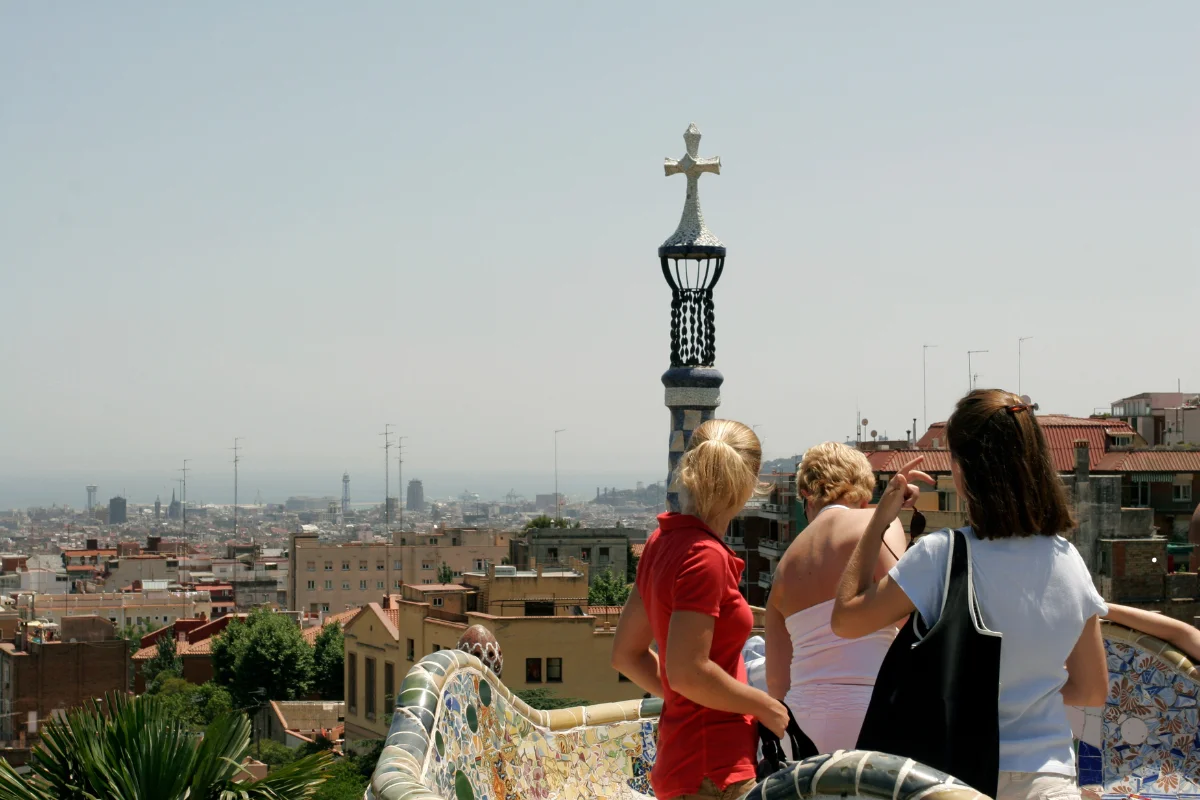
The 30-minute access window is the most important operational fact of this day. Arrive puntual or early — the system is automated and inflexible. The monumental zone includes the wavy trencadís bench, the Hypostyle Hall with 86 Doric columns and the upper esplanade with views over the Eixample grid and the Mediterranean. The park’s free zone (surrounding forest and paths) is accessible without a ticket at any hour — useful for early-morning arrivals before the booked slot.
Time in monumental zone: 1.5 hours. Then walk downhill to Gràcia: 15–20 minutes.
11:30 — Gràcia
Gràcia was an independent municipality until 1897 — its street grid doesn’t follow the Eixample’s logic because it predates the Eixample. The plazas (Plaça del Sol, Plaça de la Vila de Gràcia, Plaça de la Virreina) function as collective living rooms rather than tourist viewpoints; the market (Mercat de l’Abaceria) still serves residents.
Lunch in Gràcia: the neighborhood has an honest food scene that’s changed less than most central neighborhoods. The best brunch guide has specific options in the area.
13:00 — La Barceloneta and La Cova Fumada
Metro L4 to Barceloneta. La Cova Fumada at Carrer del Baluard 56 is where the bomba was invented — the potato-and-meat ball fried and served with alioli and hot sauce that every bar in the neighborhood has since copied. No exterior sign. Cash only. No reservations. It closes when the food runs out, typically before 14:00. Arrive at 13:00 or earlier. The experience is a shared-table neighborhood bar from 1944 that hasn’t adapted to tourism, which is the whole point.
For the Barceloneta history and the cable car situation (the two cable cars are different structures serving different routes), the neighborhood guide covers the full context.
Afternoon: beach at Barceloneta or the less-crowded adjacent stretches at Somorrostro and Sant Sebastià.
18:00 — Búnkers del Carmel
The Turó de la Rovira — a Civil War anti-aircraft battery at 262 meters — has the most complete 360° view in the city: the Eixample grid, the Sagrada Família, Tibidabo, the sea and the Pyrenees on clear days. Free, always accessible (the fenced battery area has a seasonal closing time; the surrounding open areas have none).
Transport: Metro L4 to Alfons X + bus V17 or 119 + 15-minute uphill walk. Go 30–40 minutes before sunset for the best light and manageable crowds.
Evening: dinner in Gràcia on the descent, or back to the Born.
Day 3: Two Real Options
The third day splits based on whether you want to stay in the city or leave it.
Option A — Montjuïc Complete
Montjuïc is underestimated by almost everyone who visits it casually. Going only to the castle and returning misses the actual point of the mountain.
Funicular from Paral·lel station (Metro L2 and L3) — fastest access, covered by metro ticket.
MNAC — the Romanesque art collection is the best in the world for this period: mural paintings removed from Pyrenean churches in the 20th century and transferred to the museum, showing 11th–13th century Catalan religious art at full scale. The modern Catalan art collection (Casas, Rusiñol, Nonell) is the same generation visible at Cau Ferrat in Sitges. The terrace views over Plaça Espanya and the Eixample are free. Entry: €15. Free Saturdays from 15:00 and first Sundays of the month (online reservation required even on free days).
Fundació Joan Miró — the Sert building designed specifically for the collection, with skylights calibrated for the specific quality of Mediterranean light. 14,000+ works from the 1920s onward. Entry: €15.
Montjuïc Castle — the 17th-century military fortress that served as a political prison through the Civil War and the Franco era, ceded to the city in 2007. 360° views over the port, the delta and the open sea. Entry: €12. The Montjuïc castle guide covers the full history.
Fuente Mágica (if Day 3 is Thursday, Friday or Saturday): the light-and-water show at the foot of the MNAC runs from 20:00–21:00. Free, 20–30 minutes, the natural closing sequence for Montjuïc before descending to dinner.
Total time for MNAC + Miró + Castle: 4–5 hours.
Option B — Montserrat Day Trip
The FGC R5 line from Plaça Espanya reaches the base of Montserrat in 1 hour. From there: the rack railway (cremallera) or the cable car (Aeri) to the monastery level. Combined ticket: approximately €30 round trip.
The Montserrat guide covers the complete logistics — including the most important scheduling fact: the Escolanía boys’ choir (Europe’s oldest, documented since the 14th century) does not perform on Saturdays. Weekday performances are at 13:00 and 18:45 (Monday–Thursday); Sunday at 12:00 and 18:45. If Day 3 is a weekday and hearing the choir is part of the objective, this option earns the day.
The Sant Jeroni hiking route to the 1,236m summit (Camí Nou variant: 9.3km, 545m elevation, 2h30) is the best physical experience available within a one-hour train ride from Barcelona.
Day 3 Comparison
| Montjuïc | Montserrat | |
|---|---|---|
| Best if | You want world-class art + city views | You want mountain landscape + spiritual site |
| Best day of week | Any (Fuente Mágica: Thu–Sat evening) | Weekday or Sunday (Escolanía); avoid Saturday |
| Time | 4–5 hours for the full circuit | Full day |
| Cost | €35 (MNAC + Miró + Castle) | ~€30 transport + €5.50 Museum |
| Fitness required | Minimal | Sant Jeroni route is demanding (optional) |
Budget Across Three Days
| Item | Cost |
|---|---|
| Sagrada Família (basic) | €26 |
| Park Güell | €18 |
| Sant Pau | €18 |
| Born CCM (elevated walkways) | Free |
| Montjuïc Day 3A (MNAC + Miró + Castle) | €35 |
| OR Montserrat Day 3B | ~€30 transport + €5.50 |
| La Cova Fumada bomba | ~€4 per piece |
| Búnkers del Carmel | Free |
The Barcelona travel budget guide gives the full daily cost framework including accommodation, food and transport.
Mistakes to Avoid
- Booking Sagrada Família and Park Güell for the same morning — they’re in the same general direction but the two-hour Sagrada Família visit plus transport makes a Park Güell slot before 12:00 stressful. Put them on different days.
- Arriving at La Cova Fumada after 14:00 — it’s closed, food sold out. Build lunch on Day 2 around a 13:00 arrival there.
- Planning Montserrat for a Saturday — no Escolanía. The choir is a significant part of what distinguishes this day trip.
- Treating Las Ramblas as a destination — a 20-minute walk through is appropriate; building an afternoon around it isn’t. The El Raval guide has what’s actually worth seeing in the area adjacent to the Ramblas.
- Skipping Recinte Sant Pau — it’s 400 meters from the Sagrada Família, architecturally comparable, UNESCO listed and has a fraction of the crowds. The most common Day 1 regret for people who don’t include it.
Final Insight
Three days in Barcelona done correctly produces a different city than three days done carelessly. The difference isn’t the list of places — it’s the order, the timing and the knowledge of which systems require advance engagement. The Park Güell 30-minute window, the La Cova Fumada 14:00 cutoff, the Saturday Escolanía silence — these are not arbitrary obstacles. They’re the entry points to what Barcelona actually is rather than what it presents to visitors who don’t prepare. Three days is enough to reach both versions.
For the full picture of Barcelona’s neighborhoods beyond this itinerary, the Barcelona complete travel guide organizes the city geographically and by interest type.