
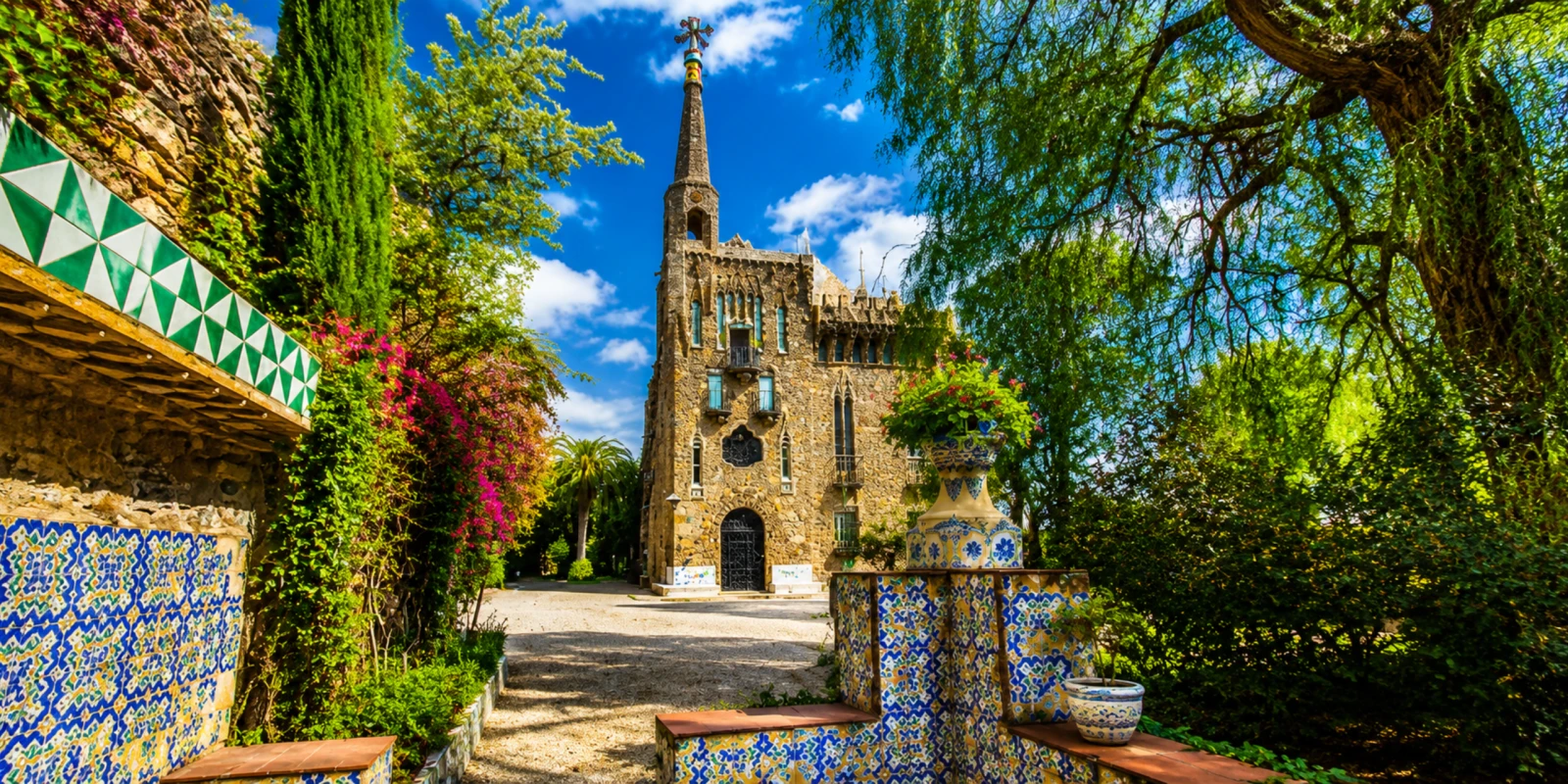

The gate shuts at 15:00, Tuesday to Sunday, with last entry around 14:00. Torre Bellesguard is the Gaudí building you see before lunch or not at all. It stands at the foot of Collserola in Sant Gervasi, roughly 25 minutes from Plaça de Catalunya, and it is the one major Gaudí house in the city where nobody queues. The morning has to be built around it, not the other way round.
The five-hour window that shapes the whole visit
Five hours a day, six days a week. Thirty hours of opening in total, which is the number that explains the empty rooms far better than the hillside address does.
Visitors usually assume the quiet comes from the location. Sant Gervasi is out of the way, and that helps. But other Gaudí sites sit further from the centre and still fill their time slots. What thins the crowd here is that the house simply does not exist after lunch.
Plan accordingly. A Bellesguard morning eats the same slot most itineraries reserve for Sagrada Família or Park Güell. It replaces something rather than fitting around it.
Allow two hours including the garden. Arriving at 13:45 technically works and wastes the visit.
Getting there without a car
The FGC suburban train from Plaça de Catalunya to Avinguda Tibidabo is the spine of the journey. From that station it is about 15 minutes on foot, uphill, or a short hop on bus 60, 123 or 196.
Two things worth knowing before you set off. The walk is genuinely steep, so in July or August it is a real climb rather than a stroll. And the surrounding streets are residential, which means no cafés clustered around the entrance the way they are around the Eixample houses. Eat before or plan to eat afterwards down in Sarrià.
The upside of the location is what sits nearby. You are minutes from the Tibidabo approach and the historic Tramvia Blau, and a short descent from Sarrià, which is the most village-like neighbourhood left inside Barcelona.
One morning at Bellesguard, step by step
A sequence that uses the whole window without rushing any part of it.
- 09:20, FGC from Plaça de Catalunya. Twelve minutes to Avinguda Tibidabo, then the uphill walk while the air is still cool.
- 10:00, arrive at opening. The first slot is the emptiest of the day and the light on the slate is still low and angled.
- 10:15, the facade before going in. Find the rose window and the shield carrying the dates 1409 and 1909 before anyone tells you about them.
- 10:45, the interior and the attic. White plaster rooms downstairs, then the bare brick vaulting upstairs that most people photograph badly and understand later.
- 11:45, the roof walk. The ronda path circles all four facades, 360 degrees over the city and the sea. This is the part to slow down for.
- 12:30, the garden and the medieval ruins. Remains of a fifteenth-century royal palace sit in the grounds, and nobody hurries you out of them.
The order matters because of light and heat rather than crowds. Interiors first while the sun is low, roof second when the view is clearest, garden last when you want to sit down. Reverse it and you climb to the terrace in full midday glare.
The Star of Venus and the 25 December alignment
The main facade carries a rose window that is not spherical like a church rosette. It shows a starry sky with an eight-pointed star at its centre, built as a rare three-dimensional stained glass panel.
Its meaning stays deliberately open. Readings include the night of the Nativity, the planet Venus long associated with the goddess of love, the star followed by the Magi, and the rose of Reus. None of them cancels the others.
The finding that made it famous is recent. According to official information from the research group based at the house, directed by Galdric Santana, Gaudí angled the glass precisely enough that every 25 December, between 16:00 and 17:00, sunlight passes through it directly and casts the star’s silhouette inside the building. The effect appears at other times of year but reaches its sharpest definition on Christmas Day.
Gaudí called the colours light left as it crossed his stained glass the ephemeral paintings of God. Here he pushed that interest into gnomonics, the study of solar movement. The catch for visitors is obvious: the alignment falls outside normal opening hours, so seeing it requires one of the special sessions the house programmes each December.
The bare brick was not a budget cut
A persistent story says the money ran out and the attic walls were left unfinished. Specialist sources contradict it. The exposed brick preserves the original loft and demonstrates Gaudí’s structural command rather than a shortfall.
That distinction changes what you are looking at. Nothing here is incomplete. The architect left visible what his other buildings hide beneath render: catalan vaulting, arches, and the brickwork carrying the roof across a loft divided into 2 levels.
Scholars treat this space, conceived as a music room, as one of the clearest bridges in his career. Its spatial logic anticipates solutions that appear later in the nave of the Sagrada Família, and the estate’s viaduct begins an experiment with column porticoes that culminates at Park Güell.
The contrast with the exterior is the thing that surprises people on the way in. Dark stone and a fortress silhouette outside; white plaster and lime inside, where the shape of ceilings and openings does all the decorative work. Anyone expecting the polychrome Gaudí of Casa Vicens will find the opposite.
Who has owned the house since 2018
Most English-language coverage still describes Bellesguard as a family home, and that stopped being accurate some time ago.
The Guilera family bought the estate in 1944. Lluís Guilera Molas, an oncologist, converted it into a hospital, and the former autopsy room survives from that period. Medical use ended in 1974, the building became the family residence, and in 2013 they opened it to visitors for the first time.
In July 2018 the insurance group Catalana Occidente acquired the property for 30 million euros before tax, committing to maintain public access and continue investing in conservation. Official data lists the building as a Bien de Interés Cultural since 1969, which meant the sale required approval from the heritage authorities.
For a visitor, nothing changed on the ground. The visit runs as it did, the guides are the same, the garden is still open after the tour. What changed is the accuracy of the story you will hear elsewhere. Bellesguard rarely appears on any things to see in Barcelona shortlist, and that omission is precisely what keeps it comfortable. If you want more Gaudí off the standard circuit afterwards, the hidden places guide covers the rest.
Frequently asked questions about Torre Bellesguard
How do you get to Torre Bellesguard from the city centre?
Take the FGC train from Plaça de Catalunya to Avinguda Tibidabo, then walk about 15 minutes uphill or connect with bus 60, 123 or 196. Total journey runs 25 to 35 minutes. By car it is roughly 15 minutes without traffic, and street parking exists nearby.
Is Torre Bellesguard worth visiting if you have already seen Sagrada Família?
Yes, and arguably it works better that way. Bellesguard is Gaudí working in straight lines with dark slate, which only reads as a deliberate choice once you know the curved work. As a first Gaudí building it can feel austere and puzzling.
What languages is the Torre Bellesguard audio guide available in?
Six. Spanish, Catalan, English, French, Japanese and Russian. Guided tours run in a narrower set of three, Catalan, Spanish and English, at fixed morning slots. Bring your own headphones, since the audio guide plays through your phone.
Set the alarm. This is the only Gaudí in Barcelona where arriving early buys you solitude instead of a shorter queue.